Quinto

Quinto-4059
Monuments
THIS PROJECT PROVIDES AN UPDATED VISION OF THE MUDEJAR MONUMENTAL HERITAGE
Quinto-3973
Pedagogy
SCHOOL MATERIALS TO WORK ON CULTURAL AND NATURAL HERITAGE
mudetrad-quinto
Mudetrad Project
A PROJECT THAT VALUES THE TRADITIONAL ARCHITECTURE OF QUINTO
portada guia didactica
Didactic Mudejar, the guide
THE GUIDE ILLUSTRATED BY DAVID GUIRAO TO HELP YOU UNDERSTAND THE MUDEJAR STYLE
Imagen decorativa para Slider
Circular from the rural school
Family walks
COOPERATIVE PROJECT BETWEEN RURAL DEVELOPMENT GROUPS

The fifth milestone

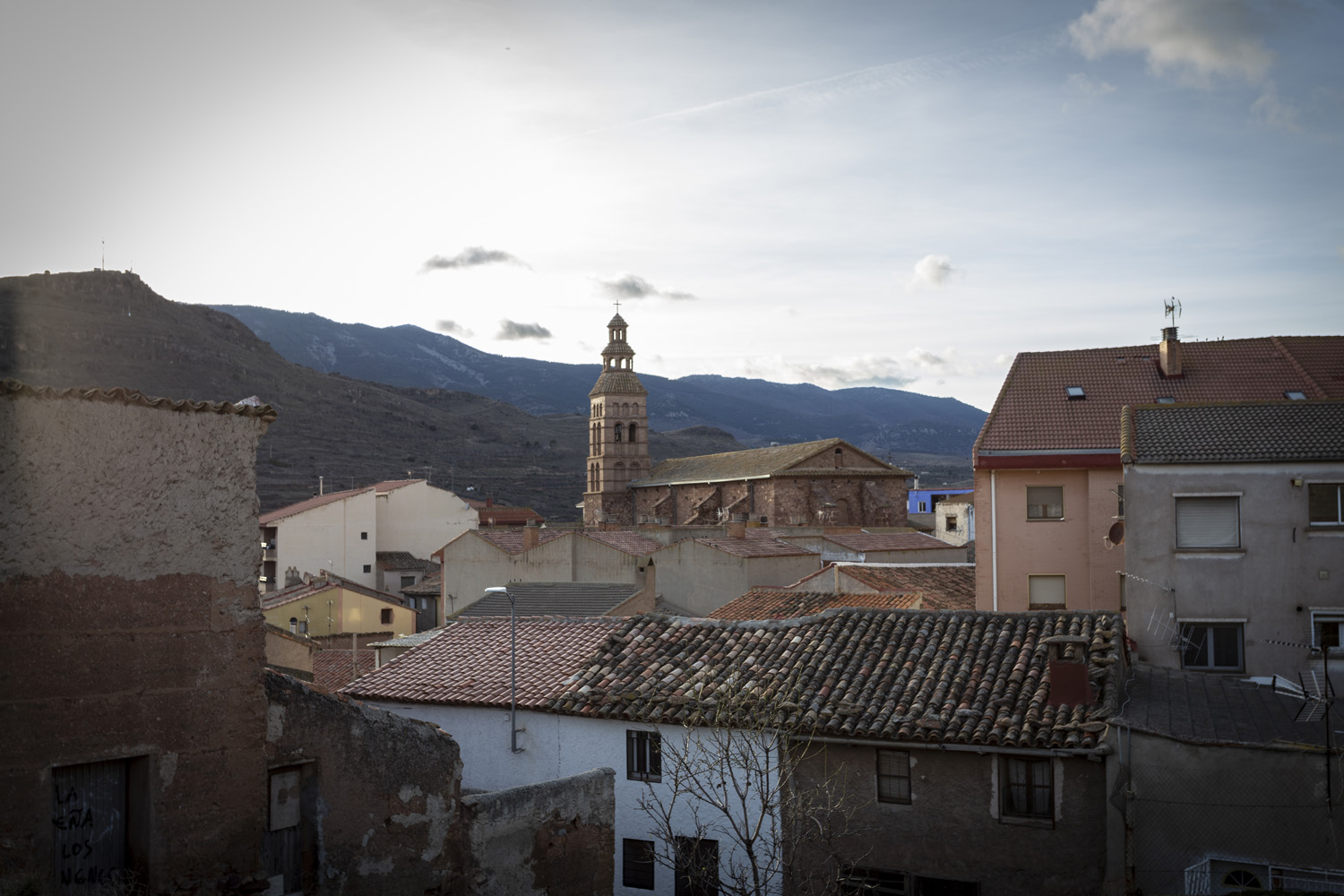
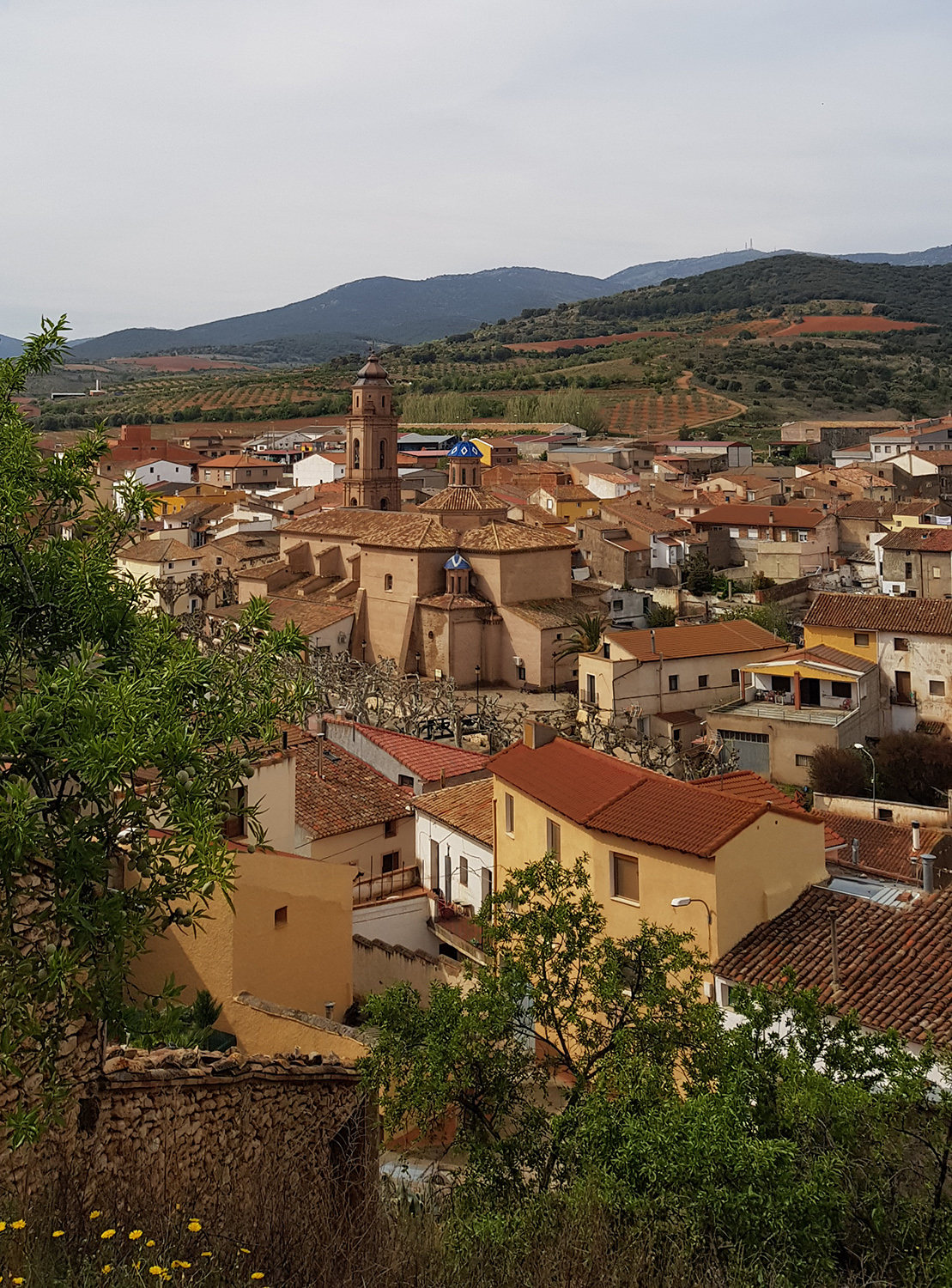
Quinto, capital of the Ribera Baja del Ebro, has a Roman past – its name derives from the fifth milestone, the road that went to Caesaraugusta – and was also a Muslim town that, despite urban development, maintains Moorish traces in part of its historic quarter.

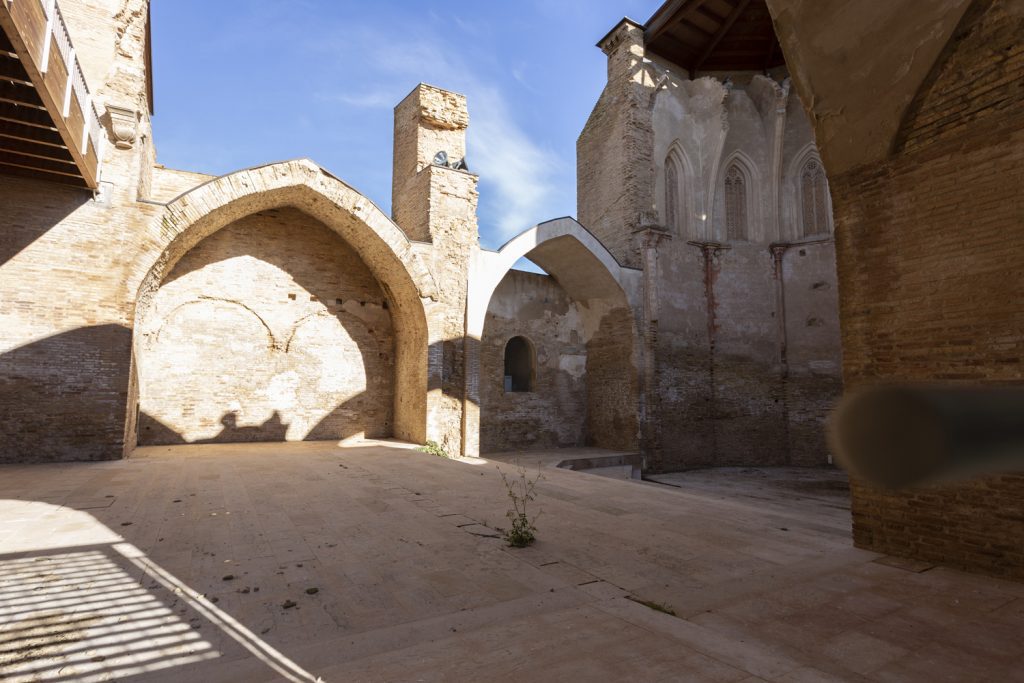
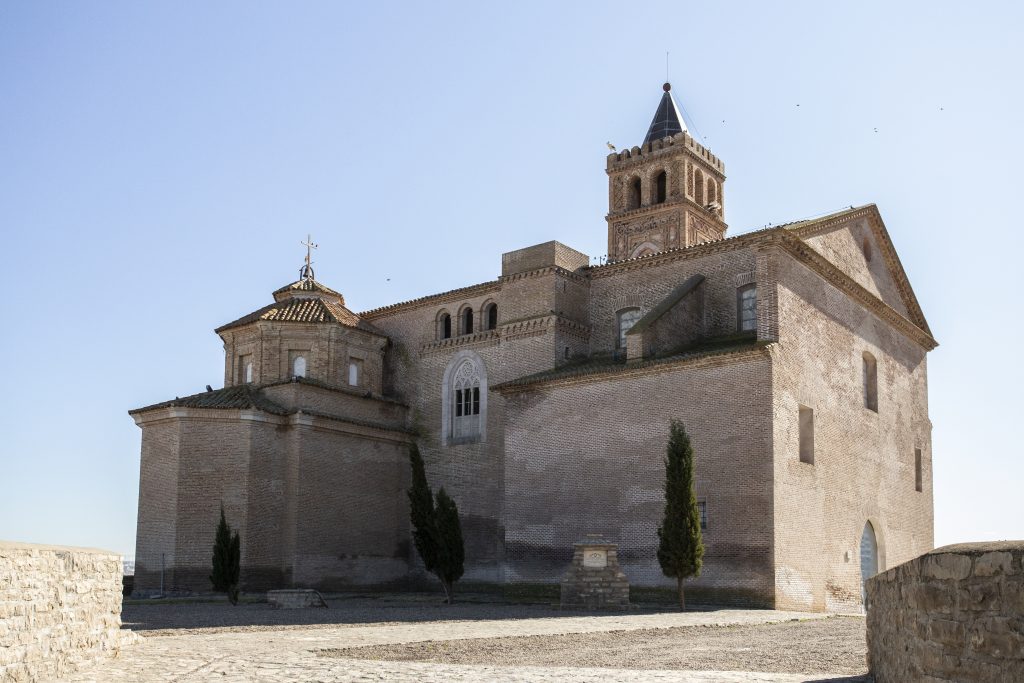
At the highest point of the village dominates the church of the Assumption, which the locals know as the The PiqueteThe church is a 14th century Mudejar temple with the typology of a fortress church in which we can see the evolution of the typology of a single nave with a polygonal apse and side chapels over which runs the patrol path or watchtower.

The building is the product of several construction phases, but its powerful volumetry is based on the original Mudejar phase, which extends from the apse to the tower. The Mudejar construction of the church has a close formal and structural relationship with the disappeared church of San Pedro Mártir in Calatayud, a fact which, together with the intervention of Benedict XIII in its construction, leads us to attribute the work to Mahoma Rami, the architect of the ‘Papa Luna’.

Quinto, capital of the Ribera Baja del Ebro, has a Roman past – its name derives from the fifth milestone, the road that went to Caesaraugusta – and was also a Muslim town that, despite urban development, maintains Moorish traces in part of its historic quarter.

At the highest point of the village dominates the church of the Assumption, which the locals know as the The PiqueteThe church is a 14th century Mudejar temple with the typology of a fortress church in which we can see the evolution of the typology of a single nave with a polygonal apse and side chapels over which runs the patrol path or watchtower.

The building is the product of several construction phases, but its powerful volumetry is based on the original Mudejar phase, which extends from the apse to the tower. The Mudejar construction of the church has a close formal and structural relationship with the disappeared church of San Pedro Mártir in Calatayud, a fact which, together with the intervention of Benedict XIII in its construction, leads us to attribute the work to Mahoma Rami, the architect of the ‘Papa Luna’.

The mausoleum in “El Piquete”

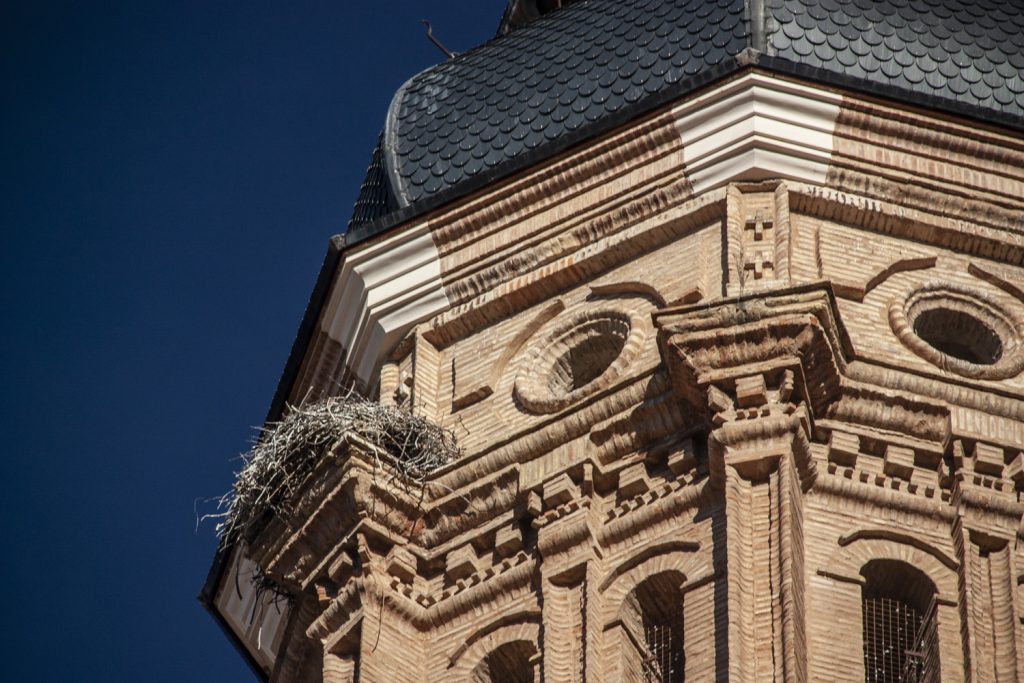
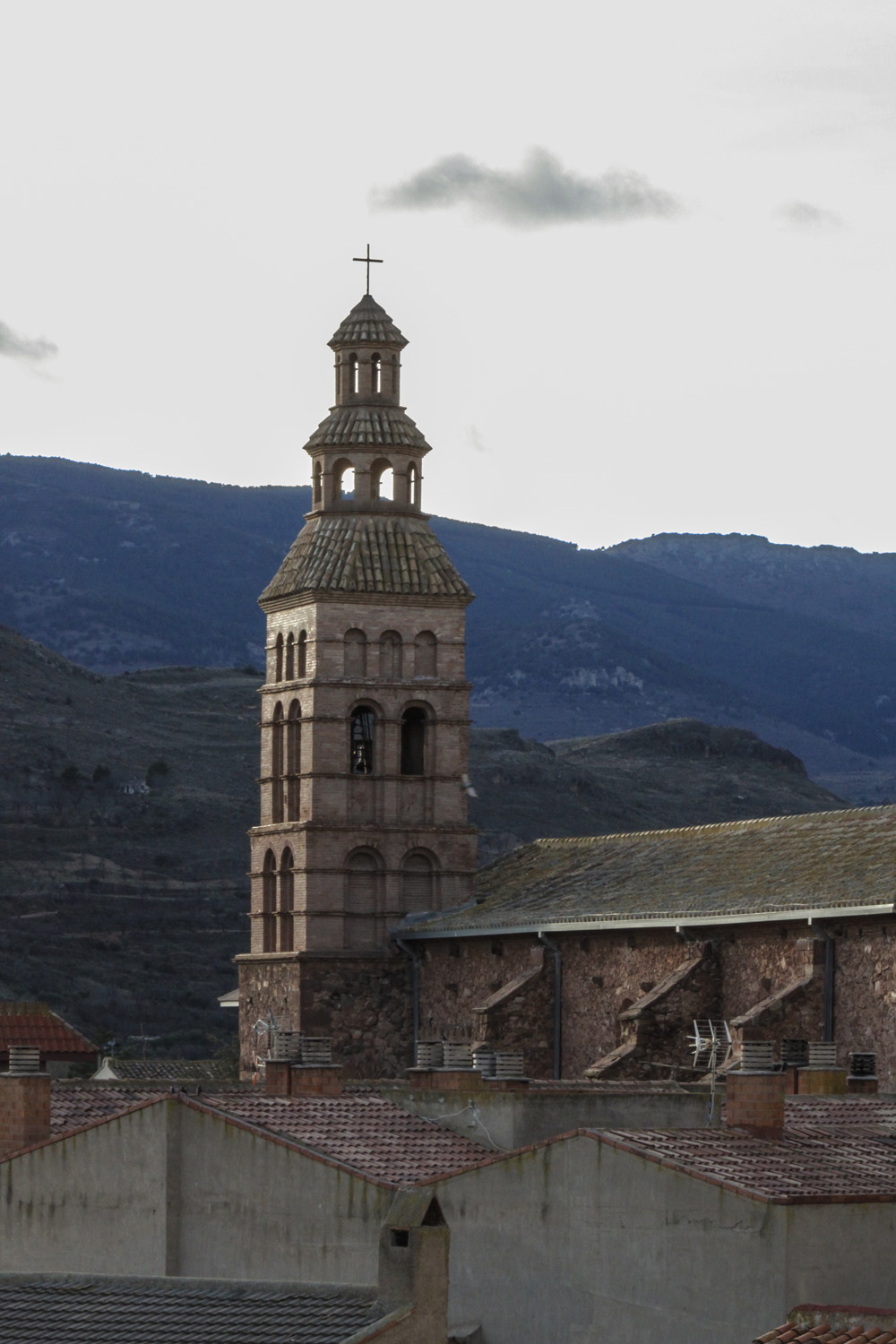
El Piquete is the main attraction of the municipality and a viewpoint from where you can contemplate the attractive urban layout and its strong link with the river. If on the outside it is striking for its elegant volumetry and masterful use of materials, it is its bell tower that stands out.

With a square floor plan, its walls are covered with Mudejar brickwork with an ornamental pattern of loops.

Its interior offers the visitor a magnificent learning experience, firstly because of the preservation of the building’s life stages and secondly because it houses the Mummy Museum a unique place where 15 mummified bodies are exhibited, as well as objects and elements from the archaeological campaigns and the intervention of the building.

Excavation work in the central nave of the old Church of the Assumption carried out in the spring of 2011 brought to light hundreds of burials that took place in this building between the 18th century and the beginning of the 19th century, some of them exceptionally well preserved due to the special characteristics of the environment and climate of the building.

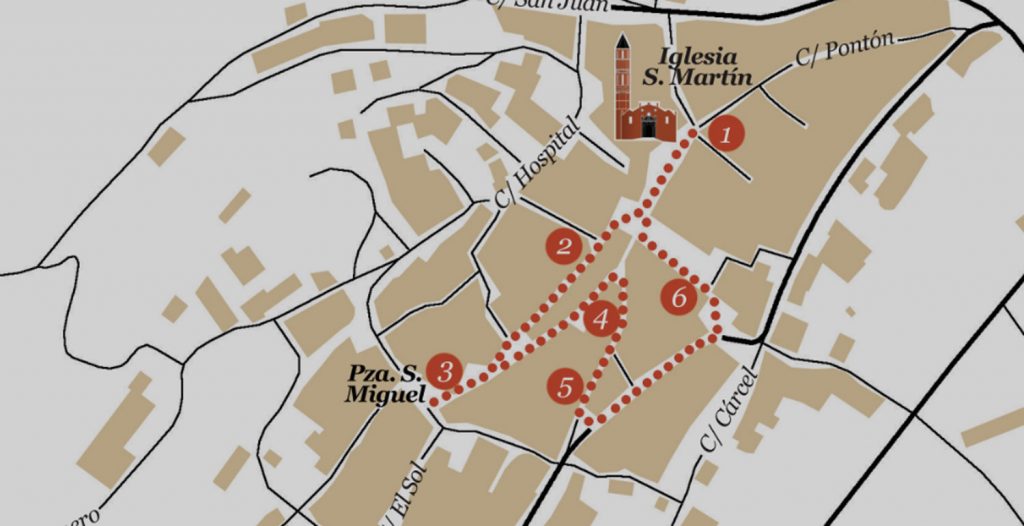
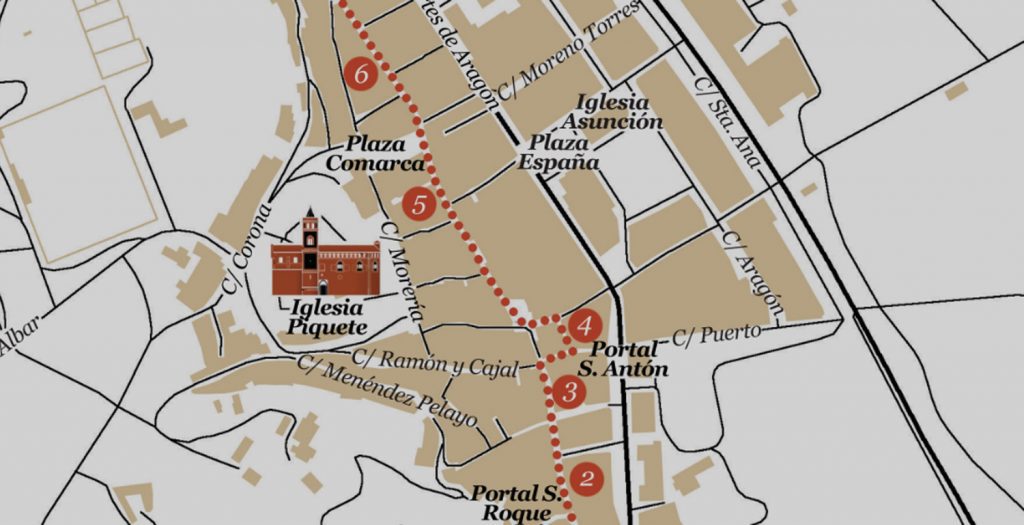
Quinto is also worth a stroll to discover its interesting town planning and preserved farmhouses, typical of the towns on the banks of the Ebro, such as the Parish House, a 16th century Aragonese brick palace. The portals of the town centre, which conserve the charm of the popular architecture of medieval and military defensive origin. Specifically, the arches of San Roque, San Miguel and San Antón, the remains of the gates of the old wall, which were transformed in the 17th and 18th centuries into chapels overhanging the street.

El Piquete is the main attraction of the municipality and a viewpoint from where you can contemplate the attractive urban layout and its strong link with the river. If on the outside it is striking for its elegant volumetry and masterful use of materials, it is its bell tower that stands out.

With a square floor plan, its walls are covered with Mudejar brickwork with an ornamental pattern of loops.

Its interior offers the visitor a magnificent learning experience, firstly because of the preservation of the building’s life stages and secondly because it houses the Mummy Museum a unique place where 15 mummified bodies are exhibited, as well as objects and elements from the archaeological campaigns and the intervention of the building.

Excavation work in the central nave of the old Church of the Assumption carried out in the spring of 2011 brought to light hundreds of burials that took place in this building between the 18th century and the beginning of the 19th century, some of them exceptionally well preserved due to the special characteristics of the environment and climate of the building.

Quinto is also worth a stroll to discover its interesting town planning and preserved farmhouses, typical of the towns on the banks of the Ebro, such as the Parish House, a 16th century Aragonese brick palace. The portals of the town centre, which conserve the charm of the popular architecture of medieval and military defensive origin. Specifically, the arches of San Roque, San Miguel and San Antón, the remains of the gates of the old wall, which were transformed in the 17th and 18th centuries into chapels overhanging the street.

Information

Town hall: 976 177 011
quinto.es
Centre for the Development of the Sea Regions of Aragon
cedemar.es

VISIT QUINTO
976 633 296

DO YOU WANT TO KNOW MORE?
Aragon Tourism
turismodearagon.com
Museum of Mummies of Quinto
momiasdequinto.es

Territorio Mudéjar Network

The city council has been a founding member of Territorio Mudéjar since 13 September 2018.
He is a member of the board of directors of the entity as a member.

Projects Territorio Mudéjar in Quinto

Monuments | View the project
Pedagogy | View the project
Mudetrad Project | View the project
Mudejar plaster | View the project
Didactic Mudejar, the guide | View the project
‘Circular’ Family walks | View the project

Quinto in the social media

Facebook: @ayuntamientodequinto @museomomiasquinto

Instagram: @aytoquinto @momiasdequinto

Twitter: @momiasdequinto

Morata de Jiloca

Morata-de-Jiloca-01
Monuments
THIS PROJECT PROVIDES AN UPDATED VISION OF THE MUDEJAR MONUMENTAL HERITAGE
Morata-W7
Pedagogy
SCHOOL MATERIALS TO WORK ON CULTURAL AND NATURAL HERITAGE
mudetrad-morata
Mudetrad Project
A PROJECT THAT VALUES THE TRADITIONAL ARCHITECTURE OF MORATA DE JILOCA
portada guia didactica
Didactic Mudejar, the guide
THE GUIDE ILLUSTRATED BY DAVID GUIRAO TO HELP YOU UNDERSTAND THE MUDEJAR STYLE
Imagen decorativa para Slider
Circular from the rural school
Family walks
COOPERATIVE PROJECT BETWEEN RURAL DEVELOPMENT GROUPS
El mudéjar y la geometría euclidiana
PLASTIC STUDY OF THE ARAGONESE MUDEJAR OF THE SPACE OF THE MUDEJAR TERRITORY

The banks of the Jiloca River

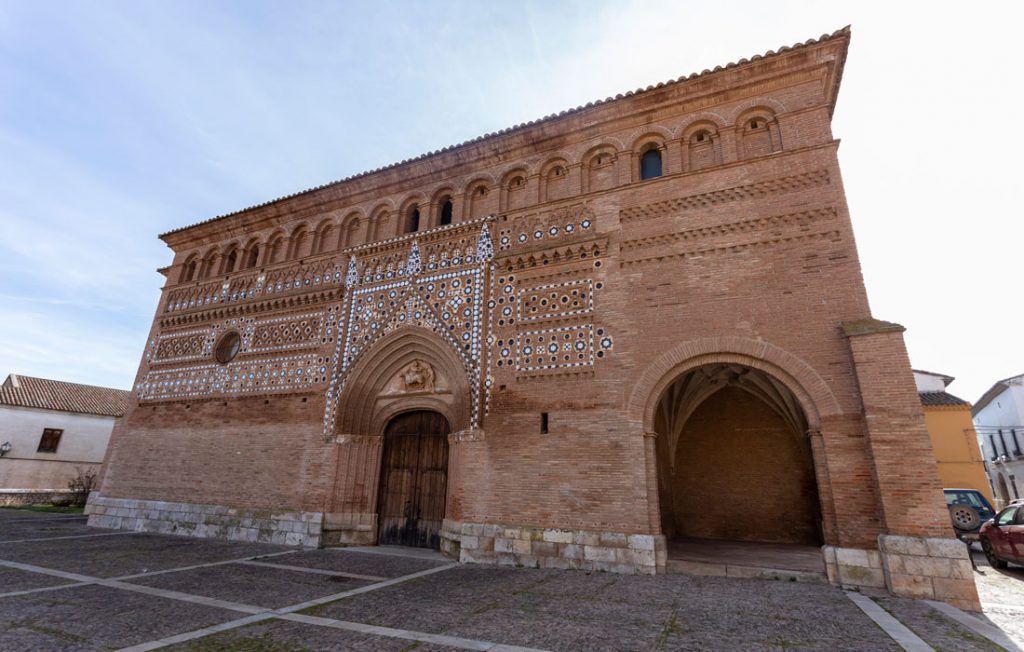
Morata de Jiloca welcomes the visitor on the left bank of the river that gives it its name with the remains of what was once a castle of Muslim origin and with the dazzling flickering of the sun’s rays reflected on the ceramics of the north façade of the church of San Martín de Tours, an essential part of Aragonese Mudejar architecture.

Typologically, this church belongs to the group of fortress-churches, with a single nave and chapels between buttresses, and is characterised by the rationality of its structure and its solid, simple elements.

Its Mudejar construction dates from the first decade of the 15th century; the history of the building underwent a reorientation at the end of the 16th century with the construction of a new chancel and the original chancel remaining as a choir at the foot of the church.

Morata de Jiloca welcomes the visitor on the left bank of the river that gives it its name with the remains of what was once a castle of Muslim origin and with the dazzling flickering of the sun’s rays reflected on the ceramics of the north façade of the church of San Martín de Tours, an essential part of Aragonese Mudejar architecture.

Typologically, this church belongs to the group of fortress-churches, with a single nave and chapels between buttresses, and is characterised by the rationality of its structure and its solid, simple elements.

Its Mudejar construction dates from the first decade of the 15th century; the history of the building underwent a reorientation at the end of the 16th century with the construction of a new chancel and the original chancel remaining as a choir at the foot of the church.

The church of San Martín de Tours

At first glance it can be seen that the church of San Martín de Tours has a wider nave and lower elevation than the Mudejar churches of this type in Aragon, but its main distinguishing feature is the large tapestry that one of its façades has become.

Decorated with highlighted brick and polychrome ceramics in white and blue, it is striking for the large number of ornamental patterns used: multi-armed crosses forming lozenges, bands of corners and uncrossed mixtilinear arches alternate with discs and tiles forming eight-pointed stars and cylinders.

The facade also stands out, following Gothic patterns but masterfully interpreted in the language of the Mudejar tradition.

All this makes the hard years of the border war seem to be forgotten to give way to a visual spectacle as in the parish church of San Miguel de la Seo in Zaragoza, the gable of the Virgin of Tobed or the disappeared church of San Pedro Martir in Calatayud.

Inside, the church of San Martín houses the altarpiece of the Descent from the Cross, made in the second half of the 15th century, a magnificent example of panel painting.

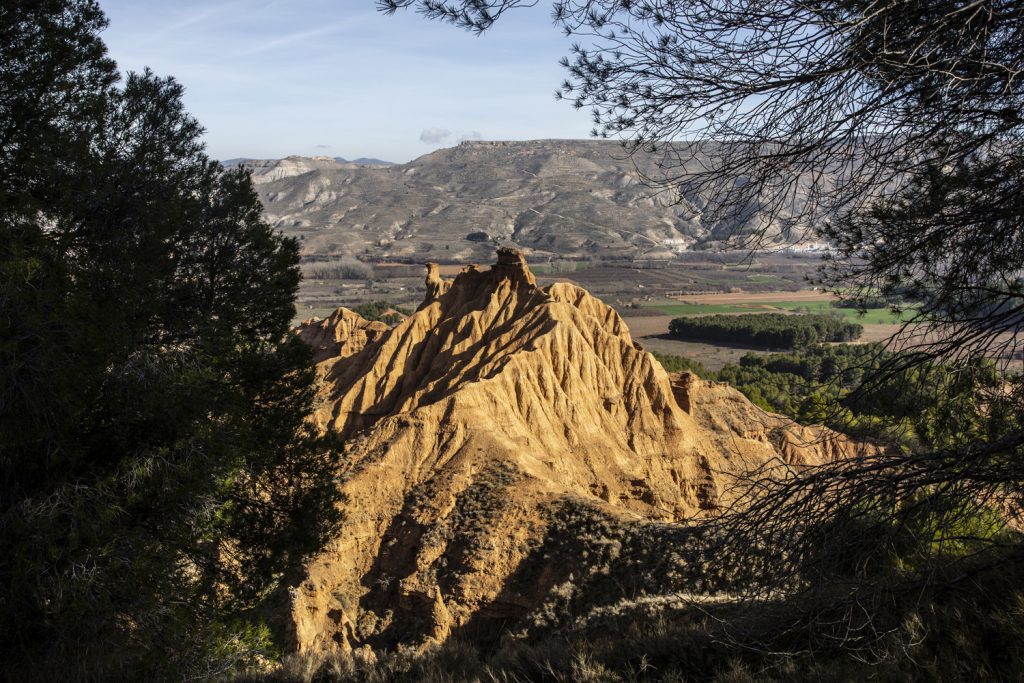
The heritage of Morata de Jiloca cannot be understood without its landscape, which is surprising for its gullies, a capricious modelling of nature. A pleasant walk along a path leads to a viewpoint where you can contemplate this phenomenon caused by the action of rain and wind on the gypsum soil in which the river Jiloca has carved its valley.

At first glance it can be seen that the church of San Martín de Tours has a wider nave and lower elevation than the Mudejar churches of this type in Aragon, but its main distinguishing feature is the large tapestry that one of its façades has become.

Decorated with highlighted brick and polychrome ceramics in white and blue, it is striking for the large number of ornamental patterns used: multi-armed crosses forming lozenges, bands of corners and uncrossed mixtilinear arches alternate with discs and tiles forming eight-pointed stars and cylinders.

The facade also stands out, following Gothic patterns but masterfully interpreted in the language of the Mudejar tradition.

All this makes the hard years of the border war seem to be forgotten to give way to a visual spectacle as in the parish church of San Miguel de la Seo in Zaragoza, the gable of the Virgin of Tobed or the disappeared church of San Pedro Martir in Calatayud.

Inside, the church of San Martín houses the altarpiece of the Descent from the Cross, made in the second half of the 15th century, a magnificent example of panel painting.

The heritage of Morata de Jiloca cannot be understood without its landscape, which is surprising for its gullies, a capricious modelling of nature. A pleasant walk along a path leads to a viewpoint where you can contemplate this phenomenon caused by the action of rain and wind on the gypsum soil in which the river Jiloca has carved its valley.

Information

Town hall
www.moratadejilocaturismo.es
Association for the Integral Development of the Region of Calatayud and the Region of Aranda
galcar.es

VISIT MORATA DE JILOCA
976 633 296

DO YOU WANT TO KNOW MORE?
Aragon Tourism
turismodearagon.com
Tourism Calatayud Region
comarcacalatayud.com
Centre for Bilbilitan Studies
cebilbilitanos.com

Territorio Mudéjar Network

The city council has been a founding member of Territorio Mudéjar since march 2019.

Projects Territorio Mudéjar in Morata de Jiloca

Monuments | View the project
Pedagogy | View the project
Mudetrad Project | View the project
Mudejar and Euclidean Geometry | View the project
Didactic Mudejar, the guide | View the project
‘Circular’ Family walks | View the project
The wall as dermis. Light in the Mudéjar | View the project
Mudéjar RGB | View the project
Assessment of the muslim-friendly potential of Territorio Mudéjar | View the project

Mainar

Mainar-3870
Monuments
THIS PROJECT PROVIDES AN UPDATED VISION OF THE MUDEJAR MONUMENTAL HERITAGE
mainar-W9
Pedagogy
SCHOOL MATERIALS TO WORK ON CULTURAL AND NATURAL HERITAGE
mudetrad-mainar
Mudetrad Project
A PROJECT THAT VALUES THE TRADITIONAL ARCHITECTURE OF MAINAR
portada guia didactica
Didactic Mudejar, the guide
THE GUIDE ILLUSTRATED BY DAVID GUIRAO TO HELP YOU UNDERSTAND THE MUDEJAR STYLE
Imagen decorativa para Slider
Circular from the rural school
Family walks
COOPERATIVE PROJECT BETWEEN RURAL DEVELOPMENT GROUPS

Resettlement village

Mainar is located on the plain of the Huerva, next to the old Royal Road to Madrid, where the silhouette of the slender Mudejar tower of the church of Santa Ana cuts across the horizon.

The powerful volumetry of the Renaissance building defines the view of Mainar, whose origin of the current urban centre can be linked to the repopulation activity of Alfonso I the Battler, characterising a place with little Islamic presence.

The temple, dedicated to Santa Ana, is a Renaissance building begun in 1544 by order of Archbishop Hernando de Aragón, to enlarge an earlier church. The completion works will last until 1576.

Of the original church, only the chapels of San Antonio and Santa Ana have been preserved. Both the facade of the church and the tower are decorated with highlighted brickwork, in the clear Mudejar tradition, which has led some authors to claim that this was one of the last examples built in this style.

Mainar is located on the plain of the Huerva, next to the old Royal Road to Madrid, where the silhouette of the slender Mudejar tower of the church of Santa Ana cuts across the horizon.

The powerful volumetry of the Renaissance building defines the view of Mainar, whose origin of the current urban centre can be linked to the repopulation activity of Alfonso I the Battler, characterising a place with little Islamic presence.

The temple, dedicated to Santa Ana, is a Renaissance building begun in 1544 by order of Archbishop Hernando de Aragón, to enlarge an earlier church. The completion works will last until 1576.

Of the original church, only the chapels of San Antonio and Santa Ana have been preserved. Both the facade of the church and the tower are decorated with highlighted brickwork, in the clear Mudejar tradition, which has led some authors to claim that this was one of the last examples built in this style.

The tower, a hallmark of the Mudejar style

The Mudejar tower, with an octagonal base and six sections of decreasing volumes marked by buttress-like arrises, is decorated with Mudejar motifs such as angled arches, lozenges, rounded arches and ceramics on the upper part. On the lower part of the body is a peculiar motif based on a combination of blades and lozenges in relief. Particularly striking is its top, a blue glazed tile dome that characterises the locality.

The interior of the church, with a single nave, is covered with a beautiful star-shaped ribbed vault that is illuminated by large high windows. At the back of the church, a choir loft was built on columns and the monumental baroque altarpiece is located at the head of the church. It preserves pieces of great interest such as a beautiful 15th century Gothic carving of Saint Blaise of Sebaste enthroned.

Mainar also conserves two small stones: that of the Virgen del Pilar, on the old road to Torralbilla; and that of San Andrés, on the road to Codos, in front of the hermitage of the same apostle.

The Mudejar tower, with an octagonal base and six sections of decreasing volumes marked by buttress-like arrises, is decorated with Mudejar motifs such as angled arches, lozenges, rounded arches and ceramics on the upper part. On the lower part of the body is a peculiar motif based on a combination of blades and lozenges in relief. Particularly striking is its top, a blue glazed tile dome that characterises the locality.

The interior of the church, with a single nave, is covered with a beautiful star-shaped ribbed vault that is illuminated by large high windows. At the back of the church, a choir loft was built on columns and the monumental baroque altarpiece is located at the head of the church. It preserves pieces of great interest such as a beautiful 15th century Gothic carving of Saint Blaise of Sebaste enthroned.

Mainar also conserves two small stones: that of the Virgen del Pilar, on the old road to Torralbilla; and that of San Andrés, on the road to Codos, in front of the hermitage of the same apostle.

Information

Town Hall: 976 807 001

Association for the Integral Rural Development of the lands of Jiloca and Gallocanta
adri.es

VISIT MAINAR
976 633 296

DO YOU WANT TO KNOW MORE?
Aragon Tourism
turismodearagon.com
Daroca Region Tourism
turismo.comarcadedaroca.com
Centre for Darocese Studies
ifc.dpz.es
Center of Jiloca Studies
www.xiloca.org

Territorio Mudéjar Network

The city council has been a full partner of Territorio Mudéjar since December 2019.

Territorio Mudéjar Projects in Mainar

Monuments | View the project
Pedagogy | View the project
Mudetrad Project | View the project
Didactic Mudejar, the guide | View the project
‘Circular’ Family walks | View the project

Magallón

Magallon-W1
Monuments
THIS PROJECT PROVIDES AN UPDATED VISION OF THE MUDEJAR MONUMENTAL HERITAGE
Magallon-W4
Pedagogy
SCHOOL MATERIALS TO WORK ON CULTURAL AND NATURAL HERITAGE
Magallon-W6
Podcast
A PODCAST THAT ENHANCES THE IMPORTANCE OF MUDEJAR ART
portada guia didactica
Didactic Mudejar, the guide
THE GUIDE ILLUSTRATED BY DAVID GUIRAO TO HELP YOU UNDERSTAND THE MUDEJAR STYLE
Imagen decorativa para Slider
Circular from the rural school
Family walks
COOPERATIVE PROJECT BETWEEN RURAL DEVELOPMENT GROUPS

Land of wine and oil

A land of wines and olive oils, the ancient Caravi stands on the promontories of the Castle and the Cabezo, evidence of its defensive origins, and preserves traces of its Iberian, Roman, Arab and Jewish past.

One of its symbols of identity is the hermitage of Nuestra Señora de la Huerta, an old Mudejar church of which part of the perimeter walls and a beautiful seven-sided polygonal apse of which only two examples exist in the whole of Aragon.

The church was built in the middle of the 14th century and has a delicate ornamentation in raised brickwork that covers the polygonal apse. The large windows are decorated with plaster lattices that form geometric and vegetal elements. Its walls were painted and remains of the scribe technique have been preserved. Annexed to the church is the old Dominican convent building, built at the beginning of the 17th century.

A land of wines and olive oils, the ancient Caravi stands on the promontories of the Castle and the Cabezo, evidence of its defensive origins, and preserves traces of its Iberian, Roman, Arab and Jewish past.

One of its symbols of identity is the hermitage of Nuestra Señora de la Huerta, an old Mudejar church of which part of the perimeter walls and a beautiful seven-sided polygonal apse of which only two examples exist in the whole of Aragon.

The church was built in the middle of the 14th century and has a delicate ornamentation in raised brickwork that covers the polygonal apse. The large windows are decorated with plaster lattices that form geometric and vegetal elements. Its walls were painted and remains of the scribe technique have been preserved. Annexed to the church is the old Dominican convent building, built at the beginning of the 17th century.

Example of inherited identity

The highest part of the town is occupied by the church of San Lorenzo. Built on the remains of an ancient castle, it visually dominates the Huecha valley. All that remains of what was once the castle is the keep, which today forms part of the church of San Lorenzo as a bell tower. Although there is no documentation on the beginning of the construction of the castle, it is dated between 1130 and 1200 and forms part of the Aragonese line of defence.

The church of San Lorenzo is late Gothic in style and is attached to a primitive religious building, the Chapel of Nuestro Señor Crucificado. Inside, in the lower part of the church, there is the surprising Mudejar-style chevet of the old church, which was preserved, together with the lower part of the tower, in the construction of the new church. The 17th century Baroque altarpiece is worth mentioning, in which some of the canvases, the work of Vicente Berdusán, stand out.

Magallón is well worth a stroll around its Plaza de España square with its arcaded arches, the Baroque chapel of El Rosario, and the palace that houses the Town Hall. It is a space that continues to host the weekly market, as it was traditionally done.

The highest part of the town is occupied by the church of San Lorenzo. Built on the remains of an ancient castle, it visually dominates the Huecha valley. All that remains of what was once the castle is the keep, which today forms part of the church of San Lorenzo as a bell tower. Although there is no documentation on the beginning of the construction of the castle, it is dated between 1130 and 1200 and forms part of the Aragonese line of defence.

The church of San Lorenzo is late Gothic in style and is attached to a primitive religious building, the Chapel of Nuestro Señor Crucificado. Inside, in the lower part of the church, there is the surprising Mudejar-style chevet of the old church, which was preserved, together with the lower part of the tower, in the construction of the new church. The 17th century Baroque altarpiece is worth mentioning, in which some of the canvases, the work of Vicente Berdusán, stand out.

Magallón is well worth a stroll around its Plaza de España square with its arcaded arches, the Baroque chapel of El Rosario, and the palace that houses the Town Hall. It is a space that continues to host the weekly market, as it was traditionally done.

Information

Town Hall: 976 858 801
www.magallon.es
Association for the Development of the Lands of Moncayo
asomo.com
VISIT MAGALLÓN
976 633 296

DO YOU WANT TO KNOW MORE?
Aragon Tourism
turismodearagon.com
Centre for Borjan Studies
cesbor.blogspot.com
Grenache Route
www.rutadelagarnacha.es

Territorio Mudéjar Network

The city council has been a full partner of Territorio Mudéjar since January 2020.

Projects Territorio Mudéjar in Magallón

Monuments | View the project
Pedagogy | View the project
Podcast | View the project
Didactic Mudejar, the guide | View the project
‘Circular’ Family walks | View the project

Cosuenda

Cosuenda-01
Monuments
THIS PROJECT PROVIDES AN UPDATED VISION OF THE MUDEJAR MONUMENTAL HERITAGE
Pedagogy
SCHOOL MATERIALS TO WORK ON CULTURAL AND NATURAL HERITAGE
mudetrad-cosuenda
Mudetrad Project
A PROJECT THAT VALUES THE TRADITIONAL ARCHITECTURE OF COSUENDA
portada guia didactica
Didactic Mudejar, the guide
THE GUIDE ILLUSTRATED BY DAVID GUIRAO TO HELP YOU UNDERSTAND THE MUDEJAR STYLE
Imagen decorativa para Slider
Circular from the rural school
Family walks
COOPERATIVE PROJECT BETWEEN RURAL DEVELOPMENT GROUPS

The shelter

In the foothills of the Sierra de Algairén and at the foot of a hill that protects its hamlet, is the town of Cosuenda.

The remains of the castle can be seen on a nearby hill. It was built as a refuge from the threats of Castilian invasion in the 14th century and, as in other castles in Aragon, a church was built inside it. In the most strategic corner is the emblem of Cosuenda: the Lisalta tower.

The fortified tower of La Lisalta

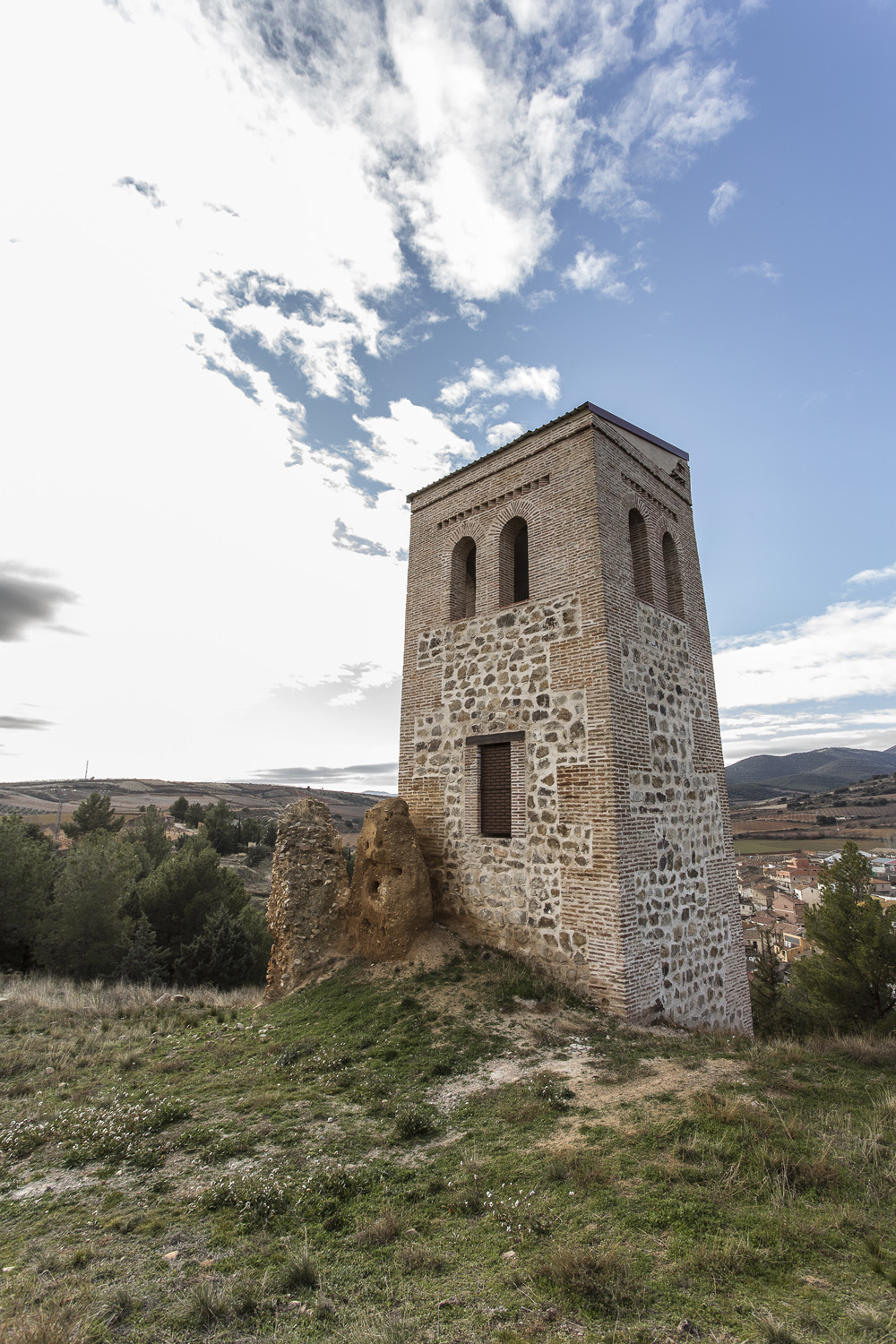
With a square floor plan of about 5 metres on each side, its walls are made of masonry with brick reinforced corners and the upper body is made entirely of brick in the Mudejar style. The recent restoration has solved the structural problems and part of the tower has been rebuilt.

The building has round-arched openings to house bells, and some theories suggest that it may have been the bell tower of the church that no longer exists. The entrance doorway, located high up, retains the interior pointed arch, also made of brick. Next to it there are still the remains of strong masonry walls that may have formed part of a small interior fortification for the defence of the isolated tower.

The artistic historical tour is complemented by the church of Nuestra Señora de los Ángeles, a baroque style temple; some stately homes such as the house of the pianist Pilar Bayona, and other buildings such as the old inn, which today houses the town hall and in the past was the hermitage of San Juan. The old rock-hewn cellars in the upper part of the village are also of historical value.

With a square floor plan of about 5 metres on each side, its walls are made of masonry with brick reinforced corners and the upper body is made entirely of brick in the Mudejar style. The recent restoration has solved the structural problems and part of the tower has been rebuilt.

The building has round-arched openings to house bells, and some theories suggest that it may have been the bell tower of the church that no longer exists. The entrance doorway, located high up, retains the interior pointed arch, also made of brick. Next to it there are still the remains of strong masonry walls that may have formed part of a small interior fortification for the defence of the isolated tower.

The artistic historical tour is complemented by the church of Nuestra Señora de los Ángeles, a baroque style temple; some stately homes such as the house of the pianist Pilar Bayona, and other buildings such as the old inn, which today houses the town hall and in the past was the hermitage of San Juan. The old rock-hewn cellars in the upper part of the village are also of historical value.

Information

Town Hall: 976 627 081
www.ayto-cosuenda.com

Association for the Integral Development of Valdejalón and Campo de Cariñena
fedivalca.org

VISIT COSUENDA
976 633 296

DO YOU WANT TO KNOW MORE?
Aragon Tourism
turismodearagon.com
Campo de Cariñena Wine Route
www.rutadelvinocampodecarinena

Territorio Mudéjar Network

The city council has been a founding member of Territorio Mudéjar since 13 September 2018.

Projects Territorio Mudéjar in Consuenda

Monuments | View the project
Pedagogy | View the project
Mudetrad Project | View the project
Didactic Mudejar, the guide | View the project
Preventive town planning | View the project
‘Circular’ Family walks | View the project

Cosuenda in the social media

Facebook: @turismocampodecarinena @rutadelvinocampodecarinena
Instagram:@turismo_carinena @rvpcampocarinena

Calatayud

CALATAYUD-inicio
Monuments
THIS PROJECT PROVIDES AN UPDATED VISION OF THE MUDEJAR MONUMENTAL HERITAGE
Morería_Calatayud
Pedagogy
SCHOOL MATERIALS TO WORK ON CULTURAL AND NATURAL HERITAGE
Calatayud-3018-baja
Podcast
A PODCAST THAT ENHANCES THE IMPORTANCE OF MUDEJAR ART
mudetrad-zuera
Mudetrad Project
A PROJECT THAT HIGHLIGHTS THE TRADITIONAL ARCHITECTURE OF CALATAYUD
portada guia didactica
Didactic Mudejar, the guide
THE GUIDE ILLUSTRATED BY DAVID GUIRAO TO HELP YOU UNDERSTAND THE MUDEJAR STYLE
Imagen decorativa para Slider
Circular from the rural school
Family walks
COOPERATIVE PROJECT BETWEEN RURAL DEVELOPMENT GROUPS
El mudéjar y la geometría euclidiana
PLASTIC STUDY OF THE ARAGONESE MUDEJAR OF THE SPACE OF THE MUDEJAR TERRITORY

Ayyub Castle

It is the most important of the towns founded in the Jalón valley thanks to its strategic situation as a crossroads for communication routes and its privileged natural location.

The Roman Bílbilis, located some six kilometres from the city, was the first large city in the area, although settlement on the riverbank is documented as far back as the Celtiberian period, where the Muslim foundation took place and where the most important fortified complex of the medieval period was built, with not only an impregnable natural enclave, but also the spectacular defensive construction – whose toponym “castle of Ayyub” means “Job’s fortress” and from which the present city takes its name. The earliest records in Arabic sources date from the emirate of Muhammad I, between 852 and 886, when the fortress was transformed into a city. This documented fact will determine the characterisation of the defensive enclave defined by five castles (Doña Martina, La Peña, La Torre Mocha, El Mayor and El Real) and long stretches of walls that protected both the inhabited farmhouse and areas of countryside and orchards that are currently built up.
After the Christian reconquest in 1120, the Christian city began to flourish, and in a short time it began to build, in a beautifully Muslim urban layout, a good number of civil and religious buildings in which the main style was Mudejar, conserving areas with an unquestionable Muslim and Jewish flavour, in the areas known as the Morería and the Judería.

It is the most important of the towns founded in the Jalón valley thanks to its strategic situation as a crossroads for communication routes and its privileged natural location.

The Roman Bílbilis, located some six kilometres from the city, was the first large city in the area, although settlement on the riverbank is documented as far back as the Celtiberian period, where the Muslim foundation took place and where the most important fortified complex of the medieval period was built, with not only an impregnable natural enclave, but also the spectacular defensive construction – whose toponym “castle of Ayyub” means “Job’s fortress” and from which the present city takes its name. The earliest records in Arabic sources date from the emirate of Muhammad I, between 852 and 886, when the fortress was transformed into a city. This documented fact will determine the characterisation of the defensive enclave defined by five castles (Doña Martina, La Peña, La Torre Mocha, El Mayor and El Real) and long stretches of walls that protected both the inhabited farmhouse and areas of countryside and orchards that are currently built up.

After the Christian reconquest in 1120, the Christian city began to flourish, and in a short time it began to build, in a beautifully Muslim urban layout, a good number of civil and religious buildings in which the main style was Mudejar, conserving areas with an unquestionable Muslim and Jewish flavour, in the areas known as the Morería and the Judería.
The Mudejar of Calatayud as a disseminating nucleus
UNESCO World Heritage 2001

The undeniable defensive character of the city shares the limelight with the imposing Mudejar heritage of the city, a style that burst into the city with force during the first half of the 14th century and whose main exponent is the collegiate church of Santa María, declared a UNESCO World Heritage Site in 2001.

The Collegiate Church of Santa María la Mayor combines Mudejar, Renaissance and Baroque elements as a result of its long history, which dates back to the years of the conquest of the city by Alfonso I. According to the work of Professor Gonzalo M. Borrás Gualis, the ensemble formed by the cloister, the apse and the lower part of the bell tower constitute the oldest monumental part of the present collegiate church; they were built in the same construction period, between 1402 and 1412, and are linked to the patronage of Pope Benedict XIII, known as the Papa Luna and to the technical direction of its master builder Muhammad Rami. This tower, the result of several phases of construction from the beginning of the 15th century to the 18th century, stands at more than 70 metres high and is the tallest of all the remaining towers in Aragon.

Alongside Santa María, the city preserves a monumental ensemble which, in each of its examples, shows us the history of the city and its powerful historical position. The religious buildings of San Andrés, San Pedro de los Francos, Nuestra Señora de la Peña, the collegiate church of Santo Sepulcro or San Juan el Real stand in a hamlet with a simple layout but with imposing palace-houses, interesting urban elements such as the Ocho Caños fountain and the Puerta de Terrer.

Time has turned the city into a perfect combination of history and modernity thanks to the conservation of such attractive places as the Convento de los Dominicos, the Hospedería del Pilar, the Arco de San Miguel or the Mesón de la Dolores.

The undeniable defensive character of the city shares the limelight with the imposing Mudejar heritage of the city, a style that burst into the city with force during the first half of the 14th century and whose main exponent is the collegiate church of Santa María, declared a UNESCO World Heritage Site in 2001.

The Collegiate Church of Santa María la Mayor combines Mudejar, Renaissance and Baroque elements as a result of its long history, which dates back to the years of the conquest of the city by Alfonso I. According to the work of Professor Gonzalo M. Borrás Gualis, the ensemble formed by the cloister, the apse and the lower part of the bell tower constitute the oldest monumental part of the present collegiate church; they were built in the same construction period, between 1402 and 1412, and are linked to the patronage of Pope Benedict XIII, known as the Papa Luna and to the technical direction of its master builder Muhammad Rami. This tower, the result of several phases of construction from the beginning of the 15th century to the 18th century, stands at more than 70 metres high and is the tallest of all the remaining towers in Aragon.

Alongside Santa María, the city preserves a monumental ensemble which, in each of its examples, shows us the history of the city and its powerful historical position. The religious buildings of San Andrés, San Pedro de los Francos, Nuestra Señora de la Peña, the collegiate church of Santo Sepulcro or San Juan el Real stand in a hamlet with a simple layout but with imposing palace-houses, interesting urban elements such as the Ocho Caños fountain and the Puerta de Terrer.

Time has turned the city into a perfect combination of history and modernity thanks to the conservation of such attractive places as the Convento de los Dominicos, the Hospedería del Pilar, the Arco de San Miguel or the Mesón de la Dolores.

Information

Town Hall: 976 881 700
www.calatayud.es

Association for the Integral Development of the Region of Calatayud and the Region of Aranda
galcar.es

VISIT CALATAYUD
976 633 296

DO YOU WANT TO KNOW MORE?
Aragon Tourism
turismodearagon.com
Tourism Calatayud Region
comarcacalatayud.com
Centre for Bilbilitan Studies
cebilbilitanos.com
The Cid’s Way
www.caminodelcid.org

Territorio Mudéjar Network

The city council has been a founding member of Territorio Mudéjar since 13 September 2018.
He is a member of the Board of Directors as Vice-President.

Projects Mudejar Territory in Calatayud

Monuments | View the project
Pedagogy | View the project
Podcast | View the project
Mudetrad Project | View the project
Mudejar plaster | View the project
Mudejar and Euclidean Geometry | View the project
Didactic Mudejar, the guide | View the project
‘Circular’ Family walks | View the project
Mudéjar RGB | View the project
Assessment of the muslim-friendly potential of Territorio Mudéjar | View the project

Calatayud in the social media

Facebook: @AyuntamientoCalatayud @TurismoCalatayud @turismo.comunidadcalatayud
Instagram:
@aytocalatayud @comarcacalatayud

Brea de Aragón

Brea-01
Pedagogy
SCHOOL MATERIALS TO WORK ON CULTURAL AND NATURAL HERITAGE
mudetrad-brea
Mudetrad Project
A PROJECT THAT HIGHLIGHTS THE VALUE OF THE TRADITIONAL ARCHITECTURE OF BREA DE ARAGÓN

The power of the church

Situated on the left bank of the Aranda river, on the route known as the Papa LunaThe town centre stands out above all for its urban development marked by the confluence of Christian, Muslim and Jewish cultures, the latter being traditionally linked to the origin of the town’s name.

In any case, it is the Islamic tradition that determines one of the most defining aspects of the town, the abundant population of Moors, counted in the census of expulsion as 2,699 people in 573 fires. In 1446 the town was sold to the Cabildo Metropolitano del Pilar of Saragossa and became an ecclesiastical lordship.

The urban complex, beyond the religious monuments, will stand out above all for its more industrial character preserved in the mill or the one known as central Brea.

Situated on the left bank of the Aranda river, on the route known as the Papa LunaThe town centre stands out above all for its urban development marked by the confluence of Christian, Muslim and Jewish cultures, the latter being traditionally linked to the origin of the town’s name.

In any case, it is the Islamic tradition that determines one of the most defining aspects of the town, the abundant population of Moors, counted in the census of expulsion as 2,699 people in 573 fires. In 1446 the town was sold to the Cabildo Metropolitano del Pilar of Saragossa and became an ecclesiastical lordship.

The urban complex, beyond the religious monuments, will stand out above all for its more industrial character preserved in the mill or the one known as central Brea.

Enduring Mudejar tradition

The parish church of Santa Ana was built between 1555 and 1556 with the intervention of the Basque master masons Juan de Gorostiza, Domingo de Lizarza and Juan Pérez. It is a Baroque temple with a single nave divided into three sections that welcomes the visitor with a façade pierced by an oculus and with a pediment that shows an eave of Mudejar tradition.

Attached to the façade is a brick tower with semicircular arches. In the 17th century, the Zaragoza master Juan de Marca was responsible for converting the vault into a barrel vault with lunettes and covering it with imposing plasterwork with ribbons, stars and geometric designs. The chapel of Nuestra Señora del Carmen, on the Epistle side, is also decorated with plasterwork in the Mudejar tradition. During the 17th century, Mudejar elements such as plasterwork became widespread, decorating vaults, domes, perpendicular arches and chapel entrance arches, which constitute the most genuine and personal decoration of the first stage of Baroque architecture in Aragon.

It is clear that the town centre has historically been marked by an industrial activity with a clear medieval tradition that has been modernised over time; this is the case of the manufacture of footwear, the importance of which is highlighted by the opening of the Footwear Museum, a centre for the study and dissemination of the footwear industry in the region.

The parish church of Santa Ana was built between 1555 and 1556 with the intervention of the Basque master masons Juan de Gorostiza, Domingo de Lizarza and Juan Pérez. It is a Baroque temple with a single nave divided into three sections that welcomes the visitor with a façade pierced by an oculus and with a pediment that shows an eave of Mudejar tradition.

Attached to the façade is a brick tower with semicircular arches. In the 17th century, the Zaragoza master Juan de Marca was responsible for converting the vault into a barrel vault with lunettes and covering it with imposing plasterwork with ribbons, stars and geometric designs. The chapel of Nuestra Señora del Carmen, on the Epistle side, is also decorated with plasterwork in the Mudejar tradition. During the 17th century, Mudejar elements such as plasterwork became widespread, decorating vaults, domes, perpendicular arches and chapel entrance arches, which constitute the most genuine and personal decoration of the first stage of Baroque architecture in Aragon.

It is clear that the town centre has historically been marked by an industrial activity with a clear medieval tradition that has been modernised over time; this is the case of the manufacture of footwear, the importance of which was boosted with the opening of the Footwear Museum, a centre for the study and dissemination of the footwear industry in the region.

Information

Town Hall: 976 824 098
www.breadearagon.es

DO YOU WANT TO KNOW MORE?
Tourism in Zaragoza
www.turismodezaragoza.es
Region of Aranda
www.comarcadelaranda.com

Territorio Mudéjar Network

The city council has been a Friend of the Mudejar in Mudejar Territory since September 2018.

Projects Mudejar Territory in Brea de Aragón

Pedagogy | View the project
Mudetrad Project | View the project

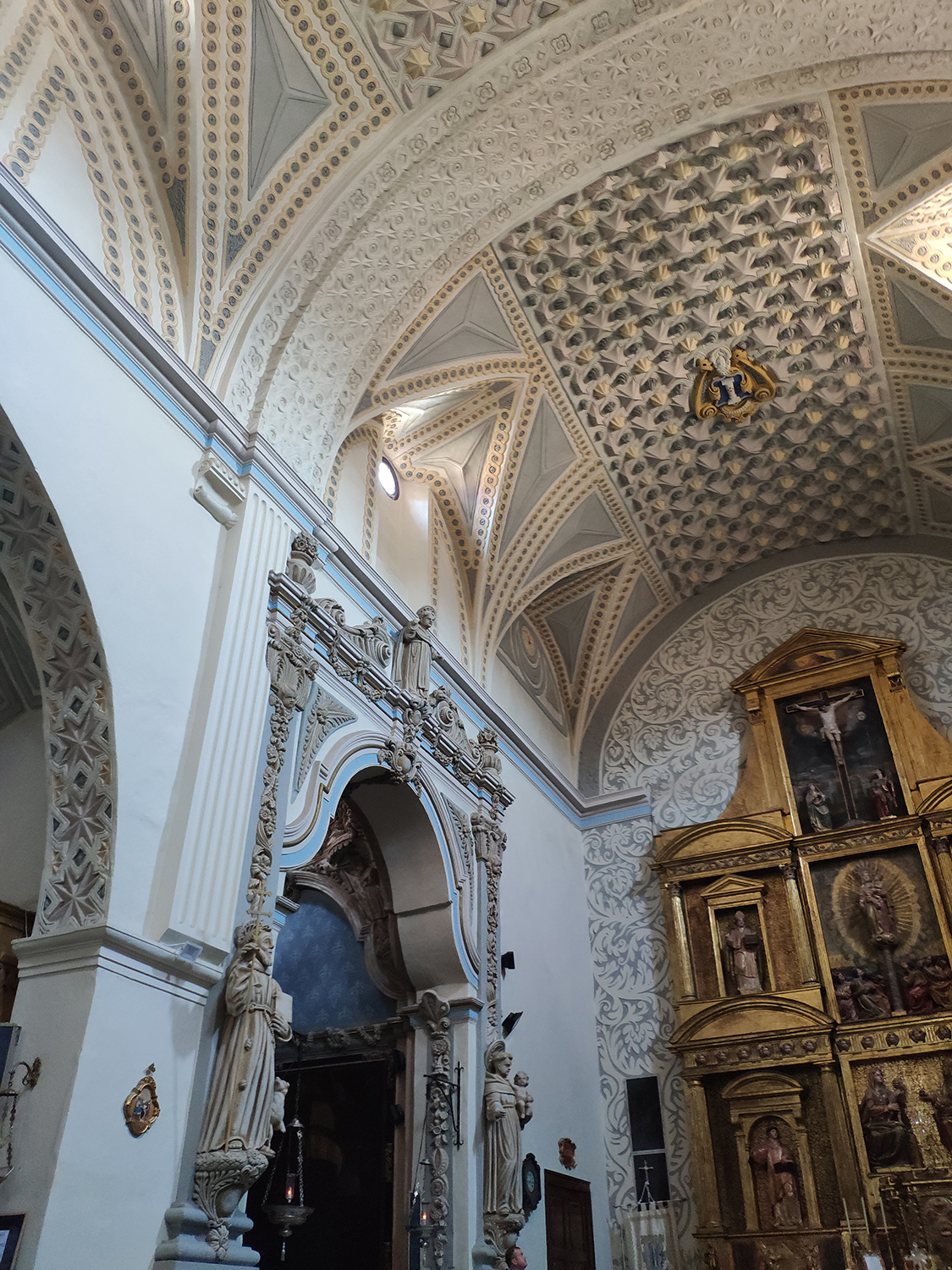
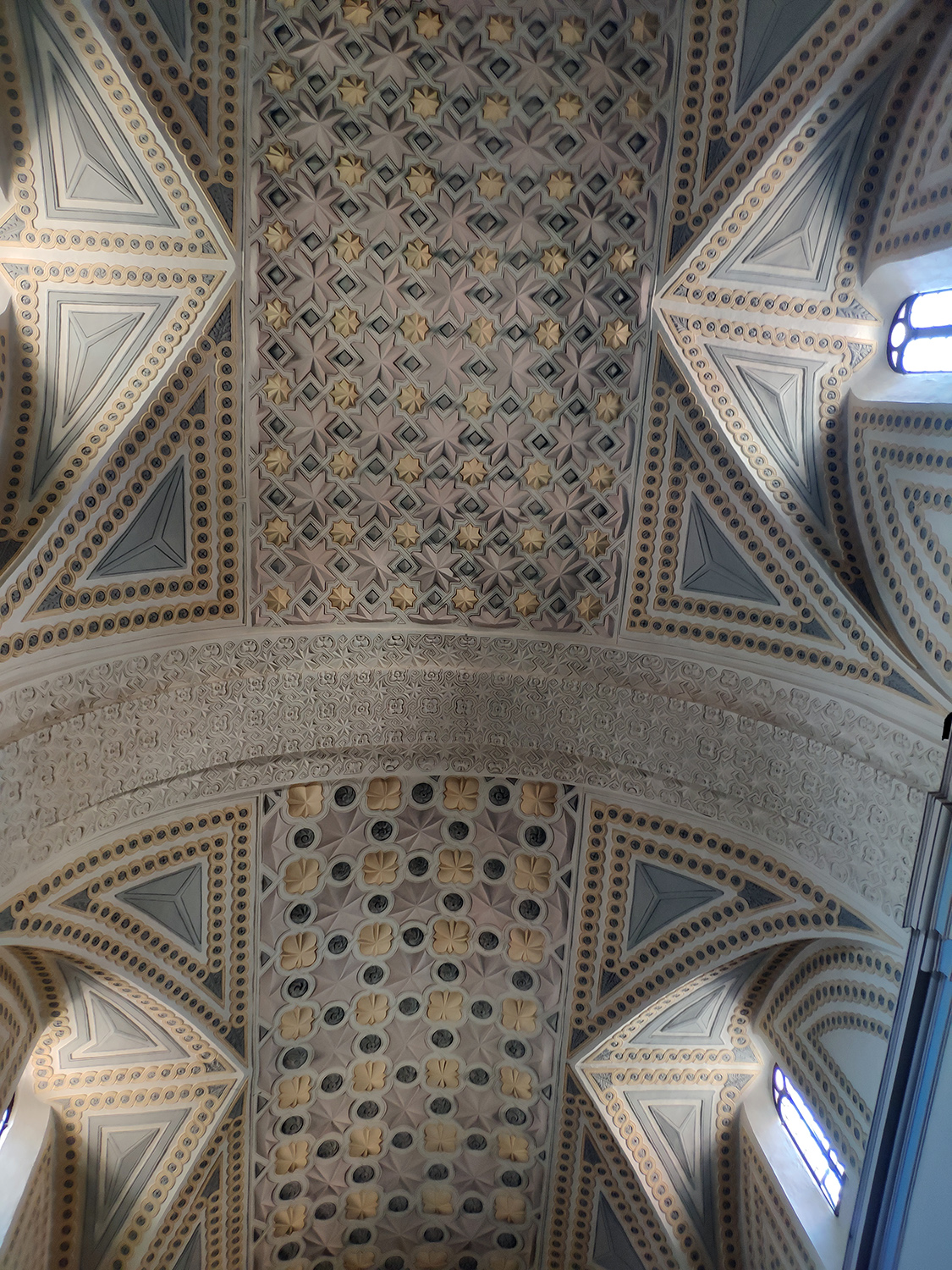
Ateca

Monuments
THIS PROJECT PROVIDES AN UPDATED VISION OF THE MUDEJAR MONUMENTAL HERITAGE
Ateca-5-baja
Pedagogy
SCHOOL MATERIALS TO WORK ON CULTURAL AND NATURAL HERITAGE
mudetrad-ateca
Mudetrad Project
A PROJECT THAT ENHANCES THE TRADITIONAL ARCHITECTURE OF ATECA
La guía didáctica
Didactic Mudejar, the guide
THE GUIDE ILLUSTRATED BY DAVID GUIRAO TO HELP YOU UNDERSTAND THE MUDEJAR STYLE
Imagen decorativa para Slider
Circular from the rural school
Family walks
COOPERATIVE PROJECT BETWEEN RURAL DEVELOPMENT GROUPS

“The ancient one”

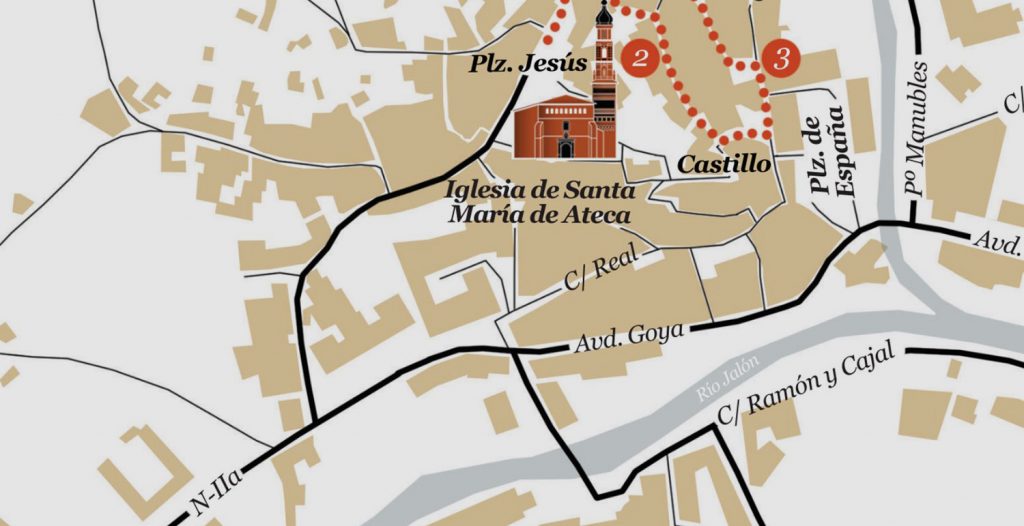
Located at the crossroads of the River Jalón with the River Manubles and the Mesa-Piedra, its historically strategic location has led to settlements in the area since the Eneolithic period, with finds documented in numerous places in the municipality.

The Islamic legacy of Ateca can be seen in the Arabic toponym from which its name “la antigua” derives, and is reflected in an attractive hamlet that is built on an urban layout of Islamic character with steep slopes, twists, turns and cul-de-sacs or covered passages, on which stand large houses with high, closed walls. The complex dialogues with the landscape marked by the use of water resources and draws attention to the system of irrigation channels, the most important element of which is the Canal del Val aqueduct.

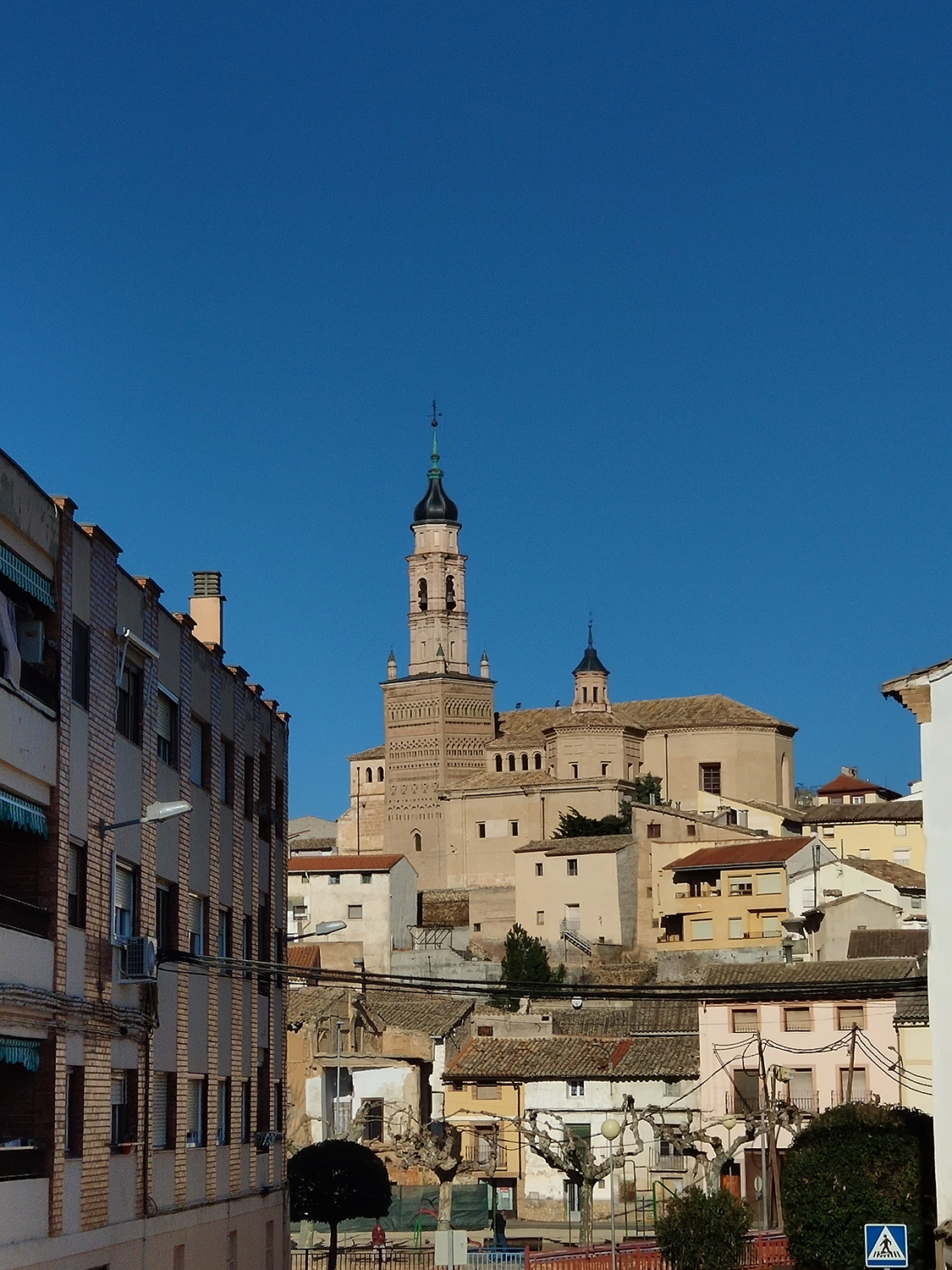
But if there is one thing that is striking about the town, it is its group of towers. The Mudejar tower of the church of Santa María, dated, according to professor Gonzalo M. Borrás Gualis, to the second half of the 13th century, is the oldest part of the complex, prior to the Mudejar church, and is totally free-standing at the foot of the church and displaced from its axis. Both its structure and its ornamental elements, somewhat archaic for the time, follow the Almohad Islamic tradition, built by Aragonese Moorish masters, perhaps following the local tradition of minarets in the region but in any case built as a Christian bell tower. In 1560, the Clock Tower was built, commissioned by the council to the master builders Domingo and Ameçot to house the new clock that was to regulate the life of the city.

Located at the crossroads of the River Jalón with the River Manubles and the Mesa-Piedra, its historically strategic location has led to settlements in the area since the Eneolithic period, with finds documented in numerous places in the municipality.

The Islamic legacy of Ateca can be seen in the Arabic toponym from which its name “la antigua” derives, and is reflected in an attractive hamlet that is built on an urban layout of Islamic character with steep slopes, twists, turns and cul-de-sacs or covered passages, on which stand large houses with high, closed walls. The complex dialogues with the landscape marked by the use of water resources and draws attention to the system of irrigation channels, the most important element of which is the Canal del Val aqueduct.

But if there is one thing that is striking about the town, it is its group of towers. The Mudejar tower of the church of Santa María, dated, according to professor Gonzalo M. Borrás Gualis, to the second half of the 13th century, is the oldest part of the complex, prior to the Mudejar church, and is totally free-standing at the foot of the church and displaced from its axis. Both its structure and its ornamental elements, somewhat archaic for the time, follow the Almohad Islamic tradition, built by Aragonese Moorish masters, perhaps following the local tradition of minarets in the region but in any case built as a Christian bell tower. In 1560, the Clock Tower was built, commissioned by the council to the master builders Domingo and Ameçot to house the new clock that was to regulate the life of the city.

On the “Camino del Cid”, the Way of El Cid

Ateca is located at a strategic point at the confluence of the rivers Manubles and Jalón and is presided over by a fortification of uncertain origin, documented in the 10th century. At that time, the castle belonged to the Banu Timlat, although it was occupied by the Cid on his way to exile (as mentioned in the Cantar del Mío Cid), and was definitively incorporated into the Kingdom of Aragon in 1120 by Alfonso I the Battler after the battle of Cutanda.

These remains of the old castle watch over the town centre of Ateca, which, in addition to the church of Santa María and the Clock Tower, stands out for its strong character and other architectural features such as the Baroque church of San Francisco and the Renaissance-style town hall, as well as for the conservation of three of the four access gates to the walled enclosure of the medieval town: Puerta de las Fraguas, Puerta del Arial and the gate of San Miguel. The fourth, called Almazán, has disappeared.

Ateca is located at a strategic point at the confluence of the rivers Manubles and Jalón and is presided over by a fortification of uncertain origin, documented in the 10th century. At that time, the castle belonged to the Banu Timlat, although it was occupied by the Cid on his way to exile (as mentioned in the Cantar del Mío Cid), and was definitively incorporated into the Kingdom of Aragon in 1120 by Alfonso I the Battler after the battle of Cutanda.

These remains of the old castle watch over the town centre of Ateca, which, in addition to the church of Santa María and the Clock Tower, stands out for its strong character and other architectural features such as the Baroque church of San Francisco and the Renaissance-style town hall, as well as for the conservation of three of the four access gates to the walled enclosure of the medieval town: Puerta de las Fraguas, Puerta del Arial and the gate of San Miguel. The fourth, called Almazán, has disappeared.

Information

Town Hall: 976 842 005
www.aytoateca.es

Association for the Integral Development of the Region of Calatayud and the Region of Aranda
galcar.es

ATECA VISIT
976 633 296

DO YOU WANT TO KNOW MORE?
Aragon Tourism
turismodearagon.com
Tourism Calatayud Region
comarcacalatayud.com
Centre for Bilbilitan Studies
cebilbilitanos.com
The Cid’s Way
www.caminodelcid.org

Territorio Mudéjar Network

The city council has been a founding member of Territorio Mudéjar since 13 September 2018.

Projects Territorio Mudéjar in Ateca

Monuments | View the project
Pedagogy | View the project
Mudetrad Project | View the project
Mudejar civil architecture | View the project
Didactic Mudejar, the guide | View the project
Preventive town planning | View the project
‘Circular’ Family walks | View the project
Mudéjar RGB | View the project

Aniñón

Aniñón-3314-baja
Pedagogy
SCHOOL MATERIALS TO WORK ON CULTURAL AND NATURAL HERITAGE
mudetrad-aninon
Mudetrad Project
A PROJECT THAT HIGHLIGHTS THE TRADITIONAL ARCHITECTURE OF ANIÑÓN
Aninon-00-IMAGEN-INICIO
Mudejar wood in Aniñón
UN RECORRIDO POR LA CARPINTERÍA MUDÉJAR DE ANIÑÓN Y SU HISTORIA
La guía didáctica
Didactic Mudejar, the guide
THE GUIDE ILLUSTRATED BY DAVID GUIRAO TO HELP YOU UNDERSTAND THE MUDEJAR STYLE
Imagen decorativa para Slider
Circular from the rural school
Family Outings
COOPERATIVE PROJECT BETWEEN RURAL DEVELOPMENT GROUPS
El mudéjar y la geometría euclidiana
PLASTIC STUDY OF THE ARAGONESE MUDEJAR OF THE SPACE OF THE MUDEJAR TERRITORY

Urban beauty

Aniñón is in a privileged location, on the foothills of the Sierra de la Virgen, where the Ribota Valley rises up in height, and opposite the Sierra de Armantes mountain range. This geography of mountain ranges and valleys rich in materials made it a favourable area for Mudejar construction because of the proximity of the materials and because there were craftsmen who knew how to work them. The best example of this can be found at the top of the town centre. On the remains of an ancient castle, we are welcomed by the church of the Virgen del Castillo with its façade, one of the most imposing Mudejar exteriors in Aragon. A great experience to discover the extraordinary richness of Muslim decoration.

The church of the Virgen del Castillo is originally a Gothic-Mudejar monument from the 14th century, which was profoundly reformed in the 16th century when the church was enlarged and the gable and the upper body of the tower were built. In the 17th and 18th centuries, several Baroque chapels were added: the chapel of the Santísimo Misterio de Aniñón, located on the south wall, opposite the main entrance to the church, and the chapel of Nuestra Señora del Rosario, located where the entrance to the church was originally located, and which was later moved to the south façade. Between 1985 and 2005, several phases of restoration work were carried out on the entire building.

Located at the exit to the old road to Calatayud is another of Aniñón’s points of interest: the arch-chapel of the town, with an ogival arch over which a two-storey body of popular character is developed.

It is worth mentioning the irregular urban layout of the town, where you can admire popular houses with white façades and two or three storeys. The Oil Museum is well worth a visit, where you can learn about the process of elaboration of the liquid gold in an original mill, as well as the Cooperative of Niño Jesús, where the rich production of the land of Aniñón is concentrated.

The church of the Virgen del Castillo is originally a Gothic-Mudejar monument from the 14th century, which was profoundly reformed in the 16th century when the church was enlarged and the gable and the upper body of the tower were built. In the 17th and 18th centuries, several Baroque chapels were added: the chapel of the Santísimo Misterio de Aniñón, located on the south wall, opposite the main entrance to the church, and the chapel of Nuestra Señora del Rosario, located where the entrance to the church was originally located, and which was later moved to the south façade. Between 1985 and 2005, several phases of restoration work were carried out on the entire building.

Located at the exit to the old road to Calatayud is another of Aniñón’s points of interest: the arch-chapel of the town, with an ogival arch over which a two-storey body of popular character is developed.

It is worth mentioning the irregular urban layout of the town, where you can admire popular houses with white façades and two or three storeys. The Oil Museum is well worth a visit, where you can learn about the process of elaboration of the liquid gold in an original mill, as well as the Cooperative of Niño Jesús, where the rich production of the land of Aniñón is concentrated.

Territorio Mudéjar Network

The city council has been a founding member of Territorio Mudéjar since 13 September 2018.

More information

Town Hall: 976 899 106
www.aninon.es

Association for the Integral Development of the Calatayud and Aranda Regions
galcar.es

VISIT ANIÑÓN
976 633 296

DO YOU WANT TO KNOW MORE?
Turismo de Aragón
turismodearagon.com
Turismo Comarca Comunidad de Calatayud
comarcacalatayud.com
Centro de Estudios Bilbilitanos
cebilbilitanos.com

Projects Mudejar Territory in Aniñón

Monuments | See the project
Pedagogy | See the project
Mudetrad project | See the project
Mudéjar wood | See the project
Mudéjar plaster | See the project
Mudéjar and Euclidean geometry | See the project
Mudéjar didactic, the guide | See the project
Preventive town planning | See the project
Mudéjar landscape | See the project
“Circular” Family walks | See the project

Torrellas

Monuments
THIS PROJECT PROVIDES AN UPDATED VISION OF THE MUDEJAR MONUMENTAL HERITAGE
Pedagogy
SCHOOL MATERIALS TO WORK ON CULTURAL AND NATURAL HERITAGE
mudetrad-torrellas
Mudetrad Project
A PROJECT THAT VALUES THE TRADITIONAL ARCHITECTURE OF TORRELLAS
portada guia didactica
Didactic Mudejar, the guide
THE GUIDE ILLUSTRATED BY DAVID GUIRAO TO HELP YOU UNDERSTAND THE MUDEJAR STYLE
Imagen decorativa para Slider
Circular from the rural school
Family walks
COOPERATIVE PROJECT BETWEEN RURAL DEVELOPMENT GROUPS

Open Muslim quarter

Situated at a crossroads between Aragon, La Rioja, Navarre and the province of Soria, Torrellas immediately immerses the visitor in a Muslim past that is present in many corners and presided over by the beauty of the church of San Martín de Tours, which conserves the lower part of the old mosque.

The church underwent a major renovation in the 17th century to make it suitable for Christian worship. The exterior is notable for its slightly leaning octagonal Mudejar tower.

It was built in two phases: between 1540 and 1550, the belfry was built up to the belfry, and around 1580 the upper body was erected. The interior of this tower has a Caliphate minaret structure, with a cylindrical central tower block around which a spiral staircase rises, covered with a vaulted brick vault in a projecting arch.

Situated at a crossroads between Aragon, La Rioja, Navarre and the province of Soria, Torrellas immediately immerses the visitor in a Muslim past that is present in many corners and presided over by the beauty of the church of San Martín de Tours, which conserves the lower part of the old mosque.

The church underwent a major renovation in the 17th century to make it suitable for Christian worship. The exterior is notable for its slightly leaning octagonal Mudejar tower.

It was built in two phases: between 1540 and 1550, the belfry was built up to the belfry, and around 1580 the upper body was erected. The interior of this tower has a Caliphate minaret structure, with a cylindrical central tower block around which a spiral staircase rises, covered with a vaulted brick vault in a projecting arch.

Interesting site in the Queiles River plains

The Muslims who remained after the Christian reconquest formed in Torrellas an important nucleus of population for the local economy at the foot of Moncayo. Craftsmen, builders, carpenters… lived there, and the La Huella del Islam Interpretation Centre, which is located inside the church of San Martín de Tours and explains what life was like for the Muslims who lived in the town until their expulsion in 1610, is a good example of this.

Torrellas also had a castle of which only vestiges of the keep remain, incorporated into an old hermitage which, in turn, has been transformed into a warehouse. It also features a former hospital, dating from the mid-18th century.

And in the town as a whole, the Plaza Mayor, where the market used to be held in the past, stands out. It is a rectangular porticoed space, with plastered stone houses and lintelled porches. The façade of the former residence of the Duke and Duchess of Villahermosa, a brick building with arches that has now been converted into a country house, is striking.

The Muslims who remained after the Christian reconquest formed in Torrellas an important nucleus of population for the local economy at the foot of Moncayo. Craftsmen, builders, carpenters… lived there, and the La Huella del Islam Interpretation Centre, which is located inside the church of San Martín de Tours and explains what life was like for the Muslims who lived in the town until their expulsion in 1610, is a good example of this.

Torrellas also had a castle of which only vestiges of the keep remain, incorporated into an old hermitage which, in turn, has been transformed into a warehouse. It also features a former hospital, dating from the mid-18th century.

And in the town as a whole, the Plaza Mayor, where the market used to be held in the past, stands out. It is a rectangular porticoed space, with plastered stone houses and lintelled porches. The façade of the former residence of the Duke and Duchess of Villahermosa, a brick building with arches that has now been converted into a country house, is striking.

Information

Town Hall: 976 199 210
www.torrellas.es
Association for the Development of the Lands of Moncayo
asomo.com

VISIT TORRELLAS 976 633 296

DO YOU WANT TO KNOW MORE?
Aragon Tourism
turismodearagon.com
Centre for Turiasonese Studies
ceturiasonenses.org

Territorio Mudéjar Network

The town has been a member of Territorio Mudéjar since January 2019.

Projects Territorio Mudéjar in Torrellas

Monuments | View the project
Pedagogy | View the project
Mudetrad Project | View the project
Didactic Mudejar, the guide | View the project
‘Circular’ Family walks | View the project