Muel

Muel 1
La guía didáctica
Didactic Mudejar, the guide
OUR GUIDE ILLUSTRATED BY DAVID GUIRAO CAN ACCOMPANY YOU ON YOUR JOURNEY
La guía didáctica
Projects
IN TERRITORIO MUDEJAR WE ARE WORKING ON NEW PROJECTS
Muel 1

"Fiel Villa" of Muel

We can place the origin of the town of Muel around the 1st century, in Roman times. Its importance lies in the creation of a Roman dam, built with the intention of regulating the water supply from the river Huerva to the most important city of the time: Caesaraugusta.

The castle of the Marquises of Camarasa, located on the highest point of the town, is identified with a castle of Islamic origin, which could also give its name to the village , mentioned as “Muwala”.

Later, there is medieval documentation, specifically from the year 1160, in which the name Molle appears. It has been linked to the word “muelle”, understanding this reference to the dam of Roman origin, as well as to “muela”, referring to the millstone.

In the year 1495, in Muel, 99 fires were recorded, which means that the town was inhabited by some 400 inhabitants, most of them Moors, Mudejars who had been forcibly converted to Christianity.

The Islamic tradition

The Islamic tradition, the result of so many centuries of cultural coexistence, is reflected in the importance of the town’s pottery workshops, important examples of which have survived.

After the expulsion of the Moors from Aragon in 1610, the town was practically depopulated. However, this work was perpetuated among the new settlers during the 17th, 18th and 19th centuries, turning Muel into a leading craft and export centre.

Although it was one of the most reputable centres, this work was interrupted in 1920 due to the introduction of new materials. It was not until 1965 that pottery work was resumed again with new professionals.

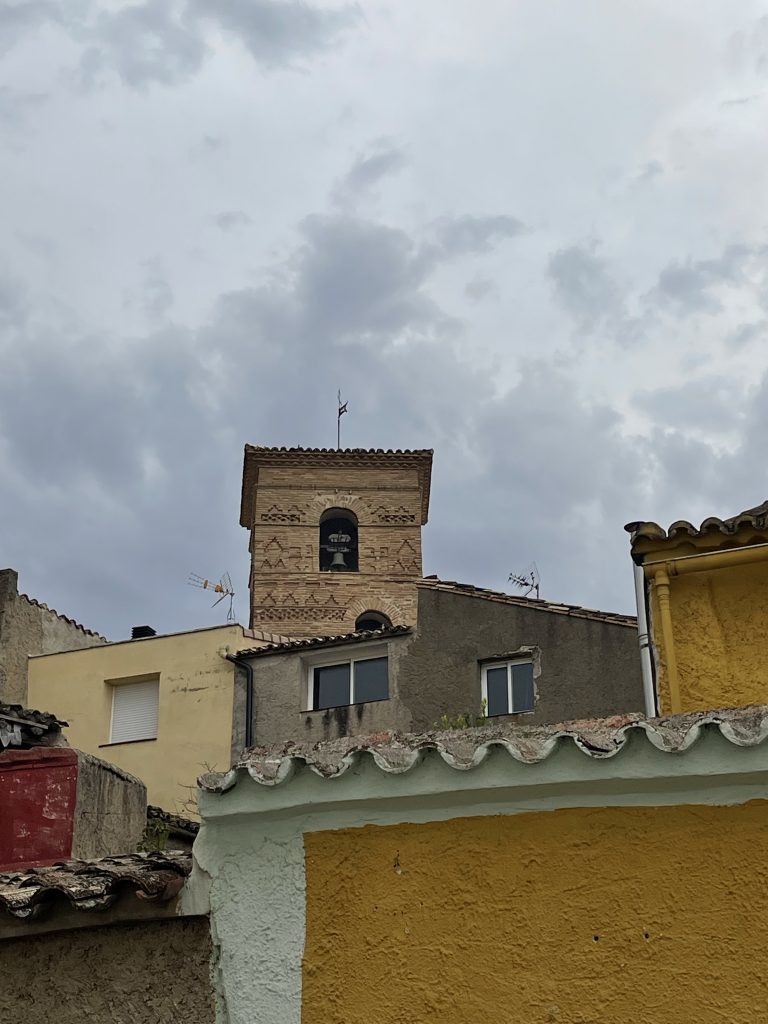
The vestiges of the medieval past in the town of Muel can be seen in different key points. One of them, the tower of the church of San Cristóbal, is the only Mudejar architectural element in the church. The current building corresponds to a work from the Baroque period.

Walking through its streets we can quickly appreciate the urban framework of Islamic tradition, with narrow, dead-end streets. In addition, the Puerta de la Villa or Mudejar Arch in the Calle Mayor still stands.

It is worth stopping along the way at the Parque de la Fuente, where, surrounded by an impressive natural setting, stands the Roman dam, which serves as the foundations of the hermitage of Nuestra Señora de la Fuente, an 18th century construction that houses wall paintings attributed to Fracisco de Goya.

Territorio Mudéjar Network

The city council has been a founding partner of Territorio Mudéjar since 2023.

More information

Town Hall: 976 140 001
muel.es

DO YOU WANT TO KNOW MORE?
Tourism Calatayud Region
turismodearagon.com
Tourism Campo de Cariñena Region
campodecarinena.es

Projects Territorio Mudéjar in Muel

Monumentos | Ver el proyecto
Pedagogía | Ver el proyecto
Proyecto Mudetrad | Ver el proyecto
Mudéjar didáctico, la guía | Ver el proyecto
“Circular” Paseos en familia | Ver el proyecto

Cariñena

Cariñena 1
Belmonte-01
Monuments
THIS PROJECT PROVIDES AN UPDATED VISION OF THE MUDEJAR MONUMENTAL HERITAGE
Belmonte-3049-baja
Pedagogy
SCHOOL MATERIALS TO WORK ON CULTURAL AND NATURAL HERITAGE
mudetrad-belmonte
Mudetrad Project
A PROJECT THAT HIGHLIGHTS THE TRADITIONAL ARCHITECTURE OF BELMONTE DE GRACIÁN
cartografia-identidades-rurales
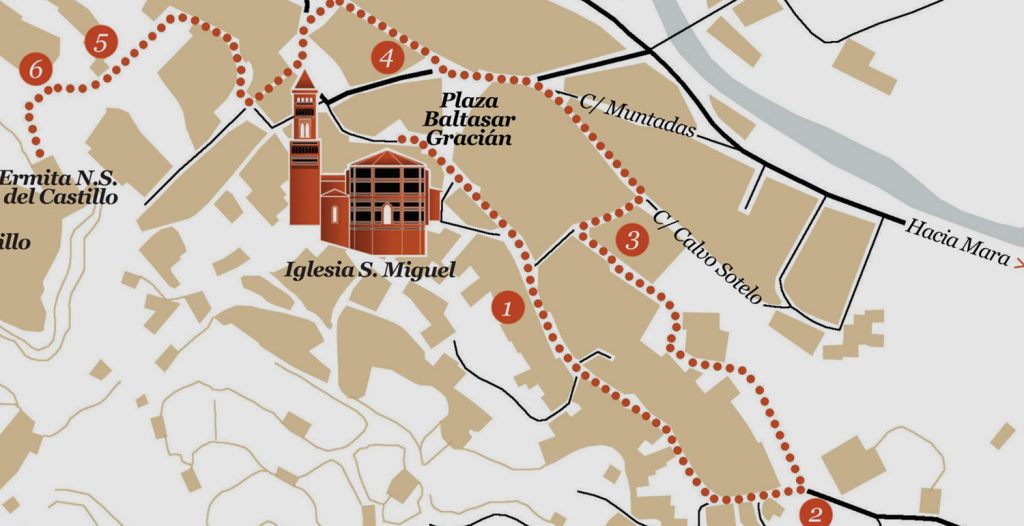
Cartography of Rural Identities
MAP OF THE TERRITORY THAT COLLECTS THE IDENTITY OF ITS INHABITANTS, HISTORY AND HERITAGE
La guía didáctica
Projects
IN TERRITORIO MUDEJAR WE ARE WORKING ON NEW PROJECTS
Cariñena 1
Cariñena 1

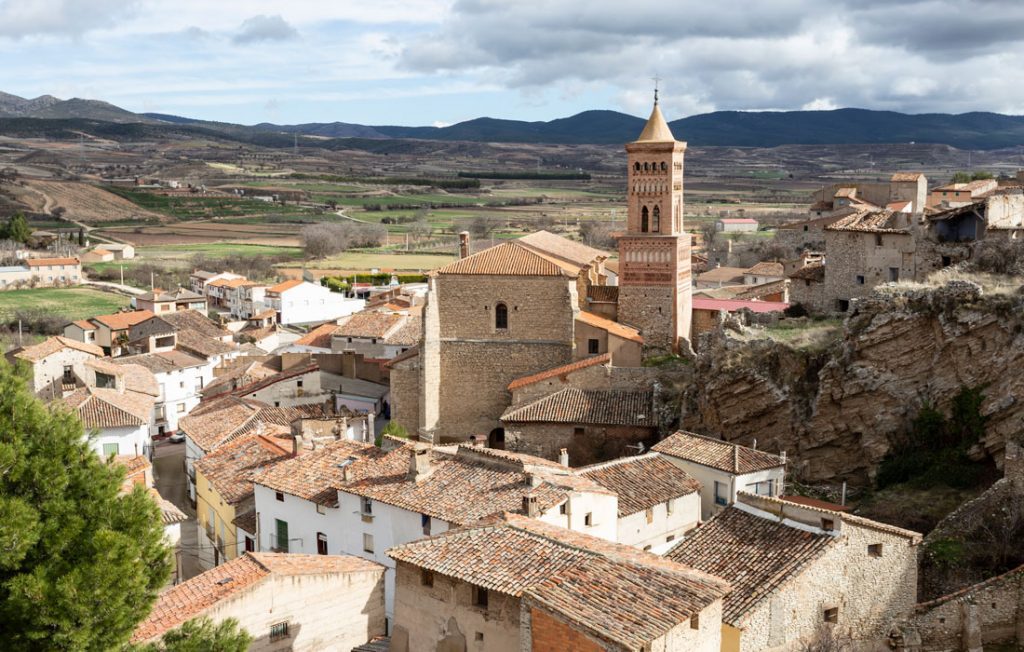
Heroic and Loyal

We can trace the historical past of Cariñena back to Roman times, when the place was called Cariniana. Since then, the town has been populated throughout history. As in the rest of the territory, the period of Islamic rule stands out, without which the Mudejar culture would never have been born.

During the Middle Ages, Cariñena was the scene of the War between the two Peters. Peter IV the Ceremonious, King of Aragon, ordered the old wall to be reinforced, although it did not serve to stop the troops of Peter I, King of Castile. The Torreón de las Monjas (Tower of the Nuns) stands out from the wall, a space that served as the Archive of the Community of Aldeas de Daroca until 1870.

The wall was completed by the towers of Las Santas, Calle Santiago and Las Sisas, which were demolished, as well as the tower of La Fuente, which was auctioned off.

As a testimony to its medieval past, Cariñena has a coat of arms, granted by the Aragonese king due to the resistance and loyalty of the inhabitants during that conflict.

During the modern period, Cariñena was home to a number of prominent figures who were connected with the monarchy, specifically with the House of Austria. Specifically, the visits of Philip II and Philip III to the town in the 16th century stand out.

Wine country

The link with wine in Cariñena can be traced back to the founding of the town in Roman times. The real importance of the cultivation and exploitation of vines can be found from the 18th century onwards, a time that corresponds to a demographic increase in the town. In the 19th century, everything related to wine grew strongly in Spain due to the phylloxera crisis in France.

The importance of wine in Cariñena was consolidated in 1932 with the creation of the DO, as well as with the strengthening of the cooperatives in the mid-20th century and the celebration of the Cariñena Protected Designation of Origin Harvest Festival (Festival of Tourist Interest in Aragon) since 1960. This festival has been updated over time, with the 75th anniversary celebration being the moment of creation of the guest of honour, who is in charge of lighting the Fuente de la Mora, from which wine flows.

Territorio Mudéjar Network

The city council is a founding partner of Territorio Mudéjar since 2023.

More information

Town Hall: 976 620 112

DO YOU WANT TO KNOW MORE?
Turismo de Aragón
turismodearagon.com
D.O Cariñena
elvinodelaspiedras.es

Projects Territorio Mudéjar in Cariñena

Mudetrad Project | View the project

Artistic residencies 2023-2024: Mudéjar pottery

Mudejar clay

The “Mudéjar Mud” project investigates the capacities of this material from its natural state to its manufacturing process and the elaboration of pieces for use or application in architecture.

Clay is the basis of Aragonese Mudejar construction, which, through its working process to achieve brick and glazed ceramics, become identifiers of our architecture and, therefore, shapers of our identity.

Using and investigating the quarries and the process of elaboration of the material, the project aims to establish certain conclusions about the constructive possibilities of the material and the differences and similarities that it has depending on the territory in which we find ourselves.

The localities in which work was carried out during the investigation were San Mateo de Gállego, Zuera, Villamayor de Gállego, Alagón, Fuentes de Ebro, Quinto, Torralba de Ribota, Aniñón, Sabiñán, Cervera de la Cañada, Ateca, Calatayud, Maluenda, Terrer, Belmonte de Gracián, Morata de Jiloca, Villafeliche, Mainar, Villarreal de Huerva and Tobed.

The methodology used begins with the search for quarries and locations where to extract the clay and pigments with which to work for the construction and decoration of the pieces, the analysis of plasticity of the samples “in situ”, the extraction of the most plastic clays and processing, the sieving and hydration of the clay, the test of plasticity, the firing to determine its deformation and porosity, the drafting of the conclusions of the analysis and the selection of the most suitable clays for the project, the construction of the pieces, the study of the most suitable clays for the construction of the pieces, the plasticity test, the firing to determine its deformation and porosity, the drawing up of the conclusions of the analysis and the selection of the most suitable clays for the project, the construction of the pieces, the study of the technique depending on the characteristics, which can be lathe, pinch, slabs or casting on moulds.

The expected results of this research process are intended to be reflected in the creation of a series of ceramic pieces inspired by Mudejar art.

The project’s objectives were as follows:

  • Use of local materials. Clays and pigments collected in the geographical area of the Mudejar territory.
  • To study the Mudejar heritage, analyse its forms and the patterns used, being the basis of inspiration for the creation of ceramic pieces.
  • To learn about other types of Mudejar and traditional ceramics existing in the localities.
  • Identify the existence of potteries, tile kilns or brick factories close to the villages where the construction material for their buildings and the ceramic elements that make them up may have come from.
  • Document testimonies of local craftsmen or people who may have worked in local potteries or tile kilns.
  • Involve local people in the search for sample locations.
  • Involve the local population in the activity “earth and colour walks”, so that they can learn about the process followed and the resources used.

LINE OF RESEARCH: New perspectives on Mudejar art.

AUTHOR: Javier Seral

Artistic residencies 2023-2024: Incorporate. On the vulnerable or how to flesh out knowledge.

Incorporate. On the vulnerable or how to flesh out knowledge.

The project “INCORPORE, de lo vulnerable o de cómo carnalizar el conocimiento”, is based on a dialogue between the body and the Mudejar heritage space, through dance, using different techniques and skills, dance/theatre, performative installation, creative writing, improvisation…

This project encompasses two parts, directly related to its objectives, which are: artistic creation, linked to and inspired by a territory (physical/emotional/imaginary/concrete), and dissemination, through creation, with a danced conference, which reflects the above, and through interaction with local populations, by means of open activities, which complete the research in the territory in order to not only access it as an object to observe, but as a subject with which to interact. To this end, the proposal includes a workshop and two dance walks that enable these relations of exchange of knowledge between people, physical spaces and common places.

In the project, the body becomes an active agent of observation through walks, contemplation, site-specific dance experiments, tasting of typical products, to achieve an approach to the psychology of the landscape, that is, to observe the behaviour of the environment and the processes that occur in it, in relation to what we understand as heritage, and which is identified in the form of monuments, urban layouts, natural environment and intangible culture.

The localities on which the project focused were mainly Calatayud, Daroca and Aniñón.

The work methodology is based on observing the environment to discover the possibilities offered by it, by means of walks, since, as it is a project for the body, it is very important to take the space to the body, to walk it, to walk through it, to draw it, to discover the weavings of the streets, the geographical features, the smells, to see the people who live in or pass through the spaces, to visualise the panoramic views.

She has had an important and constant phase of bodily preparation. In addition to walking, the author’s body was prepared with a series of exercises of different techniques – yoga, pilates, dance – breathing exercises and conscious movement, in order to keep the body open to stimulus and available to creativity.

Once the most suitable spaces for the project had been located, a series of movement practices were carried out in them.

The objectives and expected results of the project were as follows:

  • Creation of a series of video clips showing the narratives embroidered during the project, so that they can be a work of artistic dissemination inspired by the territory visited. These clips will form materials that can be projected in different spaces, as an exhibition, as a conference, as an installation, accompanied by panels with photographs and explanatory texts.
  • The creation of a performance piece based on all of the above.

LINE OF RESEARCH: New perspectives on Mudejar art.

AUTHOR: Patricia Álvarez

Research stays 2023-2024: Reading the Mudejar: Arabic inscriptions in Aragonese medieval churches (13th-15th c.)

New Perspectives on the Mudejar. Arabic inscriptions in medieval Aragonese churches (13th-15th century).

The project “New views on the Mudejar. Arab inscriptions in Aragonese medieval churches (13th-15th centuries)” project was born with a transcultural vocation and approach. Only in this way can the study of Arabic inscriptions in non-Islamic contexts contribute new and stimulating data to an ongoing line of research: that of artistic transfers between Al-Andalus and the Christian peninsular kingdoms.

With these premises in mind, the present project proposes to study the painted Arabic inscriptions preserved in medieval Aragonese sacred and funerary interiors, with special attention to those present on wooden roofs and choir windows between the end of the 13th century and the first half of the 15th century.

This chronological range is designed to answer certain questions: what Arabic formulas or mottos have survived over time? Why are certain eulogies and doxologies selected from the Andalusian epigraphic repertoire? What role did the Christian social elite play in this process of assimilation?

The localities and buildings to be analysed include the church of La Virgen de Tobed, the church of San Félix in Torralba de Ribota and the church of Santa María de Maluenda.

The methodology that will be applied to carry out the project will consist of bibliographic research and consultation of heritage archives such as the Mas Archive (Casa Ametller Barcelona), the General Administration Archive (Alcalá de Henares) and the Provincial Historical Archive of Zaragoza (state of the churches between the 19th and 20th centuries). It will be completed with a second phase of research stay for field work among the towns that make up the Mudejar Territory for the in situ study of their medieval wooden structures and Gothic paintings.

The expected results include the creation of an on-line and Open Access Digitorial, a virtual exhibition of immersive experience, programmed by professional computer scientists, which will integrate the texts and images generated in the research. It will include spin-off activities such as the communication of the research results in conference format, which could be complemented by on-site visits.

The project’s objectives were as follows:

  • To create a digitory of the Arabic inscriptions present in Aragon’s medieval artistic and historical heritage.
  • To provide a critical edition of these Arabic inscriptions (description of the monument, identification of the inscription, palaeographic description and transcription, bibliographical research).
  • Interrelating certain Arabic inscriptions with the presence of Muslim craftsmen and master builders documented in medieval Aragonese factories.
  • To dismantle certain historiographical clichés linked to the discourse on Mudejar art in the 19th and 20th centuries.
  • To bring the study of medieval epigraphy closer to the non-specialist public.

LINE OF RESEARCH: New perspectives on Mudejar art.

AUTHOR: Mar Valls

Research stays 2023-2024: New narratives on Mudejar heritage aimed at the public of knowledge and spiritual tourism in a global way.

New narratives about Mudejar heritage aimed at the public of knowledge and spiritual tourism in a global way.

Al Andalus is, in the contemporary Islamic world, a great cultural reference point. However, it is often identified with Andalusia, despite the great Islamic heritage spread throughout the peninsula.

The project seeks to make the Andalusian territory visible beyond the current autonomous community of Andalusia and, specifically, the great Mudejar and Moorish heritage of Aragon for the Muslim tourist, based on a new form of Knowledge Tourism, of higher quality, centred on heritage, its narratives, its history and its contemporary heritage.

The recent demand for this type of tourism on the part of Muslim tourists, as well as the appearance of new products, services and companies dedicated to it, means that this sector could become a mainstay of development for the towns that make up the Territorio Mudéjar Association.

Considering previous experiences and conclusions obtained from the project developed in 2022, it is proposed to carry out a communication project for the target audience (Muslim tourists and knowledge tourists). This involves generating narratives in an appropriate audiovisual language for subsequent dissemination on social networks and other media to inform the target audience about the heritage and tourism opportunities offered by Territorio Mudéjar.

The research stay was carried out in Calatayud, Morata de Jiloca, Torrellas and Tarazona.

The working methodology was based on field visits and on-site interviews, video recording and the generation of narratives.

The project’s objectives were as follows:

  • Generate narratives and audiovisual materials for dissemination, focusing on Mudejar Territory: heritage, landscape, people.
  • To disseminate and help to visualise Mudejar Territory as a Muslim-Friendly and Knowledge-Friendly tourist destination.
  • To raise awareness of the potential of Muslim Friendly Tourism among the population of the selected sites and tourist assets in the province.
  • Reinforce the presence of Territorio Mudéjar in dissemination channels such as Red de Medinas and Turespaña.
  • Reuse audiovisual materials (sounds, videos) already generated in previous projects and stays.

LINE OF RESEARCH: New perspectives on Mudejar art.

AUTHOR: Dr. Bárbara Ruiz Bejarano

Artist in residence 2023-2024: The wall as dermis. Light in the Mudejar II.

The wall as dermis. Light in the Mudéjar II

The project “The wall as dermis. Light in the Mudéjar II” is the second phase of a project of the same name, which studied the Mudéjar as a screen for the projection and manifestation of light as a vehicle for the manifestation of divinity.

On this occasion, the project has focused on the study of filtered light in sacred Mudejar spaces and its transcendence in space and time, an aspect that is approached from the point of view of artistic creation.

The documentation that has been handled from the philosophical, anthropological and art-historical point of view refers to studies carried out on Islamic architecture from the point of view of the traditional foundations that come into play, as well as the valuation of the sacred versus the profane and its expression on a general level, an approach that is applied to Mudejar art.

The intention of the project is to artistically demonstrate the materialisation of filtered light and its incidence on ornate Mudejar interior walls, how it evolves and manifests its ephemeral presence, where it is reflected and what symbolic meaning it holds, investigating various artistic possibilities that facilitate its understanding and experience; analysing the quality of the light and the materials that receive it, its incidence and presence, as well as the circumstances that lead to perceiving light as a reality suspended at a specific moment in time in the face of the hegemony of light.

The monument and the main location where the project is to be carried out is the church of the Virgen de Tobed.

The methodology is based on the observation of light, taking into account the variables of space and time and recording the evolution of the planes of light projection.

Subsequently, an audiovisual recording was made. The aim was to generate a documentary that would bear witness to the information on light variation at key moments in its development.

The project also addresses a public awareness and social function phase by using the project to carry out various activities.

The project’s objectives were as follows:

  • Experiencing the Mudejar by observing the light.
  • To value the use of contrast as a key to the creative process.
  • To use the cladding materials of Mudejar architecture in the priming and creation of the works.
  • To investigate with materials that generate material sensations similar to the original materials and to demonstrate their interaction with light.
  • Using the artistic gaze as a means of transmitting research and disseminating the territory.
  • To generate reflection on the spiritual and symbolic message of Mudejar architecture.
  • Introduce digital video documentaries and photographic images as a communication strategy.
  • Facilitate access to the knowledge and experience gained.

LINE OF RESEARCH: New perspectives on Mudejar art.

AUTHOR: Pilar García Verón

Conference to present Tarazona in the Territorio Mudéjar network

More than 70 people joined us today at the presentation conference of Tarazona in the Territorio Mudéjar Network, given by Victoria Trasobares, director of the association Territorio Mudéjar, accompanied by the Mayor, Antonio Jaray, and Pablo Escribano, Third Deputy Mayor, Delegate for Sports, Youth, Tourism and Seniors.

It has been a pleasure to tell you what we do and how we work with our partner municipalities.

We have also inaugurated the exhibition “Mudejar: the guide” with a guided tour by Eugenia Gallego, from the Territorio Mudejar team.

The exhibition will be open until 6 October on Fridays and Saturdays from 18:00 to 20:00 and Sundays from 12:00 to 14:00.

More than 70 World Heritage managers share experiences at the XVIII World Heritage Managers Meeting in Antequera

Territorio Mudéjar travels to Antequera (Málaga) to attend the 18th Meeting of World Heritage Managers. The director of Territorio Mudéjar, Victoria Trasobares, participates in this technical forum that the Ministry of Culture organises annually to promote the meeting, analysis and discussion of the problems that managers of sites inscribed on the World Heritage List encounter on a daily basis.

Its aim is to improve the conservation of these assets and to create a network of contacts between all the managers working on these assets, in order to share experiences, address challenges and find common solutions.

The meeting will be held until 26 June with activities both in the Museum of the City of Antequera and in the headquarters of the Royal Academy of Noble Arts, as well as in Antequera Town Hall, where the official reception was held this afternoon.

The meeting was opened by the Mayor of Antequera, Manolo Barón; the Deputy Mayor for Tourism and World Heritage, Ana Cebrián; the Councillor for Culture and Heritage, José Medina; the Deputy Director General for the Management and Coordination of Cultural Heritage, María Agúndez; Miriam Ugarte, from the UNESCO Conventions Department of the Ministry of Culture; Carmen Mora, Director of the Dólmenes de Antequera Archaeological Site; Alicia Castillo, lecturer at the Complutense University of Madrid;

During their stay, participants have the opportunity to visit the main monuments of the city such as the Dolmens, the Torcal, the Alcazaba and the Royal Collegiate Church of Santa Maria.

In total, more than 70 World Heritage managers are sharing experiences in this XVIII Meeting of World Heritage Managers in Antequera.

In the first workshop on social participation and world heritage we exchanged ideas on how to work on the uses of the space between the dolmens and the polygon.

We continued with a visit to the Museo de la Ciudad (MVCA), the Museo Sitio Dólmenes de Antequera and the Alcazaba.

The World Heritage Managers Meeting ended after a session on the evaluation of visitors to the Antequera Dolmens World Heritage Site and the presentation of the conclusions on social participation as the key to a management focused on people, on the inhabitants of the heritage.

On the last day, the director of Territorio Mudéjar, Victoria Trasobares, participated as coordinator of the working group “Dolmen Museum, inhabitants and visitors. Analysis and diagnosis of needs” together with the directors and managers of the sites: Menorca Talayotica (Consell de Menorca), Colonia Guell (Consortium), Risco Caido and the sacred mountains of Gran Canaria and the Historic Sanctuary of Machu Pichu in Cuzco (Peru).

Castejón de Valdejasa

Castejón de Valdejasa
Pedagogy
SCHOOL MATERIALS TO WORK ON CULTURAL AND NATURAL HERITAGE
Castejón de Valdejasa Mudetrad
Mudetrad Project
A PROJECT THAT HIGHLIGHTS THE TRADITIONAL ARCHITECTURE OF CASTEJÓN DE VALDEJASA
La guía didáctica
Didactic Mudejar, the guide
PRODUCTION OF AN EDUCATIONAL MATERIAL FOR PRIMARY AND SECONDARY SCHOOL PUPILS TO HELP THEM INTERPRET THE MUDEJAR STYLE
Castejón de Valdejasa Circular
Circular from the rural school
COOPERATIVE PROJECT BETWEEN RURAL DEVELOPMENT GROUPS
Castejón de Valdejasa

Around a Roman Road

Castejón de Valdejasa is located in the region of Cinco Villas, 45 kilometres from Zaragoza. En origen, una calzada romana transcurría por este lugar, uniendo Caesaraugusta (Saragossa) y Pompaelo (Pamplona). This place was also a Celtiberian settlement, as attested by the archaeological remains of a settlement on one of its hills.

One of the first documentary references to the locality is in the Town Charter of Ejea at the beginning of the 12th century. It was precisely during this period that cultural coexistence between Christians, Muslims and Jews was experienced in the territory. One of the examples of the Mudejar past is the church of Santa María la Mayor, dating from the late 14th and early 15th centuries. Today the Mudejar work is masked by an intervention carried out in the 20th century.

In Castejón de Valdejasa there are still some cellars that have been excavated taking advantage of the natural unevenness of the clayey terrain, with masonry fronts. Nowadays they have been adapted as meeting places, being a very picturesque place that you should not miss. There are also important examples of 16th and 17th century architecture such as the House of the Inquisition.

Castejón de Valdejasa is located in the region of Cinco Villas, 45 kilometres from Zaragoza. En origen, una calzada romana transcurría por este lugar, uniendo Caesaraugusta (Saragossa) y Pompaelo (Pamplona). This place was also a Celtiberian settlement, as attested by the archaeological remains of a settlement on one of its hills.

One of the first documentary references to the locality is in the Town Charter of Ejea at the beginning of the 12th century. It was precisely during this period that cultural coexistence between Christians, Muslims and Jews was experienced in the territory. One of the examples of the Mudejar past is the church of Santa María la Mayor, dating from the late 14th and early 15th centuries. Today the Mudejar work is masked by an intervention carried out in the 20th century.

In Castejón de Valdejasa there are still some cellars that have been excavated taking advantage of the natural unevenness of the clayey terrain, with masonry fronts. Nowadays they have been adapted as meeting places, being a very picturesque place that you should not miss. There are also important examples of 16th and 17th century architecture such as the House of the Inquisition.

Escabechado, a culinary delicacy

After visiting the main monuments mentioned above, ending with the incredible panoramic view of the town and the landscape from the Santa Ana hermitage, you can’t miss its star dish: escabechado (pickled fish).

Pickling is a traditional way of preserving food. The recipe goes back a long way and has been passed down from generation to generation, with each house having its own recipe. Castejón de Valdejasa has become famous thanks to the publicity provided by the town council, with activities such as the “Feria del Conejo Escabechado”, among others.

Castejón de Valdejasa also has many routes to do on foot or by bicycle along its extensive mountain, whose vegetation is mainly reforestation pine.

After visiting the main monuments mentioned above, and finishing with the incredible panoramic views of the city and the surrounding countryside from the hermitage of Santa Ana, don’t miss its star dish: escabechado (pickled fish).

Pickling is a traditional way of preserving food. The recipe goes back a long way and has been passed down from generation to generation, with each house having its own recipe. Castejón de Valdejasa has become famous thanks to the publicity provided by the town council, with activities such as the “Feria del Conejo Escabechado”, among others.

Castejón de Valdejasa also has many routes to do on foot or by bicycle along its extensive mountain, whose vegetation is mainly reforestation pine.

Information

City Council: 976 68 60 57

Association for the Development and Promotion of Cinco Villas
adefo.com

VISIT TO CASTEJÓN DE VALDEJASA
976 633 296

DO YOU WANT TO KNOW MORE?
Region of Cinco Villas
https://www.comarcacincovillas.es/
Tourism Castejón de Valdejasa
https://castejonvaldejasaturismo.es/

Territorio Mudéjar Network

The city council has been a full member of Territorio Mudéjar since April 2021.

Projects Territorio Mudéjar in Castejón de Valdejasa

Pedagogy| View the project
Mudetrad Project | View the project
Didactic Mudejar, the guide | View the project
“Circular” Family Outings | View the project