Bi-annual technical meeting of the Alliance of Cultural Landscapes and Related Sites in Talayónica Menorca

Territorio Mudéjar participated in the technical workshops of the Alliance of Cultural Landscapes and Related Sites, held in Menorca Talayónica, from March 10 to 12.

Maru Gallego, from the TM team, has traveled to the World Heritage site since 2023 to participate in the meeting on Communicating World Heritage Properties: Interpretive and Outreach Resources to Connect with Society. This event brings together experts in heritage, communication, and outreach to discuss the best strategies for conveying the value of sites inscribed on the World Heritage List.

This event, which combines theoretical sessions with field experiences, aims to share experiences of initiatives aimed at strengthening the connection between heritage and society through the use of tools and methodologies that facilitate its interpretation and understanding by the public.

This biannual technical meeting of the Landscape Alliance included an intense day of conferences and visits to representative sites in Menorca, such as the Naveta des Tudons, the Ciutadella-Can Saura Museum, and the Numa Foundation.

We heard Pablo Jiménez Díaz, from the Ministry of Culture, discuss the different approaches to communicating World Heritage; Celia Martínez Yáñez of ICOMOS International speak about heritage law and regulation; we learned about a benchmark heritage education program from the San Millán de la Cogolla Foundation; and we learned about practical cases of heritage dissemination, such as the experience of the Madinat al Zahra Archaeological Complex, the educational project in the Sierra de Tramuntana, and the initiatives of Talayotic Menorca aimed at the local community.

23rd anniversary of the declaration of the churches of Tobed, Cervera de la Cañada, and the collegiate church of Calatayud as World Heritage Sites

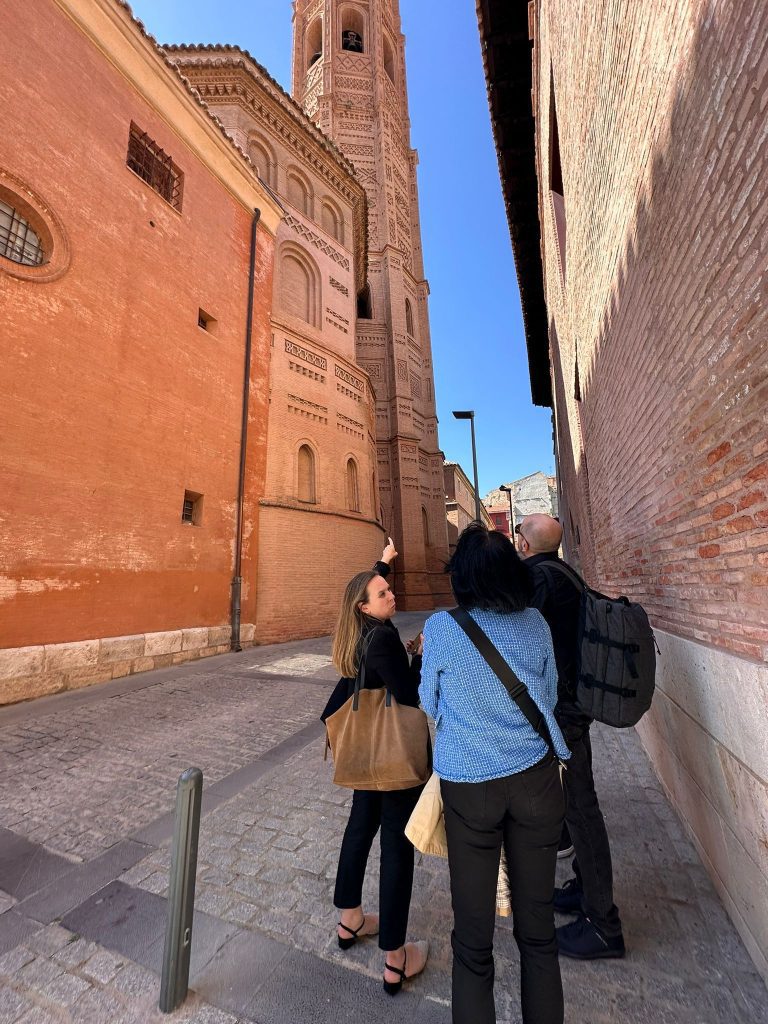
Guía señalando elementos arquitectónicos en la portada de una iglesia mudéjar durante la celebración del XXIII aniversario del Patrimonio Mundial.

On this day, 23 years ago, and after almost two years of work, the Church of the Virgin of Tobed, Santa Tecla in Cervera de la Cañada, the Collegiate Church of Santa María in Calatayud, La Seo, San Pablo and the Aljafería in Zaragoza were added to the list of sites highlighted by UNESCO as sites of outstanding universal value in the declaration of the Mudejar Architecture of Aragon as a UNESCO World Heritage Site.

The extension of the declaration to the province of Zaragoza highlighted the territorial nature of a style in which history, art, materials, landscape, traditions, and people are key.

We want to congratulate all those who work for this heritage and for their knowledge, undoubtedly the most powerful tool for its preventive conservation.

And, above all, thanks to the inhabitants who maintain these heritage sites, guarantors of this rich legacy we have inherited.

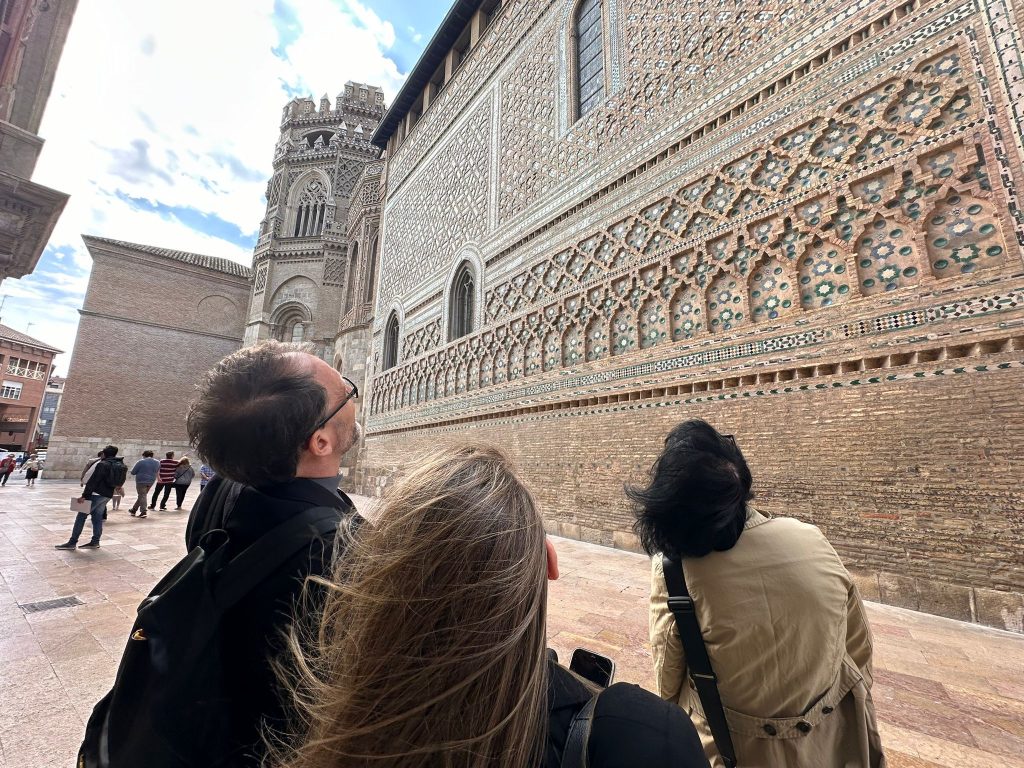
From Territorio Mudéjar, we celebrated this date today with the Mudéjar World Heritage Route, visiting the Collegiate Church of Santa María de Calatayud, the Church of Santa Tecla de Cervera de la Cañada, and the Church of the Virgin of Tobed, churches that reveal the paradigms of the style that holds the UNESCO World Heritage status. We also did so with live painting sessions by artist and researcher Pilar García Verón, who is part of the Territorio Mudéjar research network.

Specifically, on Tuesday, we will hold a meeting of researchers from the Territorio Mudéjar network with those responsible for many of the nearly fifty projects launched by this organization since its founding.

More than 70 World Heritage managers share experiences at the XVIII World Heritage Managers Meeting in Antequera

Territorio Mudéjar travels to Antequera (Málaga) to attend the 18th Meeting of World Heritage Managers. The director of Territorio Mudéjar, Victoria Trasobares, participates in this technical forum that the Ministry of Culture organises annually to promote the meeting, analysis and discussion of the problems that managers of sites inscribed on the World Heritage List encounter on a daily basis.

Its aim is to improve the conservation of these assets and to create a network of contacts between all the managers working on these assets, in order to share experiences, address challenges and find common solutions.

The meeting will be held until 26 June with activities both in the Museum of the City of Antequera and in the headquarters of the Royal Academy of Noble Arts, as well as in Antequera Town Hall, where the official reception was held this afternoon.

The meeting was opened by the Mayor of Antequera, Manolo Barón; the Deputy Mayor for Tourism and World Heritage, Ana Cebrián; the Councillor for Culture and Heritage, José Medina; the Deputy Director General for the Management and Coordination of Cultural Heritage, María Agúndez; Miriam Ugarte, from the UNESCO Conventions Department of the Ministry of Culture; Carmen Mora, Director of the Dólmenes de Antequera Archaeological Site; Alicia Castillo, lecturer at the Complutense University of Madrid;

During their stay, participants have the opportunity to visit the main monuments of the city such as the Dolmens, the Torcal, the Alcazaba and the Royal Collegiate Church of Santa Maria.

In total, more than 70 World Heritage managers are sharing experiences in this XVIII Meeting of World Heritage Managers in Antequera.

In the first workshop on social participation and world heritage we exchanged ideas on how to work on the uses of the space between the dolmens and the polygon.

We continued with a visit to the Museo de la Ciudad (MVCA), the Museo Sitio Dólmenes de Antequera and the Alcazaba.

The World Heritage Managers Meeting ended after a session on the evaluation of visitors to the Antequera Dolmens World Heritage Site and the presentation of the conclusions on social participation as the key to a management focused on people, on the inhabitants of the heritage.

On the last day, the director of Territorio Mudéjar, Victoria Trasobares, participated as coordinator of the working group “Dolmen Museum, inhabitants and visitors. Analysis and diagnosis of needs” together with the directors and managers of the sites: Menorca Talayotica (Consell de Menorca), Colonia Guell (Consortium), Risco Caido and the sacred mountains of Gran Canaria and the Historic Sanctuary of Machu Pichu in Cuzco (Peru).

Territorio Mudéjar concludes the first phase of the preliminary study to draw up a Management Plan for Mudéjar Architecture in Aragon as a World Heritage Site.

Territorio Mudéjar has completed the first phase of the preliminary studies for the drafting of the management plan for the Mudejar architecture of Aragon as a UNESCO World Heritage Site. In this phase of the project, which is funded by the Ministry of Culture*, working groups have been held with the different stakeholders, field visits and working meetings with a full list of collaborators.

Territorio Mudéjar is responsible for the development and drafting of the study and diagnostic work necessary for the drafting of the Management Plan for the Mudéjar Architecture of Aragon property. The aim is to have an instrument that will enable all areas of management to be addressed in a comprehensive, sustainable and effective manner: protection, preservation, research, dissemination and territorial and social impact.

The work of Territorio Mudéjar has included the creation of working groups by areas of work that have enabled the analysis, diagnosis and drafting of preliminary documents to compose the management plan.

In this sense, the organisation has held a round of meetings with the different actors involved: managers, town councils and competent administrations.

As an example, an initial meeting-visit was held at the beginning of February in the church of San Pablo (Zaragoza), followed by another analysis and diagnosis visit. In these meetings, the parish and Sergio García, head of management, collaborated.

Two meetings were held in La Seo: an initial working group and a diagnostic one, in which Daniel Granada, canon of La Seo and of the Cabildo and parish priest of La Seo, took part.

In Calatayud, the meetings were held with José Manuel Gimeno as representative of the City Council and with Salvador Esteras, technical expert.

In Cervera de la Cañada there have been meetings with the town and parish councils. In addition.

In the case of Tobed, work has been carried out with the Town Council’s management team through the Mahoma Calahorrí Museum.

There has also been a meeting with the Directorate General for Patrimony and a round table with the heads of service of this directorate.

In April, a European visit-meeting was organised in Calatayud, Tobed and Cervera de la Cañada with a team from the University of Zaragoza, the Politecnico di Torino and the Politecnico di Milano.

In addition, there have been meetings with ZaragozaCity Council, the Diocese of Tarazona and the different interlocutors of the Administration.

There have also been technical visits. For example, one of them, held in April, was attended by participants at European level, specifically from the Politecnico di Torino.

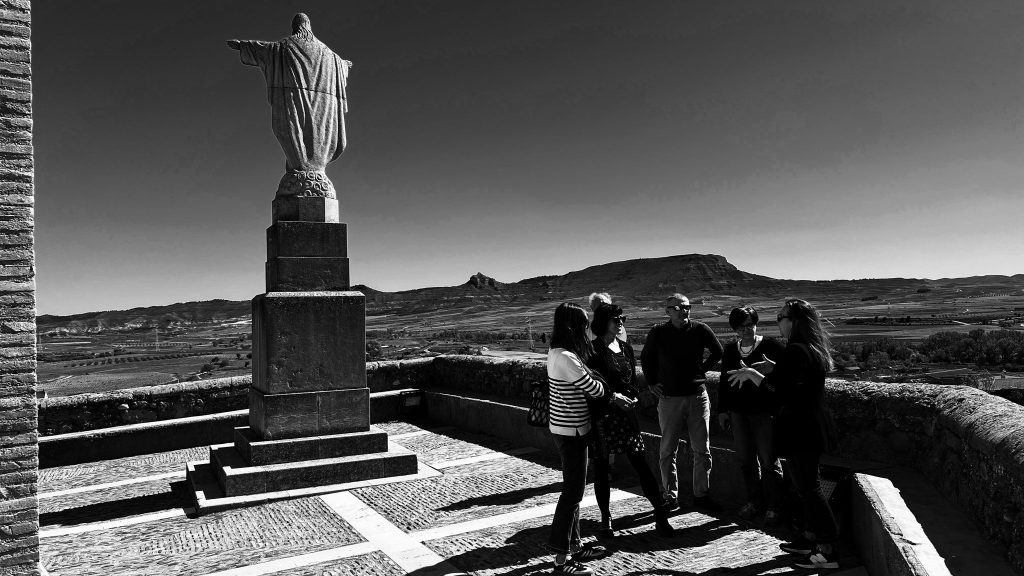
In addition, some of the issues diagnosed and worked on during these months were presented at the technical conference of the Alliance of Cultural Landscapes and Related Places held on 25 and 26 April in Tobed, Cervera de la Cañada and Calatayud. This issue was presented as part of the knowledge of the host property.

LIST OF COLLABORATORS:

During this first phase of the project , the collaboration of:

Area of collaboration: State of the art in terms of research.

Esteban Sarasa Sánchez. PhD in Philosophy and Letters (History) from the University of Zaragoza, professor emeritus and director of the J. Zurita Chair of History at the Fernando el Católico Institution in Zaragoza.

Mar Vals Fusté. PhD in History from the Rovira i Virgili University and researcher on the Territorio Mudéjar project “Reading the Mudejar: Arabic inscriptions in medieval Aragonese churches (13th-15th centuries). Based on this stay and her speciality in Art History from the inscriptions, she has collaborated in approaching the monument as a document.

Ascensión Hernández. Professor in the Department of Art History at the University of Zaragoza. She has collaborated on the state of the question of the authenticity criticism of buildings declared World Heritage, taking as a reference the work carried out on the parish church of La Seo a few years ago.

Luis Alberto Longares. PhD in Geography and lecturer in the Department of Geography and Territorial Planning at the University of Zaragoza. The area of collaboration has been the palaeoenvironmental evolution of the landscape and its knowledge for a correct management of the environment.

José Castillo Ruiz. Professor of Art History at the University of Granada. He contributes from the point of view of agrarian heritage, that is, how people have intervened in the landscape in which the monuments declared World Heritage by UNESCO are contextualised.

Area of collaboration: building management

Daniel Granada, secretary of the Cabildo de La Seo and parish priest of the parish of La Seo, and Sergio Blanco, heritage delegate of the Diocese of Zaragoza and manager at San Pablo.

Jesús Vicente Bueno, abbot of the Collegiate Church of Calatayud and heritage delegate of the Diocese of Tarazona.

Pedro Luis Hernando, professor of art history at the University of Zaragoza in Teruel and heritage delegate of the Diocese of Teruel-Albarracín.

Victoria Trasobares Ruiz, Director of Territorio Mudéjar and art historian. Manager of Tobed Mudéjar.

Working groups were held with them to analyse and diagnose aspects to be taken into account for the diagnosis of management, the state of conservation, the state of research, signposting and dissemination.

Area of collaboration: Dissemination

Irene Ruiz Bazán, professor at the Politecnico di Torino; Gianluca Vita, professor at the Fine Arts Academy of Urbino in the Department of Applied Heritage Technologies, have collaborated on digitisation strategies applied to diagnosis, dissemination and communication.

Patricia Ciria. Multimedia journalist specialising in strategic communication and marketing. She has collaborated in the diagnosis of communication, audience analysis, positioning and strategic lines of communication.

Estudio Mique. Graphic design studio specialising in branding, logos, labels, packaging, advertising and communication. He has collaborated in the analysis of branding and signage analysis of the Mudejar architecture of Aragon.

European meeting-visit to advance in the preliminary study of the management plan for the Mudejar Architecture of Aragon.

The Alliance of Cultural Landscapes and Related World Heritage Sites has held its biannual assembly in several towns of Territorio Mudéjar: Calatayud, Cervera de la Cañada and Tobed. The assembly included a technical conference for members organised around the theme “Cultural landscape and management plans for UNESCO World Heritage sites”, which was attended by speakers and members from Spain, Andorra, Portugal and Italy. On this occasion, Territorio Mudéjar organised a European meeting-visit in Calatayud, Tobed and Cervera de la Cañada with a team from the University of Zaragoza, the Politecnico di Torino and the Politecnico di Milano, which has served to advance the preliminary study for the drafting of a management plan for the Mudéjar Architecture of Aragon.

* This project of Territorio Mudéjar has been selected in the 2023 call for grants for projects for the conservation and dissemination of World Heritage properties of the Ministry of Culture and Sport. Territorio Mudéjar is thus part of a group of more than 20 Spanish organisations working to promote and improve the application of the World Heritage Convention and its guidelines. These grants are financed by the Ministry of Culture and aim to promote the development of projects for the management, protection and conservation of these assets, as well as to promote their accessibility, visibility and dissemination at national and international level.

Territorio Mudéjar is leading the preliminary work to draw up the Management Plan for Mudéjar Architecture in Aragon as a UNESCO World Heritage Site.

Today we celebrate the 22nd anniversary of the declaration of the Mudejar Architecture of Aragon as a UNESCO World Heritage Site with an important announcement: the Mudejar Territory team, led by Victoria Trasobares, is going to carry out the necessary preliminary work for the drafting, in the medium term, of the Management Plan for the “Mudejar Architecture of Aragon” as a UNESCO World Heritage Site.

Our project has been selected in the 2023 call for grants for projects for the conservation and dissemination of World Heritage properties of the Ministry of Culture and Sport. We will thus form part of a group of more than 20 Spanish organisations that will be working over the coming months to promote and improve the application of the World Heritage Convention and its guidelines.

These grants are financed by the Ministry of Culture and are intended to encourage the development of projects for the management, protection and conservation of these assets, as well as to promote their accessibility, visibility and dissemination at national and international level. In addition, one of the specific objectives this year, in line with the Mudejar Territory project, was to work on management plans in order to have an instrument that would enable all areas of management, protection, research, dissemination and territorial and social impact to be addressed in a comprehensive, sustainable and effective manner.

This work will begin with a diagnosis of the state of conservation of the assets, the instruments for their protection, their management and their signposting and dissemination. In addition, working groups will be set up with the institutions involved, with a strong focus on the territorial impact. The project will be developed through technical visits and field work.

We also continue to work in the territory with technical visits, such as those in December in Cervera de la Cañada and Tobed, to carry out one of our most important actions: professional technical advice to partner town councils on aspects of management, custody and conservation of our Mudejar heritage.

*This project is part of the 2023 grants for projects for the conservation, protection and dissemination of World Heritage properties of the call of the Directorate General of Fine Arts, Ministry of Culture.

New MOMAr meeting on best practices in heritage management

Would you like to work with educational materials related to the Mudejar identity of the villages in the classroom? Do you understand the heritage space as an innovative learning space?

In the coming weeks the first action of the project “Rural school in motion” (Circular desde la escuela rural) will begin, an introductory course to the project in which Territorio Mudéjar offers to those interested in linking education, heritage and innovation to know the starting point and the methodology with which it will work until mid 2022 together with seven of the local development groups in the province of Zaragoza coordinated by the ADRI Calatayud Aranda group.

“Rural school in motion” is a cooperation project between rural development groups coordinated by the ADRI Calatayud-Aranda group, together with Cedemar, Adefo Cinco Villas, Asomo Moncayo, Adrae Comarca Alta del Ebro, Fedivalca y Adri Jiloca Gallocanta, and financed by the Government of Aragon through the Leader programme and the Provincial Council of Zaragoza through the Territorio Mudéjar association, as a private collaborating entity that manages the implementation and execution of the initiative.

The aim is to develop educational materials related to the Mudejar identity of the villages, placing rural schools and the educational community of the villages at the centre of the project, with a triple purpose:

◾️To work on the introduction of the Mudejar heritage identity in the work programmes of schools beyond the artistic or complementary areas. ◾️To involve the educational community in the valuation of Mudejar heritage as part of their personal history, which favours the knowledge, conservation and dissemination of the identity of the towns. ◾️To use the work carried out in schools as material for dissemination and tourist use on the Mudejar heritage of the villages for family and children audiences.

🔺In the COURSE we will explain the working methodology and the results of the pilot project that was carried out in the CRA Vicort Isuela during the 2018-2019 academic year and which is the starting point for the implementation of the project in the schools of the villages of Territorio Mudéjar.

It will be taught by Laura Castejón and Víctor Gumiel, teachers who carried out the design and testing of the pilot project, and Victoria E. Trasobares, director of Territorio Mudéjar who has extensive experience in the management and implementation of Mudejar heritage management projects in rural areas.

The Department of Education has included it as an approved course in its catalogue of ongoing teacher training activities and recognises the training hours.

The course will be carried out on-line through the entity’s digital work platform that we will set up for the specific training.

Information about the course:  https://mcusercontent.com/395a3a370852ce9982369da41/files/c70fb223-f20d-4813-be10-3e7c3b7c3597/CURSO_CIRCULAR.pdf?fbclid=IwAR2ih0BoCjstPS3ueZ4pTuAGNtXDsPSmKjdEUOQ2s-Zd8UkRFONZ-xijwE4

Application form: Option 1: If you have a digital certificate or signature https://doceo.catedu.es/epgfp/portada Option 2: If you do not have a digital certificate or signature, write a message to: info@territoriomudejar.es

Information about the project:  https://mcusercontent.com/395a3a370852ce9982369da41/files/9591a2e9-2ee5-4ea0-bc3b-72947d2bbd3e/PROYECTO_CIRCULAR.pdf?fbclid=IwAR1iiN-Cw1NR7dgSk0_7lKDKLsd2_7lgBLF3JG6XL1CBHiyJ0G15-02DMKg

If you have any doubts or you want to consult us about any particular issue you can call us on 876 634 125 or write an email to info@territoriomudejar.es

Rural school in motion: bringing Mudejar heritage to the classroom.

We are never lazy to go back to school, especially if we do it to talk about how to bring the Mudejar heritage closer to future generations.

Over the last few months we have been working with the teams from schools such as CEIP Maestro Monreal in Ricla, CEIP Virgen de la Peana in Ateca, CEIP Fernando el Católico in Villarreal de Huerva, CEIP Santa Ana in Mainar, CRA Río Ribota (Aniñón, Cervera de la Cañada, Torralba de Ribota, Villarroya de la Sierra) and CEIP Fernando el Católico in Quinto to develop our Circular desde la escuela rural (Rural School in motion) programme. And we continue to move forward in the next phase and to expand this network.

It is clear to us that the rural school is a fundamental agent for the durability of links with places. As the director of Territorio Mudéjar, Victoria Trasobares, explains: “It means working from the foundations and with a medium-long term vision given that it allows us a double objective. On the one hand, to work on consolidating the school, and above all the teachers, as an active agent of quality. A measurable objective of this would be to increase the degree of reinforcement of the teaching teams. Education professionals who choose the rural school as their life project”.

On the other hand, she adds: “Working on local pride and rootedness, the rural school must be able to educate individuals with analytical skills and this can only be achieved by giving possibilities of knowledge, so that the villages unfold their full potential as a space for active learning and become a possible vital option for the future”.

Circular desde la escuela rural (Rural School in motion) is a cooperation project between rural development groups coordinated by the ADRI Calatayud-Aranda group, together with Cedemar, Adefo Cinco Villas, Asomo Moncayo, Adrae Comarca Ribera Alta del Ebro, Fedivalca and Adri Jiloca Gallocanta, and financed by the Government of Aragon, from the Leader programme, and the Provincial Council of Zaragoza through the association Territorio Mudéjar, as a private collaborating entity that manages the implementation and execution of the initiative.

Meeting of researchers to commemorate the 20th anniversary of the declaration of the Mudejar as World Heritage

Territorio Mudéjar has commemorated today the 20th anniversary of the declaration as World Heritage with a meeting of researchers that has been held in Tobed and that has brought together those responsible for many of the more than 30 projects launched by this entity since its founding.

The aim of these initiatives is to deepen the knowledge of Mudejar art from different perspectives and to generate and promote local development projects based on Mudejar heritage resources: construction materials, popular architecture and its conservation, relationship between Mudejar and agricultural heritage, podcast to learn about the territory, guide to historic Mudejar carpentry, models of cultural management and restoration projects, educational materials to interpret the Mudejar in primary and secondary schools, plastic studies on Mudejar geometry, Mudejar art in the performing arts (music, dance and minstrelsy), digital inventories and virtual reconstruction of Mudejar buildings or maps of the territory through memories and emotions to broaden the view of what it means to be Mudejar…

20th anniversary of the declaration of the Zaragoza Mudejar as World Heritage

Territorio Mudéjar and the Council of Zaragoza are celebrating today the 20th anniversary of the declaration of the Zaragoza Mudejar as World Heritage. On 14th December 2001, just two decades ago, UNESCO included six Mudejar monuments in the province of Zaragoza on its World Heritage List, thus extending the maximum recognition it had given 15 years earlier to the Mudejar of Teruel.

“The declaration of our Mudejar as World Heritage was a fundamental milestone that boosted the promotion, dissemination and international recognition of a genuinely Hispanic style in which Aragon, in general, and the province of Zaragoza, in particular, stand out as an artistic focus”, stresses the president of the Zaragoza Provincial Council and of Territorio Mudéjar, Juan Antonio Sánchez Quero. “That is why Territorio Mudéjar, the association of municipalities promoted by the Provincial Council, has spent months commemorating the 20th anniversary of an event that we will continue to celebrate throughout 2022 with an intense programme of activities aimed at both the general population and a more specialised public”.

The importance and scope of the Mudejar

The six Mudejar monuments in Zaragoza recognised as World Heritage by UNESCO are the apse, cloister and tower of the collegiate church of Santa María de Calatayud; the church of Santa Tecla de Cervera de la Cañada; the church of Santa María de Tobed; the Mudejar remains of the Aljafería palace; the tower and church of San Pablo de Zaragoza; and the apse, the Parroquieta and the dome of La Seo cathedral of Zaragoza. However, the uniqueness and scope of this style extends to more than a hundred examples of heritage in dozens of Zaragoza municipalities, so that Mudejar is present in 85% of the province’s territory.

“Mudejar is usually spoken of as Christian architecture carried out by the Mudejars, i.e. the Muslims who remained in the territory conquered by Christian power. However, the reality is that we are dealing with a much more complex phenomenon that has its roots in the arrival of the Islamic tradition in the Iberian Peninsula since the 8th century and whose influences took on their own form in the Christian era between the 13th and 16th centuries”, explains the director of Territorio Mudéjar, Victoria Trasobares. “The Mudejar is an encounter between Islamic and Christian art, the result of the coexistence of cultures in medieval Spain. An art that represents the most genuine artistic manifestation of Spain and that has in Aragon, a land of frontiers and a melting pot of cultures, its greatest exponent”, says this expert in cultural and heritage management.

Today’s activities

Territorio Mudéjar is commemorating the 20th anniversary of its declaration as World Heritage today with a meeting of researchers to be held in Tobed, bringing together those responsible for many of the more than 30 projects launched by this organisation since its foundation. The aim of these initiatives is to deepen the knowledge of Mudejar art from different perspectives and to generate and promote local development projects based on Mudejar heritage resources: construction materials, popular architecture and its conservation, relationship between Mudejar and agricultural heritage, podcast to learn about the territory, guide to historic Mudejar carpentry, models of cultural management and restoration projects, educational materials to interpret the Mudejar in primary and secondary schools, plastic studies on Mudejar geometry, Mudejar art in the performing arts (music, dance and minstrelsy), digital inventories and virtual reconstruction of Mudejar buildings or maps of the territory through memories and emotions to broaden the view of what it means to be Mudejar…

In addition, this evening the radio programme La Brújula Aragón on Onda Cero will dedicate a special monographic programme to the Zaragoza Mudejar which can be heard from 19.20 onwards and which, among many other contents, will deal with the project ‘Territorio Mudéjar Intelligent Signposting’, which will bring together all the contents created over the last three years by Territorio Mudéjar to put them at the service of the inhabitants of the municipalities, visitors and knowledge of the heritage in situ linked to renowned international projects.

Promotional campaign and other commemorations

On the other hand, the Council of Zaragoza has just launched a publicity campaign on the occasion of the anniversary of the UNESCO declaration. Under the slogan ‘Zaragoza, Mudejar province: come and meet yourself’, the campaign vindicates the importance and potential of this unique heritage that is an engine of development for the territory and that also forms part of the identity of the inhabitants of the province of Zaragoza. Although it has been launched around the anniversary of the 14th December, the adverts will be present on television, press, radio and social networks over the next few months.

In addition, over the coming year Territorio Mudéjar will continue to commemorate 20 years of World Heritage with other activities such as the presentation of the project ‘Study of Aragonese Mudejar art, the legacy of Professor Gonzalo M. Borrás Gualis’, an initiative that aims to expand knowledge about Mudejar heritage, promote the dissemination of interdisciplinary and cross-disciplinary studies on this subject and broaden knowledge about this art. In this great project, directed and coordinated by Victoria Trasobares, works a team that brings together several prestigious institutions, including the Ministry of Culture and Sport, the Polytechnic of Turin, the Polytechnic of Milan and the University of Zaragoza.

2022 will also see the culmination of the ‘Circular desde la escuela rural, el pueblo como espacio de aprendizaje’ (Rural school in motion, the village as a learning space) project, an initiative that brings together heritage, education and innovation to develop educational materials that allow schoolchildren to learn about the Mudejar identity of their villages. The project will involve the collaboration of at least 14 rural schools and will incorporate professionals based in the villages of Territorio Mudéjar and from the Challenge programme, the ‘rural Erasmus’ promoted by the Council of Zaragoza, the University of Zaragoza and the DPZ Chair on Depopulation and Creativity.

Other planned activities include the travelling exhibition, ‘Mudejar, the intelligence of beauty. 20th World Heritage Anniversary’, which will continue touring the 37 partner towns of Territorio Mudéjar and which has been made possible thanks to the collaboration of Adri Calatayud-Aranda and the Leader grants from the Aragon Rural Development Programme 2014-2020; and the consolidation of the Territorio Mudéjar Routes and the Projects on Route: each month in 2022 an activity will be programmed for each project, promoting knowledge of the heritage and the local professionals who work on them.