Annual Assembly: Territorio Mudéjar expands its network to 52 local councils and will commemorate the 25th anniversary of the UNESCO declaration UNESCO designation with an international meeting of managers of World Heritage sites

Territorio Mudéjar has held its eighth general assembly together with its scientific committee and the 52 member towns, which benefit from a programme of action aimed at strengthening management, research and the work of the member communities, at strengthening the management, research and dissemination of Mudejar hheritage, as well as the creation of a network of professionals and of employment linked to these historical and artistic resources.

The session was chaired by the chairman of the DPZ and mayor of Tobed, Juan Antonio Sánchez Quero, and featured a presentation by the director of the organisation, Victoria Trasobares, who has presented the financial statements for 2025 and the action plan for 2026, which is marked by the celebration of the 25th anniversary of the extension of the property in a series “Mudejar architecture of Aragon” on the List of World Heritage of UNESCO. This extension, approved in 2001, involved the inclusion of six monuments to the four originally designated in 1986 and consolidated the recognition internationally of the uniqueness of the Mudejar style of Aragon.

The programme for 2026, which will continue into 2027, is structured around this anniversary, particularly linked to partner municipalities such as Calatayud, Cervera in La Cañada and Tobed -where there are the monuments with UNESCO status, although the programme for activities will have an impact on all the local councils partners. There will also be involvement from the monuments partners designated World Heritage Sites World Heritage Sites and which are located in Zaragoza: San Pablo, La Seo and La Aljafería.

The main event of this commemoration will be the celebration in November of an international gathering of managers of World Heritage sites.

In this context, the organisation has drawn up a strategic plan, the details of which will be be announced in early June, focused on communication and on strengthening a16> of partnerships with public administrations and cultural organisations. The commemoration is envisaged, furthermore, as an opportunity to showcase the legacy of Mudejar art from a contemporary perspective, connecting heritage and society.

The assembly has ratified, furthermore, the admission of new members – Almonacid de la Sierra, Bárboles, Cetina, Gotor and Villanueva de Gállego – thereby expanding the regional network to 52 towns and consolidating the scope of the regional network to 52 towns and consolidating the scope of the regional network to 52 towns and consolidating the scope of the regional network to 52 towns and consolidating the scope of the regional network to 52 towns and consolidating the scope of the regional network to 52 towns and consolidating the scope of the regional network to 52 towns and consolidating the scope of the regional network to 52 towns and consolidating the scope the regional network to 52 towns and villages and consolidating the collaborative aspect of the project. During the meeting, attention was also given to the continuity of the programmes currently underway and the consolidation of the main areas of work.

Throughout 2025 and the first third of 2026, Territorio Mudéjar has maintained and expanded partnerships based on collaboration, consolidating the visibility of the partner towns and strengthening the capacity to apply for funding calls for. In the same way, we have provided tailored advice to the partner local councils, specifically, for 15 municipal projects in 2025.

In addition the following have been introduced processes for collecting data data to measure impact and improve the competitiveness of the projects, making progress on a digital strategy as a vehicle for innovation for conservation, dissemination and recognition of heritage value.

Territorio Mudéjar remains committed to research through the Estancias for Research and Projects the Estancias de Investigación y Proyectos Gonzalo M. Borrás Gualis and the Residencias Artistic Residencies, through which more than 50 professionals have taken part. Currently the projects for the year 2025 are underway, with four research centres for a creative laboratory in collaboration with organisations in which 14 professionals work. The 2026–2027 call for applications will have a special nature linked to the commemoration of the 25th anniversary.

Furthermore, the organisation continues to strengthen its network of professionals through programmes for work placements both within the curriculum and outside the curriculum, as well as its involvement in initiatives such as Desafío-Arraigo and UNITA, through which 30 international students have already completed their programmes. Territorio Mudéjar will once again offer new places in 2026.

In the field of education, the educational programmes continue to bring Mudejar heritage to new audiences. The Thursdays of Didáctica have reached more than 1,500 pupils from 20 schools, to which is adds to a pilot project in classrooms for adults. Both initiatives will continue in 2026 with a programme specifically focused on the 25th anniversary of the recognition by UNESCO.

Among the initiatives to greatest impact stands out also the programme of routes Territorio Mudéjar, aimed at promoting public awareness and cultural engagement in the region, which has exceeded the 5,000 participants since its launch in 2021.

The general meeting was attended by the board of directors (José Manuel Gimeno, representing the town of Calatayud, who holds the vice-presidency and the mayors and mayoresses of Aniñón, Maluenda, Quinto and Longares), as well as members of the scientific committee of Territorio Mudéjar: Esteban Sarasa, PhD in Medieval History and Professor Emeritus at the University of Zaragoza; José Castillo Ruiz, Professor of History of Art at the University of Granada; and Dr in History of Art and lecturer at the Polytechnic of Turin, Irene Ruiz.

Furthermore, we were joined by Mr Daniel Granada, secretary of the chapter of La Seo in Zaragoza, in order to highlight in this way the important work carried out which is carried out with the honorary members of: the Archdiocese of Zaragoza and the Diocese of Tarazona.

Workshop en Teruel: “El Mudéjar como sistema identitario en el Camino del Santo Grial”

Territorio Mudéjar has taken part in the workshop “The Mudéjar as system of identity on the Way of the Holy Grail”, which took place held in Teruel and was organised by the association Itinerario Cultural del Way of the Holy Grail in Europe, in collaboration with academic institutions and organisations, including among which is Territorio Mudéjar.

It was an an academic and public awareness event which brought together experts in architecture, architecture, tourism and heritage who discussed various perspectives on Mudejar art and its integration into strategies for cultural and territorial development.

The director of Territorio Mudéjar, Victoria Trasobares, was the person responsible for deliver the opening lecture, entitled ‘Mudéjar art: sustainability and practicality’. In it, she explained the basic principles of work carried out by the organisation and the main projects that it carries out to conclude with some reflections on

Subsequently, the historian José María Sanz Zaragoza gave a lecture entitled Unity and diversity of Mudejar art, focusing on the territorial and aesthetic diversity of this style designated World Heritage.

The programme came to a close with a round-table discussion on conclusions led by Carlos Buil Guallar and Ana Mafé García.

Exhibition of projects at the Mariano Mesonada Cultural Centre in Utebo

At the Mariano Mesonada Cultural Centre – Orús Museum in Utebo the exhibition opens today “Strategies and Projects” from Territorio Mudéjar, an initiative which brings together strategic projects, results of stays for research and artistic residencies artistic which explore new ways of bringing to life, interpret and promote our heritage.

Today we have opened to the public and we have decided to expand the options so that you can visit the exhibition.

If you are a member of a certain group, association or group and you are interested in finding out how knowledge and creativity are applied in our region, get in touch to arrange guided tours tailored to your needs.

And if you’d prefer to explore the exhibition on your own, here are the opening hours:

📅 Until 3 May:

Tuesday to Friday:10:00–14:00 y 16:00–21:00

Saturdays: 16:00–21:00

Sundays: 10:00–2:00

The fortress church of Torralba de Ribota displays the exhibition “Mudejar: the guide”.

The exhibition “Mudejar, the guide” has travelled to Torralba de Ribota. You can see it inside the church-fortress of San Félix, embraced by the paradigm of the Mudejar religious space, which is accentuated by the plaster decoration on the windows and lighting oculi, the painted and stapled decoration that covers walls and vaults, and the magnificent alfarje that supports the choir.

The inauguration and explanation, by Victoria Trasobares, will be this Saturday at 10.30 am. In addition, this Saturday there is mass in Torralba from 18.00 to 18.30 and the exhibition can be visited before and after.

???? On view until 30 July.
???? From 11.00 a.m. to 1.00 p.m.

Desafío and UNITA trainees arrive at Territorio Mudéjar to begin their training.

Territorio Mudéjar is once again a training territory. Once again this year, we are participating in the Desafío and UNITA internship programmes of the Diputación de Zaragoza and the University of Zaragoza, which allow us to train university students and recent graduates with internships in rural areas.

Four young people – Maria, Ruben Ester and Carmen Fatima – are already installed and will work in all the partner localities. Here they will be trained in key areas of the management of heritage resources in rural areas from all perspectives: data collection, financial management, dissemination… In addition, they will carry out specific work related to the special agreements of our organisation with Ricla, Fuentes de Ebro and San Mateo de Gállego.

In this first phase they will be trained in the collection of data from the partner towns in order to evaluate the infrastructures from the point of view of heritage and the services they offer. This will allow us to make progress in the preparation of a catalogue of each village in which scientific and international travellers, or those looking for à la carte experiences, can find out what is on offer.

We will be introducing you to each of them in the coming days, but here is a small preview:

María Sánchez Martín, a graduate in Art History (UZ), is currently studying for a master’s degree in cultural heritage management.

Rubén Santiago Martínez Moreno, graduate in History (UZ), master’s degree in Secondary Education. He is studying for a master’s degree in Contemporary History.

Ester Pardina Morlanes, graduate in Technical Architecture (EUPLA-UZ), Master’s degree in cooperation for development, university expert in intangible cultural heritage in Spain and Latin America, Master’s degree in geographic information technologies for land use planning. She is currently studying for a master’s degree in cultural heritage management.

Carmen Fatima Marino, graduate in Modern Languages and Cultures, languages for business (University of Pavia, Italy). She is studying for a Master’s degree in foreign languages for international communication (University of Turin).

More than 70 World Heritage managers share experiences at the XVIII World Heritage Managers Meeting in Antequera

Territorio Mudéjar travels to Antequera (Málaga) to attend the 18th Meeting of World Heritage Managers. The director of Territorio Mudéjar, Victoria Trasobares, participates in this technical forum that the Ministry of Culture organises annually to promote the meeting, analysis and discussion of the problems that managers of sites inscribed on the World Heritage List encounter on a daily basis.

Its aim is to improve the conservation of these assets and to create a network of contacts between all the managers working on these assets, in order to share experiences, address challenges and find common solutions.

The meeting will be held until 26 June with activities both in the Museum of the City of Antequera and in the headquarters of the Royal Academy of Noble Arts, as well as in Antequera Town Hall, where the official reception was held this afternoon.

The meeting was opened by the Mayor of Antequera, Manolo Barón; the Deputy Mayor for Tourism and World Heritage, Ana Cebrián; the Councillor for Culture and Heritage, José Medina; the Deputy Director General for the Management and Coordination of Cultural Heritage, María Agúndez; Miriam Ugarte, from the UNESCO Conventions Department of the Ministry of Culture; Carmen Mora, Director of the Dólmenes de Antequera Archaeological Site; Alicia Castillo, lecturer at the Complutense University of Madrid;

During their stay, participants have the opportunity to visit the main monuments of the city such as the Dolmens, the Torcal, the Alcazaba and the Royal Collegiate Church of Santa Maria.

In total, more than 70 World Heritage managers are sharing experiences in this XVIII Meeting of World Heritage Managers in Antequera.

In the first workshop on social participation and world heritage we exchanged ideas on how to work on the uses of the space between the dolmens and the polygon.

We continued with a visit to the Museo de la Ciudad (MVCA), the Museo Sitio Dólmenes de Antequera and the Alcazaba.

The World Heritage Managers Meeting ended after a session on the evaluation of visitors to the Antequera Dolmens World Heritage Site and the presentation of the conclusions on social participation as the key to a management focused on people, on the inhabitants of the heritage.

On the last day, the director of Territorio Mudéjar, Victoria Trasobares, participated as coordinator of the working group “Dolmen Museum, inhabitants and visitors. Analysis and diagnosis of needs” together with the directors and managers of the sites: Menorca Talayotica (Consell de Menorca), Colonia Guell (Consortium), Risco Caido and the sacred mountains of Gran Canaria and the Historic Sanctuary of Machu Pichu in Cuzco (Peru).

Guided visit to the exhibition “Mudejar: the guide” in Cariñena

Territorio Mudéjar presented this Tuesday in Cariñena the exhibition “Territorio Mudéjar. The guide”. The exhibition can be seen in the Santo Cristo del Santo Cristo chapel until 30 June from 9.00 to 13.00 from Monday to Sunday.
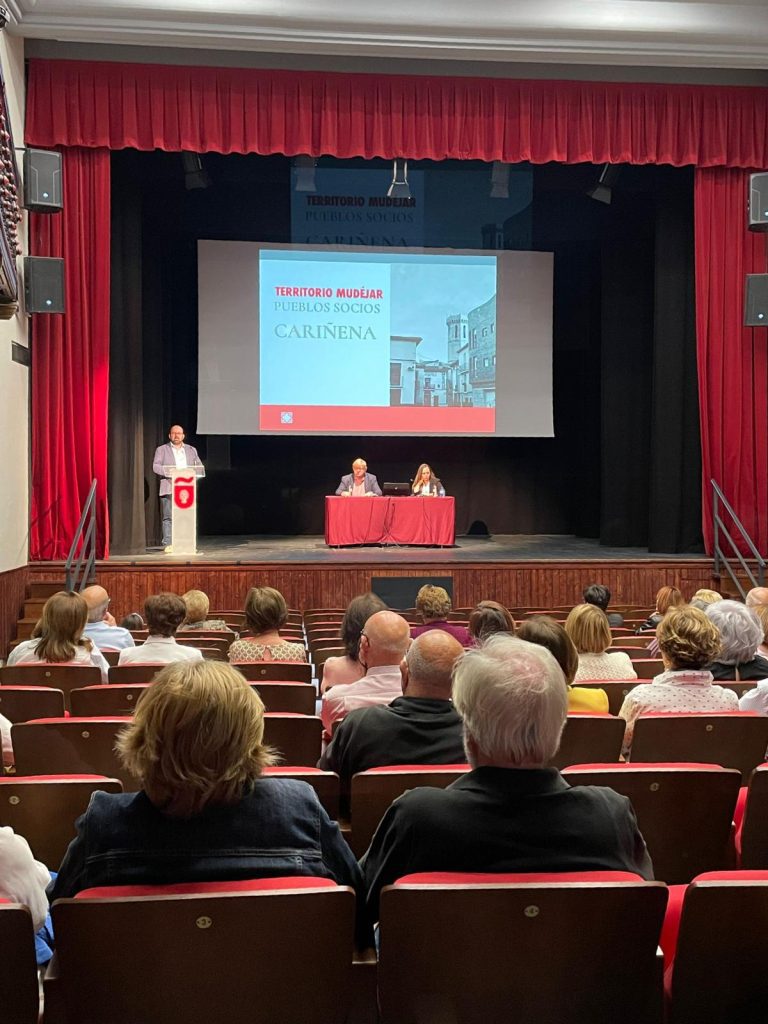
The inauguration included a guided tour of the exhibition and coincided with the conference given by Victoria Trasobares at the closing of the Universidad Popular course on the role of Cariñena in the Territorio Mudéjar network. This was held in the Olimpia Theatre in the town. The activity was presented by the mayor of Cariñena, Sergio Ortiz, and the teacher in charge of the history course, José Luis Begué.

The Mudejar heritage of our partner villages returns to the showcase of the tourism fair Aratur

Territorio Mudéjar is taking part for the sixth year in the ARATUR tourism fair in Argon and we are doing so with our heritage projects developed with our partner town councils.

Our stand will once again become a space to show what Mudejar is through the monuments, town planning, houses, landscape, trades and services of each locality.

In our stand you can make ‘visits to the Mudejar’ with historical-artistic explanations of the localities (each one in a schedule) and also of the projects that we develop there, such as the routes or the projects on route, among others.

At the end of each presentation, participants can take part in a draw for three trips to one or two partner locations.

During the fair, our stand was visited by the Minister for the Environment and Tourism, Manuel Blasco; the Director General of Tourism, Jorge Moncada; the Deputy for Tourism of the DPZ, Cristina Palacín; the Councillor for Culture and Tourism of Zaragoza City Council, Sara Fernández; the Member of the Aragonese Parliament, Leticia Soria; the Councillor of Zaragoza City Council, Armando Martínez, and Manuel Teruel, President of the Zaragoza Trade Fair, among others.

We were also visited by @huescalamagia @Livehuesca @Megustazaragoza @Franlujanzgz @Zaragozaguia

Timetable for guided tours of our stand:

SATURDAY 25 MAY

11:30. Route 4: Mestizo and frontier: Mudejar villages

Guided tour’ through Fuentes de Ebro and Rodén, Velilla de Ebro, Gelsa and Quinto with its Mummy Museum.

12:15 h. Route 5: Keys to a style, the origins. Mudejar in Illueca, Villarroya de la Sierra and Torralba de Ribota.

13:00 h. Route 6: Keys to a style, the origins. Mudejar in Zuera, Magallón and Tauste.

SUNDAY 26 MAY

11:30 Route 10: A bird’s eye view of the towers

Mudejar in Romanos, Villarreal de Huerva, Mainar, Herrera de los Navarros and Villar de los Navarros.

12:15 Route 11: A bird’s eye view of the towers

Mudejar in Utebo, Villamayor de Gállego and Muel.

13:00 Route 12: The construction of space. Light and matter

Mudejar art in Maluenda, Morata de Jiloca and Acered.

17:00 Route 13: The construction of space. Light and matter

Mudejar in Borja, Castejón de Valdejasa and San Mateo de Gállego.

17:30 h. Route 1: Mestizo and frontier: Mudejar villages

The Mudejar in Terrer, Villafeliche and Daroca

European meeting-visit to advance in the preliminary study of the management plan for the Mudejar Architecture of Aragon.

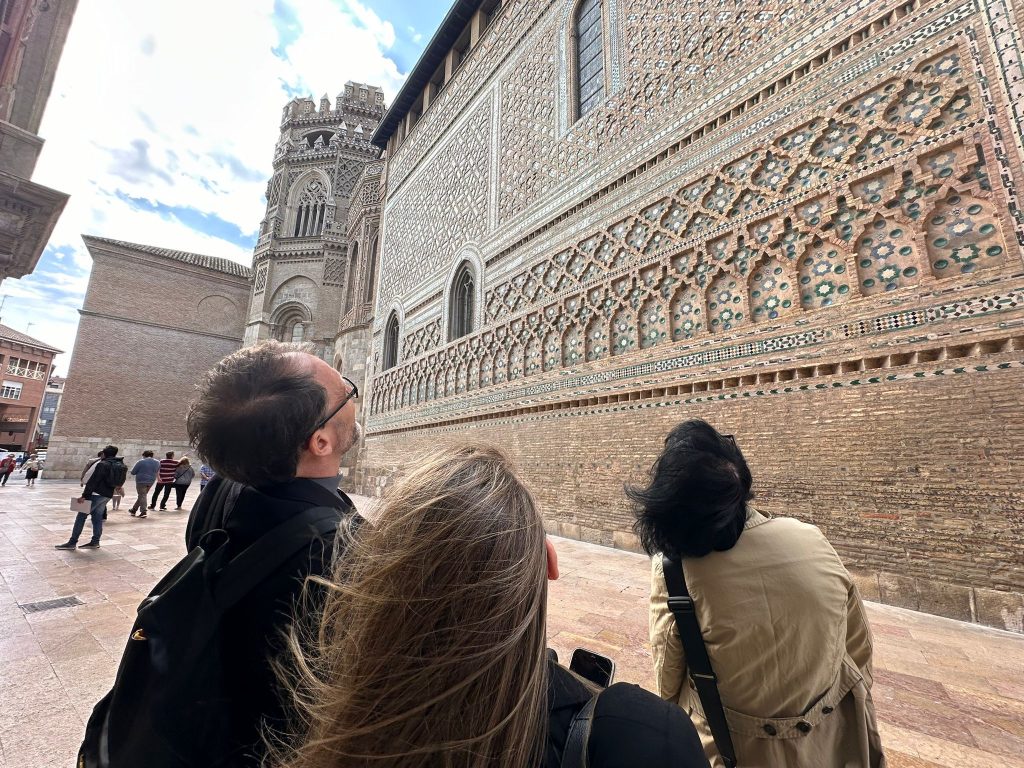
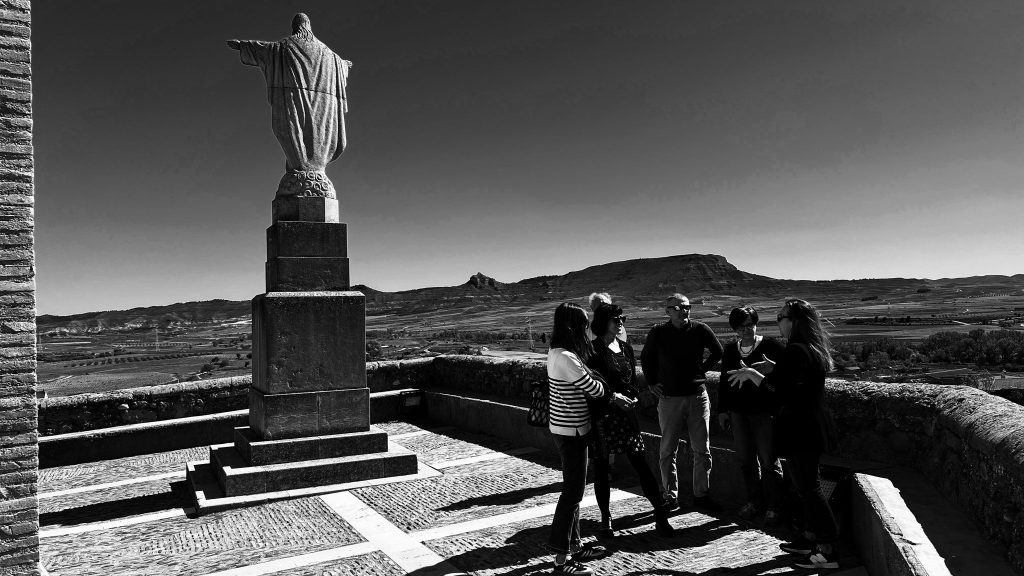
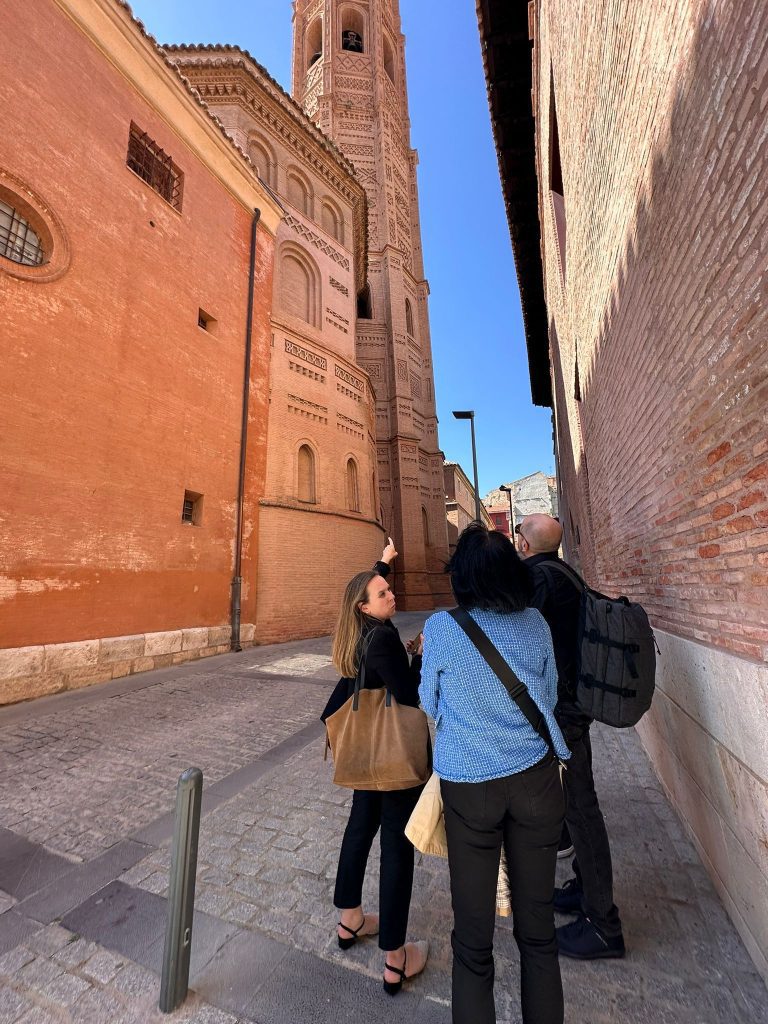
The Alliance of Cultural Landscapes and Related World Heritage Sites has held its biannual assembly in several towns of Territorio Mudéjar: Calatayud, Cervera de la Cañada and Tobed. The assembly included a technical conference for members organised around the theme “Cultural landscape and management plans for UNESCO World Heritage sites”, which was attended by speakers and members from Spain, Andorra, Portugal and Italy. On this occasion, Territorio Mudéjar organised a European meeting-visit in Calatayud, Tobed and Cervera de la Cañada with a team from the University of Zaragoza, the Politecnico di Torino and the Politecnico di Milano, which has served to advance the preliminary study for the drafting of a management plan for the Mudéjar Architecture of Aragon.

* This project of Territorio Mudéjar has been selected in the 2023 call for grants for projects for the conservation and dissemination of World Heritage properties of the Ministry of Culture and Sport. Territorio Mudéjar is thus part of a group of more than 20 Spanish organisations working to promote and improve the application of the World Heritage Convention and its guidelines. These grants are financed by the Ministry of Culture and aim to promote the development of projects for the management, protection and conservation of these assets, as well as to promote their accessibility, visibility and dissemination at national and international level.