Circular from the rural school

The “Circular from the rural school” project is a cooperation project between rural development groups led by the Asociación Territorio Mudéjar.

The following have participated in the project: ADRI Calatayud-Aranda, ADRI Jiloca-Gallocanta, FEDIVALCA -Valdejalón and Campo de Cariñena-, ASOMO Tarazona and el Moncayo, CEDEMAR -Bajo Aragón Caspe and Ribera Baja del Ebro-, ADRAE -Ribera Alta del Ebro- and ADEFO Cinco Villas.

The objective is to develop educational materials around the Mudejar identity of the towns, placing rural schools and the educational community of the towns as the center of the project.

Based on the work developed, for almost three years, the students of fifteen schools have designed a walk through their town in which we can learn about the main points of interest and their connection with the Mudejar culture.

San Mateo de Gállego

The tour has been carried out following the working model of the schools that participated in the project and adapted to the town of San Mateo de Gállego.

San Mateo de Gállego has witnessed the passage of different cultures, especially Roman and Muslim. However, in our tour of the town we go back to the medieval village founded by the Aragonese King Alfonso I the Battler shortly before the conquest of the city of Zaragoza in 1118, becoming a village dependent on the nearby town of Zuera. Stopping points and educational activities.

1. History of the town

The materials used by the Mudejars can be found in the immediate vicinity of the landscape, what we would call ‘local materials’. The main materials used for construction are clay, plaster, alabaster and wood. In the valley of the river Gállego we have an abundance of all of them. This, together with the existence of a Mudejar population, made the construction of various monuments possible.

This point is linked to the didactic activity 1.

2. Construction materials

The river Gállego did not always have the appearance that we see today, as in the past the water reached as far as the ravine. A series of actions were carried out at the end of the 1970s to shorten the meander in order to protect the church of San Mateo Apóstol and provide it with a more stable base.

After the Christian conquest, the Jewish and Muslim populations remained in the territory, otherwise there would have been serious economic problems and depopulation. It was the coexistence of these three cultures that led to the emergence of the Mudéjar style.

This point is linked to the didactic activity 3

2. Mudejar Architecture

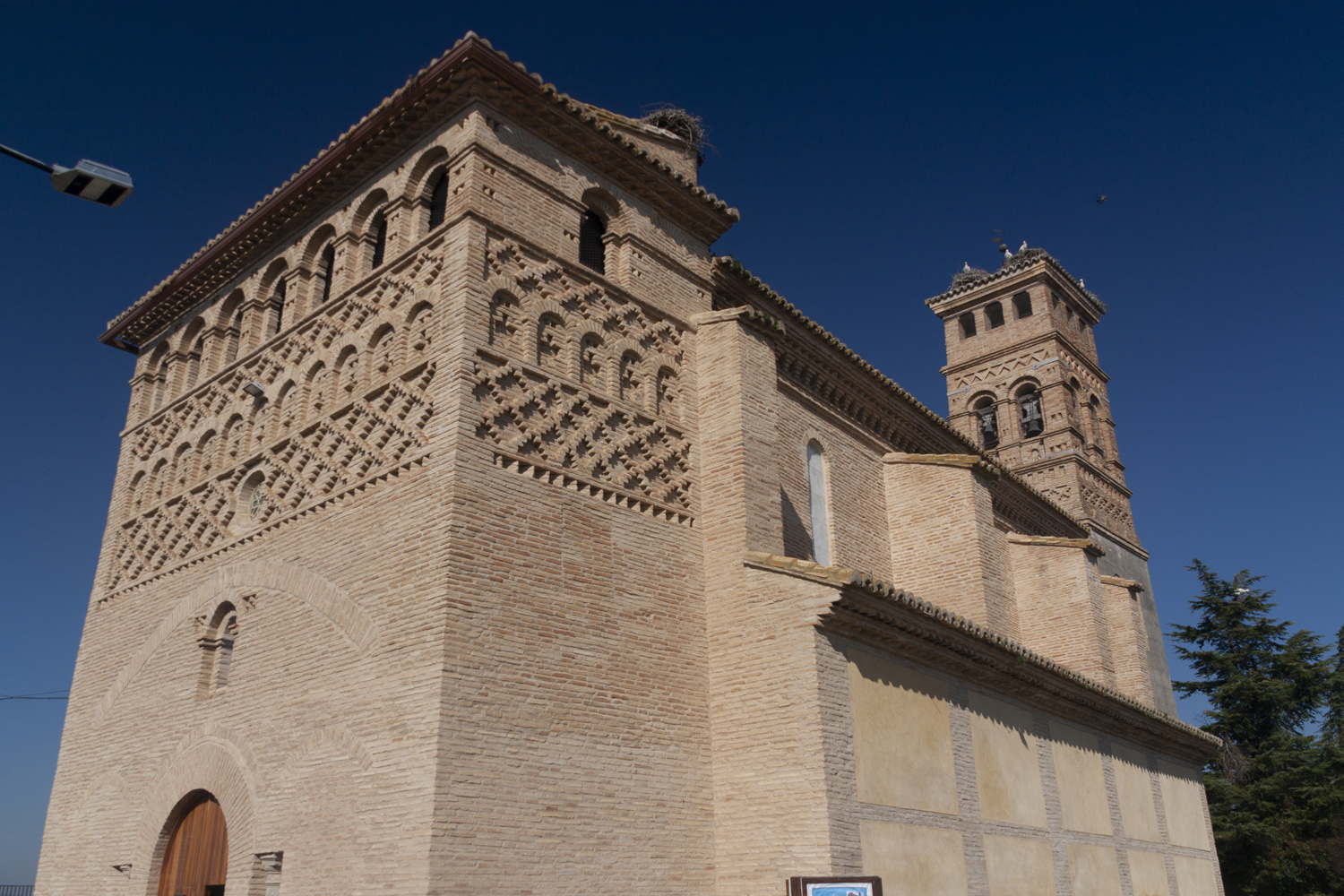
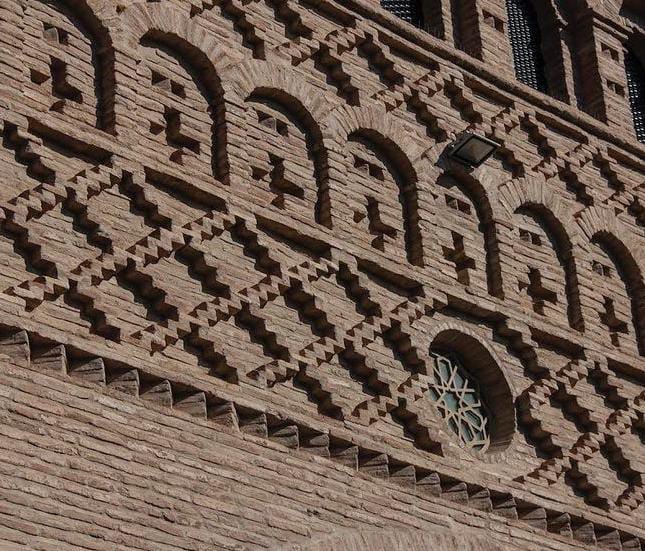
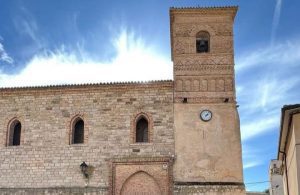
The Church of San Mateo Apóstol was built during the first decades of the 16th century in the Mudejar style. The temple was attached to an earlier tower, the lower part of which dates from the 14th century, and may have formed part of the old walled enclosure of the medieval town, as a defensive tower. On the façade, the ornamental motifs repeat those of the tower and it has a typical Aragonese gallery of semicircular arches.

This point is linked to the didactic activity 4

3. Reminiscences of the Mudejar

Mudejar art came to an end in the 17th century, when the Moors (Mudejars who converted to Christianity) were expelled. However, we have a style that has survived through the centuries. This is why, in several later constructions, we find elements that remind us of the Mudejar style. San Mateo de Gállego has several examples of reminiscences of Mudejar materials, construction techniques and ornamentation.

This point is linked to the didactic activity 5.

4. Importance of water

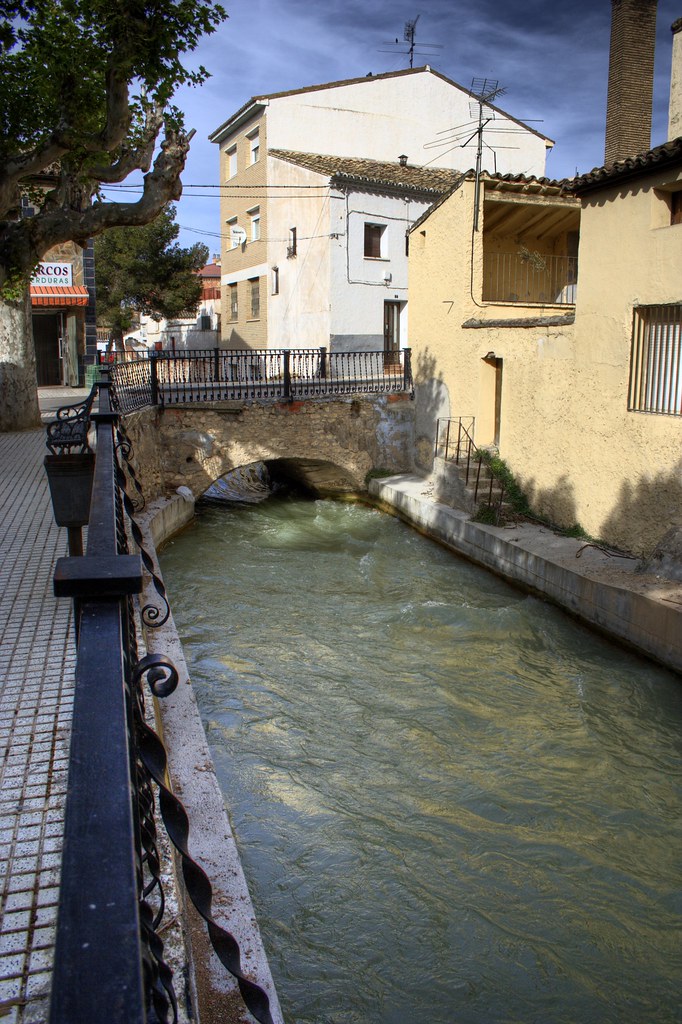
The Camarera irrigation channel is one of the four irrigation channels of the Lower Gállego, which originated in the 12th and 13th centuries. Tradition has it that it was founded by King James I the Conqueror in 1263 at the request of a chamberlain of his court in order to irrigate the lands within the municipality of San Mateo de Gállego, for which a weir had to be built.

Water is closely linked to Mudéjar art, as it is a key element for its materialisation in construction. It was also a key component in the coexistence of cultures as it was a symbol of religious purification.

This point is linked to the didactic activity 6

Related Works