Circular from the rural school
The “Circular from the rural school” project is a cooperation project between rural development groups led by the Asociación Territorio Mudéjar.
The following have participated in the project: ADRI Calatayud-Aranda, ADRI Jiloca-Gallocanta, FEDIVALCA -Valdejalón and Campo de Cariñena-, ASOMO Tarazona and el Moncayo, CEDEMAR -Bajo Aragón Caspe and Ribera Baja del Ebro-, ADRAE -Ribera Alta del Ebro- and ADEFO Cinco Villas.
The objective is to develop educational materials around the Mudejar identity of the towns, placing rural schools and the educational community of the towns as the center of the project.
Based on the work developed, for almost three years, the students of fifteen schools have designed a walk through their town in which we can learn about the main points of interest and their connection with the Mudejar culture.
Castejón de Valdejasa
The route has been carried out following the working model of the schools that participated in the project and adapted to the locality of Castejón de Valdejasa.
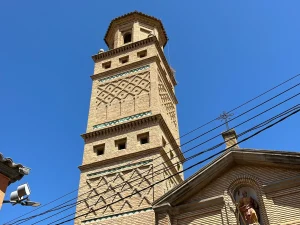
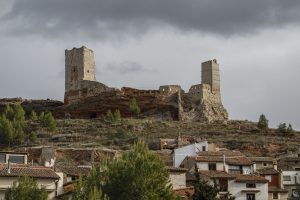
During the walk through Castejón de Valdejasa we will be able to discover several interesting places, such as the castle park from where we have privileged views of the landscape, as well as the church of Santa María la Mayor, an original construction from the Mudejar period. We will also discover other later works carried out more later in time and which we call Mudejar reminiscences.
1. History of the town
The Iberian Peninsula had been inhabited by Muslims since the 8th century. The Christians conquered the territory where the Muslims lived. In our territory this happened between 1118 and 1120. The Muslims who remained after this conquest became known as Mudejars, and preserved their religion, culture and customs. The Christians dominated the territory at that time and commissioned the Mudejars, who were accustomed to using a series of techniques, materials and decoration typical of their culture, to carry out the constructions.
This point is linked to the didactic activity 1.
2. Agriculture and landscape
Water is the most important principle of the universe according to the Qur’an, it is a divine symbol, since water is necessary for life. It is also present in the Muslims’ idea of their Paradise. For the Mudejars, who were also Muslims, water was fundamental. The Arabs, when they arrived in the territory, brought with them fruits and vegetables from their place of origin. The climate in both places is different, so they had to adapt irrigation techniques so that these crops could develop, which is why they were pioneers in the development and improvement of agriculture in the rural world. Some examples are: waterwheels, waterwheels, cisterns, irrigation ditches…
This point is linked to the didactic activity 6
3. Mudejar architecture
The Mudéjars were particularly skilled in the construction of buildings of unique technical characteristics and beauty. They were highly sought-after master builders by the great patrons of the time and their works were in keeping with the taste of the period. The church of Santa Maria la Mayor was a Mudejar construction, however, today it remains hidden due to the restoration work carried out in the 20th century.
This point is linked to the didactic activity 4
4. Reminiscences of the Mudejar style
Mudejar art came to an end in the 17th century when the Moors were expelled from the territory. However, we have preserved a style that has survived over the centuries. This is undoubtedly due to sharing a culture and territory for a long time. This is why we find materials, construction techniques and elements that remind us of the Mudejar style in later works.
This point is linked to the didactic activity 7
5. Construction materials
The materials used by the Mudejars are materials that we can find in the environment. In this way, we will see how commonly used monuments and constructions are made with the same materials and construction techniques. The most common are clay, plaster, wood and alabaster. All of them are materials that we see reflected in the monuments and popular architecture. Many of these materials can be seen from this viewpoint.
In Castejón de Valdejasa there are still some cellars at the foot of the place where we started the route, the highest point of the village. They are excavated taking advantage of the natural unevenness of the clayey terrain, and their fronts are finished off with masonry. Nowadays they have been adapted as meeting places, being a very picturesque place that you should not miss.
This point is linked to the didactic activity 3