Circular from the rural school
The “Circular from the rural school” project is a cooperation project between rural development groups led by the Asociación Territorio Mudéjar.
The following have participated in the project: ADRI Calatayud-Aranda, ADRI Jiloca-Gallocanta, FEDIVALCA -Valdejalón and Campo de Cariñena-, ASOMO Tarazona and el Moncayo, CEDEMAR -Bajo Aragón Caspe and Ribera Baja del Ebro-, ADRAE -Ribera Alta del Ebro- and ADEFO Cinco Villas.
The objective is to develop educational materials around the Mudejar identity of the towns, placing rural schools and the educational community of the towns as the center of the project.
Based on the work developed, for almost three years, the students of fifteen schools have designed a walk through their town in which we can learn about the main points of interest and their connection with the Mudejar culture.
Romanos
This walk shows us the work of the pupils of C.P Fernando el Católico de Villarreal de Huerva in the town of Romanos.
Historically, there have been different settlements around Romanos. One of the most prosperous periods in terms of news is the Middle Ages, the period in which we will focus our tour and discourse on the town of Romanos, with emphasis on the tower and fortified church.
1. History of the town
Near the present-day village of Romanos there were various settlements in the Celtiberian period. Later, during Roman times, there was a population presence, as important communication routes were located in this area. This is the origin of the present name of the town. However, it was undoubtedly the settlement of the Arabs in the vicinity of Romanos that marked the course of the town’s history.
This point is linked to the didactic activity 1.
2. Coexistence of cultures
The settlement of the Arabs in the territory for almost five centuries left a mark and an influence on the way of life that we still inherit today. The Christians conquered the territory where the Muslims lived. These settlers who remained after this conquest came to be called Mudejars, and preserved their religion, culture and customs. They excelled as farmers, craftsmen and builders. For this reason, we have preserved a large number of buildings.
This point is linked to the didactic activity 2
3. Construction materials
The materials used by the Mudejars are materials that can be found in the surroundings, what we would call, of proximity. In this way, we will see how commonly used monuments and constructions are made with the same materials and construction techniques.
In Romanos we are going to see two examples of houses where two construction techniques are used using this fundamental material, mud: adobe and tapia.
This point is linked to the didactic activity 3
4. Water and agriculture
Water is a divine symbol for Muslims. For the Mudejars, Muslims who remained in the Iberian Peninsula after the Christian conquest, water was fundamental.
The Arabs were pioneers in the introduction of irrigation techniques. In Romanos there is an irrigation channel, which irrigates the fields that surround the town and make up its landscape, which changes throughout the seasons.
This point is linked to the didactic activity 6
5. Mudejar architecture
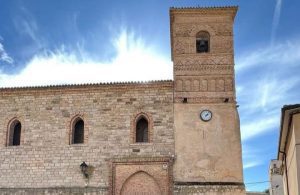
The Mudejars produced works of spectacular technical quality and beauty. They were commissioned by the great Christian lords of the time, as they greatly appreciated their architecture. In Romanos, the main monument is the church of San Pedro. In reality, when it was built, it would not have had the same appearance.
Only the tower remains from the original work, the rest of which dates from centuries later. There are many types of buildings that make up Mudejar architecture, but the construction of churches and towers stands out. The Romanos tower is very complex. This type of tower is known as a door-tower, because its lower part would have a door, which can still be seen today, but is blinded.
This point is linked to the didactic activity 7