Circular from the rural school

The “Circular from the rural school” project is a cooperation project between rural development groups led by the Asociación Territorio Mudéjar.

The following have participated in the project: ADRI Calatayud-Aranda, ADRI Jiloca-Gallocanta, FEDIVALCA -Valdejalón and Campo de Cariñena-, ASOMO Tarazona and el Moncayo, CEDEMAR -Bajo Aragón Caspe and Ribera Baja del Ebro-, ADRAE -Ribera Alta del Ebro- and ADEFO Cinco Villas.

The objective is to develop educational materials around the Mudejar identity of the towns, placing rural schools and the educational community of the towns as the center of the project.

Based on the work developed, for almost three years, the students of fifteen schools have designed a walk through their town in which we can learn about the main points of interest and their connection with the Mudejar culture.

Mesones de Isuela

The tour has been carried out following the working model of the schools that participated in the project and adapted to the locality of Mesones de Isuela.

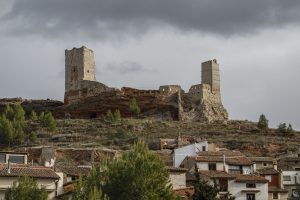
In Mesones de Isuela we are welcomed by its imposing castle, the starting point of our walk through the town. From here we have privileged views of the landscape and the town’s urban layout, which we will discover as we walk through its streets. Mesones de Isuela was, since the 13th century, a Mudejar town and its traces are still very much present.

1. History of the town

There is evidence of different settlements in the territory of Mesones de Isuela, of which the Arab population is particularly noteworthy. As a result of this, the layout of the town has been preserved and, at least since the 13th century, it has been inhabited by Mudejars, who left their mark on the territory. It was also a land of lordship, with the Casa de los Luna, a great patron of Mudejar art, standing out for its imposing castle. Inside, one of the most spectacular Aragonese Mudejar ceilings is preserved.

This point is linked to the didactic activity 1.

2. Water and agriculture

Water is the most important principle of the universe according to the Koran. It is a divine symbol, since water is necessary for life. For the Mudejars, who were also Muslims, water was essential. Moreover, the development of hydraulic engineering and agricultural techniques favoured indigenous crops, which grew better and faster. They also generated the idea of the agricultural landscape that we enjoy today.

This point is linked to the didactic activity 6

3. Coexistence of cultures

The Christians allowed the Muslims, previous settlers, to remain in the territory, as they were necessary to sustain the local economy. In Mesones de Isuela we know that the population coexisted. As a result of this coexistence, we find the urban layout of the town, at the foot of a castle and with a winding layout.

This point is linked to the didactic activity 2

4. Mudejar architecture

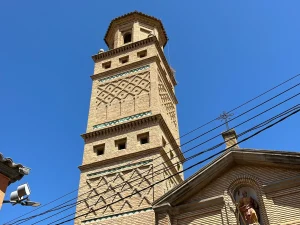
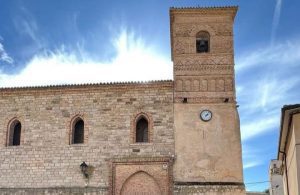
The Mudéjars were particularly skilled in the construction of buildings that were highly sought after by the great patrons of the time and their works were in the taste of the time. The materials used by the Mudejars are materials that can be found in the surroundings, what we would call, of proximity. The most common building materials were brick, plaster and wood. They also built many types of buildings, notably towers and churches.

This point is linked to the didactic activity 5.

5. Reminiscences

Calle Herrería is located very close to the church. This place allows us to talk about the use of materials and construction techniques of Islamic tradition that are still used throughout time in our territory.

In 1610 the Moors (Mudejars who converted to Christianity) were expelled from Aragon, which meant the end of the Mudejar style. Even so, we can still find buildings that are built following the same construction tradition. This is what we call the survival of the style, and we can find it in many architectural styles (houses, palaces, churches) until the 1960s.

This point is linked to the didactic activity 7

Related Works