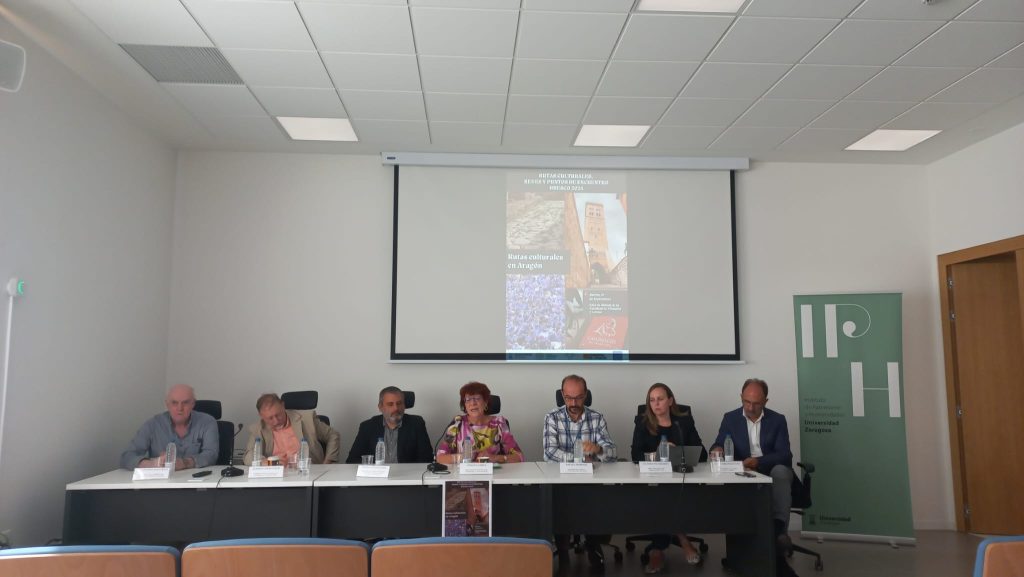
The Institute of Heritage and Humanities (IPH), in collaboration with the Gonzalo Borrás Chair and the Government of Aragon, joins the celebration of the European Heritage Days, a joint action of the Council of Europe and the European Union.
It has done so with a reflection on a selection of four particularly significant and singular cultural routes in our Autonomous Community: the Mudejar, the Iberian Heritage, the Cid and the Drum and Bass Drum.
At the meeting held today, the director of Territorio Mudéjar, Victoria Trasobares, took part in the round table discussion “Routes as a heritage management system” moderated by the director of the IPH Concha Lomba and together with Juan Carlos Lozano, Director of the Gonzalo Borrás Chair; Pedro Luis Hernando, Director of the Centro de Estudios Mudéjares del Instituto de Estudios Turolenses, José Antonio Benavente, Manager of the Consorcio Patrimonio Ibérico de Aragón; Alberto Montaner, Professor at the University of Zaragoza and Rafael Antonio Domingo, Professor at the University of Zaragoza.
Victoria Trasobares explained the Territorio Mudéjar route model, which is proving to be a success with the public and its impact on the localities, is the repercussion of the management project that the organisation has implemented through collaboration between town councils and is making it possible to disseminate heritage, presenting on the ground the research and preventive conservation projects linked to it and attracting both the general public and the specialised/scientific public through routes à la carte. This year’s conference coincides with the 75th anniversary of the Council of Europe and the 70th anniversary of the European Cultural Convention, and will be dedicated to Heritage of Routes, Networks and Connections, with the specific aim of showing not only the capacity of Cultural Heritage to create connections and links between different communities, peoples and countries, but also the need to work in a coordinated way to optimise resources and achieve greater achievements in an increasingly globalised and technified world.
Territorio Mudéjar is participating in the 16th International Symposium on Mudejarism, taking place in Teruel from October 17 to 19. More than 40 experts and researchers will meet to discuss the theme of this event: “Mudejar and Moorish Landscapes: Territories and Identities.”
The objective is to study how the different Mudejar and Moorish communities in Spain developed depending on the space in which they were located, creating more or less differentiated societies, with diverse border relations and specific political and patronage situations despite their shared cultural characteristics.
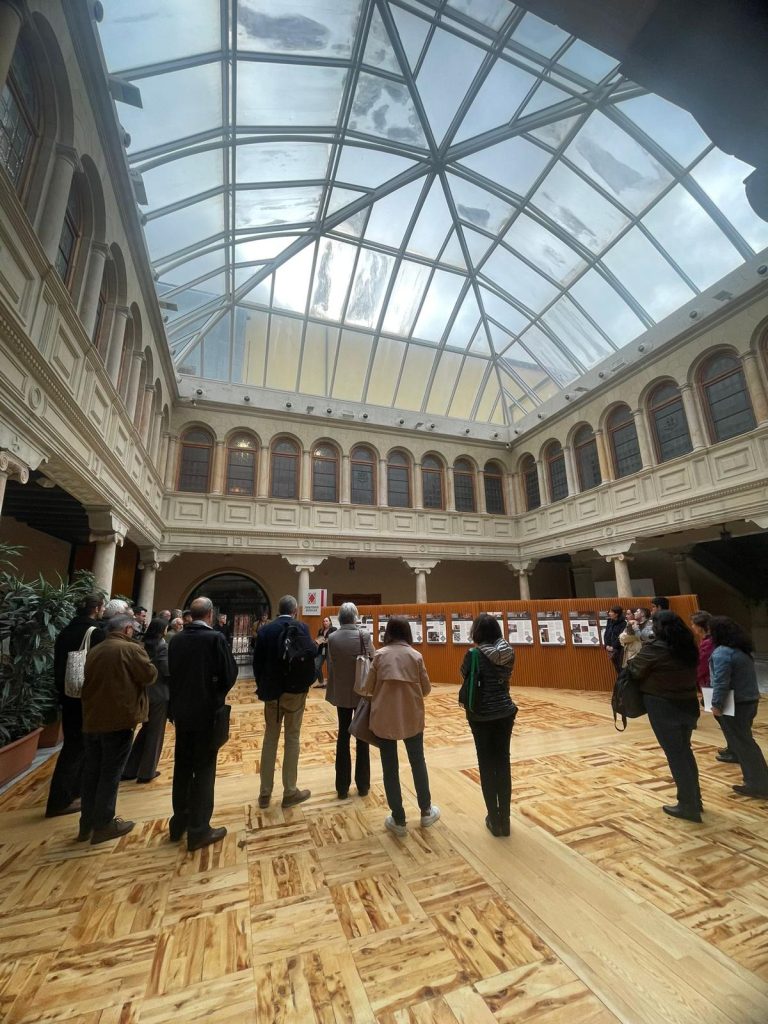
The director of Territorio Mudéjar, Victoria Trasobares, will present the exhibition of the 2019-2024 research stay and artist residency projects this Thursday at 5:30 p.m. Mudejar Architecture of Aragon. A research space open to the future. As you can see in the images, everything is already ready in the courtyard of the Museum of Sacred Art in Teruel.
This exhibition will be open until the 30th: Thursday and Friday: 9:00 a.m. to 2:00 p.m. and 4:00 p.m. to 8:00 p.m. Saturday: 9:00 a.m. to 2:00 p.m.
Additionally, on Friday at 6:00 p.m., Mar Valls Fusté, a researcher with the Territorio Mudéjar network of artist residencies and stays, will participate. Her presentation is titled “Towards a corpus of Arabic inscriptions in the Kingdom of Aragon (13th-15th centuries): premises, methodology, and results of a research project.” This project was one of those selected in the latest 2023-2024 call for “Research stays and projects. Gonzalo M. Borras Gualis.”
More than 70 people joined us today at the presentation conference of Tarazona in the Territorio Mudéjar Network, given by Victoria Trasobares, director of the association Territorio Mudéjar, accompanied by the Mayor, Antonio Jaray, and Pablo Escribano, Third Deputy Mayor, Delegate for Sports, Youth, Tourism and Seniors.
It has been a pleasure to tell you what we do and how we work with our partner municipalities.
We have also inaugurated the exhibition “Mudejar: the guide” with a guided tour by Eugenia Gallego, from the Territorio Mudejar team.
The exhibition will be open until 6 October on Fridays and Saturdays from 18:00 to 20:00 and Sundays from 12:00 to 14:00.
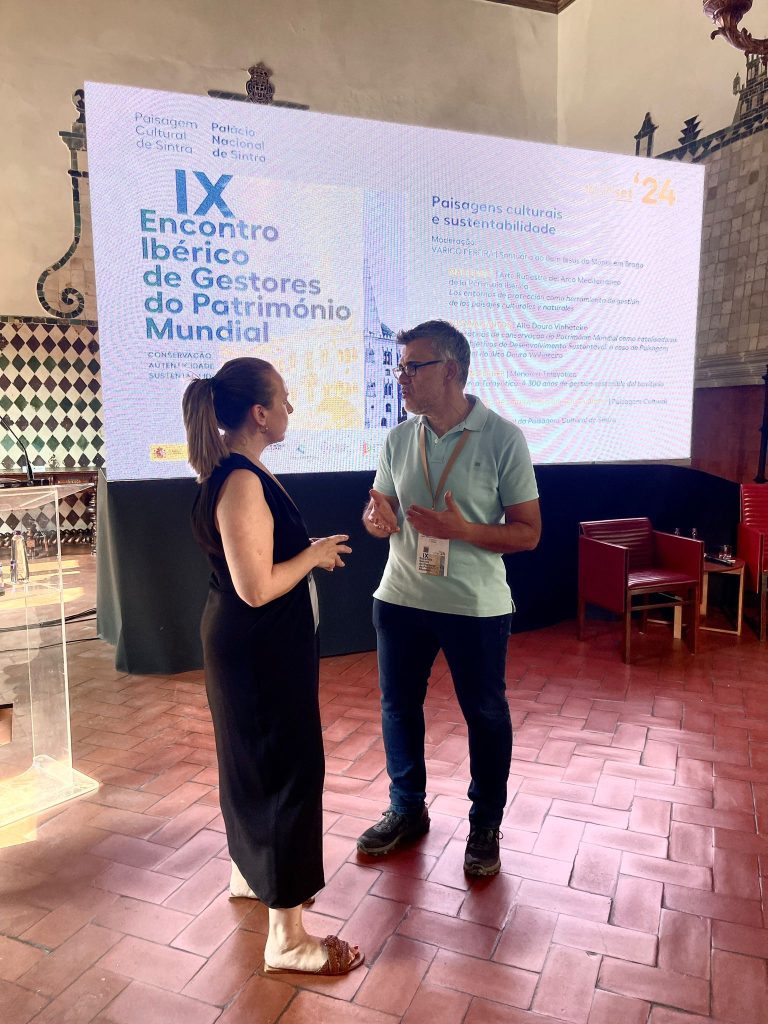
Territorio Mudéjar has participated in the 9th Iberian Meeting of World Heritage Managers held in Sintra (Portugal). This is an important framework for analysis, the exchange of information and experiences, and the sharing of best practices in very relevant areas for the protection, conservation and enhancement of World Heritage. It is also an opportunity for managers of World Heritage sites in Portugal and Spain to share their experiences and discuss issues of mutual interest.
As Victoria Trasobares, director of Territorio Mudéjar, recalled today from Sintra: “The management of heritage resources must have as a fundamental basis their permanence as heritage from a broad vision of conservation, authenticity and sustainability of World Heritage sites, and in our case, in the ability to influence our local heritage beyond types of protection. These issues require constant professional attention and therefore can be focal points for high quality work opportunities that directly impact on the permanence of our villages as we know them”.
In Sintra we continue to advance in this idea and to learn with presentations on conservation and climate change, restoration techniques, new artistic experiences and heritage of Portuguese influence, among other interesting topics.
On the second day of the IX Iberian Meeting we talked about heritage and people, safeguarding and collaborative processes and cultural landscapes and sustainability, among other interesting topics. We had the opportunity to share experiences with other managers. Among them, with Juanjo Arteaga, from the City Council of Cuenca, whose historic fortified city is a UNESCO World Heritage Site. With him we discussed possible collaborations around our rich common heritage of traditional building techniques: plaster, earth and wood.
The IX Iberian Meeting will be held this year in Portugal, in the Cultural Landscape of Sintra, and the entities in charge of the organisation are the National Commission of Unesco, Patrimonio Cultural I. P., and Parques de Sintra-Monte da Lua S. A., the managing body of this World Heritage Site.
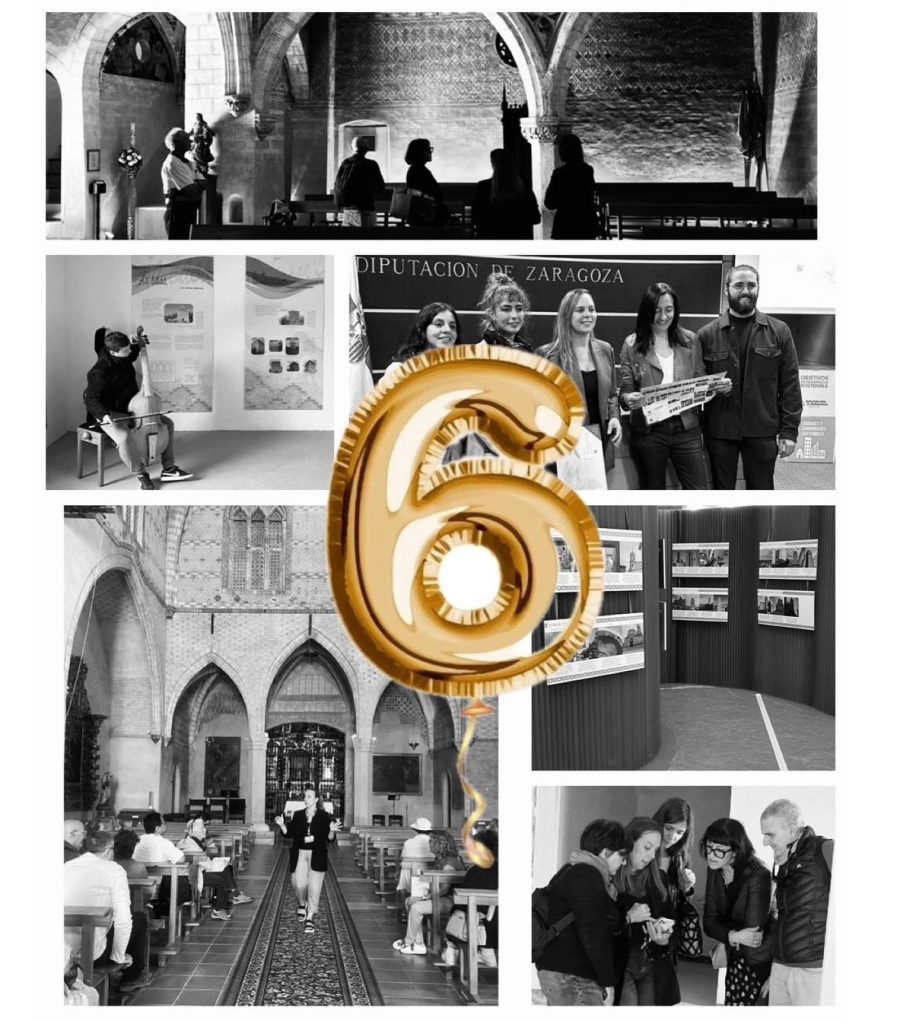
On 13 September we celebrated that it was six years ago that this network project saw the light of day after several years of work: Territorio Mudéjar was set up as a network for the management of heritage resources linked to the Mudejar, under the umbrella of the World Heritage brand held by some of our partners, but above all with quality in management as a guide, focused on the conservation of our tangible and intangible heritage as a key to the local development of our villages always as the north of the compass.
This six-year journey has brought us to 2024 with a powerful and consolidated network of management, knowledge, connections and projects that includes 47 villages, more than 50 researchers and transdisciplinary professionals, trainees and collaborations in international projects.
As you know, we like to celebrate by working and we are currently working on the new calls for Research Stays and Artistic Residencies, which we will soon make public. Our commitment to innovation and the promotion of projects that contribute to the development of villages and the responsible and sustainable use of cultural and natural heritage resources is proving to be a success. This year, the call will come with some new features that will allow us to further strengthen this network of knowledge about the Mudejar culture of our partner villages and to advance in the new uses of heritage.
Our work in the field is another of our hallmarks. You know that the Territorio Mudéjar team works in and for your villages and, thanks to the Routes project, in this work we ensure that the work we do is disseminated as widely as possible and, increasingly, there are visitors who accompany us to get to know your villages, discover your heritage and resources or get to know them in more depth. Always in small groups, with a very carefully planned programme and a route designed by heritage professionals. This year we are doing 14 different routes covering 47 destinations and the demand has meant that in this second part of the year we are increasing the number of transport places in order to be able to meet the requests.
In addition, we have taken a further step towards a la carte routes. These tailor-made heritage tours allow us to offer all the services of our partner localities to the traveller and aim to ensure that those who take them enjoy highly personalised explanations. We have already launched the first ones and we are working to give them a more international approach that combines a recreational and a scientific learning approach. Thanks to our network, in this case our participation with the Medina Network, these proposals will be presented in the next few months in Malaysia and Qatar…
We continue to travel outside our territory to bring it closer to new audiences and specialised forums. Thus, as the next event on the calendar, this week we are invited to the IX Iberian Meeting of World Heritage Managers in Sintra (Portugal), jointly organised by the Spanish and Portuguese Ministries of Culture.
And we continue to participate in national and international projects with the Turin Polytechnic Institute, the World Heritage Cultural Landscapes Alliance and other partners that make us grow as a network.
We think about the future and new professionals. That is why every year we train students thanks to the Desafío and Unita programmes – we are going to extend two of the scholarships – we collaborate with UNIVERSA and we advise on other projects of the Spanish Sustainable Development Network.
We have not lost our hallmark of providing personalised advice to our partner towns and, along these lines, we have developed special agreements with, for example, Ricla, where a dozen activities have been developed with the participation of local agents, or in Fuentes de Ebro, where we have just started the second phase and where technical support has been provided to make the heritage elements more accessible in terms of interpretation. And we are making progress on new agreements, as in the case of San Mateo de Gállego, which will soon be launched.
Our travellingexhibition “Territorio Mudéjar: the guide” continues to travel kilometres to take its didactic vision to all the towns and villages. Its next stop is Tarazona and soon it will also be on display in Mainar.
The Territorio Mudéjar network is also growing every year in terms of projects and this sixth birthday has left us with a very special one to develop. We are working to become the documentation centre for the Mudejar. Based on a special collaboration with the General Directorate of Heritage of the Government of Aragon, we are digitising all the files of more than 250 Mudejar buildings with some kind of protection according to the Aragonese Cultural Heritage Law. In this way, on the one hand, we generate our own documentary heritage, necessary for the knowledge of our fundamental resources, and on the other hand, we work to help the management processes in our localities to be agile, making available to the technical teams of our partner town councils the most complete information on the Mudejar buildings, essential for intervention, conservation or restoration projects, as well as, for example, for the application for funding through the different calls for subsidies.
Thank you very much to all of you for joining us and adding to these six years.
Territorio Mudéjar has once again collaborated in CortonaOpen3d, which this year was held in Urbino, a town in the Italian region of Le Marche (Marche).
CortonaOPen3d \ BlenderOPen3d 2024 is a Design in a Cultural Heritage context workshop that took place from 26 July to 4 August. During the workshop, participants developed an architecture-design project or an artistic installation in the context of the city of Urbino.
The workshop is an international initiative and is carried out in collaboration with the Politecnico di Milano, the Fine Arts Academies of Brera (Milan) and Urbino, the University of Zaragoza and the Escuela Superior de Diseño de Aragón.
Within this framework, Territorio Mudéjar collaborates by monitoring the projects and with two activities:
On Tuesday, the director of Territorio Mudéjar, Victoria Trasobares, was in charge of giving a presentation on the digitalisation strategy of Territorio Mudéjar through the projects carried out by the organisation and with the specific presentation of the Villarreal de Huerva project. This municipal project, carried out thanks to funding from the #fundacionemprende and the collaboration of the #comarcaCampodeDaroca, consists of using virtual reality to understand and publicise its valuable historical heritage. This initiative, which seeks to promote cultural and heritage tourism, offers visitors an immersive and unique experience that will allow them to travel back in time.
In addition, the TM director took part in the jury responsible for evaluating the projects and awarded the Territorio Mudejar mention – which coincided with the jury’s mention – to the “Delirium” project. The aim of the project was to redevelop the square of Borgo Mercatale in Urbino, today a car park at ground level and underground, to recover visually the landscape and restore an ideal connection between the views of the wall of the Cini Towers and one of the main access routes into the city.
The exhibition “Mudejar, the guide” has travelled to Torralba de Ribota. You can see it inside the church-fortress of San Félix, embraced by the paradigm of the Mudejar religious space, which is accentuated by the plaster decoration on the windows and lighting oculi, the painted and stapled decoration that covers walls and vaults, and the magnificent alfarje that supports the choir.
The inauguration and explanation, by Victoria Trasobares, will be this Saturday at 10.30 am. In addition, this Saturday there is mass in Torralba from 18.00 to 18.30 and the exhibition can be visited before and after.
???? On view until 30 July. ???? From 11.00 a.m. to 1.00 p.m.
Territorio Mudéjar travels to Antequera (Málaga) to attend the 18th Meeting of World Heritage Managers. The director of Territorio Mudéjar, Victoria Trasobares, participates in this technical forum that the Ministry of Culture organises annually to promote the meeting, analysis and discussion of the problems that managers of sites inscribed on the World Heritage List encounter on a daily basis.
Its aim is to improve the conservation of these assets and to create a network of contacts between all the managers working on these assets, in order to share experiences, address challenges and find common solutions.
The meeting will be held until 26 June with activities both in the Museum of the City of Antequera and in the headquarters of the Royal Academy of Noble Arts, as well as in Antequera Town Hall, where the official reception was held this afternoon.
The meeting was opened by the Mayor of Antequera, Manolo Barón; the Deputy Mayor for Tourism and World Heritage, Ana Cebrián; the Councillor for Culture and Heritage, José Medina; the Deputy Director General for the Management and Coordination of Cultural Heritage, María Agúndez; Miriam Ugarte, from the UNESCO Conventions Department of the Ministry of Culture; Carmen Mora, Director of the Dólmenes de Antequera Archaeological Site; Alicia Castillo, lecturer at the Complutense University of Madrid;
During their stay, participants have the opportunity to visit the main monuments of the city such as the Dolmens, the Torcal, the Alcazaba and the Royal Collegiate Church of Santa Maria.
In total, more than 70 World Heritage managers are sharing experiences in this XVIII Meeting of World Heritage Managers in Antequera.
In the first workshop on social participation and world heritage we exchanged ideas on how to work on the uses of the space between the dolmens and the polygon.
We continued with a visit to the Museo de la Ciudad (MVCA), the Museo Sitio Dólmenes de Antequera and the Alcazaba.
The World Heritage Managers Meeting ended after a session on the evaluation of visitors to the Antequera Dolmens World Heritage Site and the presentation of the conclusions on social participation as the key to a management focused on people, on the inhabitants of the heritage.
On the last day, the director of Territorio Mudéjar, Victoria Trasobares, participated as coordinator of the working group “Dolmen Museum, inhabitants and visitors. Analysis and diagnosis of needs” together with the directors and managers of the sites: Menorca Talayotica (Consell de Menorca), Colonia Guell (Consortium), Risco Caido and the sacred mountains of Gran Canaria and the Historic Sanctuary of Machu Pichu in Cuzco (Peru).
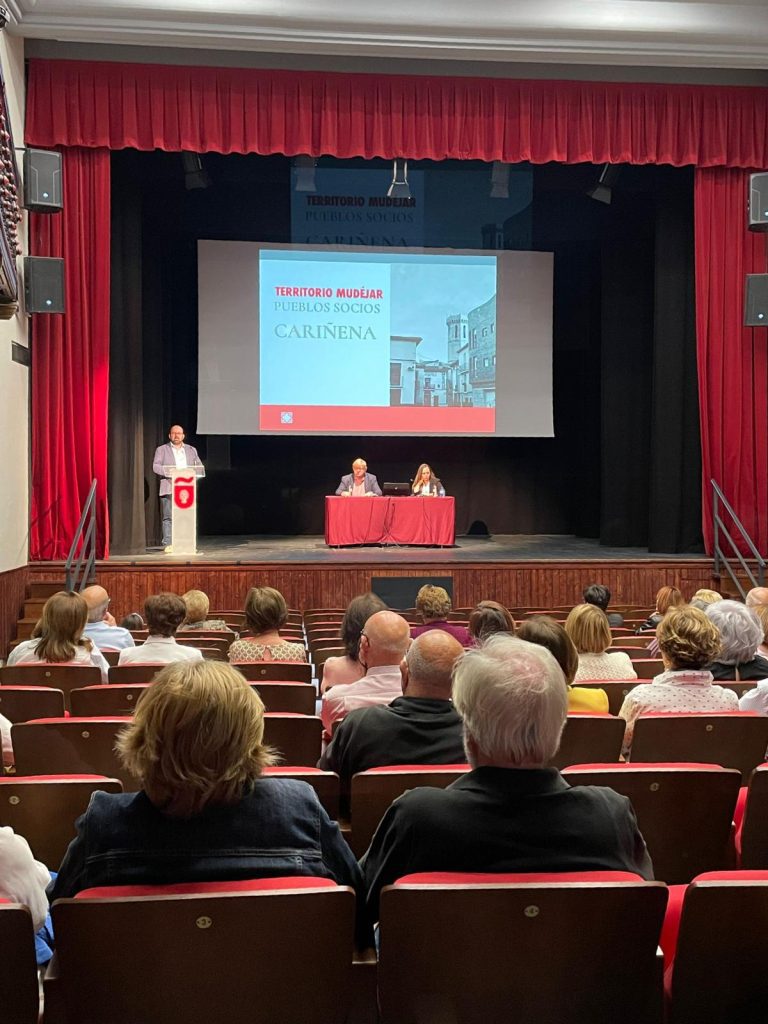
Territorio Mudéjar presented this Tuesday in Cariñena the exhibition “Territorio Mudéjar. The guide”. The exhibition can be seen in the Santo Cristo del Santo Cristo chapel until 30 June from 9.00 to 13.00 from Monday to Sunday. The inauguration included a guided tour of the exhibition and coincided with the conference given by Victoria Trasobares at the closing of the Universidad Popular course on the role of Cariñena in the Territorio Mudéjar network. This was held in the Olimpia Theatre in the town. The activity was presented by the mayor of Cariñena, Sergio Ortiz, and the teacher in charge of the history course, José Luis Begué.
Territorio Mudéjar is taking part for the sixth year in the ARATUR tourism fair in Argon and we are doing so with our heritage projects developed with our partner town councils.
Our stand will once again become a space to show what Mudejar is through the monuments, town planning, houses, landscape, trades and services of each locality.
In our stand you can make ‘visits to the Mudejar’ with historical-artistic explanations of the localities (each one in a schedule) and also of the projects that we develop there, such as the routes or the projects on route, among others.
At the end of each presentation, participants can take part in a draw for three trips to one or two partner locations.
During the fair, our stand was visited by the Minister for the Environment and Tourism, Manuel Blasco; the Director General of Tourism, Jorge Moncada; the Deputy for Tourism of the DPZ, Cristina Palacín; the Councillor for Culture and Tourism of Zaragoza City Council, Sara Fernández; the Member of the Aragonese Parliament, Leticia Soria; the Councillor of Zaragoza City Council, Armando Martínez, and Manuel Teruel, President of the Zaragoza Trade Fair, among others.
We were also visited by @huescalamagia @Livehuesca @Megustazaragoza @Franlujanzgz @Zaragozaguia
Timetable for guided tours of our stand:
SATURDAY 25 MAY
11:30. Route 4: Mestizo and frontier: Mudejar villages
Guided tour’ through Fuentes de Ebro and Rodén, Velilla de Ebro, Gelsa and Quinto with its Mummy Museum.
12:15 h. Route 5: Keys to a style, the origins. Mudejar in Illueca, Villarroya de la Sierra and Torralba de Ribota.
13:00 h. Route 6: Keys to a style, the origins. Mudejar in Zuera, Magallón and Tauste.
SUNDAY 26 MAY
11:30 Route 10: A bird’s eye view of the towers
Mudejar in Romanos, Villarreal de Huerva, Mainar, Herrera de los Navarros and Villar de los Navarros.
12:15 Route 11: A bird’s eye view of the towers
Mudejar in Utebo, Villamayor de Gállego and Muel.
13:00 Route 12: The construction of space. Light and matter
Mudejar art in Maluenda, Morata de Jiloca and Acered.
17:00 Route 13: The construction of space. Light and matter
Mudejar in Borja, Castejón de Valdejasa and San Mateo de Gállego.
17:30 h. Route 1: Mestizo and frontier: Mudejar villages
Utilizamos cookies para asegurarte la mejor experiencia en nuestra web. Puedes consultar más detalles
Funcionales
Always active
El almacenamiento o acceso técnico es estrictamente necesario para el propósito legítimo de permitir el uso de un servicio específico explícitamente solicitado por el abonado o usuario, o con el único propósito de llevar a cabo la transmisión de una comunicación a través de una red de comunicaciones electrónicas.
Preferencias
El almacenamiento o acceso técnico es necesario para la finalidad legítima de almacenar preferencias no solicitadas por el abonado o usuario.
Estadísticas
El almacenamiento o acceso técnico que es utilizado exclusivamente con fines estadísticos.El almacenamiento o acceso técnico que se utiliza exclusivamente con fines estadísticos anónimos. Sin un requerimiento, el cumplimiento voluntario por parte de tu Proveedor de servicios de Internet, o los registros adicionales de un tercero, la información almacenada o recuperada sólo para este propósito no se puede utilizar para identificarte.
Marketing
El almacenamiento o acceso técnico es necesario para crear perfiles de usuario para enviar publicidad, o para rastrear al usuario en una web o en varias web con fines de marketing similares.