Territorio Mudéjar announces a new edition of its research stays and artistic residencies to study, raise awareness and develop projects through rural heritage.

Territorio Mudéjar is holding the sixth edition of its Gonzalo M. Borrás Gualis research stays and projects to develop innovative and sustainable proposals on cultural and natural heritage that have a direct impact on the 49 member towns and promote their visibility and awareness. Those interested can apply for three research stays for projects and one artistic residency and must submit their proposals by 31 October. This year, as a new feature, the grants are being offered in partnership with other entities, such as the parish of La Seo de Zaragoza and the Centro Integral de Desarrollo del Alabastro (Alabaster Development Centre), and with international projects, such as the European ReliHE project, linked to religious heritage in rural areas. This will enrich the study of the management and conservation of Mudejar heritage resources and amplify their impact on the territory.

Specifically, Territorio Mudéjar will award three research grants for projects, each worth a maximum of €7,500. As highlighted by Charo Lázaro, the Provincial Council of Zaragoza’s representative for Culture, these grants are awarded for projects and artistic residencies aimed at “studying, raising awareness and carrying out real projects through the heritage of our rural environment”. The aim, explained Lázaro, is to develop “innovative and sustainable proposals on cultural and natural heritage that have a direct impact on the 49 member villages of Territorio Mudéjar and promote their visibility and awareness”.

Proposals must include a physical stay in one or more partner locations, demonstrate a direct impact on at least three of them, and provide evidence of the influence of this impact on the rest of the territory. “They seek to attract networks of professionals who work directly from the locations, drawing on their life experience in the villages of Territorio Mudéjar, rather than remaining at a theoretical level,” emphasised Victoria Trasobares, director of the Territorio Mudéjar association.

The modalities that can be applied for are:

1. The uses of heritage: Study, diagnosis and pilot cases in the villages of Territorio Mudéjar. This stay is being carried out in collaboration with the European project Religious Heritage in Rural Areas (ReliHE) led by the Polytechnic University of Turin, in which Territorio Mudéjar is a stakeholder through the Provincial Council of Zaragoza as a partner in the project. The scholarship is intended to study, diagnose and propose pilot cases on the historical uses of religious heritage in Territorio Mudéjar and its current state, as well as to explore the strategic role of this heritage in rural environments. Among other things, the research will result in a methodological guide for the possible and sustainable long-term uses of these assets.

“This initiative capitalises on the exchange of experiences and best practices among the international partners participating in REliHE and opens up new avenues of work to address the urgent challenge of rethinking our rural religious heritage,” explains Irene Ruiz, coordinator of the REliHE project.

2. Models for managing monuments and their surroundings from the perspective of authenticity and preventive conservation: Study, diagnosis and case studies. In partnership with the Parish Church of La Seo, Cathedral of El Salvador in Zaragoza the scholarship will be used to develop a series of proposals for the area known as Parroquieta de La Seo, a UNESCO World Heritage Site, and at least two other buildings in the villages of Territorio Mudéjar, proposing preventive conservation measures for the selected properties and their protected surroundings, proposing actions to improve their preventive conservation, and developing pilot actions to enhance the uses of the spaces and their territorial integration. The methodology obtained from this stay should be applicable to other properties in Territorio Mudéjar. The Archbishopric of Zaragoza, to whose diocese more than half of the parishes in the villages of the Mudejar Territory belong, has been an honorary member of the association since its foundation on 13 September 2018.

“The Archbishopric of Zaragoza has a close relationship with Territorio Mudéjar, having been an honorary member since 2018. But we are also united by our work to promote heritage, especially with La Parroquieta. This stay strengthens those ties in an innovative way and will allow us to transfer the results to other monuments in the partner towns of Territorio Mudéjar,” said Daniel Granada, chapter secretary of La Seo, Cathedral of El Salvador.

3. Study of alabaster gypsum and its impact on the territory in collaboration with the Comprehensive Alabaster Development Centre (CIDA). Plaster, as a fundamental material for understanding Mudejar architecture, has been the focus of previous Territorio Mudéjar exhibitions, and now, further study is being sought through a collaboration with CIDA, based in Albalate del Arzobispo. This alliance is essential due to the location of historical and current alabaster deposits in towns within the Territorio Mudéjar area and the links with companies that extract and process the product, located in or very close to the partner towns. Among other things, this grant aims to promote a study of the possibilities of this plaster and the actual implementation of traditional kilns.

Furthermore, as Santiago Martínez, coordinator of CIDA (Comprehensive Centre for Alabaster Development), points out, this initiative “opens up new avenues of research into one of the main by-products of alabaster, alabaster gypsum, and will enable the implementation of previously unexplored research programmes on alabaster gypsum at the Comprehensive Centre for Alabaster Development”.

On the other hand, Territorio Mudéjar continues to strive to become a creative laboratory and is organising an artistic residency linked to the territory and cultural landscape. Specifically, it will address the wine landscape, taking advantage of Cariñena’s selection as European City of Wine in 2025 and the fact that the villages of Territorio Mudéjar belong to three designations of origin. The residency is endowed with €4,500 and proposals may be submitted until 31 October 2025.

In this regard, the mayor of Cariñena, Sergio Ortiz, emphasises that “the interaction between man and nature throughout history to create a wine industry has shaped a unique landscape that deserves to be cared for and promoted. This residence is a great opportunity for leading artists to get to know and work in our region and join forces with our bid to become a European city of wine, but above all, to promote our rich heritage”.

Applications must be sent to the Asociación Territorio Mudéjar in digital format to the email address convocatoria@territoriomudejar.es. The terms and conditions of the call for applications and further information can be found at https://www.territoriomudejar.es/estancias-de-investigacion/.

Activities and events promoting the call for applications

Schedule to be confirmed: Visits to heritage sites in the villages of the Mudéjar Territory for assessment as case studies.

17 September [10:00 a.m. – 2:30 p.m.]: Tarazona. Convent of San Joaquín Project meeting REliHE. Religious Heritage in Rural Areas . Participation alongside entities related to the project. Organised and coordinated by the Provincial Council of Zaragoza and the Tarazona Monumental Foundation.

19 September [5pm – 7pm]: Cariñena. Casa de Cultura. Closing of the exhibition Proyectos Territorio Mudéjar (Mudejar Territory Projects) and introductory watercolour workshop based on observing the landscape with artist and researcher Pilar García Verón.

25 September. [12:00 p.m. – 12:30 p.m.]. La Almunia de Doña Godina. San Juan Palace. Opening and presentation of the exhibition “Territorio Mudéjar La Guía” (Mudejar Territory La Guía). This project is the result of the 2021 residency programme coordinated by Myriam Monterde and illustrated by artist David Guirao.

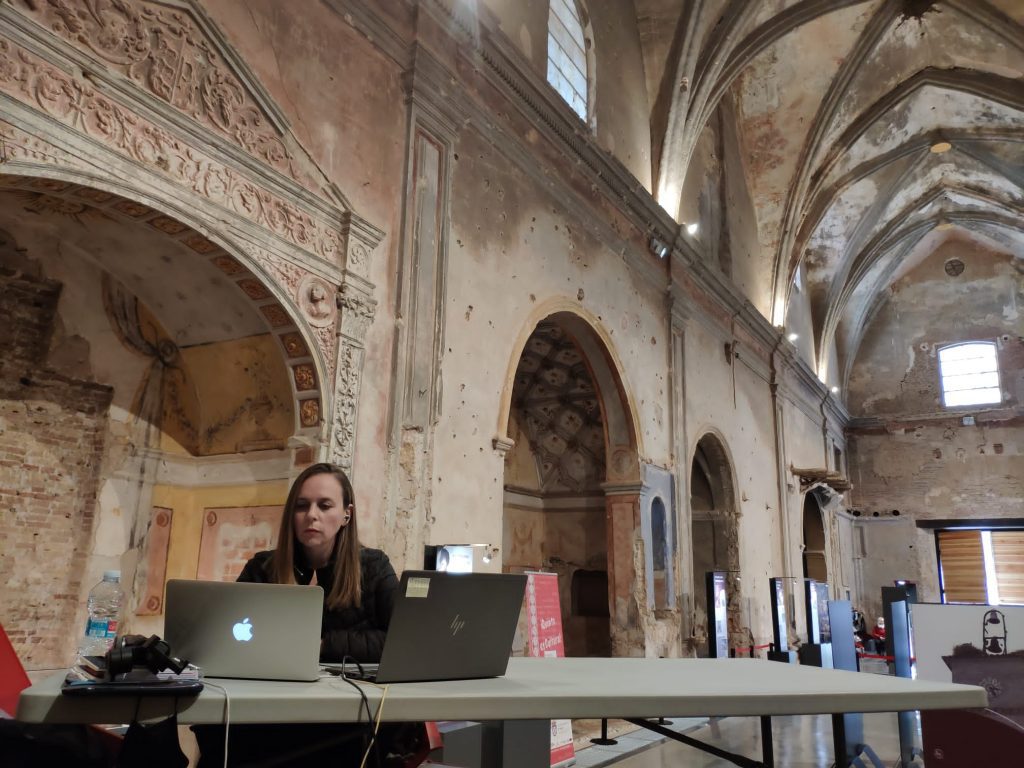
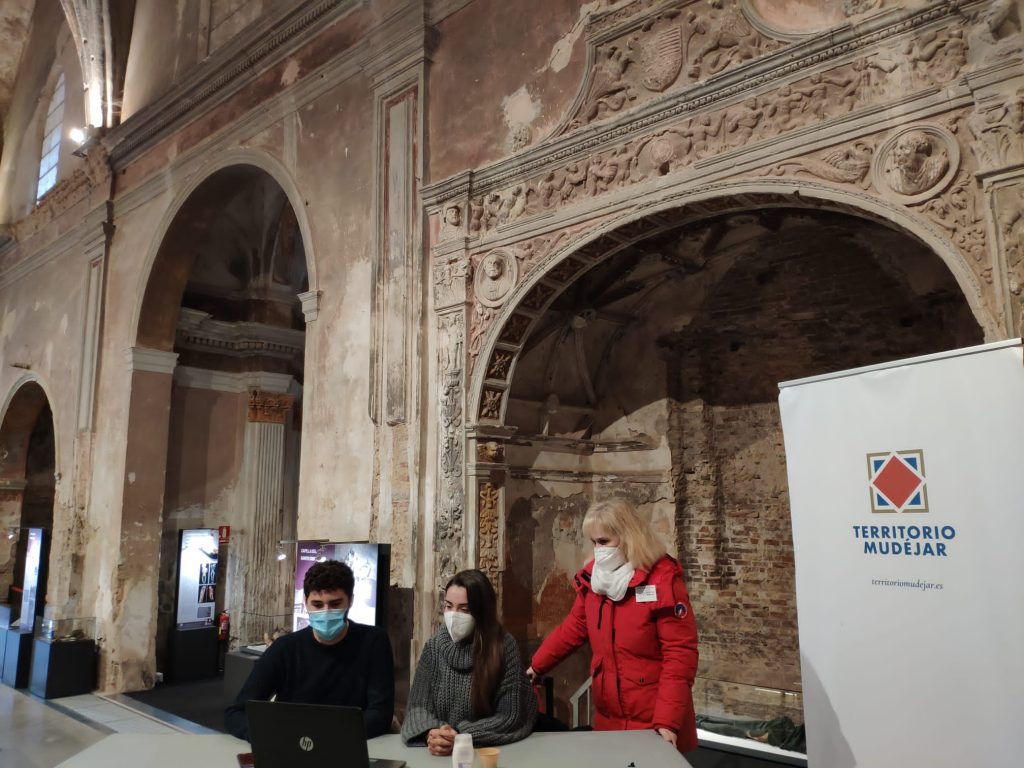
30 September [10:00–11:00]. Albalate del Arzobispo Castle. Alabaster Development Centre. Presentation: Key points for applying for the call for proposals. Webinar broadcast live from a heritage site. Open to the public in person

14 October [10:00–11:00]. Location to be determined. Presentation: Key points for applying for the call for proposals. Webinar broadcast live from a heritage site. Open to the public in person

21 October [10:00–11:00]. Location to be determined. Presentation: Key points for applying for the call for proposals. Webinar broadcast live from a heritage site. Open to the public in person.

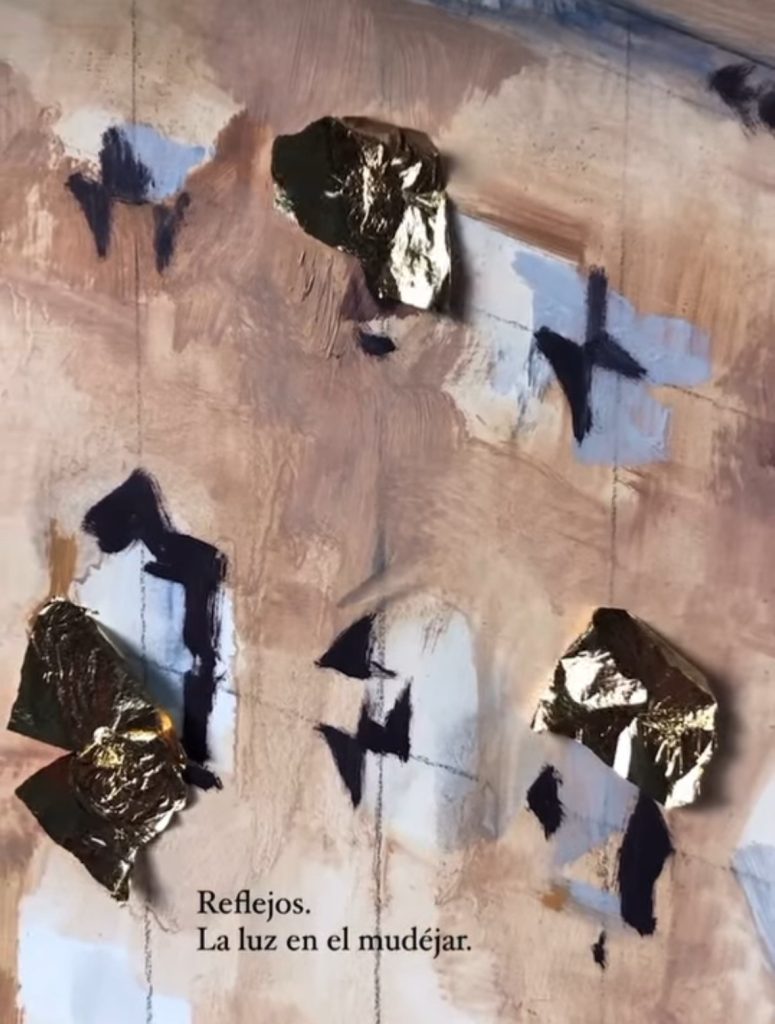
The exhibition “Light in Mudejar Art. The Wall as Skin” will be open to visitors in Cariñena until 19 September.

Territorio Mudéjar continues to support its partner towns in organising the most cultural and heritage-related aspects of their festivals. To kick off the year, the town council of Cariñena has included the temporary exhibition ‘Projects and Researchers: Pilar García Verón’ in its programme of festivities for Santo Cristo 2025. The exhibition analyses the research carried out since 2023 and showcases the most artistic results.

“The wall as skin: Light in Mudejar architecture” is an artistic research project that uses workbooks, materials, watercolours, collages and many other techniques to visually explain how light is used in Mudejar buildings to create space and sensations.

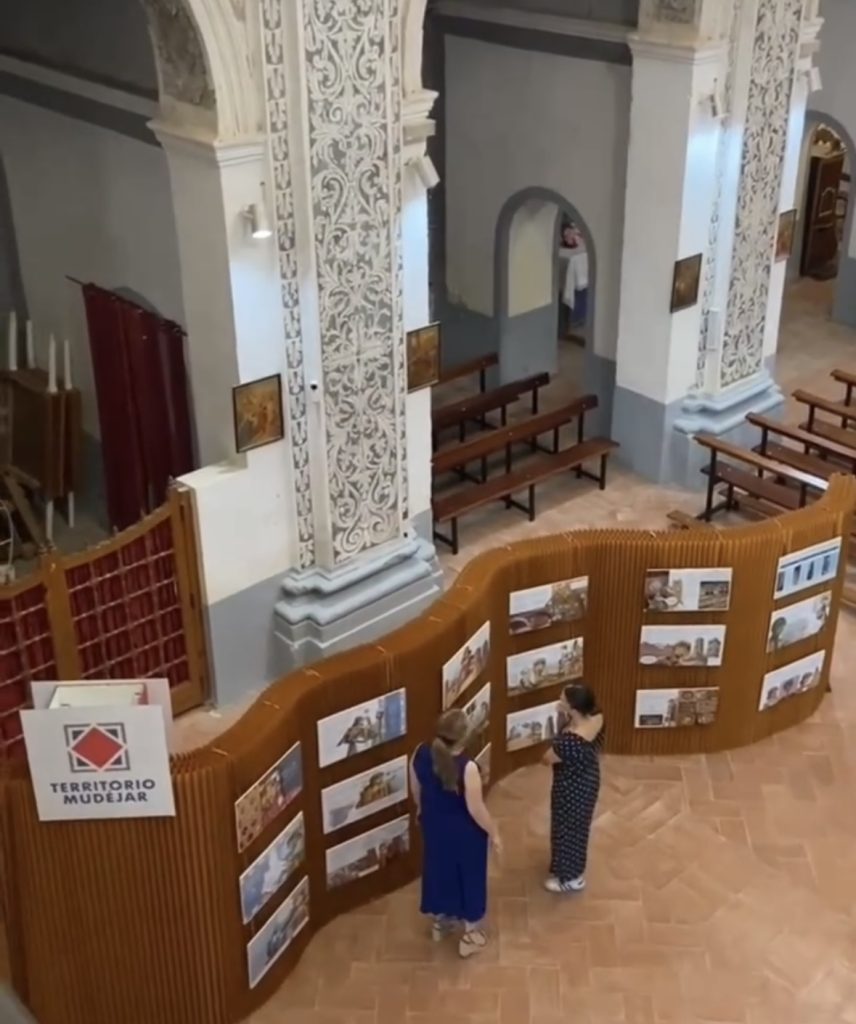
The exhibition features two display tables with artistic objects, canvases, materials and posters detailing various projects by the researcher. The display tables offer a preview of part of the new catalogue of project exhibitions that the Territorio Mudéjar network will be taking to its various partner locations over the coming months.

The exhibition has been set up in the exhibition hall of the Casa de Cultura in Cariñena and can be visited from Friday 12 September to Friday 19 September, every day from 7pm to 8.30pm.

The exhibition will close on Friday, 19 September, with a workshop on rapid watercolour painting, landscape and earth, given by artist and researcher Pilar García Verón.

We invite you to try watercolour painting. Attendance is free of charge, includes materials and is subject to space availability. It is designed for anyone who wants to experiment with their gaze, paint, brushes and materials. Just come along on Friday 19 September at 5pm and we will show you how we study Mudejar heritage through artistic observation.

The exhibition “Mudéjar, the guide” continues to tour our region: Villarreal de Huerva, Terrer and Villafeliche.

Summer is a time for visiting villages and a great opportunity to learn about their heritage and the work we do at Territorio Mudéjar. That is why the exhibition “Mudéjar, the guide” has continued touring our region over the past few weeks, stopping off at Villarreal de Huerva, Terrer and Villafeliche.

In Villarreal de Huerva, our internship team also visited the church of San Miguel Arcángel, located within an old fortified enclosure and which preserves a 15th-century Mudejar tower, the remains of an earlier construction. They also saw the remains of the castle that surrounds it and the chapel of the Virgen del Rosario. In Terrer, our interns welcomed visitors and answered their questions over the weekend. And in Villafeliche, they gave a presentation to the public in the parish church, where the exhibition was installed.

Territorio Mudéjar awards three stays and three artistic residencies for innovative projects that promote the conservation and use of Mudejar heritage in rural areas.

The Gonzalo M. Borrás Gualis stays to develop pilot projects will last six months and almost 15 villages, out of the 48 partners, will receive expert visits from the researchers.
Territorio Mudéjar has awarded three research stays and three artistic residencies aimed at supporting the work of researchers and project promoters who want to work on the development of villages through the responsible and sustainable use of cultural and natural heritage resources. This is the fifth edition of the Gonzalo M. Borrás Gualis research stays and projects and both the stays and the artistic residencies.
The projects selected range from research into new models of spiritual or religious tourism away from overcrowding, the study of painted inscriptions in Mudejar art, symbolism in our heritage, Mudejar ceramics, light in Mudejar spaces and dance and space from an artistic point of view.
These projects are in addition to the 23 from previous editions and the nearly 50 professionals who have formed the network of researchers of the stays since they were launched in 2019 and have provided new perspectives on the management of Mudejar heritage, have had a positive impact on the villages and have promoted an interdisciplinary work network. In addition, specifically, they have improved knowledge of the Mudejar as a World Heritage Site and the benefits it brings as an international brand recognised by Unesco.
The projects selected for Research Stays are:
  • New narratives on Mudejar heritage aimed at the public of knowledge and spiritual tourism in a global way. The author is Bárbara Ruiz Bejarano, PhD in Arabic and Islamic Studies (University of Alicante and Las Fuentes Foundation). This research project is part of the line “Strategic management of Mudejar heritage. Cultural landscape and urban landscape” and aims to generate dissemination narratives about the territory and research on a muslim-friendly, religious and knowledge tourism that adapts to the reality of the Mudejar heritage and its villages.
  • Reading the Mudejar: Arabic inscriptions in medieval Aragonese churches (13th-15th centuries). The author is María del Mar Valls Fusté, PhD in art history (Rovira i Virgili University) and the research project is part of the “New perspectives on Mudejar art” line. The project aims to study the inscriptions in Arabic preserved in medieval Aragonese interiors, with special attention to those present on the wooden roofs and alfarjes of Mudejar buildings.
  • Aesthetics and symbolism in Mudejar heritage. The author is Estrella Noguera Iturralde, philosopher and master in ancient world and archaeological heritage (Basque Public University and University of Zaragoza). It is part of the line “New views on Mudejar art” and studies the symbolism in the ornamental object of Aragonese Mudejar buildings from the point of view of art history and philosophical aesthetics.
The selected artist residencies are:
  • Mudéjar clay, by Javier Seral Posac, industrial designer, engineer in industrial organisation and senior technician in artistic ceramics. Mud is the basis of Mudejar construction and the author intends to use it to create pieces that reflect the Mudejar tradition and inspiration in the transformation of mud into ceramics. The residency will consist of the search for quarries, analysis of the plasticity of the samples, extraction of the clays and construction of the pieces.
  • The wall as dermis. Light in the Mudéjar II by the artist and visual arts researcher Pilar García Verón (Complutense University of Madrid). This residency continues the stay that the author carried out in 2022-2023 and studies the Mudejar as a screen for the projection and manifestation of light as a manifestation of divinity. On this occasion, she studies the filtered light of Mudéjar sacred spaces and its transcendence in space and time.
  • Incorporate. On the vulnerable or how to channel knowledge by Patricia Álvarez Álvaro, a graduate in Arabic Philology (Universidad Autónoma de Madrid) and trained in dance and dramaturgy of the image. This residency is based on a dialogue between the body and the Mudejar heritage space, through dance, using different techniques and skills: dance, theatre, performative installation, creative writing…

Territorio Mudéjar announces a new edition of its research stays to promote projects related to heritage in rural areas.

¿Te gustaría trabajar en el aula con materiales educativos en torno a la identidad mudéjar de los pueblos? ¿Entiendes el espacio patrimonial como un espacio de aprendizaje innovador?

En las próximas semanas dará comienzo la primera acción del proyecto “Circular por la escuela rural”, un curso de introducción al proyecto en el que Territorio Mudéjar ofrece a los interesados en vincular educación, patrimonio e innovación conocer el punto de partida y la metodología con la que se trabajará hasta mediados del 2022 junto a siete de los grupos de desarrollo local de la provincia de Zaragoza coordinados por el grupo ADRI Calatayud Aranda.

“Circular desde la Escuela Rural” es un proyecto de cooperación entre grupos de desarrollo rural coordinado por el grupo ADRI Calatayud-Aranda, junto a Cedemar, Adefo Cinco Villas, Asomo Moncayo, Adrae Comarca Ribera Alta del Ebro, Fedivalca y Adri Jiloca Gallocanta, y financiado por el Gobierno de Aragón, desde el programa Leader, y la Diputación Provincial de Zaragoza a través de la asociación Territorio Mudéjar, como entidad privada colaboradora que dirige la puesta en marcha y ejecución de la iniciativa.

El objetivo es desarrollar materiales educativos en torno a la identidad mudéjar de los pueblos poniendo como centro del proyecto a las escuelas rurales y a la comunidad educativa de los pueblos con una triple finalidad:

◾️Trabajar en la introducción de la identidad patrimonial mudéjar en los programas de trabajo de las escuelas más allá de las áreas artísticas o complementarias.

◾️Implicar a la comunidad educativa en la valoración del patrimonio mudéjar como parte de su historia personal lo cual favorece el conocimiento, la conservación y la difusión de la identidad de las localidades.

◾️Utilizar el trabajo realizado en las escuelas como material de difusión y uso turístico sobre el patrimonio mudéjar de los pueblos para un público familiar e infantil.

🔺 En el CURSO explicaremos la metodología de trabajo y los resultados del proyecto piloto que se llevó a cabo en el CRA Vicort Isuela en el curso 2018-2019 y que supone el punto de inicio para la implantación del proyecto en las escuelas de los pueblos de Territorio Mudéjar.

Los encargados de impartirlo serán Laura Castejón y Víctor Gumiel, maestros que llevaron a cabo el diseño y prueba del proyecto piloto, y Victoria E. Trasobares, directora de Territorio Mudéjar y con amplia experiencia en gestión e implantación de proyectos de gestión de patrimonio mudéjar en ámbito rural.

El Departamento de Educación lo ha incluido como curso homologado en su catálogo de actividades de formación permanente del profesorado y reconoce las horas de formación.

El curso se desarrollará telemáticamente a través de la plataforma digital de trabajo de la entidad que habilitaremos para la formación específica.

Información sobre el curso: https://mcusercontent.com/…/c70fb223…/CURSO_CIRCULAR.pdf

Solicitud de inscripción:

Opción 1: Si dispones de certificado o firma electrónica https://doceo.catedu.es/…/portadaInitConsultarActividad…

Opción 2: Si no dispones de certificado o firma electrónica escribe un mensaje a: info@territoriomudejar.es

Información sobre el proyecto: https://mcusercontent.com/…/9591a…/PROYECTO_CIRCULAR.pdf


Si tienes dudas o quieres consultarnos cualquier asunto particular puedes llamarnos al teléfono 876 634 125 o escribir un correo electrónico a info@territoriomudejar.es


Project MOMAr: Heritage beyond tourism

At Territorio Mudéjar we strive to develop Mudejar heritage management practices that foster responsible, sustainable tourism designed by those in the places where the heritage is located, always in conjunction with their inhabitants. We are convinced that preservation, research and dissemination of the Mudejar identity are key factors in the creation of tourism activities.

To consolidate this aim and share best practices, from today until November 13, we will be attending the second Interregional Event for Exchange of Experiences 2 (IEE 2), held in the province of Groningen, in the north of the Netherlands, entitled “Heritage, further than tourism: a sustainable future”.

Researcher Irene Ruiz Bazán (professor at the Polytechnic of Turin and Territorio Mudéjar fieldwork researcher) was in charge of moderating the good practice seminars in which several towns belonging to our network stood out in the presentation of unique projects.

The mayor of Torrellas, María Pilar Pérez, presented the Miau urban art project, which has been in place in the town since 2016.

From Alagón, as part of the Heritage and Education seminar, Julián Millán and Pablo Sebastián discussed the interesting work they are doing at the Ribera Alta del Ebro Workshop School.

And from Daroca, Irene Ruiz mentioned the work being done in Territorio Mudéjar, with contributions from researchers Ricardo Monreal and Marta López – 2020 Fieldwork grants – in the Mudejar civil architecture management project, which they are carrying out in accordance with the objectives of the new Fundación Campo de Daroca management body, reaching an important milestone by converting the Palacio de los Luna into a benchmark and a management model for private civil architecture.

On Friday, streaming from the Museo de Momias in Quinto, it will be time to look to the future in the conclusion sessions and also in the workshop on rural heritage management in the era of COVID-19, an issue that Territorio Mudéjar has thoroughly addressed so as to remain active while complying with all the safety measures and ensuring the safety of our visitors, but also, above all, that of the inhabitants of our towns.

Moreover, we have launched a multiplatform digital work solution in order to continue progressing with our projects online, aiming to work in an effective, innovative manner with historical and artistic resources, to the benefit of Mudejar heritage and our region.

Territorio Mudéjar has a strong presence in this forum, in which up to 12 people from our network are participating: students in the Challenge Program, members of city councils like those of Villarreal de Huerva and Maluenda, 2019 and 2020 fieldwork researchers, and more.

* Territorio Mudéjar is a member of MOMAr Interreg Europe (Models of Management for Singular Rural Heritage / Modelos de Gestión para el Patrimonio Rural Singular), which, under the leadership of the Provincial Government of Zaragoza and funded by the European Union, involves entities from six different countries.

Territorio Mudéjar as a role model of adapting one’s work in the era of the pandemic

Territorio Mudéjar outlined today, at the MOMAr Interregional Event, its strategy and the measures taken to continue its projects during the pandemic, in the hopes that our experience aids others in finding windows of opportunity at a time in which we must remain committed to sustainable heritage management and safe culture.

The director of Territorio Mudéjar, Victoria Trasobares, connected from the Museo de las Momias in Quinto to talk about the ways in which Territorio Mudéjar acted responsibly to protect both its network and the inhabitants of the member towns when COVID-19 broke out and the lockdowns began in March. First, the entity analyzed its action plan for 2020 and then arranged new ways of working with the towns, partners and professionals that are part of Territorio Mudéjar.

  • Daily tours of the region were replaced with virtual efforts thanks to the development of a platform that was already in progress and has proven to be highly efficient, overcoming the distances between the member towns. This has also prompted a move to develop a similar model for smart working in each of the towns.
  • Meetings also went online and we took part in national and international conversations to prepare transnational calls for proposals. Thus, the entity has constructed a network of professionals able to work remotely at the same pace and with the same goals.
  • In addition, Territorio Mudéjar has expanded its communication environments, linking our towns with international entities.
  • This has enabled them to continue using their heritage spaces, even while working remotely. And to continue focusing on creating new models of use for heritage spaces.
  • In the process, they have had to overcome difficulties, such as having to constantly reorganize their teamwork efforts and their project timelines.
  • Another complex issue was ensuring that the work done was always certain to be respectful of the inhabitants living in the historical and artistic heritage settings.
  • They also had to reorganize catering and projects.

As the director of Territorio Mudéjar, Victoria Trasobares, explained, “Our biggest success over these past months was our ability to naturally adapt to the unexpected situations, finding and taking advantage of the opportunities that arose along the way. For example, we have had a considerable presence in high impact projects like Google Arts and we were able to participate in high level events that, under normal circumstances, would have been hard for us to attend”.

In general, Territorio Mudéjar has not only continued its projects, but it even expects to see significant growth in 2021.

Territorio Mudéjar, an example of good practices at the seminar on cultural heritage as a sustainable resource in ‘empty Spain’

Territorio Mudéjar participates in the leading forums on heritage and innovation, including the online seminar entitled “El patrimonio cultural como recurso sostenible en la España vaciada” (Cultural heritage as a sustainable resource in empty Spain), sponsored by the Spanish Ministry of Culture and Sports. We not only attended, in this case, but also stood out as a role model of good practices.

At this meeting, coordinated by the Cultural Heritage Institute of Spain (IPCE) and held on October 5 and 6, the lecturers included full professors of the art history department at University of Zaragoza Ascensión Hernández Martínez and María Pilar Biel Ibáñez, who gave a conference entitled “La cultura y el patrimonio como recurso: la lucha de Aragón contra la despoblación” (Culture and heritage as a resource: Aragon’s fight against depopulation).

In line with the theme of the seminar, they discussed how this demographic challenge requires coming up with strategies to encourage people to stay in places with difficulties and studying measures that generate social benefits for the residents, attract visitors and possible new residents, and turn heritage into a driver of the economy, tourism and employment and, above all, to uphold a cultural identity.

In this regard, they explained how we, at Territorio Mudéjar, strive to consolidate a unified, collaborative management network for the use of historical and artistic resources linked to important Mudejar heritage in our towns. And also how we see these resources as a driving force in the development of the towns and as emblems of identity for upholding the communities existing in our region.

They further highlighted that our entity ensures that the projects directly affect the region through responsible and sustainable management of Mudejar cultural heritage.

Experts from the IPCE, the University of Seville’s Industrial Heritage Laboratory, the Santa María la Real and DeClausura Foundations, the Polytechnic University of Madrid School of Architecture, and Asociación Amigos de los Castillos, to name a few, also participated in the seminar. They discussed the issue of desertion of rural areas and the ensuing consequences for heritage, including the loss of traditional architecture and monuments, movable assets, habits and intangible customs.

They also assessed good practices such as reputable cultural routes, famous restoration projects, preserved monuments, foundations whose efforts have had excellent outcomes and models such as that of Territorio Mudéjar.

University of Zaragoza colloquium on the entrepreneurial adventure in rural settings

On October 15, Territorio Mudéjar took part in the discussion entitled: “Tu desafío: Conocer el mundo rural y sus posibilidades” (Your challenge: Discovering the rural world and its possibilities), organized by University of Zaragoza as part of its rural exchange program (Challenge Program) to talk about the entrepreneurial adventure.

Territorio Mudéjar is an active participant in this initiative, and has just started the second phase with its student internships. The director of Territorio Mudéjar, Victoria Trasobares, explained this, stressing that the program offers an opportunity for young people, who learn from it, and for the rural setting in which they develop their ideas.

Victoria Trasobares noted that Territorio Mudéjar makes use of its resources by generating a professional workplace; in other words, each area developed is professionalized. Since the entity works with historical and artistic heritage, there are obviously professionals with skills in this field.

Therefore, art history students are being trained in Territorio Mudéjar to construct learning experiences that take the context into account: Mudejar art, Aragonese art and a general context, because all genres are subject to some kind of influence.

Through this project, Territorio Mudéjar provides support in skills-building for art historians, so that they know how to search for information and how to use it. They also learn to discern the key components in ensuring that a project can be implemented with a likelihood of success.

In addition, this work helps further the project aimed at defining a specialized job profile for cultural heritage designated as UNESCO World Heritage located in rural settings. This Territorio Mudéjar project is funded by the Spanish Ministry of Culture and Sports, and by the Provincial Government of Zaragoza through its direct support for our entity.

Adrián Tambo from Ecotambo, Alicia Sáchez from #DulcesLocuras, Fran Saura Armelles, veterinarian, María Fernández Pérez Muro with the human resources recruiting and development department of Caja Rural de Aragón, Sandra Barceló, psychologist and independent educator specializing in social matters and mindfulness, and Yolanda Gimeno Cuenca, an environmental expert at Riegos del Alto Aragón, also took part in the University of Zaragoza course, sharing their experiences.

Meeting on depopulation: new job profiles for building a rural future

Territorio Mudéjar participated in the meeting on depopulation sponsored by Cadena SER in collaboration with the Provincial Government of Zaragoza on October 15 and 16 in Daroca and Paracuellos de Jiloca, reflecting on rural areas as a place for opportunities.

At the meeting, it was explained that towns need more than infrastructures to survive; specifically, intangible strategies are required, such as networking by public and private entities and a commitment to creativity and talent, ideas that form the foundations of Territorio Mudéjar.

Territorio Mudéjar sees the rural world as a place for opportunities at all levels, in which – as remarked during the meeting – disruptive elements that prompt a turning point are needed.

For Territorio Mudéjar, one key disruptive feature is professionalizing job profiles* linked to heritage, because this makes it possible to boost employment in rural settings, attract professionals and develop projects entailing investments.

For this reason, we are committed to finding new uses for heritage spaces and landscapes, such as technical tours, teaching specific subjects in these spaces, funding for internships, etc.

We further strengthen this course of action by attracting highly qualified professionals who generate diverse entrepreneurship projects that prompt them to settle in Mudejar locations. A clear example of this is our fieldwork grants for project development.

Furthermore, Territorio Mudéjar is seen as a role model of management and good practices in cooperation projects and transnational funding, with round tables, workshops, conferences and more.

In addition, Territorio Mudéjar engages in another of the leading lines of work highlighted at the Cadena SER meeting: education. Through projects such as ‘Territorio Mudéjar Circular desde la escuela’ (Territorio Mudéjar, Circular from schools), we strive to integrate heritage and its methods into curricula in order to raise awareness in school children about the identity of their towns and help them discover the professional options in their region. We do this through a cooperation project with local development groups, in which we are a partner.

*This Territorio Mudéjar project is funded by the Spanish Ministry of Culture and Sports, and by the Provincial Government of Zaragoza through its direct support for our entity.