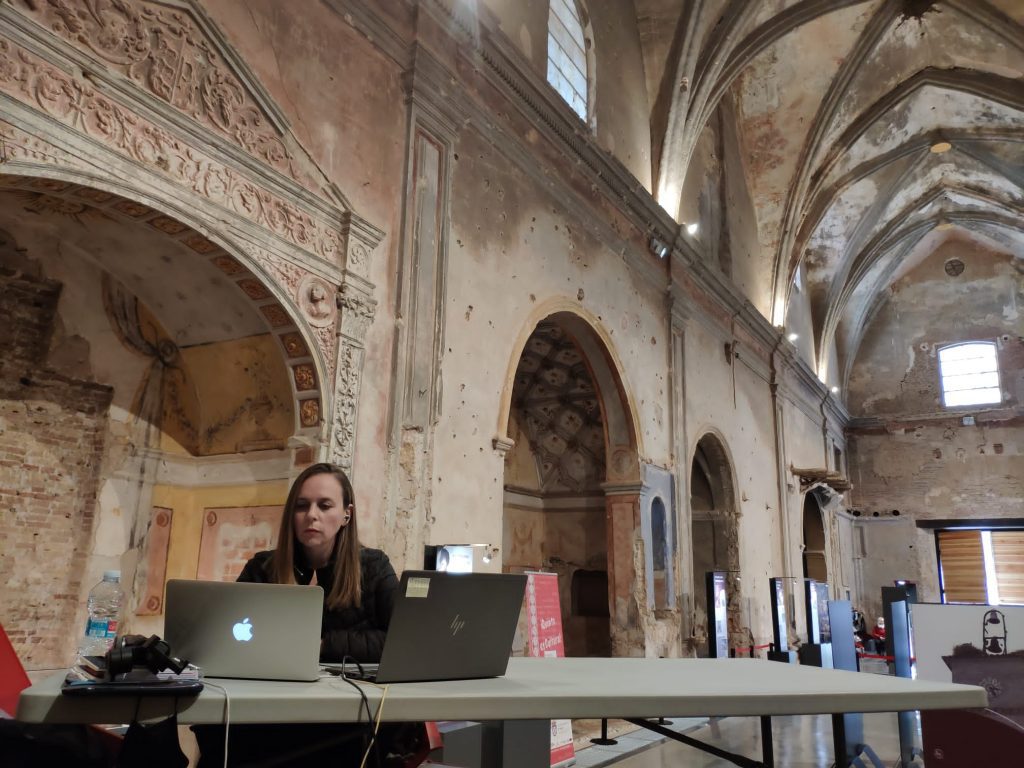
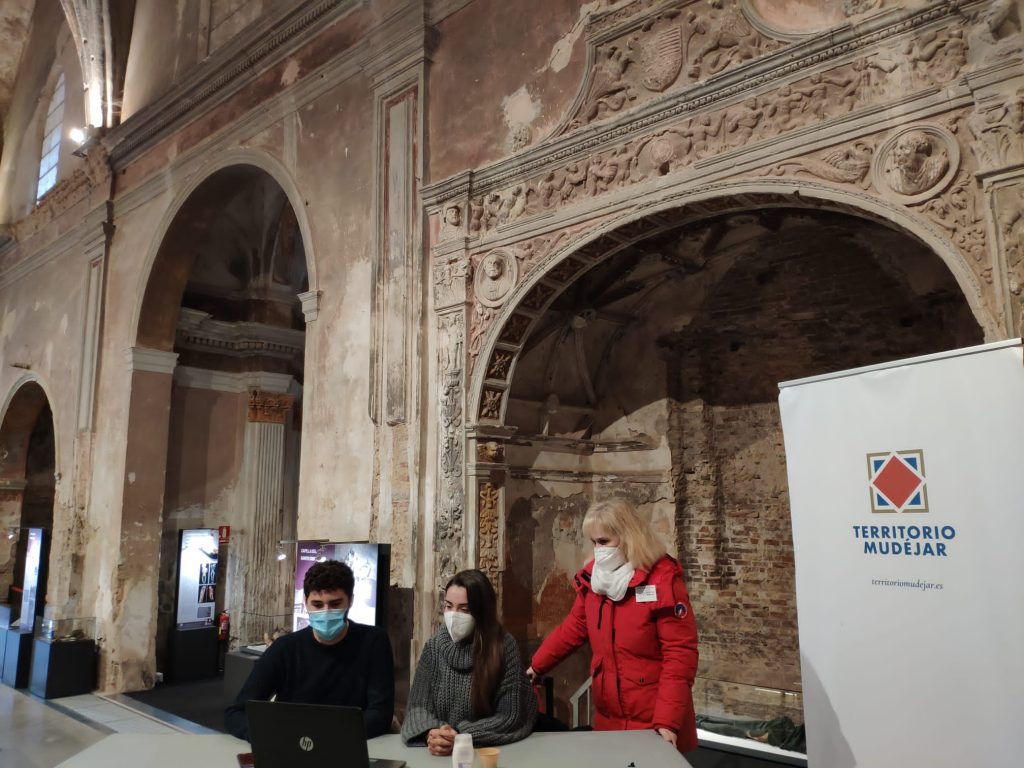
The European project MOMAr (Models of Management for Singular Rural Heritage) led by the DPZ and in which we are a stakeholder has reached its goal with the last study visit.
It has done so after four years of work, with a meeting in the province of Zaragoza that has brought together more than 60 experts in the field of heritage management and political representatives from five participating countries (Spain, Romania, the Netherlands, the Czech Republic and Germany), as well as a large group of public and private entities from the province of Zaragoza that have been an active part of the project.
MOMAr has served to promote the exchange of good practices in heritage management in rural areas of the five partner countries, as well as the implementation of new management models in each of the participating territories.
Territorio Mudéjar has been an active part of this project, which has allowed us to expose our good practices in Europe, to meet very interesting initiatives and to participate in international projects.
The final MOMAr conference has given the opportunity to explore the challenges of managing cultural and natural heritage in rural areas and to discover how partners have successfully implemented different projects and strategies in response to the singularities of these territories.
At this meeting, the manual of good practices was presented and visits were made to the industrial salt heritage of the village of Remolinos, the Uncastillo Foundation, the ceramics workshop school in Muel, Fuendetodos – with the house where Goya was born and the museum of engravings – and Los Bañales.
It has been a pleasure to share this learning journey with all of you. The project ends, but we continue to stay in touch as allies.
Would you like to work with educational materials related to the Mudejar identity of the villages in the classroom? Do you understand the heritage space as an innovative learning space?
In the coming weeks the first action of the project “Rural school in motion” (Circular desde la escuela rural) will begin, an introductory course to the project in which Territorio Mudéjar offers to those interested in linking education, heritage and innovation to know the starting point and the methodology with which it will work until mid 2022 together with seven of the local development groups in the province of Zaragoza coordinated by the ADRI Calatayud Aranda group.
“Rural school in motion” is a cooperation project between rural development groups coordinated by the ADRI Calatayud-Aranda group, together with Cedemar, Adefo Cinco Villas, Asomo Moncayo, Adrae Comarca Alta del Ebro, Fedivalca y Adri Jiloca Gallocanta, and financed by the Government of Aragon through the Leader programme and the Provincial Council of Zaragoza through the Territorio Mudéjar association, as a private collaborating entity that manages the implementation and execution of the initiative.
The aim is to develop educational materials related to the Mudejar identity of the villages, placing rural schools and the educational community of the villages at the centre of the project, with a triple purpose:
◾️To work on the introduction of the Mudejar heritage identity in the work programmes of schools beyond the artistic or complementary areas.
◾️To involve the educational community in the valuation of Mudejar heritage as part of their personal history, which favours the knowledge, conservation and dissemination of the identity of the towns.
◾️To use the work carried out in schools as material for dissemination and tourist use on the Mudejar heritage of the villages for family and children audiences.
🔺In the COURSE we will explain the working methodology and the results of the pilot project that was carried out in the CRA Vicort Isuela during the 2018-2019 academic year and which is the starting point for the implementation of the project in the schools of the villages of Territorio Mudéjar.
It will be taught by Laura Castejón and Víctor Gumiel, teachers who carried out the design and testing of the pilot project, and Victoria E. Trasobares, director of Territorio Mudéjar who has extensive experience in the management and implementation of Mudejar heritage management projects in rural areas.
The Department of Education has included it as an approved course in its catalogue of ongoing teacher training activities and recognises the training hours.
The course will be carried out on-line through the entity’s digital work platform that we will set up for the specific training.
Application form:
Option 1: If you have a digital certificate or signature
https://doceo.catedu.es/epgfp/portada
Option 2: If you do not have a digital certificate or signature, write a message to: info@territoriomudejar.es
If you have any doubts or you want to consult us about any particular issue you can call us on 876 634 125 or write an email to info@territoriomudejar.es
Today we introduce you to Andrea, an International Cooperation student from the University of Turin who is doing her internship at Territorio Mudéjar thanks to the European programme UNITA- Rural Mobility.
“I decided to do my internship with Territorio Mudéjar because I would like to specialise in local development in relation to cultural heritage management and sustainable tourism”, Andrea explains. And then adds: “I hope that through this experience I will be able to bring useful strategies for Italian heritage management and establish future relationships”.
At the moment she lives and works in Tobed, together with the students of the Challenge project of the University of Zaragoza.
This autumn, Territorio Mudéjar resumes its guided tours to discover the Mudejar heritage of the province of Zaragoza in its broadest sense – monuments, urbanism, landscape, trades… – always with scientific rigour and hand in hand with professionals. The initiative “Mudejar Territory: a journey to beauty”, promoted together with the Council of Zaragoza, includes 12 routes divided into five themes: cultural fusion, the origins of the artistic style, the towers and the fortress churches. It is a journey back in time through an artistic style that was present from the 13th to the 16th century and which left a legacy that has earned some of its monuments the UNESCO World Heritage designation.
The first routes begin in September:
The Mudejars: Mestizo Land and borderland: one through Magallón, Torrellas and Fréscano and another through Saviñán, Mesones de Isuela and La Almunia de Doña Godina. They will show how the period of fusion between the Christian, Jewish and Muslim cultures is still clearly reflected today in the country houses, urbanism and monuments of these towns.
Keys to a style: towers. You will visit Romanos, Villarreal de Hueva, Mainar and Villar de los Navarros. These routes immerse visitors in the origins of the style and explain how the Islamic tradition gradually gained ground, with its particular technical solutions, quality and attractive and captivating aesthetics. Specifically, these routes will visit the Mudejar towers, which characterise the ‘skyline’ of the territory and are one of the most exceptional representations of this style.
The Mudejar space: Tobed, Maluenda and Morata de Jiloca. This is a route through some of the most beautiful fortress-churches, temples of a clearly defensive style, with privileged locations, framed in beautiful country houses and integrated into the landscape.
This initiative is part of the commemoration of the 20th anniversary of the declaration of the Mudejar of the province of Zaragoza as a UNESCO World Heritage Site.
The pedagogical nature and the use of new technologies in the field of heritage management were the focus of the third interregional meeting of the European project MOMAr (IEEE3 From theory to practice.Experimental Models of Management Tested) in which we have participated this week as an attending “stakeholder”.
This event has allowed us to learn and be inspired by the initiatives that are being carried out in the field of Management of Singular Rural Heritage in all the countries participating in the project. This meeting has also allowed the use of cultural and natural spaces for the direct benefit and enjoyment of the population.
Thus, the Daroca Town Hall announced the International Early Music Festival, which, with almost half a century of history, has become a world reference. Both training courses and concerts are attended every year by hundreds of professionals and lovers of early music from all over the world. It is a meeting that brings together the immense local architectural and historical heritage with international art and culture. The festival’s director, Javier Artigas, took the opportunity to confirm that this year’s edition will take place from 3 to 10 August. The broadcast of this experience was made from the church of San Miguel.
Territorio Mudéjar has participated this Thursday in the second meeting of the European project MOMAr, a pioneering meeting with entities of the province linked to cultural heritage.
The event, with the aim of being a meeting point and a space to create new synergies within the sector, was held in an on-line format open to the public, with the participation of more than 50 professionals linked to heritage management and a streaming audience of more than 200 interested people.
In the session, we explained how we work to be a hub of rural innovation and follow strategies of:
Research: with stays and professional internships in rural areas.
Communication, dissemination and knowledge: with the inhabitants as protagonists, working to attract national and international entities to the territory, taking advantage of the World Heritage brand; and working carefully with the media.
Investment and future projects: Working with specialised teams in calls for funding and building virtual workspaces to strengthen collaboration strategies.
In addition, we have explained our role based on:
Use the heritage space from a disruptive point of view and directly linked to the local development of the communities.
The strengthening of historical-artistic heritage management thinking as a strategy, which affects multiple actions, and cultural management as a tool.
Attraction of professionals to the rural environment on a permanent basis, facilitating its implementation.
The evidence that the only way to have more significant results is through the strengthening of networking and the acquisition of roles within the network.
The need to exchange good practices without losing sight of the fact that it is not enough to replicate but to think about how it works in your territory and the assets on which your management is based.
And we talked about our commitment to professionalization understood as quality, projects and results.
The European MOMAr (Models of Management for Singular Rural Heritage) project, led by the Provincial Council of Zaragoza and in which Territorio Mudéjar participates, has brought together 28 heritage experts, including a delegation from Zaragoza, on a study visit to the province of Groningen (Netherlands). The goal is to exchange best practices and learn about Dutch management models firsthand.
The visit took place on April 27 and 28 and was attended by the Zaragoza Provincial Council, including Juan José Borque, coordinator of the Citizenship Department, and Mª Carmen Gracia, head of the Culture Service; Victoria Trasobares, director of Territorio Mudéjar; three of the mayors who belong to the association: Maria Rosario Lázaro, mayor of Villarreal de Huerva; Marta Gracia Blanco, mayor of Almunia de Doña Godina; and Alfonso Puertas, mayor of Torralba de Ribota; and Julio Zaldívar, manager of the Tarazona Monumental Foundation.
MOMAr’s European partners from Mehedinti County (Romania), the Saxony-Anhalt region (Germany), South Bohemia (Czech Republic), the Dutch hosts, and the project’s technical advisory committee, formed by Irene Ruiz and Marisa Sebastián, also participated.
This study visit is the third of a total of four, which seek to exchange knowledge on asset management models among European experts, all from rural areas. The ultimate goal is to import best practices and, with them, develop an Action Plan in which each region will develop new proposals for improving local projects.
The rehabilitation of historical heritage, giving it new social and educational uses for the benefit of local communities, through cooperation between public administrations and private properties, marked the practical visits on this trip.
The first stop on the tour was Maarhuizen, an architectural complex located atop an artificial mound, remnant of what was once a farming village centuries ago. Today, one of its former farms is being reconstructed as part of a holistic project seeking to create a cultural and natural meeting point, involving educational centers in the rehabilitation process.
We visited one of the churches of the Groningen Historic Church Foundation. This organization manages nearly 100 churches, most of them medieval and privately owned. In these churches, religious space has become a community space, open to the public and serving social purposes. Proof of this is the exhibition “Festivity! In the East and in the West,” located in a restored medieval tower and exploring celebrations of different religions (Catholic, Jewish, and Muslim). Through an interactive experience, the exhibition seeks to create common ground between different faiths and open up a non-judgmental intercultural dialogue among its visitors.
The expedition also approached the Wadden Sea, the largest intertidal flat system in the world, listed by UNESCO as a World Heritage Site for its unique geological and ecological values and high biological diversity.
The rural region of Oldamst, located near the German border, was the focus of experts’ attention during the second day of work. This area was considered the breadbasket of Holland decades ago thanks to its fertile land. However, depopulation and the loss of local agriculture have left hundreds of farms abandoned or in serious danger of collapse. Adding to this process of degradation are earthquakes, largely caused by gas extraction, and soil oxidation, which causes significant subsidence. Thus, an enormous historical heritage, in private hands, faces the costly challenge of reconstruction and rehabilitation, but they are not doing it alone, as public administrations are contributing financially and strategically to the preservation of these centuries-old buildings.
Territorio Mudéjar has taken part in the study trip-visit to South Bohemia, in the Czech Republic, as part of the MOMAr programme, in which it participates.
After two years of work identifying good practices in heritage management in rural areas of Europe, this trip has allowed the projects presented by the partner from the Czech Republic to be seen on the ground. A form of knowledge exchange between international experts that offers the possibility of assessing the importation of successful cases to the reality of heritage in Zaragoza.
The conference began with a presentation of the tourist offer of the South Bohemia region by the director of the regional tourist office, together with a visit to the castle hotel in the town of Hluvoboká nad vltavou.
Afterwards, a visit was made to a historic malting plant in the village of Písek as an example of reconstruction of industrial heritage for social use. The building is now a public toy library offering educational exhibitions for children, with great success among the local population.
The experts got to know the Soběslav municipal library, a success story in the recovery of a disused historical space. The public facility is located in what used to be a medieval castle, which, thanks to the architectural renovation initiated by the residents, now offers a communal space for the local community dedicated to culture.
On the second day, the trip began with a visit to the monument to the national hero, Jan Žižka, in the village of Trocnov, a replica of a medieval farmhouse completely reconstructed with original materials and techniques. It is a necessary and unique place for the recovery of historical memory in the whole country, as no original building from that time has been preserved.
There was also a visit to a 14th century castle which the Malše River Castles Association is rebuilding through a cross-border cooperation project with Austria and which is part of an extensive line of defence along the common border.
There, a working session was held between the project partners to analyse cases of heritage infragestion and from which it was concluded that it is necessary to include the local population in all heritage management projects. Together with the Libau Foundation of Groningen, Territorio Mudéjar participated as a stakeholder, contributing its experience in the management of heritage resources in rural areas as part of local development in all its facets.
The day ended with a tour of the Renaissance town of Český Krumlov, a UNESCO World Heritage Site. The town attracted millions of tourists before the pandemic but the consequences on international mobility have made it a case study because of the challenges and opportunities that are now opening up in the field of heritage management.
The Spanish delegation was made up of those responsible for the project on behalf of the Diputación de Zaragoza, Lorena Laga and Isabel Soria, as well as the director of Territorio Mudéjar, Victoria Trasobares; and the mayors of Quinto, Jesús Morales; of Torrellas, María Pilar Pérez; and of Velilla de Ebro, María Rosario Gómez.
They were accompanied by MOMAr’s European partners from Mehedinti County (Romania), the region of Saxony-Anhalt (Germany), the province of Groningen (The Netherlands), the Czech hosts, and the project’s technical advisory committee formed by Irene Ruíz and Marisa Sebastián.
At Territorio Mudéjar we strive to develop Mudejar heritage management practices that foster responsible, sustainable tourism designed by those in the places where the heritage is located, always in conjunction with their inhabitants. We are convinced that preservation, research and dissemination of the Mudejar identity are key factors in the creation of tourism activities.
To consolidate this aim and share best practices, from today until November 13, we will be attending the second Interregional Event for Exchange of Experiences 2 (IEE 2), held in the province of Groningen, in the north of the Netherlands, entitled “Heritage, further than tourism: a sustainable future”.
Researcher Irene Ruiz Bazán (professor at the Polytechnic of Turin and Territorio Mudéjar fieldwork researcher) was in charge of moderating the good practice seminars in which several towns belonging to our network stood out in the presentation of unique projects.
The mayor of Torrellas, María Pilar Pérez, presented the Miau urban art project, which has been in place in the town since 2016.
From Alagón, as part of the Heritage and Education seminar, Julián Millán and Pablo Sebastián discussed the interesting work they are doing at the Ribera Alta del Ebro Workshop School.
And from Daroca, Irene Ruiz mentioned the work being done in Territorio Mudéjar, with contributions from researchers Ricardo Monreal and Marta López – 2020 Fieldwork grants – in the Mudejar civil architecture management project, which they are carrying out in accordance with the objectives of the new Fundación Campo de Daroca management body, reaching an important milestone by converting the Palacio de los Luna into a benchmark and a management model for private civil architecture.
On Friday, streaming from the Museo de Momias in Quinto, it will be time to look to the future in the conclusion sessions and also in the workshop on rural heritage management in the era of COVID-19, an issue that Territorio Mudéjar has thoroughly addressed so as to remain active while complying with all the safety measures and ensuring the safety of our visitors, but also, above all, that of the inhabitants of our towns.
Moreover, we have launched a multiplatform digital work solution in order to continue progressing with our projects online, aiming to work in an effective, innovative manner with historical and artistic resources, to the benefit of Mudejar heritage and our region.
Territorio Mudéjar has a strong presence in this forum, in which up to 12 people from our network are participating: students in the Challenge Program, members of city councils like those of Villarreal de Huerva and Maluenda, 2019 and 2020 fieldwork researchers, and more.
* Territorio Mudéjar is a member of MOMAr Interreg Europe (Models of Management for Singular Rural Heritage / Modelos de Gestión para el Patrimonio Rural Singular), which, under the leadership of the Provincial Government of Zaragoza and funded by the European Union, involves entities from six different countries.
Territorio Mudéjar outlined today, at the MOMAr Interregional Event, its strategy and the measures taken to continue its projects during the pandemic, in the hopes that our experience aids others in finding windows of opportunity at a time in which we must remain committed to sustainable heritage management and safe culture.
The director of Territorio Mudéjar, Victoria Trasobares, connected from the Museo de las Momias in Quinto to talk about the ways in which Territorio Mudéjar acted responsibly to protect both its network and the inhabitants of the member towns when COVID-19 broke out and the lockdowns began in March. First, the entity analyzed its action plan for 2020 and then arranged new ways of working with the towns, partners and professionals that are part of Territorio Mudéjar.
Daily tours of the region were replaced with virtual efforts thanks to the development of a platform that was already in progress and has proven to be highly efficient, overcoming the distances between the member towns. This has also prompted a move to develop a similar model for smart working in each of the towns.
Meetings also went online and we took part in national and international conversations to prepare transnational calls for proposals. Thus, the entity has constructed a network of professionals able to work remotely at the same pace and with the same goals.
In addition, Territorio Mudéjar has expanded its communication environments, linking our towns with international entities.
This has enabled them to continue using their heritage spaces, even while working remotely. And to continue focusing on creating new models of use for heritage spaces.
In the process, they have had to overcome difficulties, such as having to constantly reorganize their teamwork efforts and their project timelines.
Another complex issue was ensuring that the work done was always certain to be respectful of the inhabitants living in the historical and artistic heritage settings.
They also had to reorganize catering and projects.
As the director of Territorio Mudéjar, Victoria Trasobares, explained, “Our biggest success over these past months was our ability to naturally adapt to the unexpected situations, finding and taking advantage of the opportunities that arose along the way. For example, we have had a considerable presence in high impact projects like Google Arts and we were able to participate in high level events that, under normal circumstances, would have been hard for us to attend”.
In general, Territorio Mudéjar has not only continued its projects, but it even expects to see significant growth in 2021.
Utilizamos cookies para asegurarte la mejor experiencia en nuestra web. Puedes consultar más detalles
Funcionales
Always active
El almacenamiento o acceso técnico es estrictamente necesario para el propósito legítimo de permitir el uso de un servicio específico explícitamente solicitado por el abonado o usuario, o con el único propósito de llevar a cabo la transmisión de una comunicación a través de una red de comunicaciones electrónicas.
Preferencias
El almacenamiento o acceso técnico es necesario para la finalidad legítima de almacenar preferencias no solicitadas por el abonado o usuario.
Estadísticas
El almacenamiento o acceso técnico que es utilizado exclusivamente con fines estadísticos.El almacenamiento o acceso técnico que se utiliza exclusivamente con fines estadísticos anónimos. Sin un requerimiento, el cumplimiento voluntario por parte de tu Proveedor de servicios de Internet, o los registros adicionales de un tercero, la información almacenada o recuperada sólo para este propósito no se puede utilizar para identificarte.
Marketing
El almacenamiento o acceso técnico es necesario para crear perfiles de usuario para enviar publicidad, o para rastrear al usuario en una web o en varias web con fines de marketing similares.