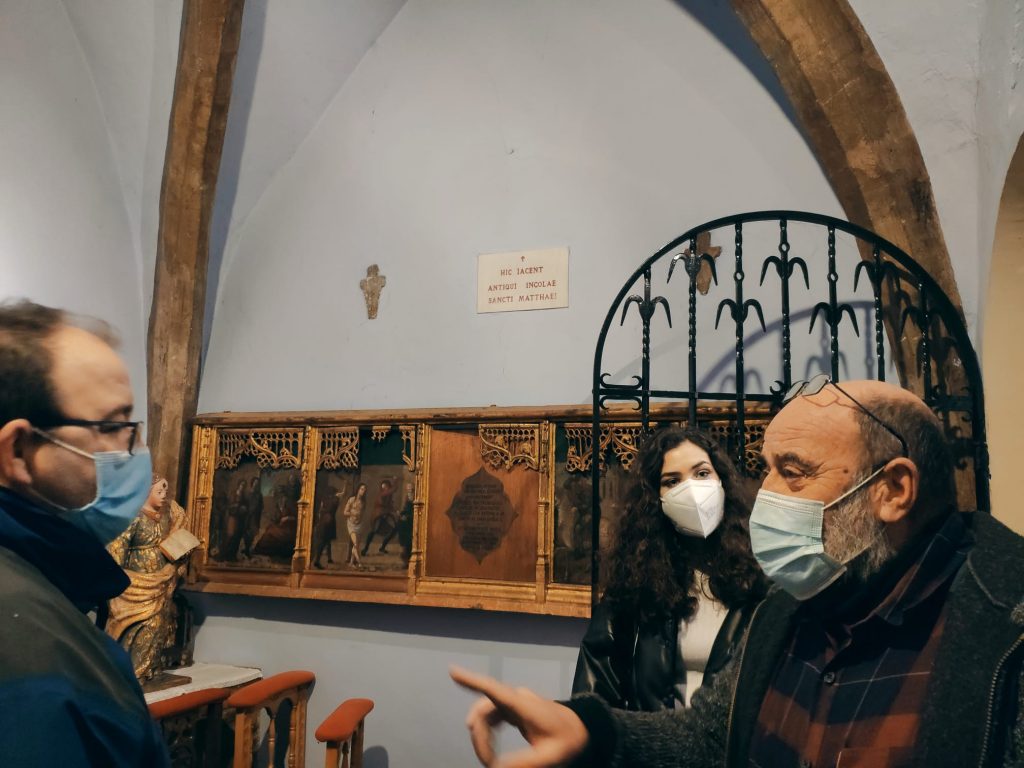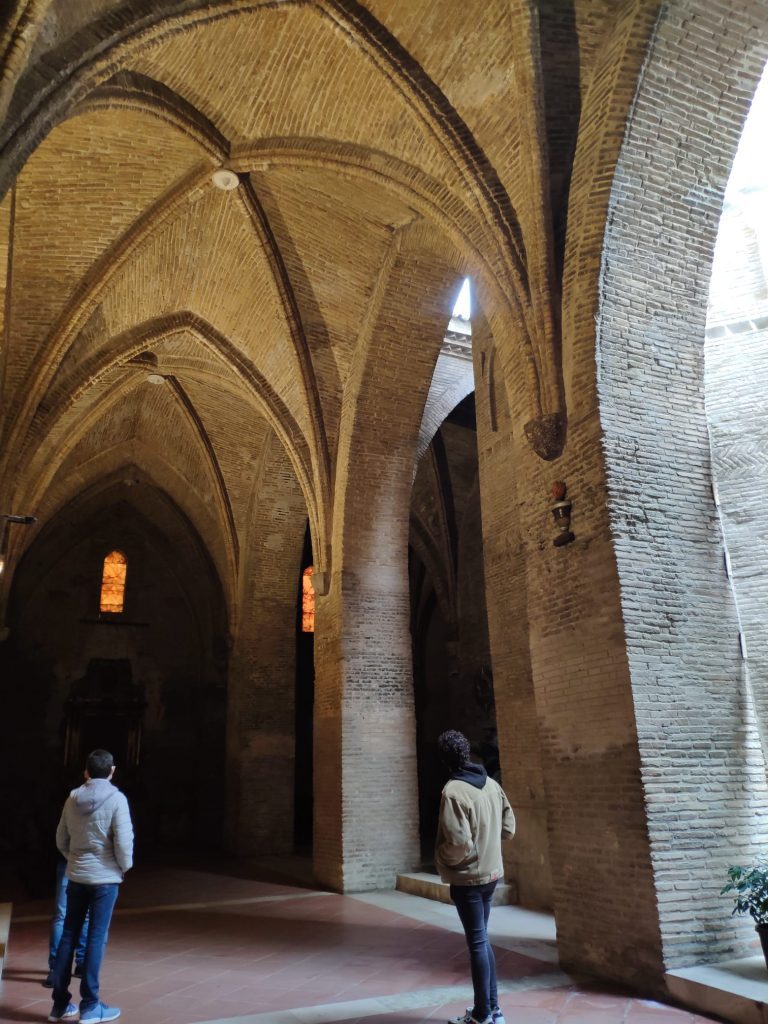
Territorio Mudéjar awards three stays and three artistic residencies for innovative projects that promote the conservation and use of Mudejar heritage in rural areas.

The Gonzalo M. Borrás Gualis stays to develop pilot projects will last six months and almost 15 villages, out of the 48 partners, will receive expert visits from the researchers.
Territorio Mudéjar has awarded three research stays and three artistic residencies aimed at supporting the work of researchers and project promoters who want to work on the development of villages through the responsible and sustainable use of cultural and natural heritage resources. This is the fifth edition of the Gonzalo M. Borrás Gualis research stays and projects and both the stays and the artistic residencies.
The projects selected range from research into new models of spiritual or religious tourism away from overcrowding, the study of painted inscriptions in Mudejar art, symbolism in our heritage, Mudejar ceramics, light in Mudejar spaces and dance and space from an artistic point of view.
These projects are in addition to the 23 from previous editions and the nearly 50 professionals who have formed the network of researchers of the stays since they were launched in 2019 and have provided new perspectives on the management of Mudejar heritage, have had a positive impact on the villages and have promoted an interdisciplinary work network. In addition, specifically, they have improved knowledge of the Mudejar as a World Heritage Site and the benefits it brings as an international brand recognised by Unesco.
The projects selected for Research Stays are:
  • New narratives on Mudejar heritage aimed at the public of knowledge and spiritual tourism in a global way. The author is Bárbara Ruiz Bejarano, PhD in Arabic and Islamic Studies (University of Alicante and Las Fuentes Foundation). This research project is part of the line “Strategic management of Mudejar heritage. Cultural landscape and urban landscape” and aims to generate dissemination narratives about the territory and research on a muslim-friendly, religious and knowledge tourism that adapts to the reality of the Mudejar heritage and its villages.
  • Reading the Mudejar: Arabic inscriptions in medieval Aragonese churches (13th-15th centuries). The author is María del Mar Valls Fusté, PhD in art history (Rovira i Virgili University) and the research project is part of the “New perspectives on Mudejar art” line. The project aims to study the inscriptions in Arabic preserved in medieval Aragonese interiors, with special attention to those present on the wooden roofs and alfarjes of Mudejar buildings.
  • Aesthetics and symbolism in Mudejar heritage. The author is Estrella Noguera Iturralde, philosopher and master in ancient world and archaeological heritage (Basque Public University and University of Zaragoza). It is part of the line “New views on Mudejar art” and studies the symbolism in the ornamental object of Aragonese Mudejar buildings from the point of view of art history and philosophical aesthetics.
The selected artist residencies are:
  • Mudéjar clay, by Javier Seral Posac, industrial designer, engineer in industrial organisation and senior technician in artistic ceramics. Mud is the basis of Mudejar construction and the author intends to use it to create pieces that reflect the Mudejar tradition and inspiration in the transformation of mud into ceramics. The residency will consist of the search for quarries, analysis of the plasticity of the samples, extraction of the clays and construction of the pieces.
  • The wall as dermis. Light in the Mudéjar II by the artist and visual arts researcher Pilar García Verón (Complutense University of Madrid). This residency continues the stay that the author carried out in 2022-2023 and studies the Mudejar as a screen for the projection and manifestation of light as a manifestation of divinity. On this occasion, she studies the filtered light of Mudéjar sacred spaces and its transcendence in space and time.
  • Incorporate. On the vulnerable or how to channel knowledge by Patricia Álvarez Álvaro, a graduate in Arabic Philology (Universidad Autónoma de Madrid) and trained in dance and dramaturgy of the image. This residency is based on a dialogue between the body and the Mudejar heritage space, through dance, using different techniques and skills: dance, theatre, performative installation, creative writing…

Special agreement with the municipality of Daroca to form a technical and scientific advisory work team for the Tourism Sustainability Plan.

Territorio Mudéjar has signed a special agreement with the town council of Daroca to form a technical and scientific advisory work team for the local tourist destination sustainability plan.

The “Sustainability and Modernization Plan of the City Council of Daroca. Facilitating access to Heritage from accessibility” (PSTD) has included Territorio Mudéjar -an association of which Daroca has been a founding member since 2018- in its technical-scientific work table. The entity will collaborate in the project through advice, consultation, monitoring and scientific support in terms of historical-artistic heritage management for the development of the Plan.

We recall that this project was approved by the Secretary of State for Tourism of the Ministry of Industry, Trade and Tourism and the Department of Industry, Competitiveness and Business Development of the Government of Aragon at the end of 2022. And it is focused on several actions:

  • The adequacy of the walled framework.
  • The adequacy of the area of the Castillo Mayor.
  • The adequacy of roads and trails that allow access and visit both castle, walls and other existing monuments (towers, La Mina, green areas, etc.).
  • The decoration of facades within the Lienzos de Historia project, also known as Muralea.
  • The adequacy and rehabilitation of streets with the burying of wiring.

A large part of the actions of this sustainability plan affect the Historic-Artistic Site of Cultural Interest of the city of Daroca, declared according to Decree 1450/1968 of June 6 and published in the BOE nº158 of July 2, 1968. And to assets of different nature included as the fortified enclosure of Daroca and “La Mina”, both declared BIC.

In this context, Territorio Mudéjar will create a specific work team to support the municipality of Daroca in the development of the PSTD. The team will have a group of experts coordinated by the management team. To form this team, Territorio Mudéjar will select:

A scientific-technical advisor expert in the management of the historical-artistic heritage of Daroca from the field of preventive conservation, intervention and the study of the use of heritage in the service of cultural and heritage tourism.

It will also have two emerging professionals as project assistants and will create a training internship position for recent graduates through an agreement signed with UNIVERSA – Employment Counseling Office of the University of Zaragoza-.

Finally, a PSTDoffice will be created for neighbors, businesses and those interested in the project in order to study the synergies arising from the Plan .

CONVOCATIONS:

  • Extraordinary professional call.

Selection of an assistant professional

Project Management

Advice, consultation, monitoring and scientific support in the management of historical-artistic heritage for the development of the Tourism Sustainability Plan for the city of Daroca.

Electronic address: https://www.territoriomudejar.es/convocatoria-plan-de-sostenibilidad-daroca/

Publication of terms and conditions: August 16 , 2023

Submission of bids: Until August 31 , 2023 at info@territoriomudejar.es.

  • Call for internships for recent graduates.

Selection of a “Training internship through projects” position.

Information: info@territoriomudejar.es

Applications: As of September 1 , 2023

If you have any doubts or would like to consult us about any particular issue regarding the project, you can call us at 876 634 125 or write an e-mail to info@territoriomudejar.es.

Territorio Mudéjar announces a new edition of its research stays to promote projects related to heritage in rural areas.

¿Te gustaría trabajar en el aula con materiales educativos en torno a la identidad mudéjar de los pueblos? ¿Entiendes el espacio patrimonial como un espacio de aprendizaje innovador?

En las próximas semanas dará comienzo la primera acción del proyecto “Circular por la escuela rural”, un curso de introducción al proyecto en el que Territorio Mudéjar ofrece a los interesados en vincular educación, patrimonio e innovación conocer el punto de partida y la metodología con la que se trabajará hasta mediados del 2022 junto a siete de los grupos de desarrollo local de la provincia de Zaragoza coordinados por el grupo ADRI Calatayud Aranda.

“Circular desde la Escuela Rural” es un proyecto de cooperación entre grupos de desarrollo rural coordinado por el grupo ADRI Calatayud-Aranda, junto a Cedemar, Adefo Cinco Villas, Asomo Moncayo, Adrae Comarca Ribera Alta del Ebro, Fedivalca y Adri Jiloca Gallocanta, y financiado por el Gobierno de Aragón, desde el programa Leader, y la Diputación Provincial de Zaragoza a través de la asociación Territorio Mudéjar, como entidad privada colaboradora que dirige la puesta en marcha y ejecución de la iniciativa.

El objetivo es desarrollar materiales educativos en torno a la identidad mudéjar de los pueblos poniendo como centro del proyecto a las escuelas rurales y a la comunidad educativa de los pueblos con una triple finalidad:

◾️Trabajar en la introducción de la identidad patrimonial mudéjar en los programas de trabajo de las escuelas más allá de las áreas artísticas o complementarias.

◾️Implicar a la comunidad educativa en la valoración del patrimonio mudéjar como parte de su historia personal lo cual favorece el conocimiento, la conservación y la difusión de la identidad de las localidades.

◾️Utilizar el trabajo realizado en las escuelas como material de difusión y uso turístico sobre el patrimonio mudéjar de los pueblos para un público familiar e infantil.

🔺 En el CURSO explicaremos la metodología de trabajo y los resultados del proyecto piloto que se llevó a cabo en el CRA Vicort Isuela en el curso 2018-2019 y que supone el punto de inicio para la implantación del proyecto en las escuelas de los pueblos de Territorio Mudéjar.

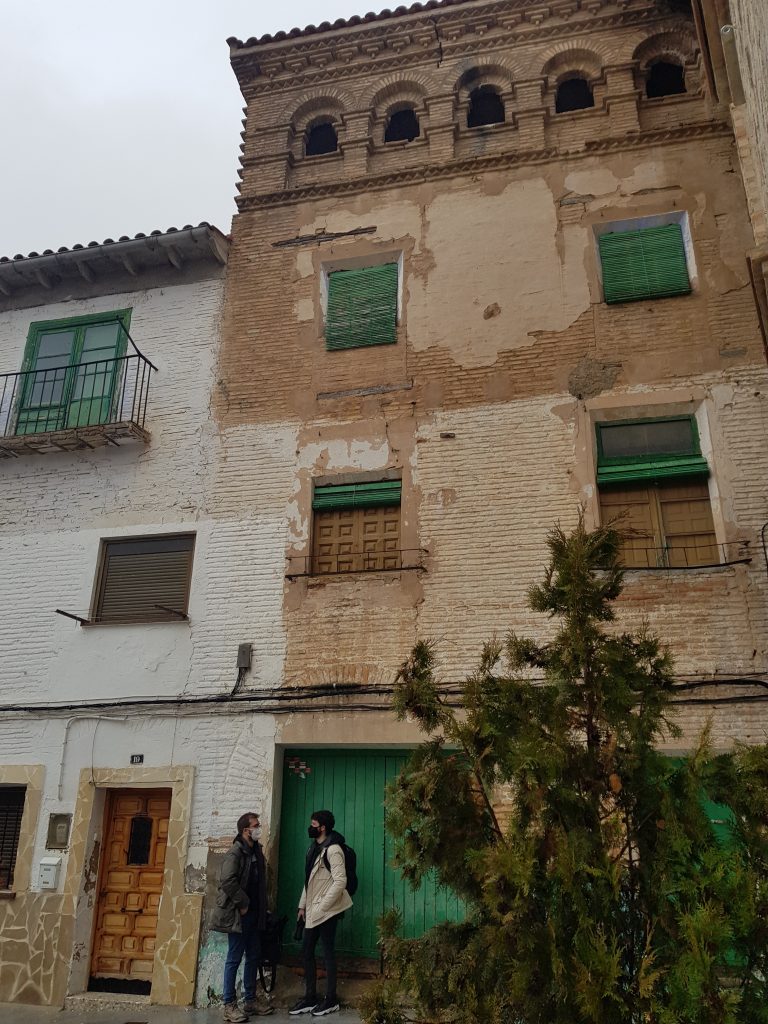
Los encargados de impartirlo serán Laura Castejón y Víctor Gumiel, maestros que llevaron a cabo el diseño y prueba del proyecto piloto, y Victoria E. Trasobares, directora de Territorio Mudéjar y con amplia experiencia en gestión e implantación de proyectos de gestión de patrimonio mudéjar en ámbito rural.

El Departamento de Educación lo ha incluido como curso homologado en su catálogo de actividades de formación permanente del profesorado y reconoce las horas de formación.

El curso se desarrollará telemáticamente a través de la plataforma digital de trabajo de la entidad que habilitaremos para la formación específica.

Información sobre el curso: https://mcusercontent.com/…/c70fb223…/CURSO_CIRCULAR.pdf

Solicitud de inscripción:

Opción 1: Si dispones de certificado o firma electrónica https://doceo.catedu.es/…/portadaInitConsultarActividad…

Opción 2: Si no dispones de certificado o firma electrónica escribe un mensaje a: info@territoriomudejar.es

Información sobre el proyecto: https://mcusercontent.com/…/9591a…/PROYECTO_CIRCULAR.pdf


Si tienes dudas o quieres consultarnos cualquier asunto particular puedes llamarnos al teléfono 876 634 125 o escribir un correo electrónico a info@territoriomudejar.es


Territorio Mudéjar, a breeding ground for new professionals in the management of historical-artistic heritage

At Territorio Mudéjar we make the most of our resources to generate professional fields of excellence, in which each area we develop is specialised and works to find solutions of innovative use for the “heritage space” as a space for professional development and learning.

These days we are finalising the different actions that are part of the practical study for the definition of a specialised professional profile for cultural heritage located in rural territories and that in our case coincides with the work that we actively carry out with the localities that hold the UNESCO World Heritage declaration.

This project, funded by the Ministry of Culture and Sport through its 2019 call of grants for projects for the conservation, protection and dissemination of World Heritage Sites, as well as by the Council of Zaragoza through its direct aid to Territorio Mudéjar, aims to make our entity a benchmark in terms of the quality applied to the development of projects linked to management and accessibility strategies, understanding that the quality and achievement of objectives of our projects must begin by strengthening the skills and abilities of the people who work on them on a daily basis.

In this line, we have developed different actions throughout the year 2020 through which we are working on the creation of synergies with entities of recognised prestige in our territory such as the Tarazona Monumental Foundation, the Santa Mª de Albarracín Foundation, the Association of Municipalities of the Camino de Santiago or the Sobrarbe-Pyrenees Geopark, among others.

In addition, we are in continuous contact with national and international entities that work to ensure that professionalization is the key to the future of our heritage as an economic agent and from different points of view, such as Icomos España or Aproha.

The richest and most stimulating actions are found in the incorporation of students, recent graduates and emerging professionals in the different projects that we carry out through the University of Zaragoza, for the Challenge Programme, for entities such as Cepyme that train for professionalization, or through the introduction of students in training period for the development of their Master’s or Bachelor’s Degree Final Project.

For this reason, students of Art History, History and other humanistic fields are training in Territorio Mudéjar to be able to build a learning process that takes into account the contexts: Mudejar art, Aragonese art and the general context, because no art is free of influences.

As an example of some of the initiatives we are working on:

-We have been in San Mateo de Gállego making a technical visit so that Sarai Salvo -student of the #ChallengeProgramme2020- gets to know the town and can start working on her Master’s Degree Final Project on the parish museum of San Mateo de Gállego, using the knowledge learned in the creation of focal points of heritage and cultural action for the town.During the visit we also visited the Mudejar pottery workshop Siglo XXI of Fernando Malo, a ceramics workshop specialising in the reproduction of Mudejar tiles for restorations, which will form an active part of our student’s project.

-We have also done technical visits to Magallón (town council) and Tarazona (Tarazona Monumental Foundation) with Derry Holgado and Alfredo Notivol, as part of the internships they are doing through the programme for recent graduates in the first case and through CEPYME in the second.

-With Derry Holgado we visited the Tarazona Monumental Foundation, the Santa María de Albarracín Foundation, the UNESCO Sobrarbe-Pyrenees World Geopark and the church of San Pablo in Zaragoza, one of the buildings declared UNESCO Mudejar World Heritage.

-Eugenia Gallego, another of our students, is working on her Final Master’s Degree Project on the management plan for towers in Villarreal de Huerva, Mainar and Romanos.

-María Foradada is studying different options within Territorio Mudéjar that allow her to develop her Bachelor’s Degree Final Project and finish her degree studies with a clear focus on Mudejar heritage and its practical application in rural areas.

With this project we contribute to training professionals with specific skills through the real application of the contents of the training programmes, who know how to detect what is essential in order for a project to be carried out and have a chance of success.

Likewise, with this work we are making progress in the project to define a professional profile for the management of historical-artistic heritage located in rural areas, financed by the Ministry of Culture and Sport and by the Council of Zaragoza through its direct aid to our organisation.

Territorio Mudéjar will launch a new call for research stays on June 1, with two new features: digital strategy as a vehicle for innovation and the incorporation of the creative field through the modality of “artist residencies”

On June 1, Territorio Mudéjar will open the fourth edition of the “Gonzalo M. Borrás Gualis” Fieldwork Stays and Projects, aimed at directly supporting the work of researchers and project promoters who want to work on the development of the towns based on the responsible and sustainable use of cultural and natural heritage resources.

The call offers advice on possible projects for all those professionals who need guidance regarding what kind of proposals can be submitted.

For this reason, we invite you to the presentation programme, where we will explain the rules for participation and you will get to know the results of the projects and the researchers of the 2021 stays.

Each presentation will include an activity related to the project and the space chosen. We look forward to seeing you!

🔴 The first presentation will take place on Wednesday, June 1, at 18.30 with the collaboration of the Monasterio de las Canonesas del Santo Sepulcro.

There, researchers Myriam Monterde, Elisa Plana, David Guirao and José Manuel Herráiz will explain the project Educational Mudejar: the guide.

The stay has focused on the creation of educational material for primary and secondary school students in order to help them interpret the Mudejar through a combination of illustrations and real images as well as to value its rich legacy.

🔴 On Thursday, June 2, at 18.30 in the parish church of San Félix in Torralba de Ribota, Laura Villacampa, Ignacio Pérez Bailón and Javier Gómez Patrocinio will present the project Preventive Urbanism, a tool to take care of our towns.

This research stay offers an analysis and comparative study of the urban planning regulations governing architectural interventions in various towns in the Mudejar Territory.

🔴 On Friday, June 3, at 18.30 in the church of San Miguel de Daroca, María Amor Borque and Serge Dambrine will present Scenic Mudejar, a challenge.

This study has focused on defining strategies in the territory that promote Mudejar identity and reinforce its professional networks through research, creation and artistic dissemination in the field of musical and performance art. It has also designed actions that will enable the programming of future performing art events in the region.

🔴 On Sunday, June 5, at 11.30 a.m. in the church of La Virgen de Tobed, Chema Agustín will present the project The Mudejar and Euclidean geometry or plane geometry.

This fieldwork stay deals with the plastic study of the Aragonese Mudejar in the area of the Mudejar Territory and, by extension, in the province of Zaragoza. The project has made it possible to collect and study Mudejar layout, studying it in depth and with geometric rigour.

These activities are free of charge and prior registration is recommended until 18.00 the day before the activity takes place, by telephone (+34 876 634 125), Whatsapp (+34 649 799 405) or email (info@territoriomudejar.es)

We will soon give the details of the event and inform you of all the news and we hope you will participate. See you in Territorio Mudéjar!