Circular from
the country school
The “Circular from the rural school” project is a cooperation project between rural development groups led by the Asociación Territorio Mudéjar.
The following have participated in the project: ADRI Calatayud-Aranda, ADRI Jiloca-Gallocanta, FEDIVALCA -Valdejalón and Campo de Cariñena-, ASOMO Tarazona and el Moncayo, CEDEMAR -Bajo Aragón Caspe and Ribera Baja del Ebro-, ADRAE -Ribera Alta del Ebro- and ADEFO Cinco Villas.
The objective is to develop educational materials around the Mudejar identity of the towns, placing rural schools and the educational community of the towns as the center of the project.
Based on the work developed, for almost three years, the students of fifteen schools have designed a walk through their town in which we can learn about the main points of interest and their connection with the Mudejar culture.
Villarreal de Huerva
This walk shows us the work of the pupils of the Fernando el Católico CP school in Villarreal de Huerva.
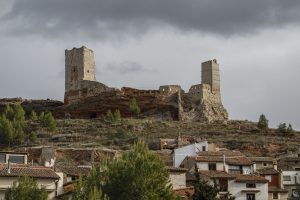
Nowadays, Villarreal de Huerva still reveals its historical and artistic past, reflected in the remains of its castle and church. From here we start the route, and then continue on to the Huerva river, from where we will get a panoramic view of the town, as well as some information about the importance of water during the Middle Ages up to the present day.
1. History of the town
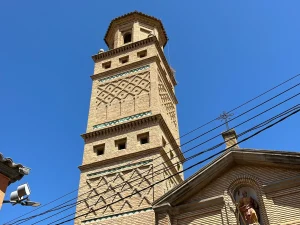
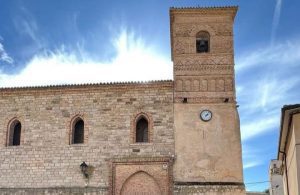
Villarreal de Huerva had a primitive Mudejar church of which today we can only see the tower. During the fighting in the 14th century, this church was fortified with a perimeter wall and the tower that can be seen from this point. It is from here that the present-day population is gradually built up.
This point is linked to the didactic activity 1
2. Mudejar architecture
The Mudéjars were particularly skilled in the construction of buildings of unique technical characteristics and beauty. They were highly sought after by the great patrons of the time and their works became the taste of the time. Although the present-day church of Villarreal (except for the tower) is Baroque, the interior has sgraffito work, the technique of which could be associated with the way the Mudejars worked the plaster sgraffito. The enclosure tower had a purely defensive function.
This point is linked to the didactic activity 5
3. Construction materials
The building materials used by the Mudejars can be found in the natural environment surrounding the monument, i.e. they were local materials. The most abundant were clay, plaster and wood. In Villarreal de Huerva, the materials can be seen in nature and also in the monuments and popular architecture.
This point is linked to the didactic activity 3
4. Water and agriculture
The Muslims were particularly adept at cultivating the land. They also introduced their own products, as well as irrigation techniques. Villarreal de Huerva, like other nearby towns, stands out for its agricultural landscape. The most abundant crops today are wheat and barley.
This point is linked to the didactic activity 6
5. Reminiscences
We could consider the period of Mudejar art creation to have ended in the 17th century, after the expulsion of the Moors. However, we have preserved a style that has survived over the centuries. This is why we find materials, construction techniques and elements that remind us of Mudéjar in later works, such as the peirons, which, in addition to having a religious function, serve to mark roads and boundaries.
This point is linked to the didactic activity 7