Circular from
the country school
The “Circular from the rural school” project is a cooperation project between rural development groups led by the Asociación Territorio Mudéjar.
The following have participated in the project: ADRI Calatayud-Aranda, ADRI Jiloca-Gallocanta, FEDIVALCA -Valdejalón and Campo de Cariñena-, ASOMO Tarazona and el Moncayo, CEDEMAR -Bajo Aragón Caspe and Ribera Baja del Ebro-, ADRAE -Ribera Alta del Ebro- and ADEFO Cinco Villas.
The objective is to develop educational materials around the Mudejar identity of the towns, placing rural schools and the educational community of the towns as the center of the project.
Based on the work developed, for almost three years, the students of fifteen schools have designed a walk through their town in which we can learn about the main points of interest and their connection with the Mudejar culture.
Quinto
This walk shows us the work of the students of the CEIP Fernando el Católico school in Quinto.
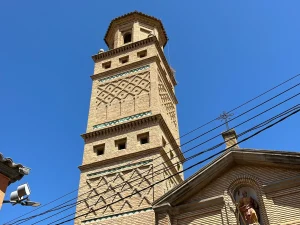
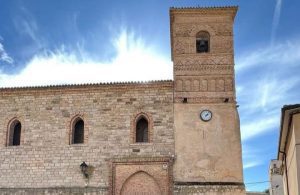
Quinto, it was inhabited by Muslims since the 8th century, although its foundation is Roman. The Christians conquered the territory where the Muslims lived at the beginning of the 12th century. In the town of Quinto, traces of its Islamic and medieval past can be seen, especially in the imposing Mudejar church of La Asunción, popularly known as El Piquete.
1. History of the town
During the Middle Ages the Christians dominated the territory and commissioned many of the constructions to the Mudejars, who were accustomed to using a series of techniques, materials and decoration typical of their culture. The Gateway of San Miguel marks the entrance to the medieval town.
This point is linked to the didactic activity 1
2. Coexistence of cultures
In Quinto, the three cultures that make up the Mudejar culture coexisted: Jewish, Christian and Muslim. They lived segmented into different neighbourhoods or aljamas, where their religion and customs were respected, but in exchange they had to pay tribute. The Muslim aljama was probably in the vicinity of the street known today as “Morería”.
This point is linked to the didactic activity 2
3. Mudejar architecture
At the highest point of the village we find the church of Nuestra Señora de la Asunción, popularly known as “Piquete. It is a fortress church; it serves as a strategic point from which to keep watch along its patrol path, and also fulfils a religious function. The interior is preserved as it was after one of the clashes that took place during the Spanish Civil War. It currently houses the museum of mummies.
This point is linked to learning activity 5.
4. Water and landscape
The Arabs, when they came to the territory, brought with them fruits and vegetables from the place where they lived. The climate in both places is different, so the Arabs became pioneers in the introduction of irrigation techniques in the rural world. Some examples are waterwheels, waterwheels, cisterns and the most common, irrigation ditches. In Quinto there are also irrigation ditches to irrigate the abundant fields.
This point is linked to the didactic activity 6
5. Construction materials
From here we can see another view of the church, as well as some of the materials in their natural state. The materials used by the Mudejars are local, as they can be found in the surrounding area. For this reason, we will see that monuments and constructions in common use are made with the same materials and construction techniques.
This point is linked to the didactic activity 3
6. Reminiscences of the Mudejar
Finally, we can see an example of an Aragonese palace house from the 16th century. We can see how the use of the material, the construction technique and some of the decoration derive from the construction inheritance left by the Mudejars when they passed through Quinto.
This point is linked to the didactic activity 7