Circular from
the country school

The “Circular from the rural school” project is a cooperation project between rural development groups led by the Asociación Territorio Mudéjar.

The following have participated in the project: ADRI Calatayud-Aranda, ADRI Jiloca-Gallocanta, FEDIVALCA -Valdejalón and Campo de Cariñena-, ASOMO Tarazona and el Moncayo, CEDEMAR -Bajo Aragón Caspe and Ribera Baja del Ebro-, ADRAE -Ribera Alta del Ebro- and ADEFO Cinco Villas.

The objective is to develop educational materials around the Mudejar identity of the towns, placing rural schools and the educational community of the towns as the center of the project.

Based on the work developed, for almost three years, the students of fifteen schools have designed a walk through their town in which we can learn about the main points of interest and their connection with the Mudejar culture.

Villar de los Navarros

The route has been carried out following the working model of the schools that participated in the project and adapted to the locality of Villar de los Navarros.

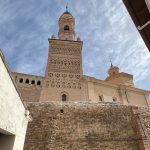
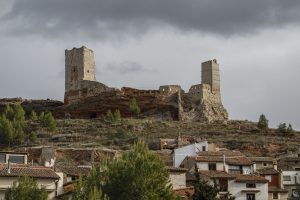
The town of Villar de los Navarros is located at the foot of the Herrera mountain range. This place witnessed one of the most bloody battles of the first Carlist war. In addition, during the tour we will discover the legacy that is still preserved, of a great historical-artistic wealth of Islamic tradition. The town’s main landmark is the Mudejar church of San Pedro Apóstol, with its unique tower.

1. History of the town

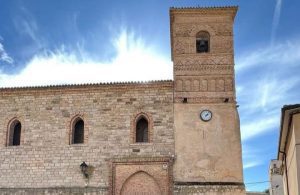
The whole town stands out for being a defensive place, sheltered by the mountains, where Mudéjares, the Muslims who remained in the territory after the Christian conquest, probably lived and carried out their activities. The Church of San Pedro dates back to the 15th century, and its tower is particularly noteworthy.

This point is linked to the didactic activity 1.

2. Coexistence of cultures

After the arrival of the Christians in the territory, we can say that the Mudejar period began. The Christians allowed the Muslims, the previous settlers, to remain in the territory, maintaining their religion and customs, but they forced them to live segmented, in neighbourhoods that we call morerías, and also to pay tribute.

This point is linked to the didactic activity 2

3. Construction materials

The materials used by the Mudejars are materials that can be found in the surroundings, what we would call, of proximity. In this way, we will see how commonly used monuments and constructions are made with the same materials and construction techniques.

This point is linked to the didactic activity 3

4. Water and landscape

In the vicinity of Villar de los Navarros there are several rivers of special importance: the Cámaras, the Huerva and the Jalón. Its basins articulate a landscape, which, together with its mountains, configures one of its main hallmarks.

This point is linked to the didactic activity 6

5. Mudejar architecture

Mudejar architecture is architecture made by Mudejar master builders. As part of the demands of the Christian lords, they built different types of buildings: churches, palaces, dwellings and cloisters. One of the most important typologies are towers.

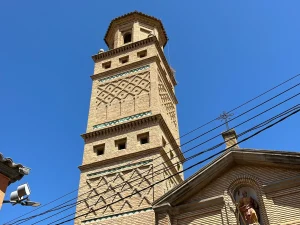
The church of San Pedro de Villar de los Navarros is a unique example of the Mudejar style, as it has a unique tower solution. The interior conserves the Mudejar structure, masked by later alterations, of which the most notable features are the scribing in the choir area.

In the tower of San Pedro de Villar de los Navarros we find different types of brick decoration: double-edged zigzag strips, interlaced mixtilinear arches and panels of criss-crossed lines forming lozenges.

This point is linked to the didactic activity 7

Related Works