Circular from
the country school

The “Circular from the rural school” project is a cooperation project between rural development groups led by the Asociación Territorio Mudéjar.

The following have participated in the project: ADRI Calatayud-Aranda, ADRI Jiloca-Gallocanta, FEDIVALCA -Valdejalón and Campo de Cariñena-, ASOMO Tarazona and el Moncayo, CEDEMAR -Bajo Aragón Caspe and Ribera Baja del Ebro-, ADRAE -Ribera Alta del Ebro- and ADEFO Cinco Villas.

The objective is to develop educational materials around the Mudejar identity of the towns, placing rural schools and the educational community of the towns as the center of the project.

Based on the work developed, for almost three years, the students of fifteen schools have designed a walk through their town in which we can learn about the main points of interest and their connection with the Mudejar culture.

Mainar

This walk shows us the work of the pupils of the CEIP Santa Ana school in Mainar.

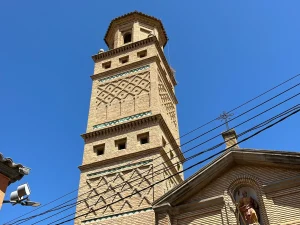
The main Mudejar monument in the village of Mainar is the tower of the church of Santa Ana. It is one of the later towers of the style, which was erected in the town as an identifying element. During the tour, as well as admiring the monument, we will see the surrounding landscape.

1. History of the city

The Christians conquered the territory where the Muslims lived between 1118 and 1120. The Muslims who remained after this conquest became known as Mudejars. The Christians admired the art built by the Mudéjars, so they became patrons. The Mudejar monument at Mainar is late, but there was probably an earlier settlement.

This point is linked to the didactic activity 1

2. Mudejar architecture

The main building in Mainar is the tower of Santa Ana, which dates from a late period within the style. The Mudéjars needed decoration as a fundamental part of their constructions. Thus, they generated light and shadow, making the monument change depending on the sunlight. In Mainar we see angled angles and multi-armed crosses forming lozenges.

This point is linked to the didactic activity 5.

3. Coexistence of cultures

During the Middle Ages, three cultures coexisted. The Christians were the ones who held the power, above all, the monarchy, the Church, and the nobility. They allowed the previous settlers to continue to inhabit the cities, but with a series of conditions: they had to live in their own nuclei (barrios or aljamas) and pay tribute. The cultures that coexisted were Christians, Muslims and Jews.

This point is linked to the didactic activity 2

4. Importance of agriculture

Muslims were particularly adept at cultivating the land. The introduction of home-grown products and irrigation techniques to help them flourish not only led to new and succulent foodstuffs, but also helped existing crops to grow better and faster. Particularly in Mainar, depending on the sowing cycles, we can see its fields in different colours: reddish, brown, yellow and green.

This point is linked to the didactic activity 6.

5. Importance of water

Water is the most important principle of the universe according to the Qur’an, considered a divine symbol, as water is necessary for life. It is also present in the idea of the Muslim paradise. During the Islamic domination, different hydraulic engineering systems were introduced and developed, such as waterwheels, irrigation channels, dams… Therefore, for the Mudejars, who were also Muslims, water was fundamental.

This point is linked to the didactic activity 7

Related Works