
Utebo
Village Territorio Mudéjar
The eighth milestone
The roots of this settlement can be traced back as far as the archaeological remains preserved of a “villae” Roman near the eighth milestone of the military road which ran from Ilerda which ran from Ilerda which ran from Ilerda which ran from Ilerda which ran from Ilerda which ran from Ilerda which ran from Ilerda which ran from Ilerda which which ran from Ilerda to Legio VII Gemina. Hence it is that some studies link the name of Utebo with “octavus”.
The historic centre centres itself around the church, the main landmark of the town, in an organic and irregular manner, organised through three main spaces: Plaza de España, the Cuatro Esquinas and Plaza del antiguo Ayuntamiento.
In Utebo there are a variety of architectural styles from the the late 16th century and early 17th century. All of them are constructed using materials of traditional use which might refer us to the Islamic tradition: brick plastered with plaster. This heritage is blended with new artistic styles from the West, giving rise to an architectural style with characteristics that are unique and genuine, which we know as the Aragonese Renaissance.
The roots of this settlement can be traced back as far as the archaeological remains preserved of a “villae” Roman near the eighth milestone of the military road which ran from Ilerda which ran from Ilerda which ran from Ilerda which ran from Ilerda which ran from Ilerda which ran from Ilerda which ran from Ilerda which ran from Ilerda which which ran from Ilerda to Legio VII Gemina. Hence it is that some studies link the name of Utebo with “octavus”.
The historic centre centres itself around the church, the main landmark of the town, in an organic and irregular manner, organised through three main spaces: Plaza de España, the Cuatro Esquinas and Plaza del antiguo Ayuntamiento.
In Utebo there are a variety of architectural styles from the the late 16th century and early 17th century. All of them are constructed using materials of traditional use which might refer us to the Islamic tradition: brick plastered with plaster. This heritage is blended with new artistic styles from the West, giving rise to an architectural style with characteristics that are unique and genuine, which we know as the Aragonese Renaissance.

Projects Region Mudéjar in Utebo
Pedagogy | View project
Project Mudetrad | View project
The Mudejar style and Euclidean geometry | View project Project Mudetrad | View project
Mudéjar educational, the guide | View project
“Circular” Walks for families | View project
The wall as dermis. The light in the Mudejar style | View the project
More information
Town Hall: 976 770 111
https://utebo.es/
VISIT UTEBO
976 633 296
WOULD YOU LIKE TO FIND OUT MORE?
Tourism in Aragón
turismodearagon.com
Tourism Central Comarca
https://comarcacentral.es/
Territorio Mudéjar Network
The town council has been a member of the Territorio Mudéjar since April 2022.
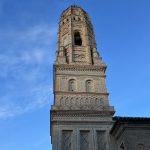


“The bell tower of the mirrors”
The tower, also known as ‘the bell tower of the mirrors’ because of the reflections and glints that the sun produces on the ceramics that cover it, it is a magnificent example of late Mudejar style and is typical of the type of the mixed-style tower. The date of completion of the work and its architect from an inscription located on the first frieze of the square section, in the manner of a decorative border: […] izola Master Alonso de Leznes, completed in the year 1544.
The inscription is made of glazed ceramic from Muel, with a white background and the inscribed characters in manganese oxide. Leznes was a prominent master of works who also worked also on the Lonja in Zaragoza and on the church in Longares.
A must-see is the Mariano Mesonada Cultural Centre, in the Plaza de España. Here is located a museum dedicated to the painter José Orús and it hosts various cultural activities. Also the El Molino Cultural Centre, a former flour mill which has been given has been given a new role as a municipal cultural venue.
The tower, also known as ‘the bell tower of the mirrors’ because of the reflections and glints that the sun produces on the ceramics that cover it, it is a magnificent example of late Mudejar style and is typical of the type of the mixed-style tower. The date of completion of the work and its architect from an inscription located on the first frieze of the square section, in the manner of a decorative border: […] izola Master Alonso de Leznes, completed in the year 1544.
The inscription is made of glazed ceramic from Muel, with a white background and the inscribed characters in manganese oxide. Leznes was a prominent master of works who also worked also on the Lonja in Zaragoza and on the church in Longares.
A must-see is the Mariano Mesonada Cultural Centre, in the Plaza de España. Here is located a museum dedicated to the painter José Orús and it hosts various cultural activities. Also the El Molino Cultural Centre, a former flour mill which has been given has been given a new role as a municipal cultural venue.