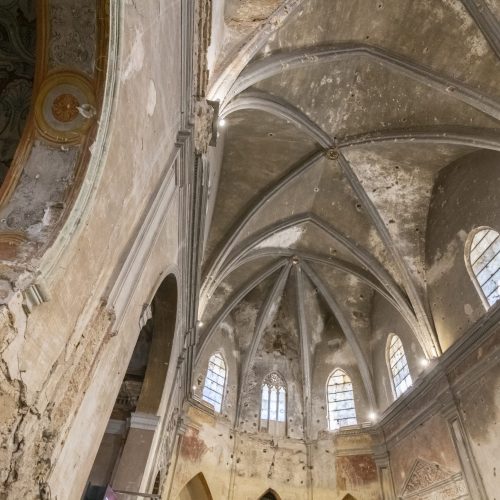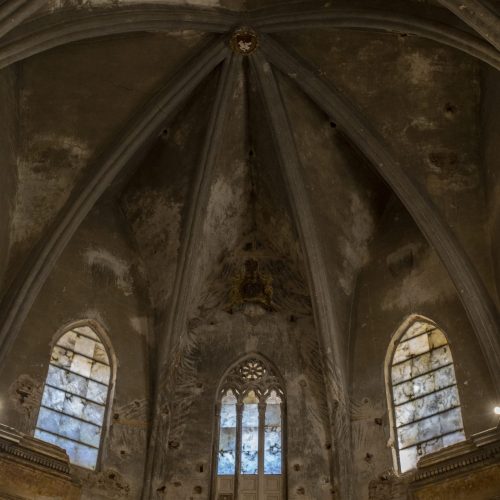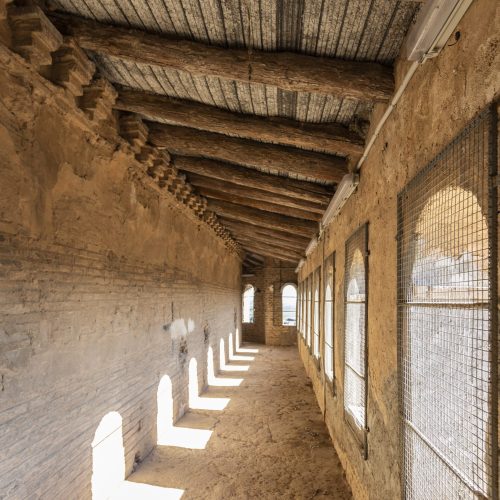
Church of San Miguel, Borja

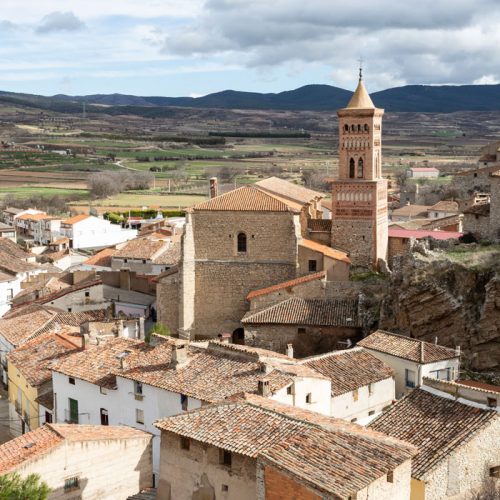
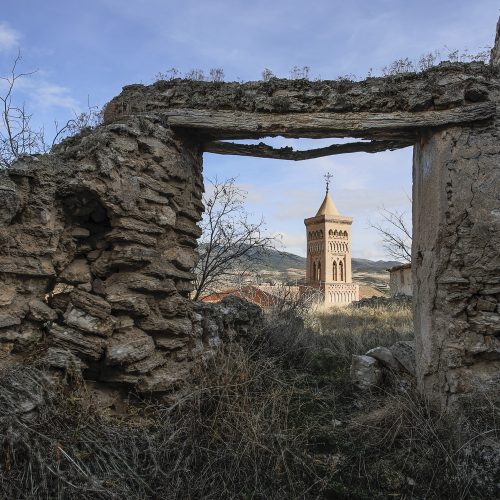
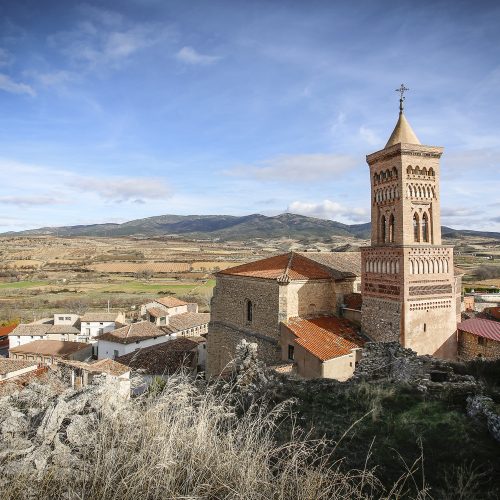
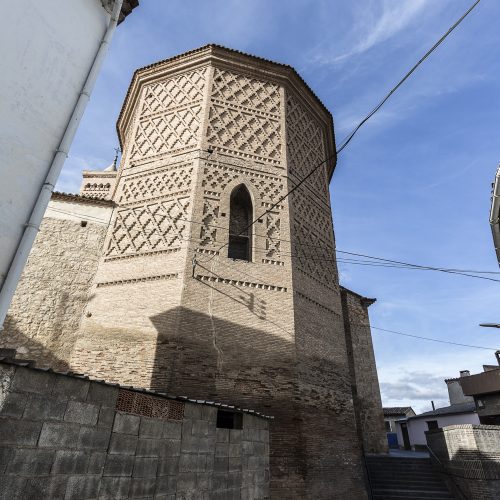
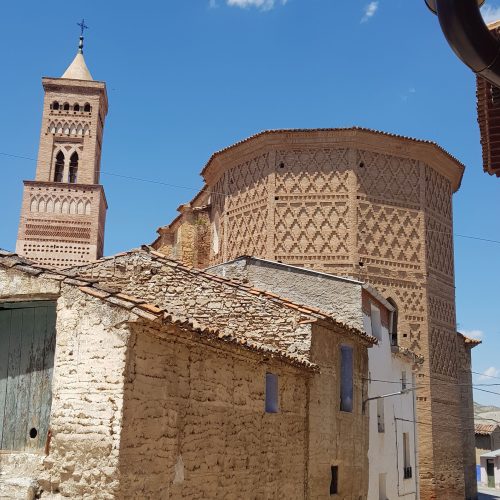
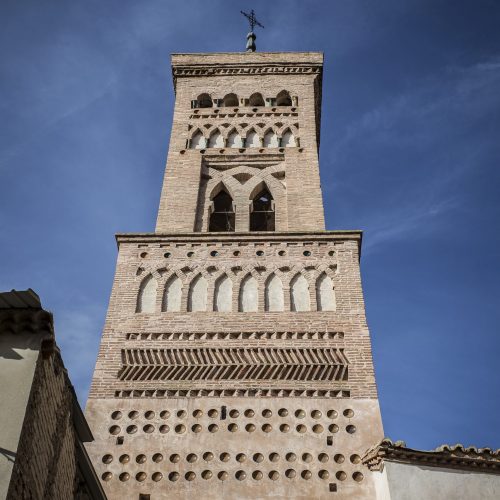
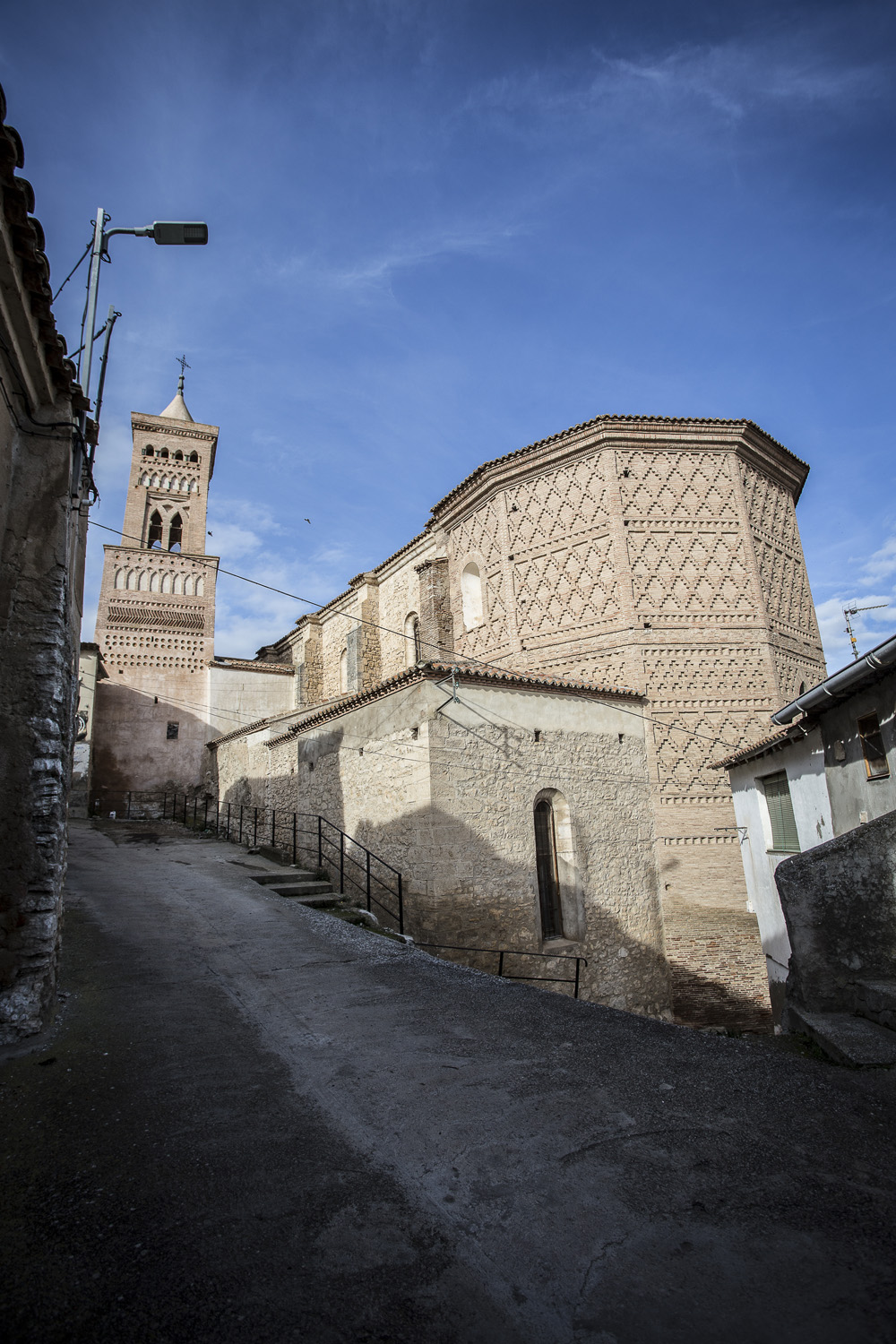
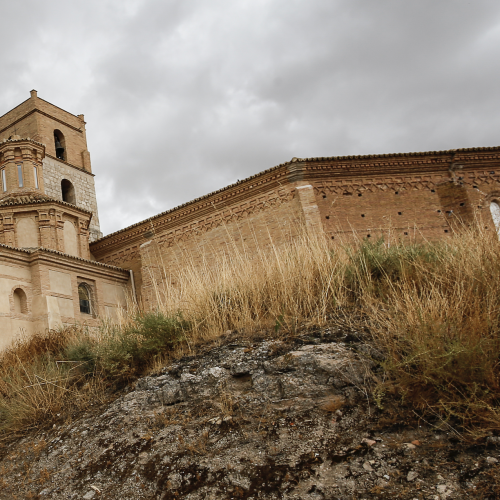
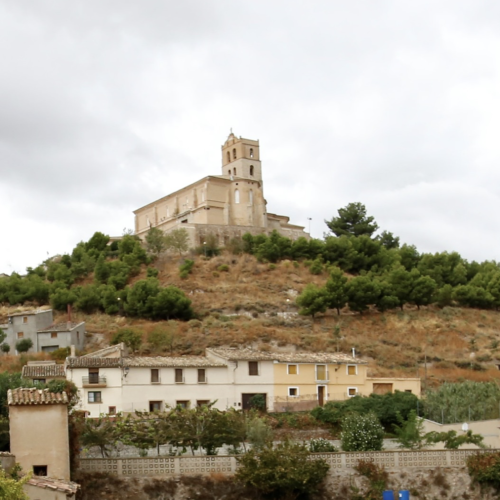
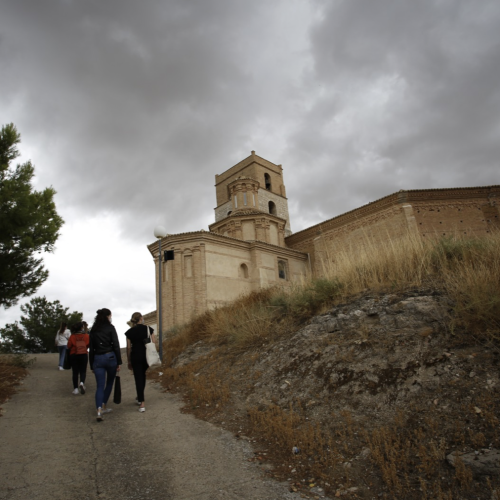
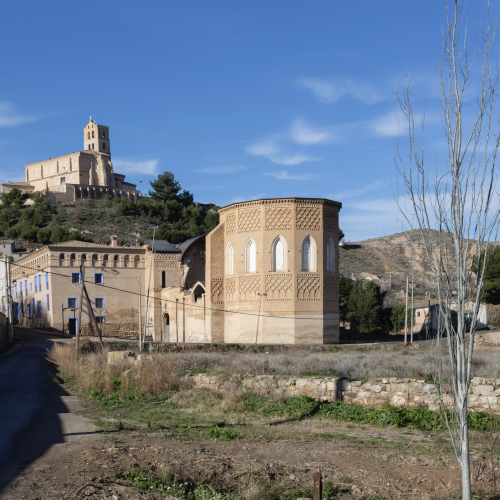
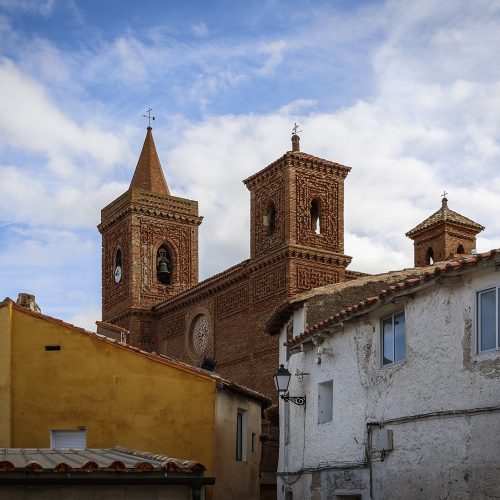
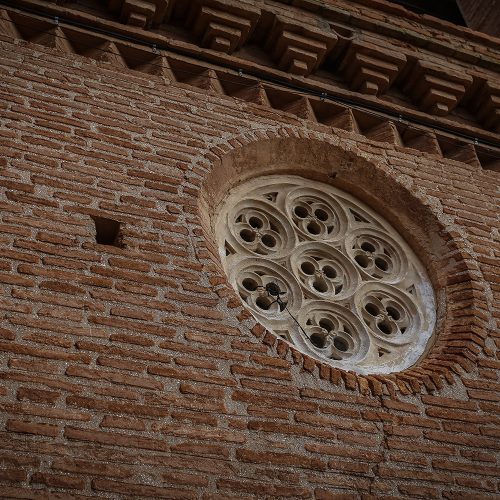
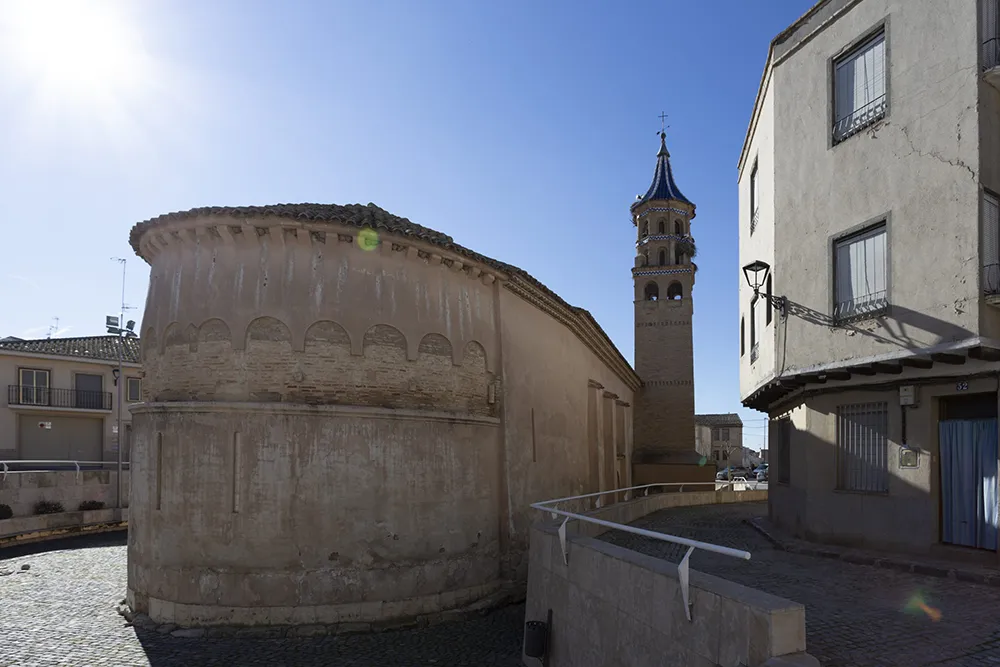
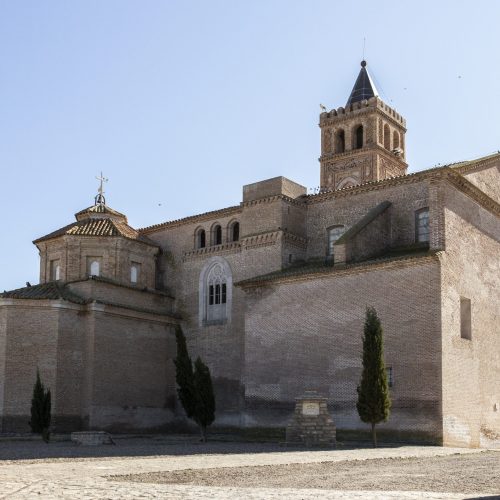
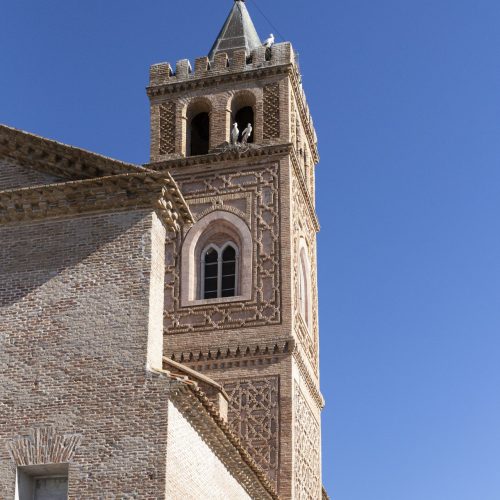
Vista lateral de la ex colegiata de Santa María de Borja con su imponente torre mudéjar al atardecer.

Church of San Miguel, Borja

Plaza de San Francisco 50540 Zaragoza

CURRENT PROTECTION STATUS: Listed asset

TYPE OF ASSET: Property

CATEGORY: Religious

ARCHITECTURAL STYLE: Mudejar

CONSTRUCTION DATE

Construction of the original building began in the 12th century and was completed in the 13th century. From this period, only the apse, covered by a semi-dome, and the bay containing the presbytery remain standing.

In the 14th and 15th centuries, expansion, renovation and reconstruction work took place, bringing the number of naves to four, separated by diaphragm arches, and adding a wood ceiling structure. A side portico was built, located along the third and fourth bays of the nave on the Gospel side and opening through two pointed brick arches, now covered over. The chapel located in the second bay on the Epistle side, which may have originally been built as the lower section of a bell tower, was also completed.

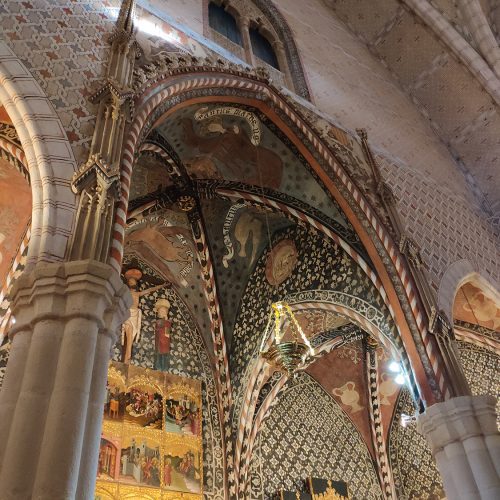
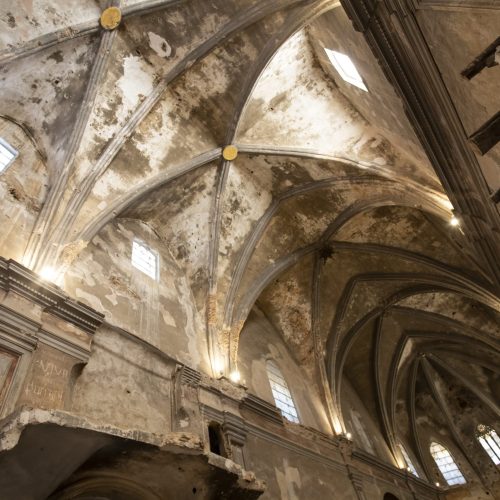
Remodeling work was done in the 15th and 16th centuries. The portico was closed off, transformed into two chapels dedicated to Nuestra Señora de las Nieves and San Juan de Porta Latina, and two new chapels were built: in the second bay on the Gospel side and in the third bay of the Epistle wall. During this period, quadripartite rib vaults were also raised over the east end, first bay and side chapels.

Further remodeling was done in the 18th century. The ancient structure was concealed when the number of bays was raised to six, underpitch vaults resting on surbased arches were built over the nave, an impost molding line was installed at the height of the vault springing line and the entrance to the temple was moved to the west end wall.
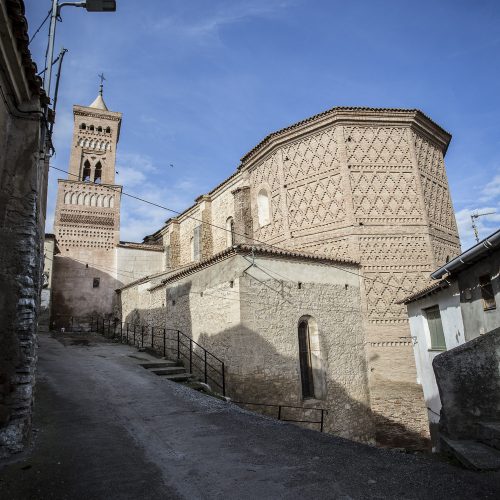
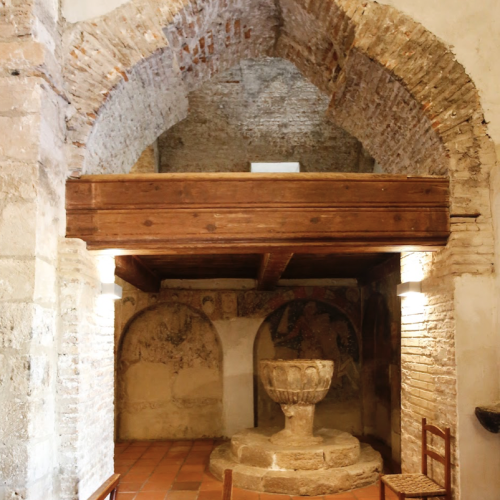
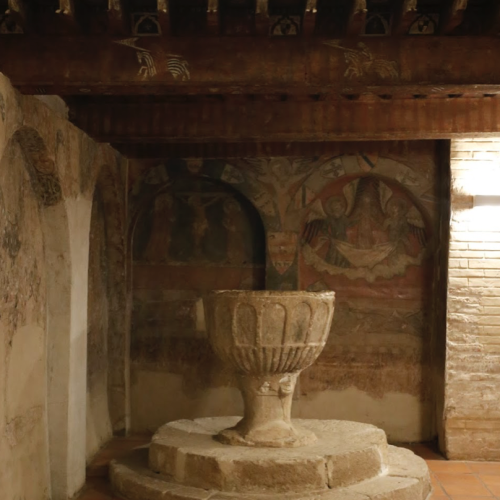
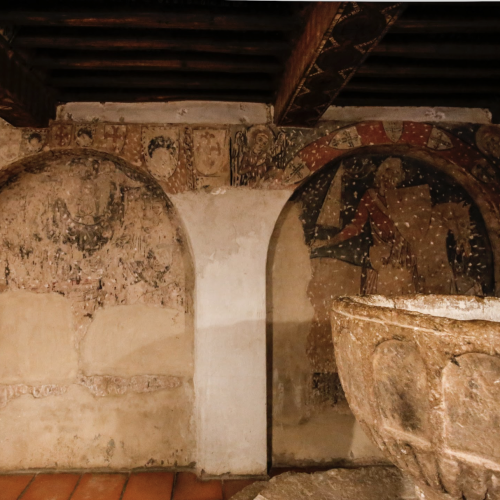
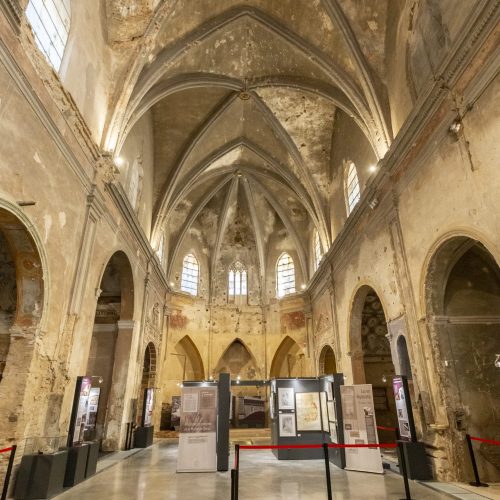
The ancient church of San Miguel, a unique construction due to the changes rendered over the years, currently houses the Archeological Museum. The construction phases sustained by this building span from the 13th century to the 17th century. The north façade was created during the Mudejar expansion of the previous Romanesque temple, where the arches framing the original entrance portico can still be seen.

We know that the first construction was from the mid-13th century in the Romanesque style, the main building material being masonry.

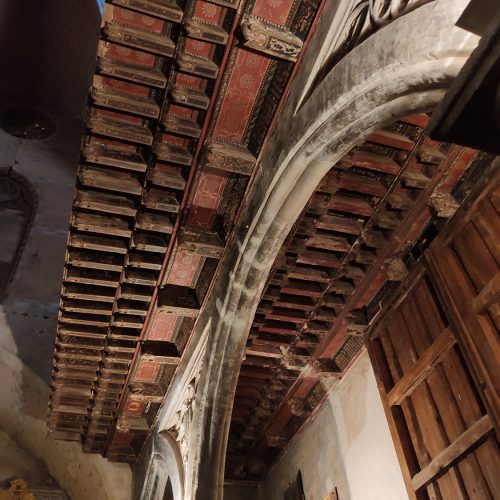
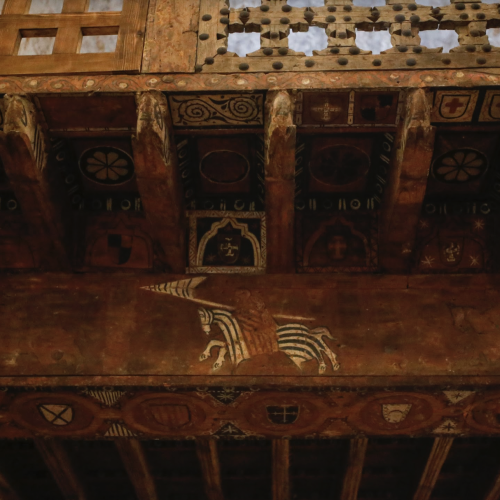
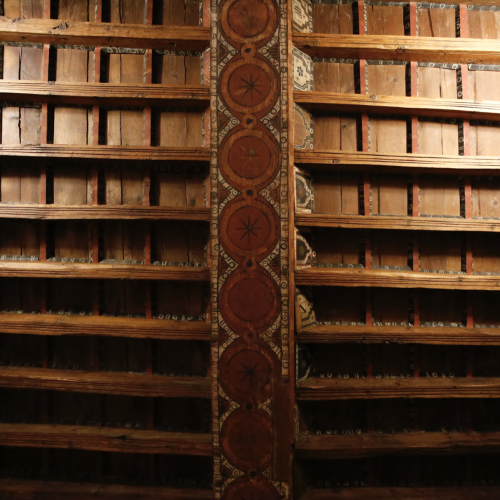
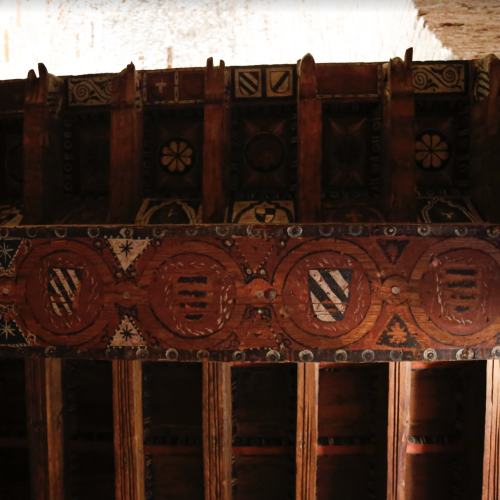
This is a single nave temple with five bays and a semicircular apse, with a presbytery and five chapels attached to the sides of the nave. In the 14th and 15th centuries, three bays were added to the original 13th-century nave, covered by a wood ceiling structure divided by pointed diaphragm arches. It is actually a false roof structure, given that each side is a slanted alfarje system, as is also the case in the side aisle of the church of the Magdalena in Tarazona, for example. This ceiling was covered over in the remodeling done in the late 17th or early 18th century, when an underpitch vault was built over the bays of the nave and the walls were adorned with pilasters, capitals and moldings in the Baroque style. The ceiling structure was revealed again in the restoration and the original beams were replaced, so only the structure is original.
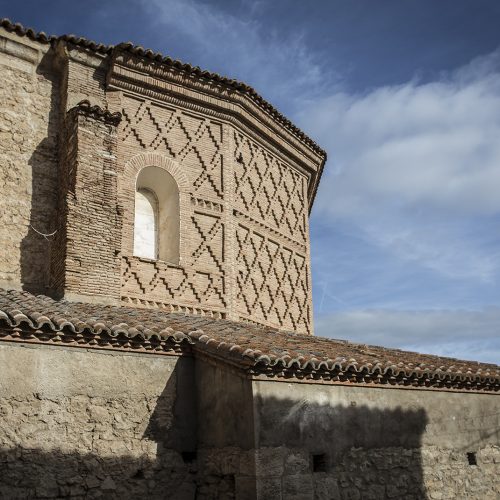
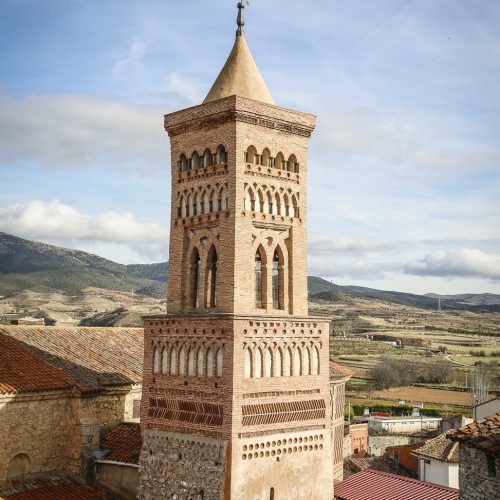
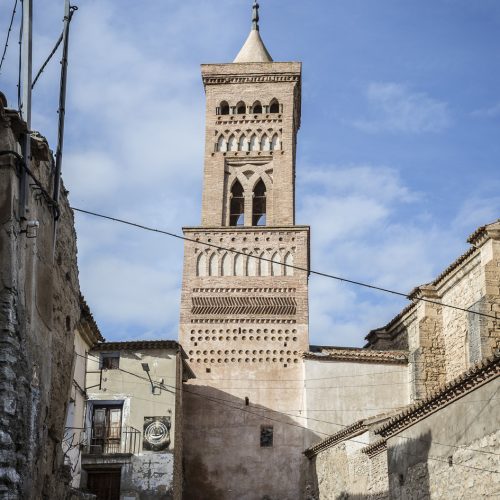
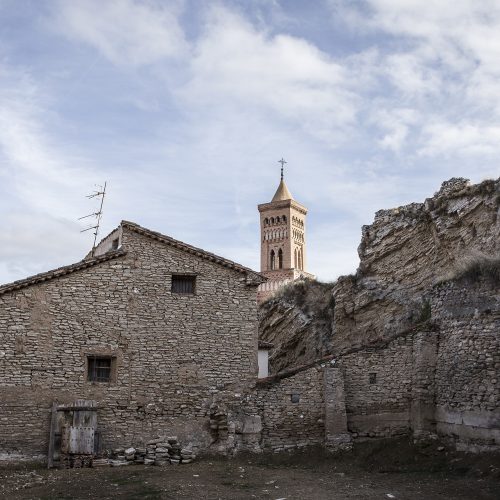
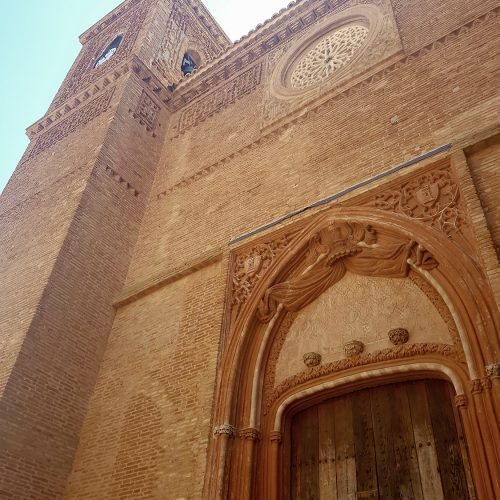
A small exterior space opens off of the church in the apse area, offering a partial view, in which the only decorative element is a line of scroll modillions under the eaves, while one side of the first section of the Mudejar tower is decorated with a strip of angled brick and a line of corbels that appear to define the transition to the next level. This tower, like the extension of the nave to five bays and the aforementioned portico with two arches, was built during the expansion of the church which took place in the late 14th or early 15th century.

The Romanesque structure at the east end consists of a semicircular apse covered by a semi-dome reinforced with ribs that join together in a boss and the adjacent bay with a pointed rib vault. A pointed arch opening with a wide splay leads to the interior at the center of the apse cylinder.

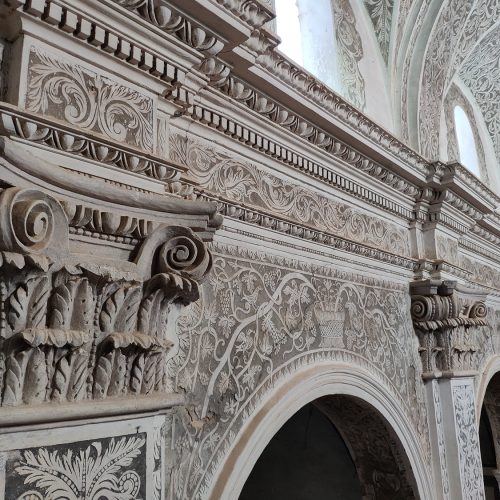
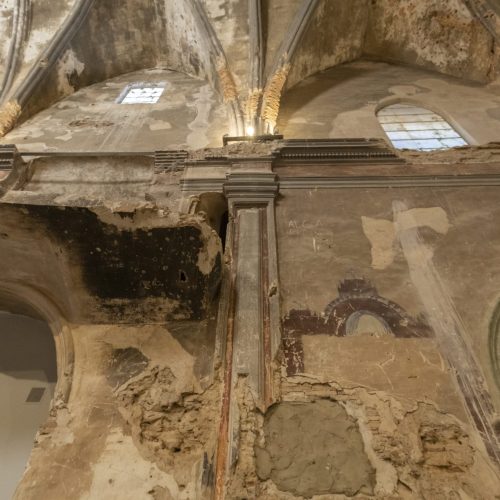
In the Baroque era, the springing lines of the ribs in the first bay and the first transverse arch were decorated with rectangular capitals displaying scroll motifs. They rest on a narrow impost molding that runs around the apse and the south side. Stepped molding runs over the capitals and along the south side of this bay.

Interventions

Restoration, 20th to 21st century

In July 1999, the restoration of the church of San Miguel that had begun in 1988 was completed. Conversion into a museum, 21st century. This religious building currently houses the Archeological Museum of Borja.

Projects and interventions

Projects and interventions, and the driving forces behind them, define the history of monumental buildings and how they are perceived.

Declarations

Declaration, 21st century

The Official Gazette of Aragon dated December 2, 2002 published the Department of Culture and Tourism Order of November 5, 2002 declaring the church of San Miguel in Borja (Zaragoza) a Listed Asset of Aragonese Cultural Heritage.

Bibliography

CASANOVA, Mariano. Restauración de monumentos en Borja. Boletín Informativo del Centro de Estudios Borjanos. 1991 , nº 52, p. 4-5.

FERRER, Pablo. Un poco de historia y de clausura franciscana, pared con pared. Heraldo de Aragón. 22/06/2020 , nº 42.195, p. 13.

HERNANDO SEBASTIÁN, Pedro Luis; Sancho Bas, José Carlos. Del arte medieval al Neoclasicismo en el Campo de Borja [En línea]. En AGUILERA ARAGÓN, Isidro; BLASCO SANCHO, Mª Fernanda. . Comarca del Campo de Borja. Gobierno de Aragón, 2004.p. 179-200.

HERNANDO SEBASTIÁN, Pedro Luis; Sancho Bas, José Carlos. El arte mudéjar en la comarca del Campo de Borja [En línea]. En AGUILERA ARAGÓN, Isidro; BLASCO SANCHO, María Fernanda. (coord.). Comarca del Campo de Borja. Gobierno de Aragón, 2004.p. 201-219. [Consulta: 18 de diciembre de 2020]. 

La iglesia de San Miguel de Borja. Boletín Informativo del Centro de Estudios Borjanos. 1988 , nº 48, 

Appendixes

Church of San Miguel

Plaza de San Francisco
50540, Borja (Zaragoza)

Visit Borja

City Hall: 976 852 001
www.borja.es
WOULD YOU LIKE TO KNOW MORE?
www.turismodezaragoza.es

Church of San Miguel, Belmonte de Gracián

Church of San Miguel, Belmonte de Gracián

Plaza de Baltasar Gracián, s/n. 50332 Belmonte de Gracián (Zaragoza)

CURRENT PROTECTION STATUS: Asset of Cultural Interest (ACI)

TYPE OF ASSET: Property

CATEGORY: Religious

ARCHITECTURAL STYLE: Mudejar

CONSTRUCTION DATE:
Original construction, 16th century. Constructed mainly in the 16th century in the late Gothic style adjacent to a Mudejar tower. Only the apse remains from this period.

Expansion, 16th century. In the 16th century, the previous 14th-century church was expanded, of which only the apse remains. The new phase can be seen above all in the switch from the use of brick to stone.
The church of San Miguel in Belmonte de Gracián was constructed in two phases. The original construction from the 14th century was a Mudejar church, of which only the tower and apse (in addition to the Gothic addition) remain standing today.

The lower part of the church is considered a Mudejar construction whereas the upper part is late Gothic. The difference between the two architectural styles can be seen above all in the materials used, given that the entire temple is made of stone except for the apse and tower, erected in brick.
The apse is polygonal in shape and lacks buttresses, with decorative motifs based on diamond shapes and angled brick. Most Mudejar apses were designed without buttresses so as not to interrupt the strips of decoration.

The construction materials are mainly brick and gypsum (or plaster). Its ornamentation is clearly Mudejar: panels of protruding brick detail work combined with diamond and crisscrossing shapes separated by angled brick friezes.

Projects and interventions

Projects and interventions, and the driving forces behind them, define the history of monumental buildings and how they are perceived.

Declarations

21st century (2001) The Official Gazette of Aragon (BOA) from October 26, 2001 published Decree 232/2001, of October 2, by the Government of Aragon, declaring the apse and tower of the church of San Miguel in Belmonte de Gracián (Zaragoza) an Asset of Cultural Interest, Monument category.

Current condition

Of the original Mudejar construction of this parish church, the only part remaining is the free-standing tower erected in the early 14th century and the apse, dating from the early 18th century. The tower is located on the south side of the church. The rest of the building was replaced in the 17th century using ashlars and masonry in the classical Baroque style.

Bibliography

CABAÑERO SUBIZA, BERNABÉ. Las torres mudéjares aragonesas y su relación con los alminares islámicos y los campanarios cristianos que les sirvieron de modelo, Turiaso. 1995 , nº XII, p. 11-51.

CRIADO MAINAR, JESÚS. La escultura romanista en la comarca de la Comunidad de Calatayud, Institución Fernando el Católico, Zaragoza, 2013.

GALIAY, JOSÉ. Arte mudéjar aragonés, Institución Fernándo el Católico, Zaragoza, 2002.

MILLÁN GIL, JULIÁN Y SANMIGUEL MATEO, AGUSTÍN (COORD.). Comarca de la Comunidad de Calatayud, Colección Territorio nº 20, Departamento de Presidencia y Relaciones Institucionales del Gobierno de Aragón, Zaragoza, 2005.

NAVAL MAS, ANTONIO. Arte de Aragón emigrado en coleccionismo USA, Huesca: [s.n.], 2015. SANMIGUEL MATEO, A. Torres de ascendencia islámica en las comarcas de Calatayud y Daroca, Centro de estudios bilbilitanos, Institución Fernando el Católico, Calatayud, 1998.

VV.AA. Comunidad de Calatayud y El Monasterio de Piedra, Colección RutasCai por Aragón nº 12, Zaragoza, 2004.

VV.AA. Tierra Mudéjar. El Mudéjar Aragonés, Patrimonio Mundial, Heraldo de Aragón, D.L. 2002.

Appendixes

Church of San Miguel

Plaza de Baltasar Gracián, s/n. 50332 Belmonte de Gracián (Zaragoza)

Visit Belmonte de Gracián 

City Hall
www.belmontedegracian.es
WOULD YOU LIKE TO KNOW MORE?
www.turismodezaragoza.es

Church of San Miguel Arcángel, Villarreal de Huerva

Church of San Miguel Arcángel, Villarreal de Huerva

CURRENT PROTECTION CATEGORY: Listed

TYPE OF PROPERTY: Real estate

CATEGORY: Religious

ARCHITECTURAL STYLE: Mudejar

DATE OF CONSTRUCTION: 16th century

The Mudejar tower is the only remaining vestige of the old church. The primitive 14th century temple, of which we have hardly any information, was replaced in the 17th century by the new Baroque construction. Nowadays, its appearance is distorted with respect to how it was originally, since, with the reconstruction of the temple in the 17th century, the tower was enlarged with a last body. In addition, what is probably the altar table of the original church has recently been found in the area surrounding the church, and can now be seen in the entrance atrium.

We have, therefore, an example of the rich Mudejar heritage that Aragon boasts, proof of which is that this tower has been protected since 2002 by virtue of the Order of 12 July, by which the Department of Culture and Tourism of the Government of Aragon declares the “Bell Tower of the Church of San Miguel Arcángel” in Villarreal de Huerva a Catalogued Asset of Aragonese Cultural Heritage. Among the different types of towers found in Mudejar architecture, the one in Villarreal belongs to those that have Islamic decoration, but do not have an Islamic structure, i.e. a minaret structure. These towers correspond to the layout of the stately towers of castles. In these towers, which have vaulted brick rooms inside, which also make them difficult to destroy, the ascent is much more complicated than in the minaret towers, where the floors were made of wood. These characteristics can easily be associated with the defensive nature of these towers, which in the case of Villarreal is evident, since, as we have mentioned, the church was part of a walled enclosure with a military function. Traditionally, the tower at Villarreal has gone largely unnoticed in the historiography of Mudéjar art. The sparse decoration and austerity of the tower itself, and the body with which it was rebuilt following the reconstruction of the church in the 17th century, have contributed to this neglect. Likewise, the large volume of the new Baroque church also helped to overshadow the tower.

The tower, made entirely of brick, is located at the foot of the church, on the south side or Epistle side, has a square floor plan and is divided into superimposed rooms, with the exception of the first body, which is solid. Above this initial level there is a first room which is accessed from the choir of the church, about six metres high, covered with ribbed vaulting. This body has smooth walls on the outside, which are only altered by the presence of three narrow arpilleras.

Next, we find a second room that is covered with a vaulted ceiling, which is accessed by a narrow intramural L-shaped staircase with a steep slope and high and uncomfortable steps, embedded in the east wall forming a small box covered with brick vaults formed by the approximation of courses. In this second room there are two windows more than a metre apart on each side, with the exception of the north side, where the staircase enters, which only has one. This would have been the original bell tower, hence the presence of the openings and the concentration of decoration on the outside.

The windows are semicircular and below them there is a continuous line of angled brickwork. The openings are flanked by small single bands of angled brick between two double or staggered bands above and below. Between the windows, the single line of angled brickwork is replaced by simple brick lozenges, again between two double lines. Above the openings is a row of cantilevered brick corbels forming an impost, which seems to indicate the end of the original masonry, which may have been topped by a terrace with a lantern, insisting in any case on the defensive purpose indicated by the tower’s structure.

Finally, today we find a rough brick pyramid on top of the vault that covers the second room, on which a barrel vault rests, which serves as the base for the added bell tower. On the outside, a large plain cloth serves as a base for the last section, which has an octagonal floor plan and a decoration in the upper part with Mudejar reminiscences that seems to be a recent addition.

We can see, therefore, how in the tower of Villarreal we find some of the most characteristic ornamental elements of Aragonese Mudéjar, such as the angles, also known as sawtooths. Geometric motifs, such as rhombuses, are also elements where brick finds its maximum expressive possibilities. In Villarreal, we also see the oldest system for flying eaves made of brick, a system using bricks that are closed off with L-shaped intramural stairs inside the tower between them at the top by approximation of courses, which is used on exteriors to separate different bodies and in the eaves performs the function of the corbels. We have seen that this same system of approximation of courses is also used in the vaulting of the stairwells.

Interventions

Restoration, 20th Century to 21st Century

Projects and interventions

Projects and interventions and their promoters define the history of monumental buildings as well as the perception of them.

The downloadable document presents the current status of the files under review, which will allow us to update our knowledge of each of the monumental buildings.

Declarations

Declaration, 21st Century

Bibliography

Alvar, J.: Etnografía de Aragón, Guara, 1986.

Beltrán, J.: Tradiciones y leyendas de Daroca, Zaragoza, 1929.

Blánquez Herrero, C.: El agua y Aragón, Prensa Diaria Aragonesa S.A., El Periódico de Aragón, Grupo Z.

Borras Gualis, G.M.: Arte Mudéjar aragonés, Guara, 1987.

Corral Lafuente, J.L., La Comunidad de Aldeas de Daroca en los siglos XIII y XIV: orígenes y proceso de consolidación, Institución Fernando el Católico, 1987.

Diarte Lorente, P.: La Comunidad de Daroca: Plenitud y crisis (1500-1837), Daroca, Centro de Estudios Darocenses.

Latas Fuertes, J., Valero Valenzuela M.E.: Villarreal de Huerva. Apuntes sobre su historia y patrimonio histórico-artístico, Diputación de Zaragoza, 2011.

Mañas Ballestín, F. (coord..): Comarca Campo de Daroca, Government of Aragón.

Margalé Herrero, F., Margalé Herrero, A.: Los peirones de la Comarca de Jiloca y Campo de Daroca/ inventario, índices y fotografías, Centro de Estudios del Jiloca, Calamocha (Teruel), 2002.

Mateos Royo, J.A.: Auge y decadencia de un municipio aragonés: El Concejo de Daroca en los siglos XVI y XVII, Centro de Estudios Darocenses, Daroca, 1997.

Navascués Haba, M. (coord..): Alimentos y gastronomía en Aragón, Caja de Ahorros Inmaculada D.L., Zaragoza, 2006.

Ronco Lario, A.: Campo de Romanos, subcomarca con identidad propia, Mainar, Ayuntamiento de Mainar, 1990.

Serrano Dolader, A.: Huellas y conjuros: por tierras zaragozanas de Daroca y Gallocanta, Institución Fernando el Católico, Zaragoza, 2014.

Ubieto Arteta, A.: Leyendas para una historia paralela de Aragón Medieval, Institución Fernando el Católico, Zaragoza, 1998.

Rural Development Area Plan for the Campo de Daroca Region. Environmental sustainability report , Government of Aragon, January 2011

The Celtiberian sites, Turismo Comarca de Daroca.

Las neveras y la artesanía del hielo: La protección de un patrimonio etnográfico en Europa (Seminar, Fuendetodos, 1999), Institución Fernando el Católico, Zaragoza, 2001.

Appendixes

Church of San Miguel Arcángel

50490 Villarreal de Huerva (Zaragoza)

Visit Villarreal de Huerva

Town Hall: 976 807 041
aytovillarrealdehuerva.es
DO YOU WANT TO KNOW MORE?
www.turismodezaragoza.es

Church of San Mateo Apóstol, San Mateo de Gállego

Church of San Mateo Apóstol, San Mateo de Gállego

Plaza de la Iglesia. San Mateo de Gállego
CURRENT PROTECTION STATUS: ACI

TYPE OF ASSET: Property

CATEGORY: Religious

ARCHITECTURAL STYLE: Mudejar

CONSTRUCTION DATE: Original construction, 16th century

The original construction period is not documented but it was probably a fortified Mudejar church. The volume standing under the tower dates from the 14th century and the presbytery and upper levels are from the 15th century. The parish church dates from the 16th century. The earliest construction date is unknown but documents show that the choir and part of the tower were erected in 1580, while the high altar was repaired in 1582.

Insertion of movable elements, 16th century
In 1572 a canvas was purchased to adorn the magnificent high altar.
Located on a terrace known as Plaza del Castillo in San Mateo de Gállego (Zaragoza), the relevance of this church lies in its exterior, given that it boasts one of the most lavishly decorated façades of all the Aragonese Mudejar churches. The parish church was built in the 16th century but it was probably a fortified Aragonese Mudejar church originally. This assertion is also backed by its location on a hill overlooking the valley and by the fact that the tower has no entrance at street level but only from the second floor.

Its current appearance is the result of extensive changes. The earliest structure was probably the tower, to which an apse was later attached. Brick was the construction material use. The building features a single nave with two bays covered with rib vaults, with side chapels and another space for the choir at the west end. The east end has straight sides and is covered with a stellar vault.

The tower, erected over the ruins of the castle, has a square footprint and a central buttress. Over the spaces that were repurposed from the castle wall, another level, made of brick, was added, to be used as a bell tower. The stairs run between the tower and its central buttress, covered by small barrel vaults. The top of the tower has a typical Aragonese walkway. This tower is decorated with stepped decorative battlements, diamond shapes, recessed squares, oculi and zig-zags.

Interventions

Restoration, 20th to 21st century

In 1998 a restoration project was carried out. It contained a report on health and safety in the workplace.

Projects and interventions

Projects and interventions, and the driving forces behind them, define the history of monumental buildings and how they are perceived.

Declarations

Declaration, 20th century

On March 9, 1983, the church of San Mateo in San Mateo de Gállego (Zaragoza) was declared a Historical and Artistic Monument (today, an Asset of Cultural Interest).
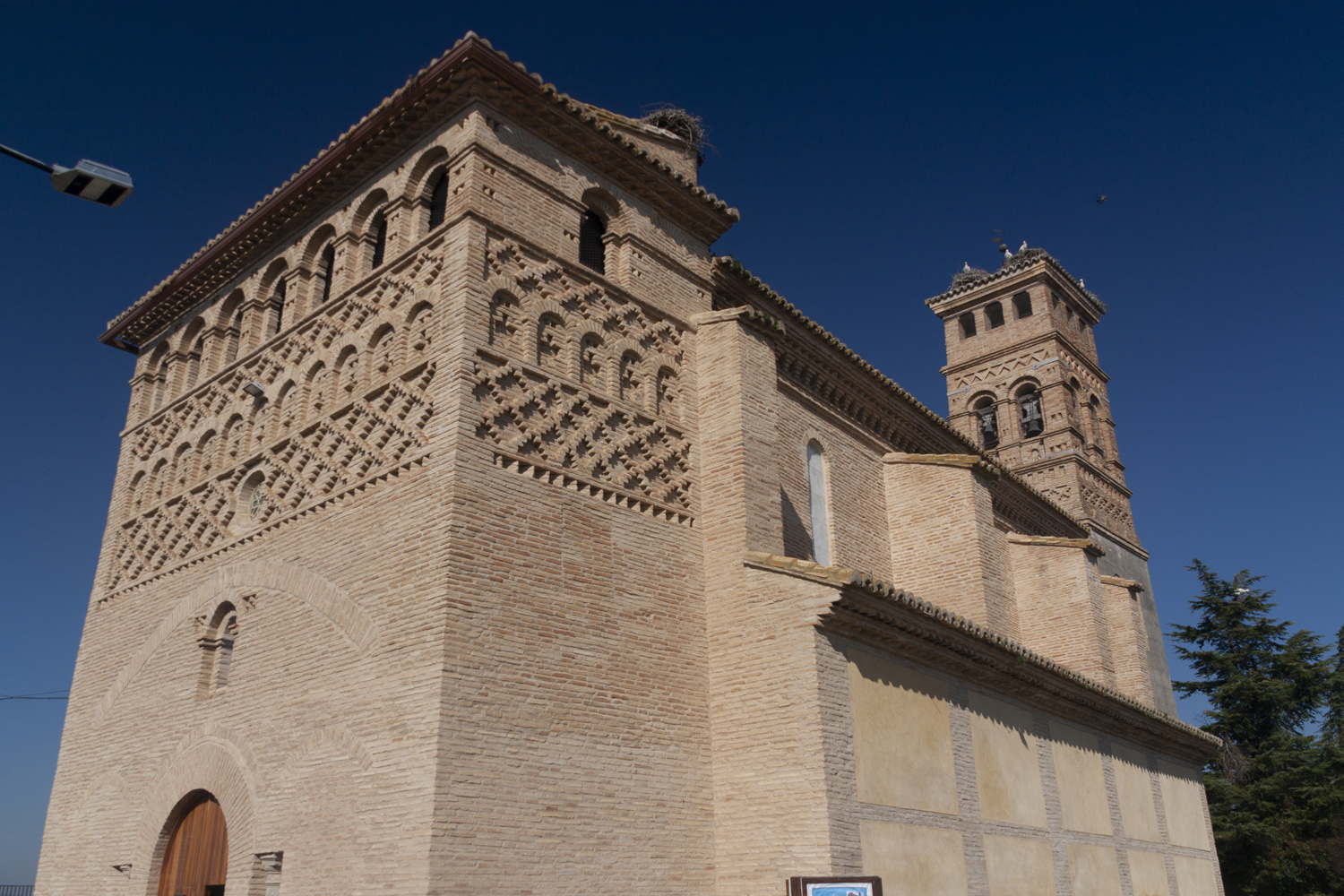
Under the Department of Culture and Tourism Order of October 15, 2001 (Official Gazette of Aragon dated November 14, 2001), the original declaration of the church of San Mateo as an Asset of Cultural Interest was supplemented, defining the Asset and its protected environment and specifying the most relevant movable assets therein.

Bibliography

Arte Mudéjar Aragonés. Patrimonio De La Humanidad, Institución Fernando el Católico, Zaragoza, 2002.

Tierra Mudéjar. El mudéjar Aragonés, Patrimonio Mundial, Heraldo de Aragón, D.L. 2002.

Appendixes

Church of San Mateo Apóstol

Plaza de la Iglesia
San Mateo de Gállego (Zaragoza)

Visit San Mateo de Gállego

City Hall: 976 684 180 wwww.sanmateodegallego.es WOULD YOU LIKE TO KNOW MORE? www.turismodezaragoza.es

Church of San Lorenzo Mártir, Magallón

Church of San Lorenzo Mártir, Magallón

C/ Liso Joaquín, 20. Magallón (Zaragoza)
CURRENT PROTECTION STATUS: ACI
TYPE OF ASSET: Property
CATEGORY: Religious
ARCHITECTURAL STYLE: Mudejar
CONSTRUCTION DATE: 14th century
The church of San Lorenzo Mártir was built in the Mudejar style in the 14th century. Several research projects have found that it was probably constructed adjacent to or over an earlier medieval castle, which explains the use of ashlars.

The typical materials in Mudejar art were used in the construction of this church, such as molded brick pieces. The church has a single nave and, according to research by Doctors María Isabel Álvaro Zamora and Gonzalo Borras Gualis, is the result of combining two temples.
The older of the two is a single-nave church likely dating from the 14th century, of which the five-sided apse has been preserved. In turn, the more recent church is a hall church with a polygonal chevet facing west, scallop-shaped squinches in the corners and three naves of equal height separated by cylindrical columns. The entire structure was covered by a stellar vault and the building is unique in that the southern nave extends to where it meets with the medieval apse, using the original structure in that of the new temple.

Interventions

Restoration, 20th to 21st century

From November 2009 to December 2010, cleaning of the brick work on the building and the stone and rammed earth exteriors took place.

In 2011, the Baroque high altar created between 1676 and 1680 was restored.

Projects and interventions

Projects and interventions, and the driving forces behind them, define the history of monumental buildings and how they are perceived.

Declarations

Declaration, 21st century

The Official Gazette of Aragon (BOA) from December 28, 2017 published Decree 207/2017, of December 19, by the Government of Aragon, declaring the Church of San Lorenzo Mártir in Magallón (Zaragoza) an Asset of Cultural Interest, Monument category.

Bibliography

ALVARO ZAMORA, María Isabel; Borrás Gualis, Gonzalo. Algunas dotaciones barrocas en la iglesia parroquial de San Lorenzo de Magallón (Zaragoza) [En línea]. En Coloquio de Arte Aragonés (3º. 1983. Huesca). Universidad de Zaragoza, 1985.p. 275-295. 

CHIRIBAY CALVO, Rafael. La serie “Reparación de Templos” del Archivo Diocesano de Zaragoza (1ª parte). Aragonia Sacra. 1996 , nº XI, p. 185-220. 

CHIRIBAY CALVO, Rafael. La serie “Reparación de Templos” del Archivo Diocesano de Zaragoza (2ª parte). Aragonia Sacra. 1997 , nº XII, p. 207-241. 

GALINDO PÉREZ, SILVIA. (COORD.). Aragón. Patrimonio cultural restaurado. 1984/2009: Bienes muebles, Gobierno de Aragón, Zaragoza, 2010. LORENZO LIZALDE, JOSÉ IGNACIO. Excavación de urgencia en la iglesia parroquial de San Lorenzo de Magallón (Zaragoza), En Arqueología aragonesa 1986-1987. Gobierno de Aragón, Zaragoza, 1991.p. 467-470. 

PANO GRACIA, JOSÉ LUIS ET AL. Magallón: patrimonio artístico religioso, Centro de Estudios Borjanos e Institución Fernando el Católico, Zaragoza, 2002

LACARRA DUCAY, María del Carmen. San Lorenzo de Magallón (Zaragoza). Obra restaurada de Tomás Giner. Cuadernos de Estudios Borjanos [En línea]. 1981 , nº 7-8, p. 233-251. 

LERÍN DE PABLO, Javier. El ayuntamiento de Magallón empieza la restauración de la iglesia de San Lorenzo. Heraldo de Aragón. 09/11/2009 p. 12. 

LERÍN DE PABLO, Javier. Magallón restaurará el retablo mayor de su parroquia. Heraldo de Aragón. 19/12/2010 p. 22. 

LORENZO LIZALDE, José Ignacio. Excavación de urgencia en la iglesia parroquial de San Lorenzo de Magallón (Zaragoza). En Arqueología aragonesa 1986-1987. Gobierno de Aragón, 1991.p. 467-470. 

La iglesia de Magallón, en peligro. Boletín Informativo del Centro de Estudios Borjanos. 1990 , nº 50, p. 2. Localizan la imagen de la Virgen de la Cama en la iglesia de Magallón. Heraldo de Aragón. 14/01/2016 p. 15. 

NAVARRO GALA, Rosario. El archivo parroquial de Magallón (Zaragoza) y su interés para la onomástica personal aragonesa (1549-1636). Archivo de Filología Aragonesa [En línea]. 1998 , nº 54-55, p. 287-297. <http://ifc.dpz.es/recursos/publicaciones/16/29/10navarro.pdf>. 

PANO GRACIA, José Luis et al. Magallón: patrimonio artístico religioso. Zaragoza: Centro de Estudios Borjanos e Institución Fernando el Católico, 2002. 

PANO GRACIA, José Luis et al. Noticias documentales del retablo mayor de la iglesia parroquial de San Lorenzo de Magallón (Zaragoza). cuadernos de Estudios borjanos [En línea]. 1999 , nº 41-42, p. 11-40. 

PUEYO LUESMA, José. Restos de retablos de Tomás Giner en San Juan y San Pedro de Zaragoza (1468) y parroquial de Magallón (1466). Aragón [En línea]. 1943 , nº 185, p. 89-95. 

Appendixes

Church of San Lorenzo Mártir

C/ Liso Joaquín, 20
Magallón (Zaragoza)

Visit Magallón

City Hall: 976 858 801 www.magallon.es WOULD YOU LIKE TO KNOW MORE? www.turismodezaragoza.es

Church of San Félix, Torralba de Ribota

Church of San Félix, Torralba de Ribota

Calle Mayor, s/n. 50311 Torralba de Ribota

CURRENT PROTECTION STATUS: ACI

TYPE OF ASSET: Property

CATEGORY: Religious

ARCHITECTURAL STYLE: Mudejar

CONSTRUCTION DATE: 1367 and 1420

The church of San Félix in Torralba de Ribota is an example of a fortified church with a single nave, straight east end and side aisles.

The presbytery has a straight east end wall and is composed of three square plan chapels that open onto the central nave by means of three pointed arches.

The single nave has three bays covered by a quadripartite rib vault and the bays are separated by three shorter bays projecting toward the buttresses, covered by a pointed barrel vault. It is important to note that these buttresses are only pronounced in the plan view, not on the façade.

The two bays covered by the rib vault and the smaller bays covered by the barrel vault are separated by means of transverse arches. The rib vaults are decorated with bosses: a pendant of muqarnas, also found in the church of Santa María in Tobed but larger in size, and a flat disc with a Gothic crest topped by a tower (the crest of Torralba de Ribota).
The side chapels between the buttresses are covered by quadripartite rib vaults, except for the one in the bay at the west end, which has a pointed barrel vault.

There are a number of apertures arranged similarly to those of the church in Tobed, although there is just one opening in the presbytery of this church in Torralba de Ribota, directly linking it to that of Santas Justas y Rufina in Maluenda.

In the raised choir at the west end of the church, there is a large polychrome wood alfarje ceiling structure held up by three arches on Tuscan order columns.

Above the side chapels and the three chapels in the presbytery there is a passageway for defensive purposes that extends to the exterior with large pointed-arch windows between each buttress tower, six over the presbytery chapels.

The exterior decoration features protruding brick work, with more lavish decoration on the gables. The interior decoration consists of painted brick designs throughout the nave and Mudejar plasterwork covering the apertures, which are pointed-arch windows with colonettes in this case, separated in two by a single mullion.

Interventions

Restoration, 20th to 21st century

Restoration, 20th century (1953-1972) The church underwent a thorough process of restoration to return it to its original Mudejar appearance, mainly occurring at three times: In 1953 the roofs were repaired; in 1961 the tower and north façade were restored; in 1972 restoration work focused on the main façade.

Restoration, 20th century (1986- 2003)

From 1986 to 1992, restoration work was undertaken in several phases, starting with shoring up the foundations and strengthening or replacing highly worn construction elements, then continuing in diverse areas of the building, particularly the roofs.

From 1997 to 2003, the exterior restoration of the building was completed and a partial restoration of the interior was carried out, specifically on the coffered wood ceilings, the murals in the central nave and side aisles and the plasterwork. These interventions were funded by the Government of Aragon with a budget of 605,624 euros.

Restoration, 21st century (2016)

The interior of the building was restored, renovating the items left untouched during the restoration work in 2003.

Projects and interventions


Declarations

Declaration1931, 20st century

The church of San Félix in Torralba de Ribota was declared a Historical and Artistic Monument under the Ministry of Public Instruction and Fine Arts Decree of June 3, 1931 published in the Gazette on June 4 1931.

Declaration, 21st century (2001)

The Official Gazette of Aragon dated November 14, 2001 published the Department of Culture and Tourism Order of October 15, 2001, whereby the original declaration of the church of San Félix in Torralba de Ribota (Zaragoza) is supplemented pursuant to Transitional Provision One of Aragonese Cultural Heritage Act 3/1999, of March 10.

Bibliography

BORRÁS GUALIS, GONZALO M. El Arte Mudéjar, Instituto de Estudios Turolenses, Zaragoza, 1990.

GONZALO M. BORRÁS GUALIS. El islam. De córdoba al mudéjar, Ed.Sílex,Madrid, 2000.

MÉNDEZ DE JUAN, JOSÉ FÉLIX ET AL. (COORD.). Aragón Patrimonio Cultural Restaurado. 1984/2009. Bienes inmuebles, Gobierno de Aragón, Zaragoza, 2010.

PIEPER, KATHARINA. YESERÍAS MUDÉJARES ARAGONESAS. Características de los ventanales y óculos de yeso de un maestro activo en Tobed, Torralba de Ribota y Maluenda, En XII Simposio Internacional de Mudejarismo (Teruel,2005): Actas. Instituto de Estudios Turolenses, 2007.p. 177-192.

SANMIGUEL MATEO, AGUSTÍN. Torres de ascendencia islámica en las comarcas de Calatayud y Daroca, Centro de estudios bilbilitanos, Institución “Fernando el Católico”, Calatayud , 1998.

  • VV.AA. Arte Mudéjar Aragonés. Patrimonio de La Humanidad, Institución Fernando el Católico, Zaragoza, 2002.
  • VV.AA. Tierra mudéjar. El Mudéjar Aragonés, patrimonio mundial, Heraldo de Aragón, D.L. 2002
  • ALEGRE ARBUÉS, Fernando. El retablo de Nuestra Señora de Cigüela. Restitución del estado original de la mazonería de Juan de Moreto [En línea]. En Encuentro de Estudios Bilbilitanos (9º. 2015. Calatayud). Centro de Estudios Bilbilitanos, 2016.p. 677-689. [Consulta: 30 de diciembre de 2020]. <https://ifc.dpz.es/recursos/publicaciones/35/56/_ebook.pdf>.
  • BORRÁS GUALIS, Gonzalo. Arte mudéjar aragonés. Zaragoza: CAZAR, 1985.
  • BORRÁS GUALIS, Gonzalo. La iglesia mudéjar de San Félix de Torralba de Ribota [En línea]. En YAGÜE GUIRLES, Ángel; BORRÁS GUALIS, Gonzalo; LACARRA DUCAY, María del Carmen. . Torralba de RibotaRemanso del mudéjar. Institución Fernando el Católico, 2011.[Consulta: 28 de diciembre de 2020]. <https://ifc.dpz.es/recursos/publicaciones/31/27/_ebook.pdf>.
  • BORRÁS GUALIS, Gonzalo. Las iglesias-fortaleza en la frontera con Castilla. En BORRÁS GUALIS, Gonzalo; MOGOLLÓN CANO-CORTÉS, Pilar. . El arte mudéjarLa estética islámica en el arte cristiano. Museum Ohne Grenzen, 2000.p. 119-133.
  • BORRÁS GUALIS, Gonzalo. Mahoma Rami, maestro de obras. En BORRÁS GUALIS, Gonzalo; LAVADO PRADINAS, Pedro; MOGOLLÓN CANO-CORTÉS, Pilar. . El arte mudéjarLa estética islámica en el arte cristiano. Museum Ohne Grenzen, 2000.p. 134-135.
  • CRIADO MAINAR, Jesús. La escultura romanista en la comarca de la Comunidad de Calatayud y su área de influencia [En línea]. Calatayud: Centro de Estudios Bilbilitanos, 2013.[Consulta: 7 de julio de 2021]. <http://cebilbilitanos.com/wp-content/uploads/2019/11/ESCULTURA-ROMANISTA-EN-CALATAYUD.pdf>.
  • FILGUEIRA VALVERDE, José. Donaciones Pastor. Dos tablas del maestro de Torralba siglo XV. El Museo de Pontevedra. 1972 , nº 26, p. 71-73.
  • GARCÍA, Mariano. Reaparece en Granada una tabla flamenca vendida hace un siglo en Torralba de Ribota. Heraldo de Aragón [En línea]. 02/05/2019 p. 40. [Consulta: 30 de diciembre de 2020]. <https://www.heraldo.es/noticias/ocio-y-cultura/2019/05/02/torralba-de-ribota-tabla-flamenca-granada-1312436.html>.
  • HEREDIA MORENO, María del Carmen. La cruz procesional de Torralba de Ribota (Zaragoza). Boletín del Museo e Instituto Camón Aznar. 1989 , nº 36, p. 39-50.
  • HERNÁNDEZ MARTÍNEZ, Ascensión. Fernando Chueca Goitia y el arte mudéjar aragonés: arquitectura, historia y restauración: La intervención en la iglesia de San Félix de Torralba de Ribota (1953-1972). e-rph [En línea]. Junio 2012 , nº 10, [Consulta: 28 de diciembre de 2020]. <https://revistadepatrimonio.es/index.php/erph/article/view/120/104>.
  • HERNÁNDEZ MARTÍNEZ, Ascensión. La actuación de la Dirección General de Bellas Artes en Aragón (1938-1958): la labor de los arquitectos conservadores Manuel Lorente Junquera y Fernando Chueca Goitia. En GARCÍA CUETOS, María del Pilar; ALMARCHA NUÑEZ-HERRADOR, María Esther; HERNÁNDEZ MARTÍNEZ, Ascensión. (coord.). Restaurando la memoriaEspaña e Italia ante la recuperación monumental de posguerra. Trea, 2010.p. 41-66.
  • IBÁÑEZ FERNÁNDEZ, Javier; Zaragozá Catalán, Arturo. Hacia una historia de la arquitectura de la Corona de Aragón entre los siglos XIV y XV a partir de los testeros de los templos: Ábsides construidos, ábsides proyectados e ideales y ábsides sublimes. Artigrama [En línea]. 2014 , nº 29, p. 261-305. [Consulta: 30 de diciembre de 2020]. <https://www.unizar.es/artigrama/pdf/29/3varia/01.pdf>.
  • LACARRA DUCAY, María del Carmen. El retablo de la Virgen con el Niño del maestro de Torralba, donación de los señores Várez Fisa al Museo Nacional del Prado [En línea]. En Encuentro de Estudios Bilbilitanos (9º. 2015. Calatayud). Centro de Estudios Bilbilitanos, 2016.p. 573-580. [Consulta: 30 de diciembre de 2020]. < https://ifc.dpz.es/recursos/publicaciones/35/56/_ebook.pdf>.
  • LACARRA DUCAY, María del Carmen. Banco de retablo con tablas de San Fabián, Santa Águeda, Epifanía, Santa María Magdalena y San Sebastián. En Joyas de un patrimonio IIIRestauraciones de la Diputación de Zaragoza (1999-2003). Diputación Provincial de Zaragoza, 2003.p. 119-123.
  • LACARRA DUCAY, María del Carmen. Retablo de San Félix de Gerona. En Joyas de un patrimonio IIIRestauraciones de la Diputación de Zaragoza (1999-2003). Diputación Provincial de Zaragoza, 2003.p. 97-117.
  • LACARRA DUCAY, María del Carmen. San Martín de Tours partiendo su capa con un pobre en la pintura cuatrocentista aragonesa. Aragonia Sacra. 2019 , nº XXV, p. 151-168.
  • LACÁRCEL, Silvia. Asignatura pendiente en Torralba de Ribota. Heraldo de Aragón. 28/12/2015 p. 13.
  • LACÁRCEL, Silvia. Primeros pasos para la restauración de la iglesia de Torralba de Ribota. Heraldo de Aragón. 06/07/2016 p. 14.
  • LÓPEZ LANDA, José María. Iglesias gótico-mudéjares del arcedianado de Calatayud. Arquitectura. 1923 , nº 49,
  • MÉNDEZ DE JUAN, José Félix et al. (coord.). Aragón. Patrimonio cultural restaurado. 1984/2009Bienes inmuebles. Zaragoza: Gobierno de Aragón, 2010.
  • PIEPER, Katharina. Yeserías mudéjares aragonesas. Características de los ventanales y óculos de yeso de un maestro activo en Tobed, Torralba de Ribota y Maluenda. En XII Simposio Internacional de Mudejarismo (Teruel,2005)Actas. Instituto de Estudios Turolenses, 2007.p. 177-192.
  • SANMIGUEL MATEO, Agustín. Torres de ascendencia islámica en las comarcas de Calatayud y Daroca. Aragón (España). Calatayud: Centro de Estudios Bilbilitanos, 1998.
  • SANMIGUEL MATEO, Agustín; Petriz Aso, Ana Isabel. La sillería gótico-mudéjar de Torralba de Ribota. En Encuentro de Estudios Bilbilitanos (6º, 2000, Calatayud). Centro de Estudios Bilbilitanos, 2005.p. 435-445.
  • VALERO SUÁREZ, José María. (dir.). Joyas de un patrimonio IV: Restauraciones de la Diputación Provincial de Zaragoza (2003-2011). Zaragoza: Diputación de Zaragoza, 2011.

Appendixes

Church of San Félix

Calle Mayor, s/n. 50311
Torralba de Ribota (Zaragoza)
Visit Torralba de Ribota

City Hall: 976 899 302

WOULD YOU LIKE TO KNOW MORE? www.turismodezaragoza.es

Church of San Antonio Abad, Tauste

Church of San Antonio Abad, Tauste

CURRENT PROTECTION CATEGORY: BIC

TYPE OF PROPERTY: Real estate

CATEGORY: Religious

ARCHITECTURALSTYLE: Romanesque and Mudejar

DATE OF CONSTRUCTION: 13th century

Located in the Arrabal neighbourhood, presiding over the Plaza de San Antonio, the small church of San Antonio Abad stands free of attached buildings. It is a modest Romanesque construction dating from the 13th century whose tower was built in the 16th century. Built on a simple ground plan, it has a single nave with seven bays and a semicircular apse preceded by a presbytery. The interior, lacking in luxury and ostentation, has a diaphanous space of slender proportions only compartmentalised by the choir raised at the foot. It is enclosed by an oven vault in the apse, a pointed barrel vault in the presbytery and a wooden frame over pointed diaphragm arches in the nave.

On the outside, it is a simple volume with a unitary character, determined by the combination of brick and masonry, currently under a cement render.

The walls are articulated only by the compartmentalisation of the buttresses, the opening of two simple openings and the access through the north wall, as well as the blind semicircular arcade that decorates the apse; the original access, opened in the south wall by a simple semicircular arch doorway crowned in the keystone with a very deteriorated relief of Saint Martin, is currently covered with an alabaster panel.

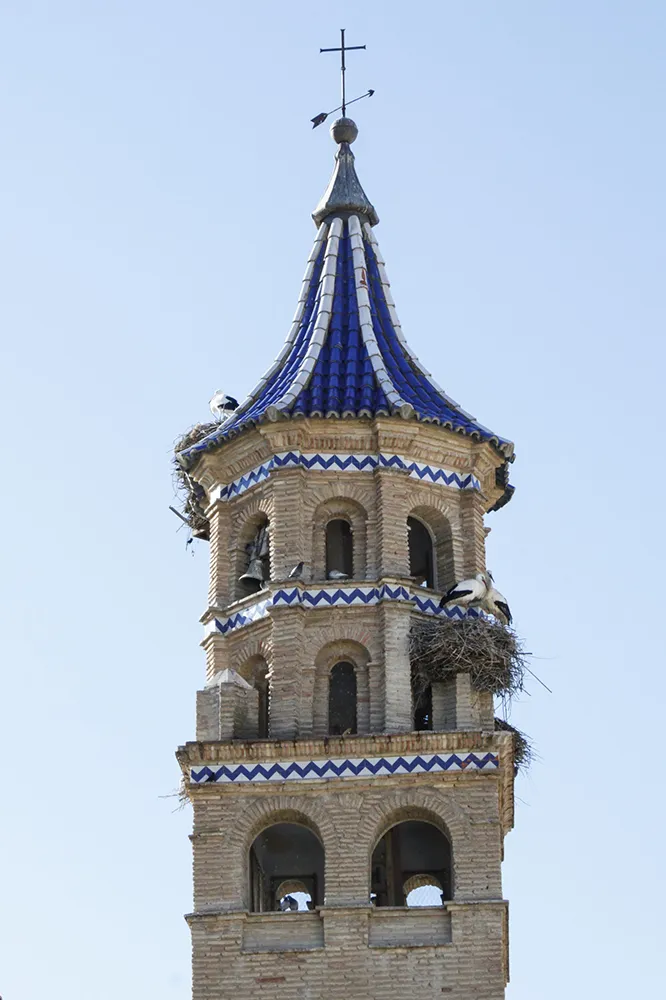
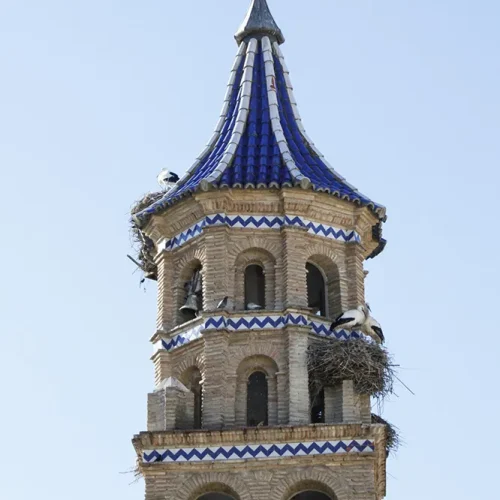
The Mudejar-style tower, attached in the 16th century to the foot of the nave, was built in brick on a base of stone ashlars. It consists of two lower sections with a square floor plan and an upper section with an octagonal floor plan. With a very simple articulation by means of semicircular openings, the decoration based on rows of angled bricks and ceramic friezes stands out.

In the 16th century, the façade was transformed, the apse was enlarged and a Mudejar tower was built.

Interventions

Restoration, 20th Century to 21st Century

From 1/01/2021 – 31/12/2021 the integral restoration of the church will be carried out, co-financed by the City Council, which will be in charge of the exterior, and the Government of Aragon, whose intervention will focus on the interior. The general objectives of the intervention are to restore the structural safety of the building and to solve the serious problems of damp in the walls.

Projects and interventions

Projects and interventions and their promoters define the history of monumental buildings as well as the perception of them.

The downloadable document presents the current status of the files under review, which will allow us to update our knowledge of each of the monumental buildings.

Declarations

Declaration, 21st Century

The Official Gazette of Aragon of 18 October 2002 published the Order of 24 September 2002, of the Department of Culture and Tourism, declaring the Church of San Antonio Abad in Tauste (Zaragoza) to be a listed cultural heritage site in Aragon.

Bibliography

BARCELÓ, Noeli. More than 130,000 to eliminate damp in the church of San Antón de Tauste. Heraldo de Aragón [On line]. 03/01/2021 p. 15<https://www.heraldo.es/noticias/aragon/zaragoza/2021/01/03/mas-130-000-euros-eliminar- humedad-iglesia-san-anton-tauste-zaragoza-1413097.html<>.

GARCÍA GUINEA, Miguel Ángel; Pérez González, José María (dir.). Encyclopaedia of the Romanesque in Aragon: Zaragoza. Aguilar de Campoo: Fundación Santa María la Real,

GARCÍA LLORET, José Luis. Three little-known Romanesque doorways in the churches of San Antón in Tauste (Zaragoza), San Miguel in Almudévar (Huesca) and San Salvador in Luesia (Zaragoza). Suessetania. 1999 , no 18, p. 28-44.

MENJÓN RUIZ, Marisancho. The artistic heritage of the town of Tauste [On line]. In Tauste en su historia: Actas de las I Jornadas sobre Historia de Tauste, 13 to 17 December 1999.

Asociación Cultural El Patiaz, 2001.p. 28-61. [Accessed: 23 July 2020].<https://drive.google.com/file/d/0BwYSxMNn-RKGYms3MVRwejBZeXc/vew>.

MENJÓN RUIZ, Marisancho. La iglesia de San Antón de Tauste: algunos datos sobre su historia y su restauración [On line]. In Tauste en su historia: Actas de las X Jornadas sobre

History of Tauste, 9 to 13 February 2009. Asociación Cultural El Patiaz, 2011.p. 111-152.<https://drive.google.com/file/d/0BwYSxMNn-RKGQ1dTcm1XTkM1M2M/view>

MORTE GARCÍA, Carmen; Castillo Montolar, Margarita (coord.). The Renaissance altarpiece of Tauste. Zaragoza: Institución Fernando el Católico, 2012.

Appendixes

Church of San Antonio Abad, Tauste

Pl. San Antón, 31
50660 Tauste (Zaragoza)
Visit Tauste

Town Hall: 976 854 950
tauste.es
WANT TO KNOW A LITTLE MORE?
www.turismodezaragoza.es

Cabañas chapel, La Almunia de Doña Godina

Cabañas chapel, La Almunia de Doña Godina

50100 La Almunia de Doña Godina, Zaragoza

CURRENT CATEGORY OF PROTECTION:
Bien de Interés Cultural (BIC)

TYPE OF PROPERTY: Real estate

CATEGORY: Religious

ARCHITECTURAL STYLE: Mudejar

DATE OF CONSTRUCTION: 12th, 13th, 14thCentury

This is an old Romanesque chapel built in the 12th century because Cabañas was a very important centre of population during the Middle Ages.

The original hermitage would have a rectangular nave and a semicircular apse, as well as a porticoed atrium on the epistle wall. In other words, it would follow the basic precepts of a Romanesque hermitage. Throughout the 13th century, a series of transformations were carried out, such as the closure of the atrium to create a new nave and the change of the entrance to the nave, located in the new wall.

In relation to the mural cycle of the right lateral nave, we can see how different narrative scenes are developed, such as: The cycle of the Passion, the life of St. Nicholas of Bari, the life of St. Ursula etc.

In addition, there are three arcosoliums on the side wall. On one side, the Caballero de Cabañas, the Cabañero Lopez de Luna and the Caballero Albero, with their specific heraldic coats of arms. At the foot of the nave, below the Mudejar alfarje, are the two most interesting arcosoliums due to the quality of their paintings. They are the tombs of Horia Pérez and Doña Guillelma Pérez.

The alfarje is located at the foot of the side nave. It is a small alfarje of great interest due to the quality of its painting. Its structure is based on the arrangement of transversal beams on which longitudinal braces are placed. From the front, we can see how an overhang is supported by corbels. The closing of the upper part of the window frame is made of openwork wood with motifs of an octagonal loop of four and crosses.

Interventions

Restoration, 20th Century to 21st Century

It was restored in 1960 in which the original south doorway, an essential element of the original church, was removed. A new space was also opened up on the Gospel side to obtain greater symmetry of the whole, completely altering the external appearance of the church and especially the doorway.

Projects and interventions

Projects and interventions and their promoters define the history of monumental buildings as well as the perception of them.

The downloadable document presents the current status of the files under review, which will allow us to update our knowledge of each of the monumental buildings.

Declarations

Declaration, 21st Century

20th Century to the 21st Century The Cabañas Chapel has been a National Monument since 27th October 1978 and was declared an Asset of Cultural Interest on 11th March 2002.

Bibliography

ALLO MANERO AND MATEOS GIL. La Almunia de Doña Godina. Guía histórico-artística, Diputación General de Aragón, Zaragoza, 1987.

ABBAD RÍOS, Francisco. Monumental Catalogue of Spain: Zaragoza. Madrid: CSIC, 1957.

ANDREU LORENTE, Concepción; Potoc Pozo, María Carmen. Some curiosities about the hermitage of Cabañas. Ador. 2009 , nº 14, p. 31-41. Work progresses on the restoration of the alfarje of the Cabañas hermitage. Heraldo de Aragón. 29/04/2019 p. 44.

BENITO, Félix. Inventory of the architectural heritage of the province of Zaragoza. Unpublishedinventory, Government of Aragon, 1988.

BORRÁS GUALIS, Gonzalo. Aragonese Mudejar art . Zaragoza: CAZAR, 1985.

CABELLO SOLANAS, Santiago. Portraits of memory. La Almunia de Doña Godina: [s.n.], 1997.

The Mudejar alfarje of the hermitage of Cabañas will be consolidated soon. Heraldo de Aragón. 18/08/2018 p. 15.

FACI, Roque Alberto. Aragón, reyno de Christo y dote de María Santíssima. Zaragoza: Diputación General de Aragón, 1979.

GARCÍA GUINEA, Miguel Ángel; Pérez González, José María(dir.). Encyclopaedia of the Romanesque in Aragon: Zaragoza. Aguilar de Campoo: Fundación Santa María la Real, 2010. GUDIOL, José. Medieval painting in Aragon. Zaragoza: Institución Fernando el Católico, 1971.

MAÑAS BALLESTÍN, Fabián. The hermitage of the virgin of Cabañas. La Almunia de Doña godina: Asociación Cultural L’Albada, 2007.

MAÑAS BALLESTÍN, Fabián. The hermitage of the Virgin of Cabañas. Ador. 2009 , nº 14, p. 13-29. MOYA CERDÁN, Fausto. Cabañas and La Almunia in its beginnings. Ador. 1996 , no. 3, p. 29-53.

POST, Chandler Rafhton. A history of spanish painting. Nueva York: Kraus Reprint Co., 1970.

RÍOS GRACIA, Luis de los; Estarán Molinero, José. Anecdotario de Cabañas. Ador. 2009 , no. 14, p. 275-283.

MAÑAS BALLESTÍN, F. Las pinturas de la ermita de Cabañas, Revista La Replazeta nº 6, June, 2000.

VV.AA. La Almunia de Doña Godina, Colección Territorio, Comarca del Valdejalón, Diputación General de Aragón, 2003, p. 251.

Appendixes

Cabañas chapel

50100 La Almunia de Doña Godina
Zaragoza

Visit La Almunia de Doña Godina

Town Hall: 976 600 076
www.laalmunia.es
WANT TO KNOW MORE?
www.turismodezaragoza.es

El Piquete / Museo de las Momias, Quinto

El Piquete / Museo de las Momias, Quinto

Cerro de la Corona, s/n, 50770 Quinto, Zaragoza

CURRENT PROTECTION STATUS: ACI

TYPE OF ASSET: Property

CATEGORY: Religious

ARCHITECTURAL STYLE: Mudejar

CONSTRUCTION DATE: 15th century
With its imposing size and location, the ancient church of La Asunción, or “El Piquete”, dominates the town of Quinto. This Mudejar structure was originally used for military defense purposes, with construction estimated to have begun in the early 15th century, attributed to Mahoma Rami, master bricklayer for Benedict XIII, or Papa Luna.

The building is now owned by the municipality and after more than three decades of restoration work, was reopened in 2017 as a social and cultural venue.

The history of its construction is rather complex. It was originally a Mudejar-style church with a single nave divided into three bays, featuring side chapels and a pentagonal apse plus two towers at the corners of the west end (there are references to a second tower, in addition to the one still standing, which may have stood on the Gospel side, although there are no architectural traces of its existence).

The original nave volume was increased in height and finished with a passageway of small round arches, typical of the Renaissance style in Aragon, in the 16th century, at which time some of the interior chapels were also remodeled.

The last two bays of the nave were added in the 17th century and the large chapel in the first bay, which opens to the Gospel side, is even later. The complex history of the building’s construction has led to hybrid forms and somewhat imbalanced exterior volumes that nonetheless render it highly interesting in terms of its uniqueness and the shapes of the decorative motifs and architectural features.

The entire exterior is made of exposed brick, and the original volume, spanning from the east end to the bell tower, can be clearly distinguished from the Baroque addition located at the west end. This latter is slightly higher and decorated in an austere fashion, its most striking feature being the enormous triangular pediment decorated with mutules crowning the gable of the west end. Running along the upper section of the original 15th century building is the Renaissance-era arched passageway resting on the former eaves over step pyramid-shaped corbels. The passageway arches running along the nave volume are double and rounded whereas those over the east end are slightly pointed.

The most striking features of the original structure are the openings, the door and the tower.

A complex window, composed of three small pointed arches separated by octagonal mullions and framed in a large molded arch of the same shape, opens up on each of the façades.

The portal consists of a straight recessed arch over which there is a pointed arch framed by a surround. Both display a series of concave and convex moldings forming archivolts that rest on engaged colonettes topped by small capitals with plant motifs in very poor condition. In the tympanum there are three canopies that must have once held now-lost sculptures and heraldic coats of arms with a diamond pattern and two four-legged animals. There are also draped coats of arms in the spandrels with two crosses and plant elements in the center.

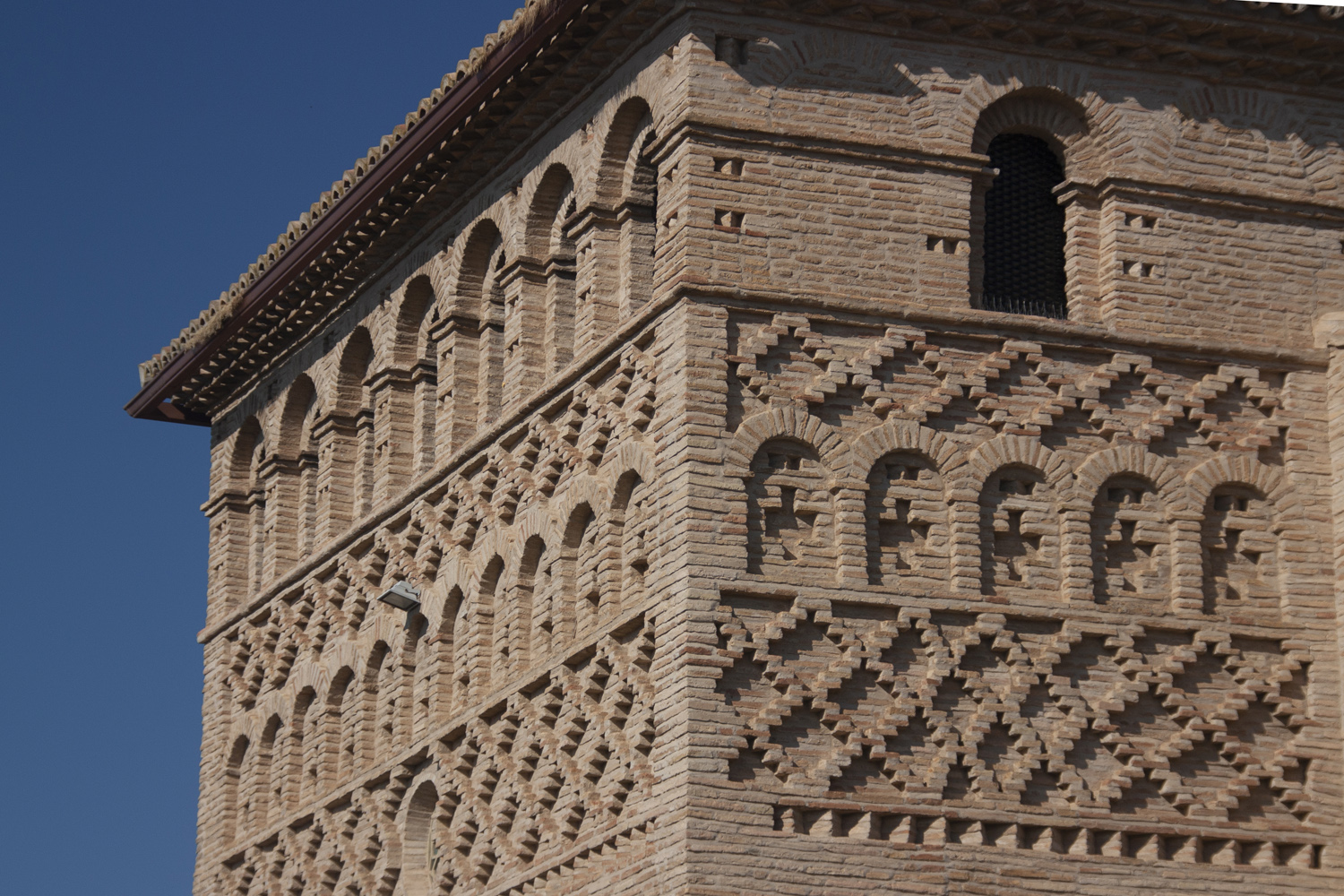
The tower is located in the center of the south wall, where the west end of the church originally stood. It has a square footprint with four sections separated by friezes of sawtooth decorative motifs and cornices resting on step pyramid- shaped corbels. The brick decoration, with four- and eight-sided interlacing motifs, is striking, covering the entire panel of the second section and framing coupled pointed-arch windows surrounded by a larger pointed arch decorated with a brick surround in the third section (originally the belfry).

The final section was created when the tower was raised in height in the 16th century, and is also decorated with somewhat simpler Mudejar-style interlacing designs. Above this section stands a crenelated top followed by a cone-shaped spire. The interior structure consists of a cylindrical central buttress with a spiral staircase.

The church interior contains a single nave divided into four bays, of which the two at the west end, dating from the Baroque expansion, are shorter. Side chapels are built into all the bays, and display a wide variety of characteristics depending on their intended purpose and construction period.

The five-sided polygonal apse is covered by a ribbed vault with triple torus molding on the ribs, which join at a central boss. Pointed arch arcosolia are built into the central walls, located under the aforementioned windows, the central one of which has been filled in and features trilobed arches crowned by Gothic tracery and a small rose window. Shallow chapels are built into the straight sides, each of which is covered by differently designed rib vaults. During the 16th century remodeling, elegant portals were added, featuring surbased arches flanked by pilasters and crowned with friezes overflowing with decorative reliefs showing mythological figures and beasts and medallions containing portraits.

The four bays of the nave are covered by quadripartite rib vaults, the ribs of which are resting on pilasters joined by a molded entablature decorated with mutules, both resulting from the remodeling done in the 18th century. They all have side chapels.
Two shallow chapels opened off of the first bay of the nave. The one on the Epistle side still remains, covered by a rib vault. On the Gospel side, the Santa Ana chapel was created in the 18th century, a large, square space covered by a dome and finished with a small polygonal chevet reminiscent of the shape of the church’s main chapel. This space is austerely decorated with Baroque moldings and rocaille. Another small, shallow chapel opens off the next bay,

and its pointed barrel vault is decorated with 18th century paintings; opposite this, there is a small space covered by a quadripartite rib vault that provides access to the tower and the upper gallery that runs along the Mudejar part of the church (the first two bays of the nave and the straight sides of the east end).

The last two bays were added in the late 17th century and contain deeper side chapels. This expansion sought a sense of unity with the previous structure, covering the new bays with vaults that were identical to the existing ones, while introducing a new shoring system based on pilasters and a cornice at the springing point of the vaults; this system was also used in the rest of the nave. A high choir (now gone) was built at west end and large windows with surbased arches were created. The decoration on the walls consisted in sgraffito and painted brick designs on plaster, covering the ribs of the vaults. The bosses were decorated with now-lost coats of arms, only the ribbons surrounding them remaining.

The most interesting chapels from the Baroque addition are located in the next to last bay. They both have domes, one circular and the other ellipsoidal, although some architectural features, such as the lanterns, have been lost.

The interior gallery that runs along the entire front part of the church, level with the arched passageway, is also striking.

The floorplan of the church follows one of the most characteristic outlines in this style: a single nave with a polygonal apse and chapels between the buttresses, first used in the church of San Pablo in Zaragoza in the late 13th century.

The decorative patterns on the tower can be related to the towers in Longares, San Félix in Torralba de Ribota, San Miguel de los Navarros in Zaragoza and one of the chapels in the apse of the Seo in Zaragoza. The structural, formal and decorative similarities between the ancient parish church in Quinto and the aforementioned buildings, as well as other contemporary churches such as Santa Tecla in Cervera de la Cañada and the now-lost San Pedro Mártir in Calatayud, have led certain scholars to link this church to the school of the master bricklayer Mahoma Rami, an artist with ties to Papa Luna.

The interior of the former church of La Asunción, popularly known as “El Piquete”, now houses the Quinto Mummy Museum. It contains a permanent exhibition of fifteen mummified bodies from the 18th and 19th centuries, as well as funeral objects and religious rituals.

During the final stages of the restoration of El Piquete, a number of graves were discovered inside the church containing bodies that had been preserved naturally in perfect condition. The finding became quite popular across the country, referred to as “the Mummies of Quinto”.

Following several years of research, documentation and preventive conservation, the Quinto City Council opened a museum in 2018 to display this collection of mummified human remains from the 18th and 19th centuries, along with funeral and religious objects uncovered over the course of three archeological excavation campaigns.

This museum is the first exhibition space of its kind in Spain, not only displaying the fifteen bodies in perfectly preserved condition, but also exhibiting them in the same location where they were buried. All of this affords visitors an unprecedented, unique experience that confronts them with life and death in the incomparable setting of El Piquete.

Interventions

Restoration, 20th to 21st century

In 1982 it was declared an artistic historical monument. Starting in 1983, different phases of action would begin. The first of them were works related to the structural restoration of the building, the tower, spire and roofs.

In 1996 the City Council of Quinto, together with the Zaragoza Provincial Council, began work on the facades, concluding in 2003. After the exterior restoration work, they would focus on the interior of the building.

Projects and interventions

Projects and interventions, and the driving forces behind them, define the history of monumental buildings and how they are perceived.

The downloadable file shows the current status of review proceedings in progress, making it possible to gradually update the knowledge about each monumental building.

Declarations

Declaration, 21st century

Bibliography

BORRÁS GUALIS, Gonzalo. Arte mudéjar aragonés. Zaragoza: CAZAR, 1985.

CHIRIBAY CALVO, Rafael. La serie «Reparación de Templos» del Archivo Diocesano de Zaragoza (2a parte). Aragonia Sacra. 1997 , no XII, p. 207-241.

GALIAY SARAÑANA, José. El lazo, motivo ornamental destacado en el estilo mudéjar: su trazado simplicista. Edición facsímil. Zaragoza: Institución Fernando el Católico, 1995.
LACARRA DUCAY, María del Carmen. El mecenazgo artístico de don Francisco Clemente Pérez (Francesc Climent Çapera), prior en la Colegiata de Santa María de Daroca (1394- 1404) y arzobispo de Zaragoza (1415-1419) y (1429-1430). En SIMÓ CASTILLO, Joan Baptista. (coord.). El pontificado de Benedicto XIII después del Concilio de Constanza.

Asociación Amics del Papa Luna, 2018.p. 53-70.

PEÑA GONZALVO, Javier. El Piquete de Quinto. Aragón Turístico y Monumental. 2018 , no 385, p. 4-8.

PEÑA GONZALVO, Javier. Mahoma Ramí, arquitecto de Benedicto XIII. En Jornadas de Estudio VI Centenario del Papa Luna (1994. Calatayud-Illueca). Centro de Estudios Bilbilitanos, 1997.p. 299-315.

PUYOL IBORT, Marta. Inventario de patrimonio arquitectónico de la Ribera Baja del Ebro. Inventario inédito, Comarca Ribera Baja, 2006.

PÉREZ BERIAIN, E. Luz verde al futuro museo de momias de Quinto, que podría abrir en seis meses. Heraldo de Aragón [En línea]. 13/07/2017 p. 16.

. PÉREZ BERIAIN, E. Quinto reabre por fin el Piquete tras 34 años en obras. Heraldo de Aragón [En línea]. 11/11/2017 p. 18 .

PÉREZ FERNÁNDEZ, Esther P; Río Bonafonte, Ma Romualda del. Trasobares Ruiz, Victoria E. Arte mudéjar en la Ribera Baja del Ebro [En línea]. En BES GRACIA, Pilar; BLASCO ZUMETA, Javier. (coord.). Comarca de Ribera Baja del Ebro. Gobierno de Aragón, 2005.p. 185-194.

https://comarcas.es/pub/documentos/documentos_bloque-III.2_beee7149.pdf

Appendixes

El Piquete / Museo de las Momias

Cerro de la Corona, s/n
50770 Quinto (Zaragoza)

Visit Quinto

City Hall: 976 177 011 wwww.quinto.es WOULD YOU LIKE TO KNOW MORE? www.turismodezaragoza.es

Collegiate church of the Santo Sepulcro, Calatayud

Collegiate church of the Santo Sepulcro, Calatayud

Plaza de España 1. 50300

CURRENT PROTECTION STATUS: Listed

TYPE OF ASSET: Property

CATEGORY: Religious ARCHITECTURAL STYLE: Mudejar

CONSTRUCTION DATE: Original construction, 14th century. Classified as proto-Mudejar. Zuera is a key location in the discussion of the early development of the style.
The military order of the Holy Sepulcher of Jerusalem established its command in Calatayud after the estate of king Alfonso I was settled, who had bequeathed the kingdom of Aragon to the military orders. In 1156, the temple and house of the Holy Sepulcher was founded in Calatayud. During the 14th century, the canons of the Holy Sepulcher were major patrons of Mudejar art.

Construction of the collegiate church existing today was completed by the architect Gaspar de Villaverde, offering a magnificent example of proto-Baroque architecture in the Herrerian style. Of particular note is the Mudejar cloister building, now in ruins, only half of which – the side or arcade attached to the collegiate church and part of the two adjacent sides – remains standing. The cloister had a square footprint with five bays on each side or arcade, covered by a quadripartite rib vault; thus, three pointed arches separated by solid buttresses open onto the interior courtyard. In certain parts of the bays, the original painted brick decoration can be seen, which the scholar Gonzalo Borrás has linked to the cloister of the canonesses of the Holy Sepulcher of Zaragoza.

There are two more floors above the flank of the cloister attached to the monastery: the main floor has three pointed arch openings for each arch on the ground floor and belongs to the original Mudejar construction, possibly dating, according to hypotheses, from around 1370. The upper floor, now exhibiting round arches, was part of an expansion in the 16th century.

Interventions

Restoration, 20th to 21st century

1986 Fernando Fernández Lázaro

1990 – 1996 Ángel Luis Muñóz Barrado

Projects and interventions

Projects and interventions, and the driving forces behind them, define the history of monumental buildings and how they are perceived.

Declarations

Declaration, 21st century

Declaration, 21st century (2002). The Official Gazette of Aragon dated August 9, 2002 published the Department of Culture and Tourism Order of July 1, 2002 declaring the Collegiate church of the Santo Sepulcro in Calatayud (Zaragoza) a Listed Asset of Aragonese Cultural Heritage.

Bibliography

ALEGRE ARBUÉS, Fernando. Las fábricas medievales del convento del Santo Sepulcro de Calatayud. Interpretación a partir de su levantamiento planimétrico y análisis constructivo. En VII Encuentro de Estudios Bilbilitanos: Calatayud y Comarca (Calatayud, 28-30 abril, 2006). Centro de Estudios Bilbilitanos, 2009. vol. 2, p. 379-396.

BORRÁS GUALIS, Gonzalo. Arte mudéjar aragonés. Zaragoza: CAZAR, 1985.

CRIADO MAINAR, Jesús. La escultura romanista en la comarca de la Comunidad de Calatayud y su área de influencia [En línea]. Calatayud: Centro de Estudios Bilbilitanos, 2013.[Consulta: 7 de julio de 2021].
Comienza la restauración de la cúpula de la colegiata del Santo Sepulcro. Heraldo de Aragón. 07/12/2009 p. 13.

Finaliza la rehabilitación de la torre sur de la colegiata. Heraldo de Aragón. 09/02/2016 p. 15.

LACÁRCEL, Silvia. Convenio para restaurar un chapitel del Santo Sepulcro. Heraldo de Aragón. 16/10/2014 p. 14.

LACÁRCEL, Silvia. Empiezan las obras en los claustros del Santo Sepulcro y el Seminario de Nobles. Heraldo de Aragón. 16/11/2009 p. 13.

LACÁRCEL, Silvia. Nuevos restos llevan a revisar la historia de los claustros del Sepulcro de Calatayud. Heraldo de Aragón. 06/11/2010 p. 13.

La DPZ concede ayudas de urgencia a seis iglesias de la provincia. Heraldo de Aragón. 27/12/2015 p. 14.

MANRIQUE ARA, María Elena. Hacia una biografía de Félix Malo, maestro escultor de Barbastro afincado en Calatayud (ca. 1733-1779): Datos familiares y profesionales inéditos. Boletín del Museo e Instituto Camón Aznar. 1996 , nº LXIV, p. 99-126. Nuevas obras en la torre de la Colegiata del Santo Sepulcro. Heraldo de Aragón. 24/02/2015 p. 15.

QUINTANILLA MARTÍNEZ, Emilio; Rincón García, Wifredo. Noticias históricas y artísticas sobre la Colegiata del Santo Sepulcro de Calatayud entre 1621 y 1651. En Jornadas de Estudio sobre la Orden del Santo Sepulcro (5ª. 2007. Calatayud y Zaragoza). [s.n.]2009.p. 145-175. QUINTANILLA MARTÍNEZ, Emilio; Rincón García, Wifredo. Noticias históricas y artísticas sobre la Colegiata del Santo Sepulcro de Calatayud entre 1652 y 1684. En Jornadas de Estudio sobre la Orden del Santo Sepulcro (6ª. 2011. Zaragoza). [s.n.]2011.p. 57-79.

QUINTANILLA MARTÍNEZ, Emilio; Rincón García, Wifredo. Noticias históricas y artísticas sobre la Colegiata del Santo Sepulcro de Calatayud entre 1780 y 1807. En Jornadas de Estudio sobre la Orden del Santo Sepulcro (3ª. 1999. Calatayud y Zaragoza). [s.n.]2000.p. 119-138.

RINCÓN GARCÍA, Wifredo. El patrimonio de la Orden del Santo Sepulcro en Aragón: La Real Colegiata del Santo Sepulcro de Calatayud y el Monasterio de la Resurrección de Zaragoza. Aspectos artísticos e historiográficos. En LÓPEZ-YARTO ELIZALDE, Amelia; RINCÓN GARCÍA, Wifredo. (coord.). Arte y patrimonio de las órdenes militares de Jerusalén en España: hacia un estado de la cuestión. Centro de Estudios de la Orden del Santo Sepulcro, 2010.p. 267-288. RINCÓN GARCÍA, Wifredo; Quintanilla Martínez, Emilio. La Fundación del Santo Sepulcro de Calatayud y sus priores hasta 1570. En Encuentro de Estudios Bilbilitanos (6º. 2000. Calatayud). [s.n.]2005.p. 343-348.

RUBIO SEMPER, Agustín. Estudio documental de la iglesia del Santo Sepulcro de Calatayud. Seminario de Arte Aragonés. 1978 , nº 25-26, p. 101-107. Retiran andamios en la torre del Santo Sepulcro. Heraldo de Aragón. 08/02/2018 p. 20.

SANMIGUEL MATEO, Agustín. Arte mudéjar en la ciudad de Calatayud. Zaragoza: Centro de Estudios Bilbilitanos, 2007. SANMIGUEL MATEO, Agustín. El claustro del Santo Sepulcro de Calatayud. En Jornadas de Estudio sobre la Orden del Santo Sepulcro (1º.1991. Calatayud y Zaragoza). [s.n.]1991.p. 281- 292.

SANMIGUEL MATEO, Agustín. Una visión de Jerusalén en tres retablos de la Colegiata del Santo Sepulcro de Calatayud. En Jornadas de Estudio sobre la Orden del Santo Sepulcro (2ª. 1995. Zaragoza). [s.n.]1996.p. 359-371.

SANMIGUEL MATEO, Agustín; Petriz Aso, Ana Isabel. Las caballerizas medievales de la Orden del Santo Sepulcro de Calatayud. En Jornadas de Estudio sobre la Orden del Santo Sepulcro (4º. 2003. Calatayud y Zaragoza). [s.n.]2004.p. 368-371.

SÁNCHEZ MOLLEDO, José María. Don Miguel Monterde (1730-1791), Prior del Santo Sepulcro de Calatayud. En Jornadas de Estudio sobre la Orden del Santo Sepulcro (4ª. 2003. Calatayud y Zaragoza). [s.n.]2004.p. 169-177.

URZAY BARRIOS, José Ángel. (coord.). Calatayud. Historia, arte, arquitectura y urbanismo: Una guía para salvaguardar la ciudad. Calatayud: Centro de Estudios Bilbilitanos, 2019.

Appendixes

Collegiate church of the Santo Sepulcro

Plaza de España, 1
50300 Calatayud (Zaragoza)

Visit Calatayud

City Hall: 976 881 700 www.calatayud.es WOULD YOU LIKE TO KNOW MORE? www.turismodezaragoza.es