Circular from the rural school
The “Circular from the rural school” project is a cooperation project between rural development groups led by the Asociación Territorio Mudéjar.
The following have participated in the project: ADRI Calatayud-Aranda, ADRI Jiloca-Gallocanta, FEDIVALCA -Valdejalón and Campo de Cariñena-, ASOMO Tarazona and el Moncayo, CEDEMAR -Bajo Aragón Caspe and Ribera Baja del Ebro-, ADRAE -Ribera Alta del Ebro- and ADEFO Cinco Villas.
The objective is to develop educational materials around the Mudejar identity of the towns, placing rural schools and the educational community of the towns as the center of the project.
Based on the work developed, for almost three years, the students of fifteen schools have designed a walk through their town in which we can learn about the main points of interest and their connection with the Mudejar culture.
Longares
The route has been carried out following the working model of the schools that participated in the project and adapted to the town of Longares.
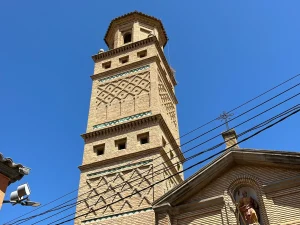
Longares was a walled town, with different entrance gates, which separated the walled enclosure of the town from the outside. We are going to cross some of them to be able to walk through its urban layout, which leads us to a singular example of the Mudejar tower of the church of the Asunción Nuestra Señora de Longares.
1. History of the town
According to its etymology, Longares comes from Latin, which is probably why we can already find some kind of settlement from this period. When the territory was conquered by the Christians in 1118, the Muslim population living in the walled town became known as Mudejar. In Longares, the Mudejar culture can be seen in its main monument, but also in the layout of the farmhouse and in the agricultural techniques that have been preserved.
This point is linked to the didactic activity 1.
2. Mudejar Architecture
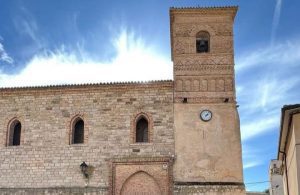
The Mudéjars were particularly skilled in the construction of buildings of unique technical characteristics and beauty. The main monument in Longares is the tower of the church of Nuestra Señora de la Asunción. According to its structure and decoration, the tower was built in the second half of the 14th century. It formed part of a complex with the old Mudejar church, of which a canvas is still preserved.
This point is linked to the didactic activity 5.
3. Materials
The materials used by the Mudejars can be found in what we would call the local environment. In Longares, we can observe the construction materials used for Mudéjar monuments applied to other types of domestic construction. The main materials used are: clay, plaster, alabaster and wood, applied to both the interior and exterior of the buildings.
This point is linked to the didactic activity 2
4. Coexistence of cultures
The coexistence of Christian, Muslim and Jewish cultures is what made up medieval society in our territory. After the Christian conquest we can speak of Mudejar. Some of the streets that we can walk through today in the town show us the vestiges of its medieval past, reflected in its urban layout of Islamic tradition, with winding streets, nooks and crannies.
This point is linked to the didactic activity 3
5. Reminiscences of the Mudejar style
We could say that Mudejar art came to an end in the 17th century, when the Moors (Mudejars who converted to Christianity) were expelled from the Iberian Peninsula. However, we can see how the style survived throughout the following centuries. This is why, in various constructions, we find ornamental elements, construction techniques and materials that remind us of the Mudejar style.
During the late nineteenth and early twentieth centuries, medieval styles were revived, which became known as neo-medievalism. In the case of Mudejar, we will have a current that will be called Neo-Mudejar. In Longares there are several examples of this artistic trend.
This point is linked to the didactic activity 7