Circular from the rural school
The “Circular from the rural school” project is a cooperation project between rural development groups led by the Asociación Territorio Mudéjar.
The following have participated in the project: ADRI Calatayud-Aranda, ADRI Jiloca-Gallocanta, FEDIVALCA -Valdejalón and Campo de Cariñena-, ASOMO Tarazona and el Moncayo, CEDEMAR -Bajo Aragón Caspe and Ribera Baja del Ebro-, ADRAE -Ribera Alta del Ebro- and ADEFO Cinco Villas.
The objective is to develop educational materials around the Mudejar identity of the towns, placing rural schools and the educational community of the towns as the center of the project.
Based on the work developed, for almost three years, the students of fifteen schools have designed a walk through their town in which we can learn about the main points of interest and their connection with the Mudejar culture.
Illueca
The route has been carried out following the working model of the schools that participated in the project and adapted to the town of Illueca.
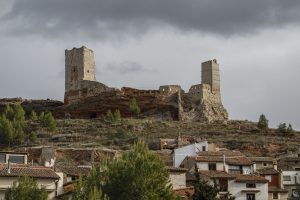
Illueca, like the other villages in the valleys of the Aranda and Isuela rivers, had a strong Mudejar population that coexisted with Christian and Jewish communities. On top of a rocky spur stands the castle-palace of the Count of Argillo, popularly known as the castle of Pope Luna. This was the birthplace of one of the most important and influential figures of the medieval period in Spain and abroad, who was also a great patron of Mudejar art: Pedro Martínez de Luna, who was appointed Pope in Avignon as Benedict XIII, known as “Papa Luna”.
1. History of the town
On the hillside, at the foot of the castle, there is an urban hamlet of historic character, very different from the new areas of expansion due to its Jewish-Muslim street layout, in which the numerous bends in the streets stand out, forming attractive corners of the façades, which combine the whitewashing of the simplest houses with the brick of the noblest buildings such as the Casa Saldaña.
This point is linked to the didactic activity 1.
2. Patronage
Mudejar art is art made by Mudejars and commissioned by Christians. But among Christians, only those who formed part of the social elite of medieval times could afford to commission buildings of such mastery. The castle-palace of Illueca is closely linked to the figure of Pope Luna. It has many phases of construction between the 16th and 17th centuries.
This point is linked to the didactic activity 2
3. Master builders
The Mudéjars were particularly skilled in the construction of buildings of unique technical characteristics and beauty. They were highly sought after by the great patrons of the time and their works were in the taste of the time. Some of the names of these masters have survived, such as Mahoram Calahorri and Mahoram Rami. In particular, Mahoram Rami was Benedict XIII’s favourite master builder and is associated with some of the elements built in the palace.
This point is linked to the didactic activity 4
4. Importance of water and landscape
The Arabs were pioneers in the introduction of irrigation techniques in the rural world. Examples include waterwheels, waterwheels, cisterns and the most common, irrigation ditches. The introduction of agricultural products and techniques also favoured local crops, which grew better and faster. In addition, the idea of the agricultural landscape was generated, which is fundamental for understanding our localities. From here there is a marvellous view of the Moncayo.
This point is linked to the didactic activity 6
5. Mudejar architecture
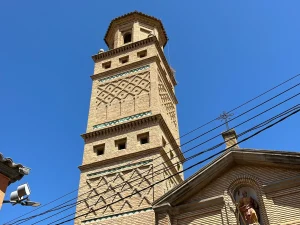
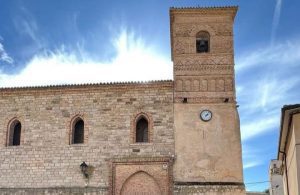
Mudejar architecture was established between the 12th century, when the territory inhabited by the Muslims was conquered by the Christians, and the 17th century, when the Moors (Mudejars converted to Christianity) were expelled. The interior of the parish church of St. John the Baptist shows us the survival of the Islamic tradition through the Baroque plasterwork carried out by the master Juan de Marca at the end of the 17th century.
This point is linked to the didactic activity 5.
6. Reminiscence
There are some buildings built after the expulsion of the Moors. These buildings allow us to talk about the use of materials and construction techniques of Islamic tradition that have continued to be used over time in our territory. We can speak of survival or reminiscences until the 60s of the 20th century.
This point is linked to the didactic activity 7