Circular from the rural school

The “Circular from the rural school” project is a cooperation project between rural development groups led by the Asociación Territorio Mudéjar.

The following have participated in the project: ADRI Calatayud-Aranda, ADRI Jiloca-Gallocanta, FEDIVALCA -Valdejalón and Campo de Cariñena-, ASOMO Tarazona and el Moncayo, CEDEMAR -Bajo Aragón Caspe and Ribera Baja del Ebro-, ADRAE -Ribera Alta del Ebro- and ADEFO Cinco Villas.

The objective is to develop educational materials around the Mudejar identity of the towns, placing rural schools and the educational community of the towns as the center of the project.

Based on the work developed, for almost three years, the students of fifteen schools have designed a walk through their town in which we can learn about the main points of interest and their connection with the Mudejar culture.

Cosuenda

The tour has been carried out following the working model of the schools that participated in the project and adapted to the town of Cosuenda.

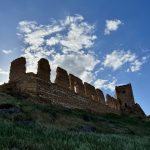
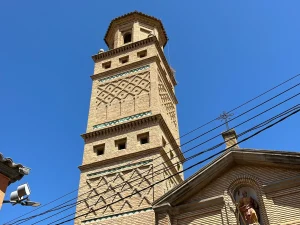
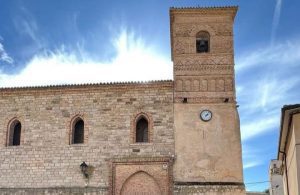
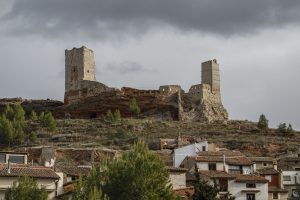
In the town of Cosuenda, its defensive origins are evident from the first point along the route: the Lisalta tower, from where we can see the whole town from a bird’s eye view. Continuing on and going down to continue the walk you will find the wine cellars, built with local materials. Finally, we will go to the church of Nuestra Señora de los Ángeles to understand the permanence of Mudejar materials and construction techniques over the centuries.

1. History of the town

The Muslims who remained after the Christian conquest became known as Mudejars, and preserved their religion, culture and customs. The oldest medieval remains in Cosuenda are those of the castle, built in the 14th century to protect the town. It is called the Lisalta tower and is located in the highest part of the village, from where we can see the whole village and the Sierra de Algairén.

This point is linked to the didactic activity 1.

2. Construction materials

The Mudéjars were particularly skilled in the construction of buildings of unique technical characteristics and beauty. The materials used by the Mudejars are materials that can be found in the surroundings, what we would call, of proximity. In Cosuenda, we can observe the construction materials used for Mudejar monuments applied to other types of construction for domestic use. Houses and cellars, created for everyday use, so, although in Cosuenda we do not have a Mudejar monument, we can understand the materials and their repeated use over time through other constructions.

This point is linked to the didactic activity 3

3. Importance of water and landscape

Water is the most important principle of the universe according to the Koran. It is a divine symbol, since water is necessary for life. It is also present in the Muslims’ idea of their Paradise. For the Mudejars, who were also Muslims, water was fundamental. In Cosuenda we find El Barranco, through which water is channelled, running through the middle of the town in the form of a small stream. In Cosuenda there is a centre for the interpretation of the fauna and flora of the Sierra de Algairén called Plantaria.

This point is linked to the didactic activity 6

4. Coexistence of cultures

The Christians allowed the Muslims to stay in the territory, as they were necessary to sustain the local economy. They kept their religion and customs, but they had to live separately, in neighbourhoods that we call morerías, just as the Jews did in the Jewish quarters. In Cosuenda we would probably have all kinds of populations, coexisting indistinctly throughout the entire hamlet.

This point is linked to the didactic activity 2

5. Reminiscences of the Mudejar style

Mudejar art came to an end in the 17th century, when the Moors (Muslims converted to Christianity) were expelled from the territory. However, we have a style that has survived through the centuries. This is undoubtedly due to sharing a culture and a territory for so many centuries. This is why, in several later constructions, we find ornamental elements, materials and construction techniques that remind us of the Mudejar style and that give us a clue to the importance it had, and still has in our territory. This is the case of the church of Nuestra Señora de los Ángeles in Cosuenda, although of Baroque construction, Mudejar reminiscences can be observed. Moreover, following the tradition of the Muslim dwelling, where life is lived behind closed doors, thus preserving privacy. The gates that we have passed through along the route were what separated one neighbourhood from another.

This point is linked to the didactic activity 7

Related Works