Circulate from
the rural school
The “Circular from the rural school” project is a cooperation project between rural development groups led by the Asociación Territorio Mudéjar.
The following have participated in the project: ADRI Calatayud-Aranda, ADRI Jiloca-Gallocanta, FEDIVALCA -Valdejalón and Campo de Cariñena-, ASOMO Tarazona and el Moncayo, CEDEMAR -Bajo Aragón Caspe and Ribera Baja del Ebro-, ADRAE -Ribera Alta del Ebro- and ADEFO Cinco Villas.
The objective is to develop educational materials around the Mudejar identity of the towns, placing rural schools and the educational community of the towns as the center of the project.
Based on the work developed, for almost three years, the students of fifteen schools have designed a walk through their town in which we can learn about the main points of interest and their connection with the Mudejar culture.
Belmonte de Gracián
The route has been carried out following the working model of the schools that participated in the project and adapted to the locality of Belmonte de Gracián.
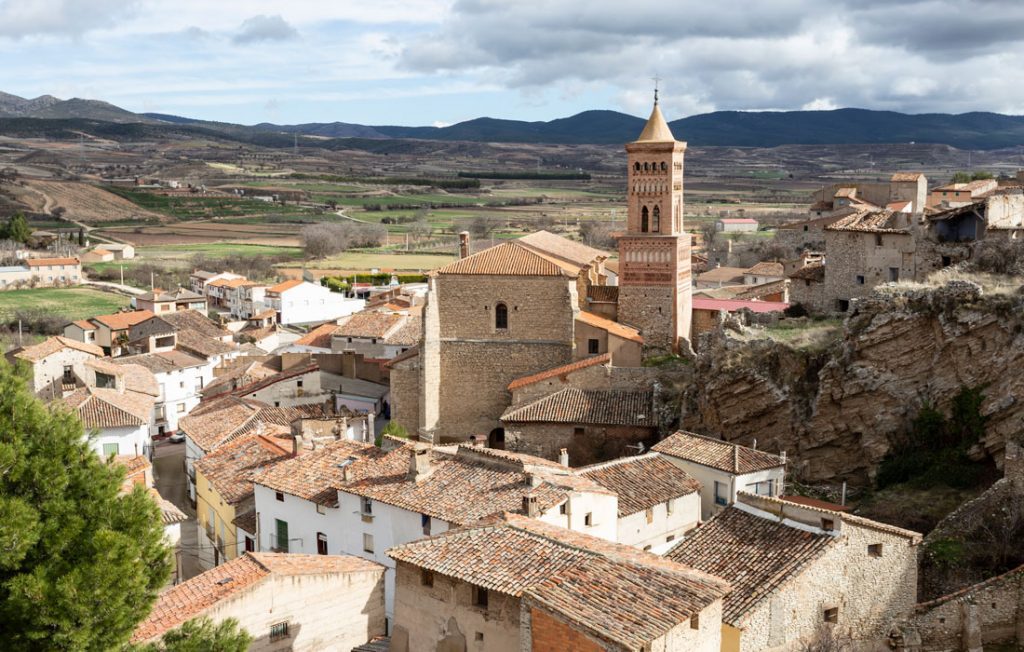
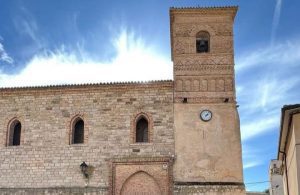
The town of Belmonte de Gracián, birthplace of one of the most illustrious Spanish writers of the Golden Age: Baltasar Gracián, is presided over by the church of San Miguel, a temple with a polygonal apse of extraordinary Mudejar decoration. The town centre is located next to a hill, a place that was crowned by a Muslim castle in the Islamic period. As the remains of its past show, Belmonte de Gracián has ancient origins, of which we can highlight its Mudejar past in medieval times.
1. History of the town
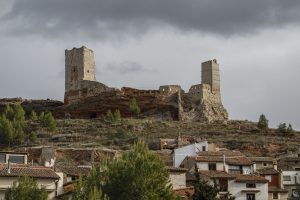
The origin of the village’s name has Celtiberian roots and could mean “shining mountain”, although it is also said that it may refer to the Celtiberian solar deity. Near this place there was a great Celtiberian city called Segeda (Sekaisa). The same locality was taken by the Romans and, from 711 onwards, Islam was present in the area. Some vestiges remain, such as the remains of its castle, dated by some scholars to the 10th century. They can be found in the place where we are located, where the church of Nuestra Señora del Castillo was later built.
This point is linked to the didactic activity 1.
2. Construction materials
The materials used by the Mudejars are materials that can be found in the surroundings, what we would call, of proximity. In this way, we will see how commonly used monuments and constructions are made with the same materials and construction techniques. The most common are clay, plaster, wood and alabaster. Belmonte de Gracián is built over a natural alabaster quarry.
This point is linked to the didactic activity 3
3. Coexistence of cultures
The Christians allowed the Muslims, previous settlers, to remain in the territory, as they were necessary to sustain the local economy. In Belmonte de Gracián no Moorish or Jewish quarter is preserved, but we do know that the Mudejars were settled in the territory due to the church that we have preserved.
This point is linked to the didactic activity 2
4. Mudejar architecture
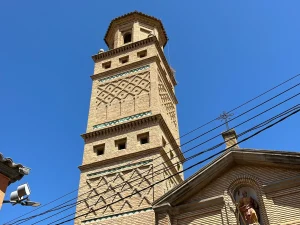
The Mudéjars were particularly skilled in the construction of buildings of unique technical characteristics and beauty. They were highly sought-after master builders by the great patrons of the time and their works were in keeping with the taste of the period. In some Mudéjar buildings, a rich decoration stands out. Although it also served to make it more beautiful, the Mudejars needed decoration, they generated light and shadow, making the monument change depending on the light and weather conditions. This is what we know as the aesthetics of “the changeable”. All these characteristics are perfectly reflected in the apse of the church of San Miguel. Furthermore, walking a little further along the same street, we can appreciate a stupendous view of the church tower, one of the most paradigmatic examples of Mudejar architecture.
This point is linked to the didactic activity 4
5. Water and agriculture
Water is the most important principle of the universe according to the Koran. It is a divine symbol, since water is necessary for life. It is also present in the Muslims’ idea of their Paradise.
For the Mudejars, who were also Muslims, water was essential. They introduced different crops into territory that had to cope with much drier climatic conditions. For this reason, they were the disseminators of many irrigation techniques that we still use today, for example, irrigation ditches, waterwheels, waterwheels…
Mudejar is often referred to as a “valley culture”, since the Mudejar populations were concentrated in the valleys of the great rivers: the Ebro and its tributaries: the Jalón, the Huerva, the Ribota, the Jiloca and the Perejiles. And, therefore, many monuments.
This point is linked to the didactic activity 6