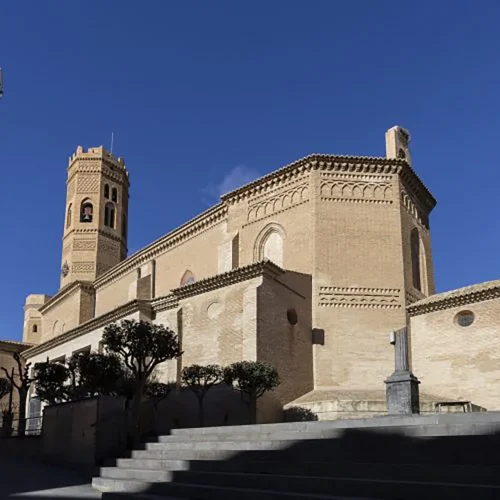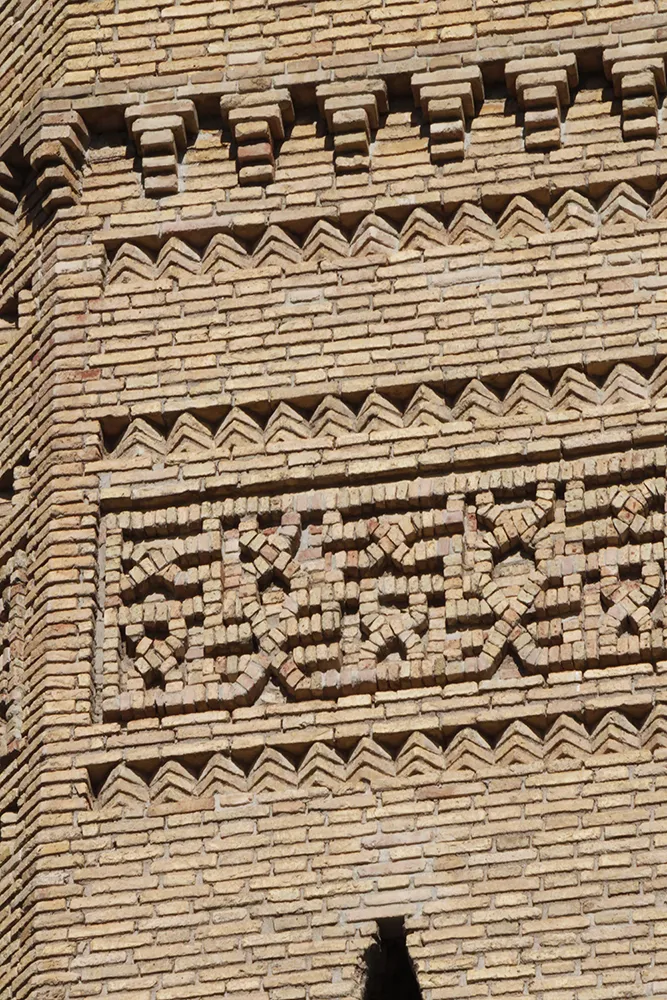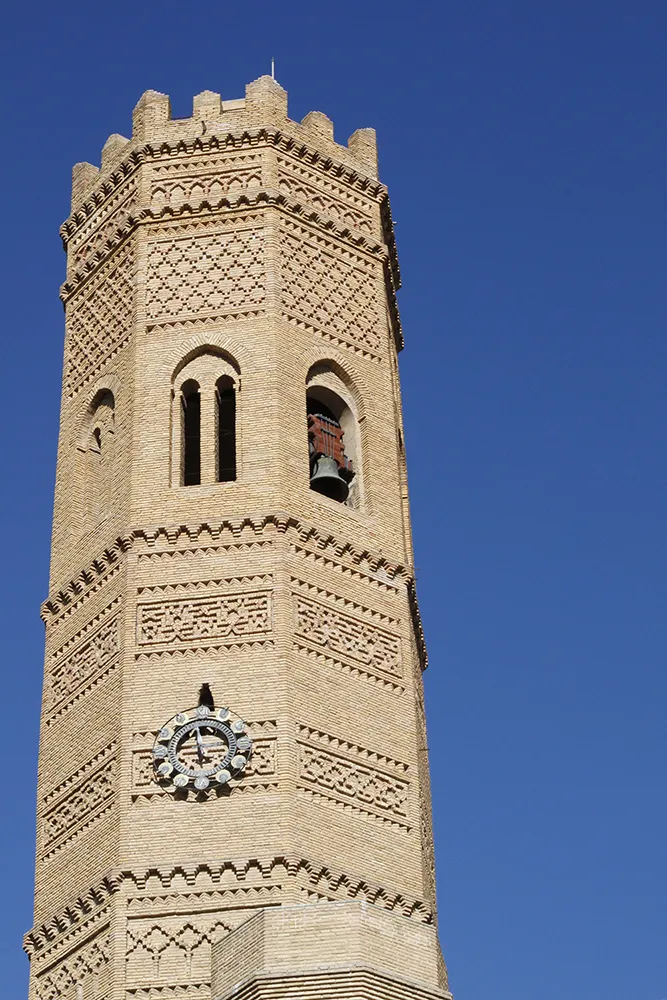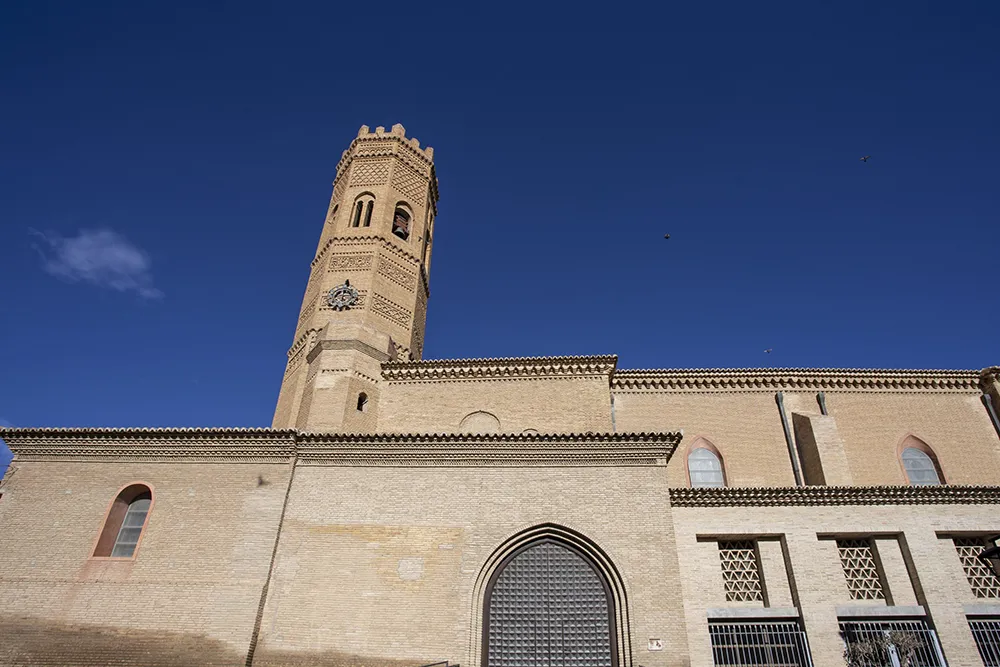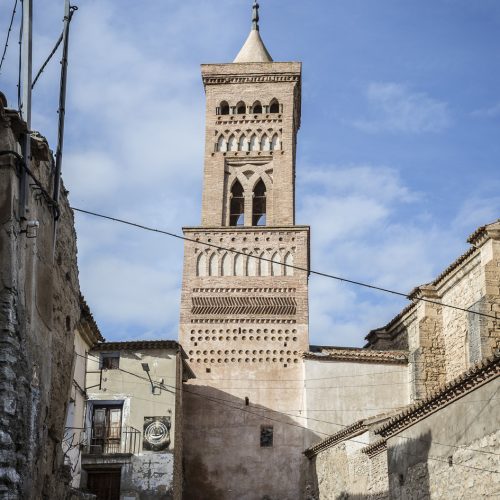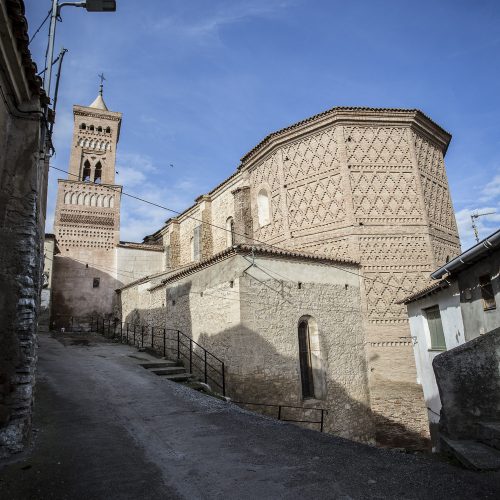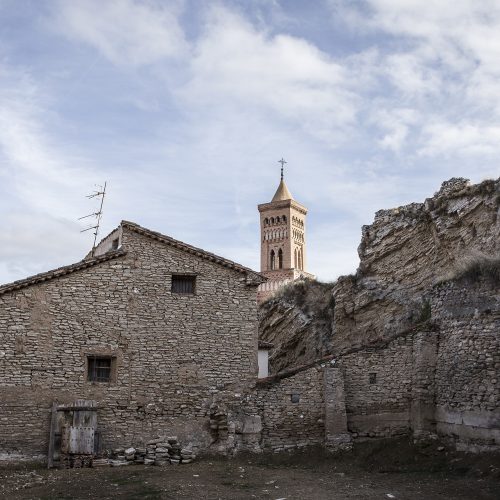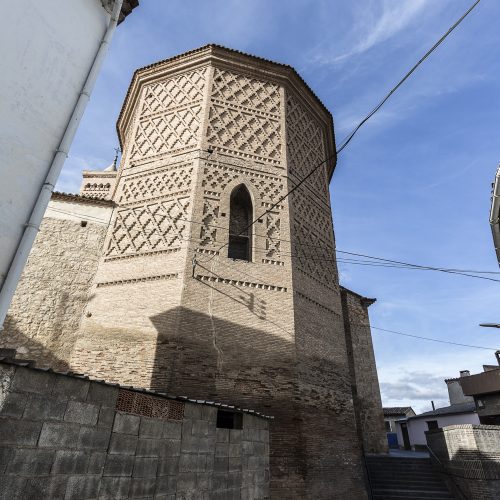
Church of Santa María, Tobed

Church of Santa María/de la Virgen de Tobed,
Tobed

Plaza de San Pedro, 50325 Tobed (Zaragoza)

CURRENT CATEGORY OF PROTECTION:
Bien de Interés Cultural (BIC)

TYPE OF PROPERTY: Real estate

CATEGORY: Religious

ARCHITECTURAL STYLE: Mudejar

DATE OF CONSTRUCTION: start 1356

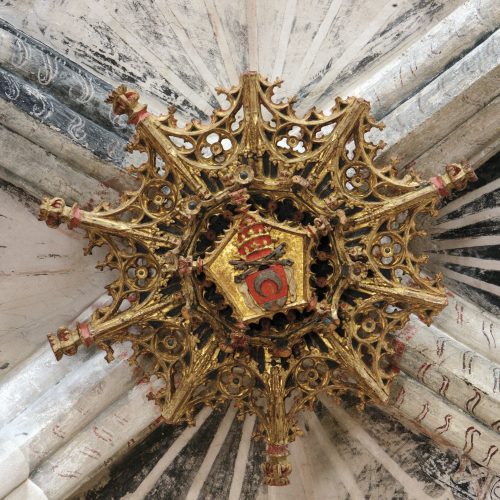
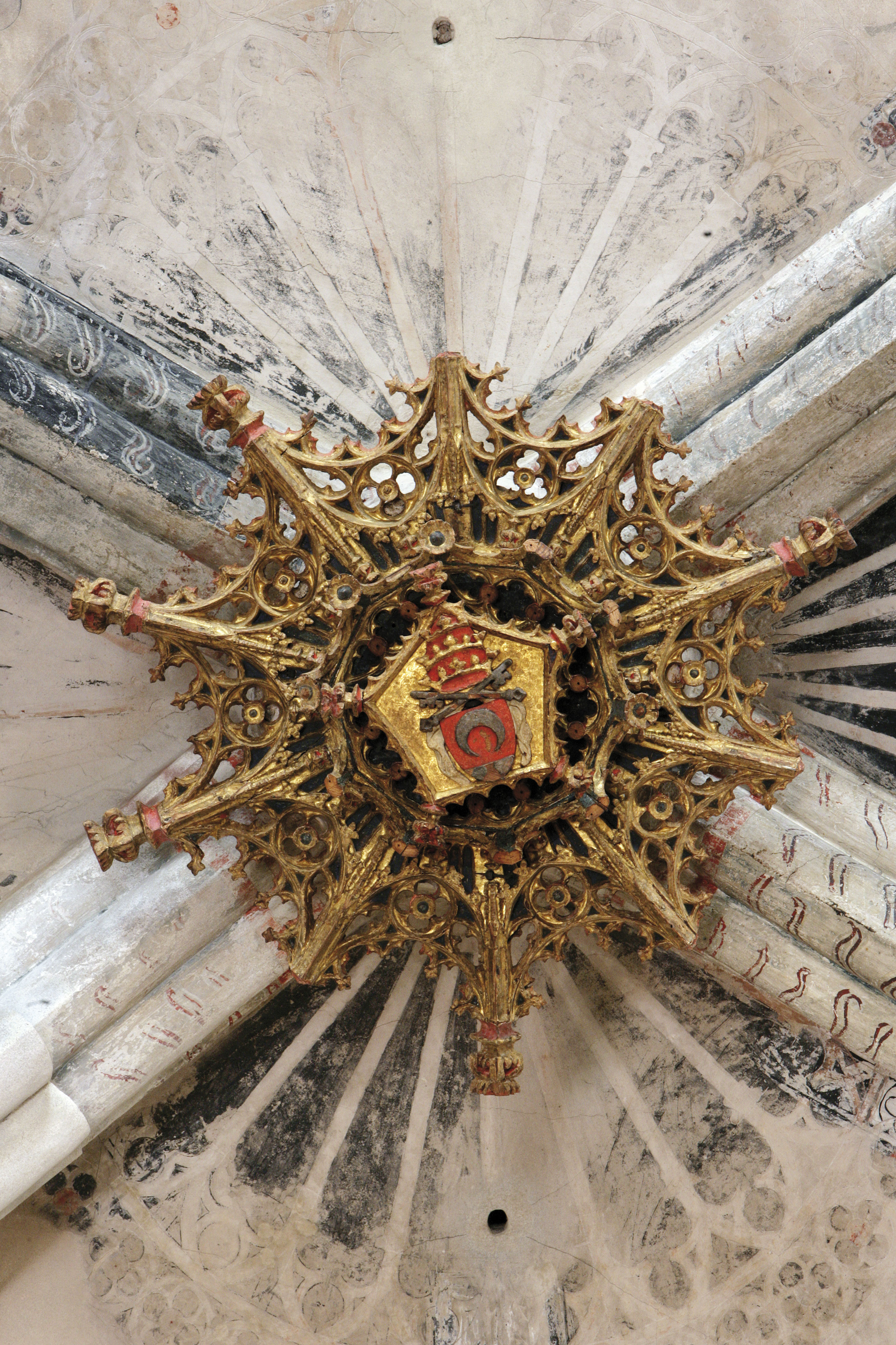
According to preserved documentation, construction of the Church of Our Lady of Tobed began on April 1, 1356, during the term of Fray Domingo Martínez de Algarví (1347-1384) as prior of the Holy Sepulcher in Calatayud, and with Fray Juan Domingo as commander of Tobed. By June 3, 1359, at least the apse had been completed. The coat of arms of Benedict XIII, present in the last section of the church, cannot be earlier than September 28, 1394, the date of his ascension to the papacy. Therefore, the construction of the church can be reliably dated to the second half of the 14th century.

There is consistency in the relative chronology of the fortified churches mentioned. Although Tobed, Torralba de Ribota, and Morata de Jiloca share a similar structure, they have distinctive features that allow us to identify a specific chronological sequence for each one:

Professor Gonzalo Borrás highlights notable differences in the width of the single nave. In the church of Tobed, it measures between 9.90 and 11 meters, while in later churches there is an increase in size. This change suggests a growing interest in covering larger spaces.

Another significant aspect is the width of the sections covered with pointed barrel vaults. In Tobed, these reach 2.60 meters, a measurement greater than that of the other examples, reflecting a design that lightens the pressure on the buttresses. In addition, an architectural evolution can be observed in the introduction of a pointed barrel vault section between the three square chapels of the presbytery and the first section of the nave, an element absent in Tobed at the time of its construction.

These characteristics reinforce the idea that the church of the Virgin of Tobed constitutes the initial prototype of this model of fortress church.

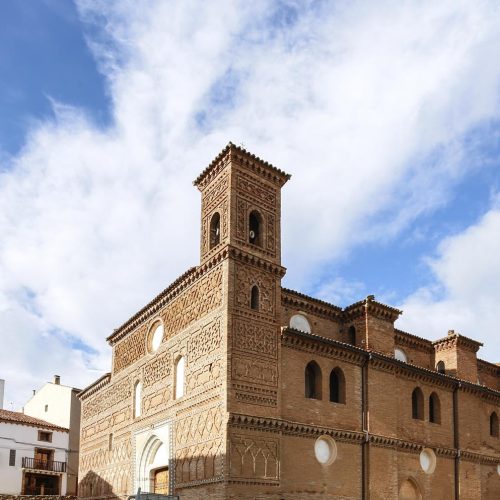
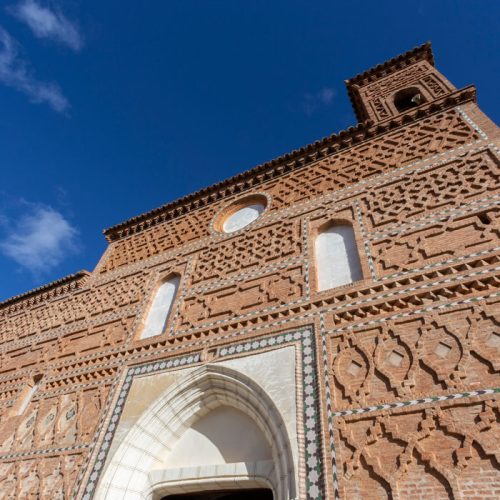
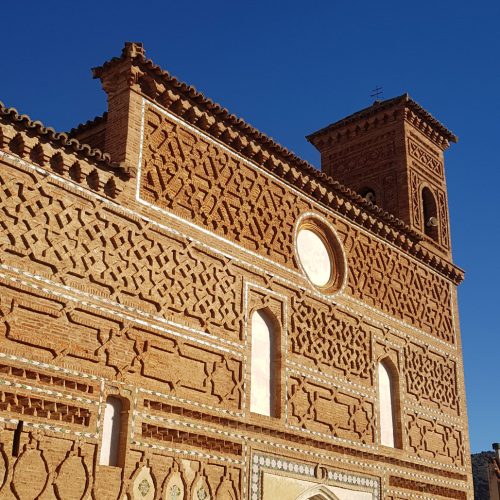
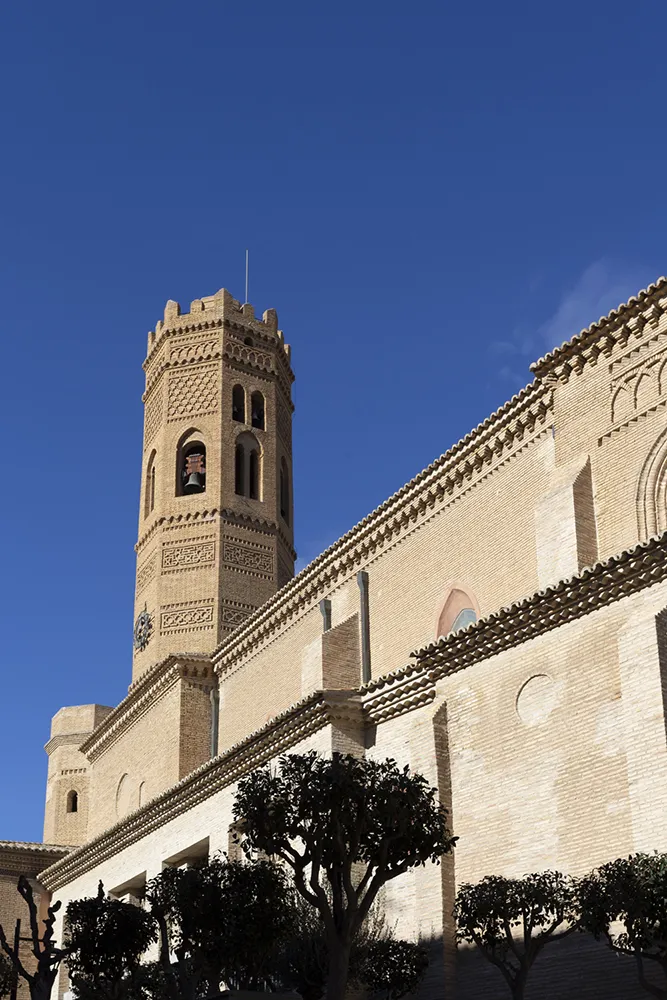
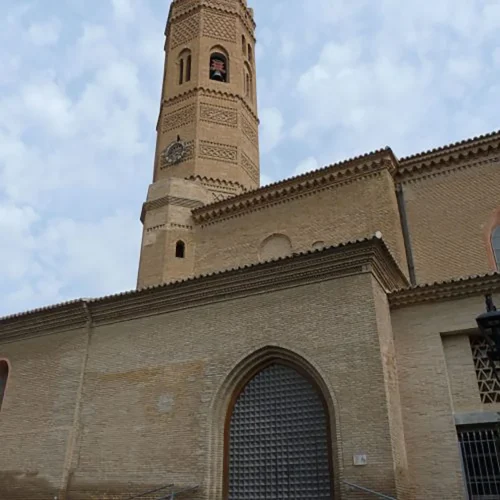
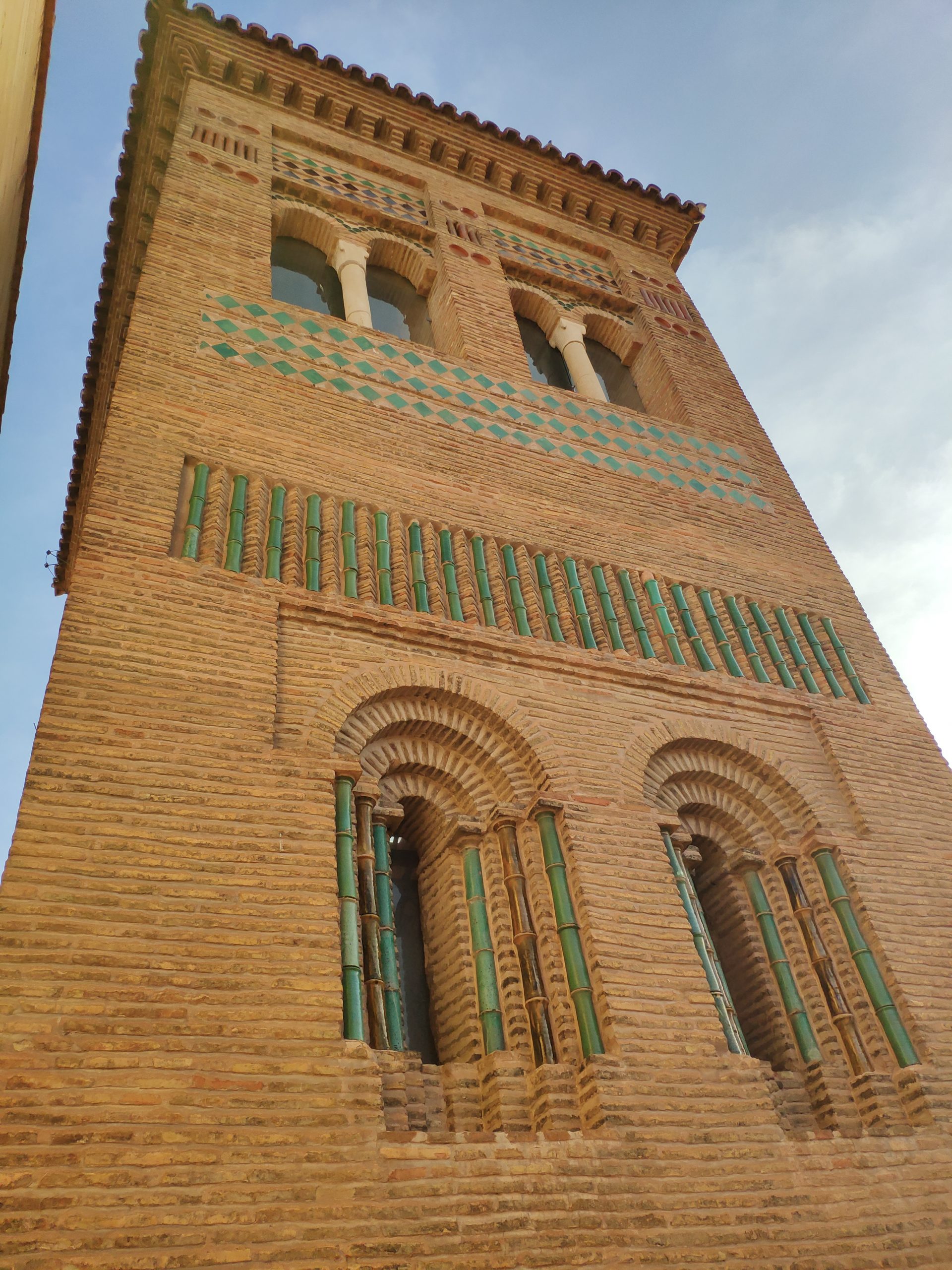
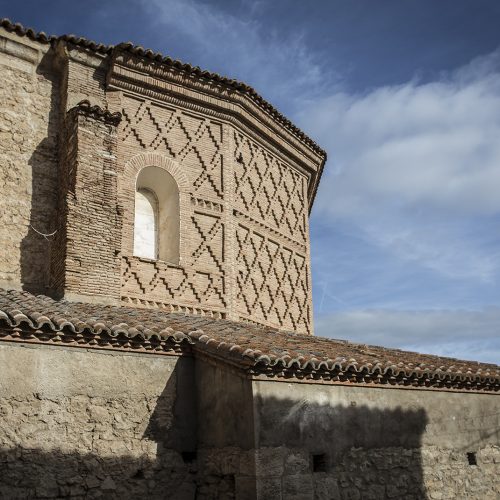
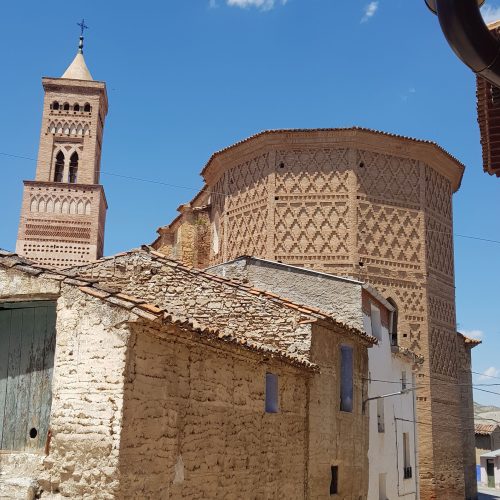
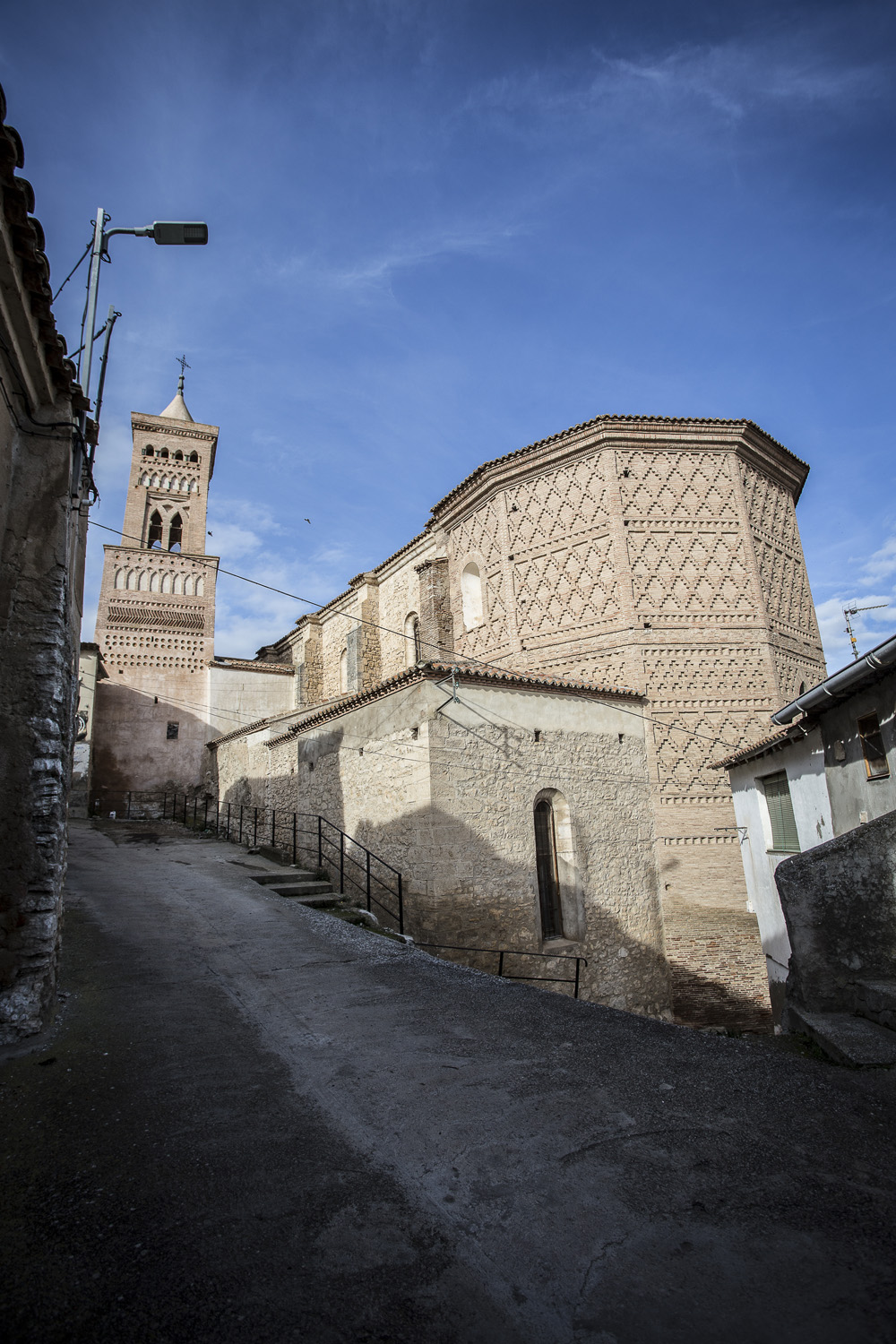
Among the various types of Mudejar churches in Aragon, historians have highlighted one key category: the fortress church. These churches are named for their strong military appearance (fig. 1).
The spread of this type of church was greatly influenced by the period of war between Castile and Aragon, notably the War of the Two Peters (1358-1366) between Peter I the Cruel of Castile and Peter IV the Ceremonious of Aragon.

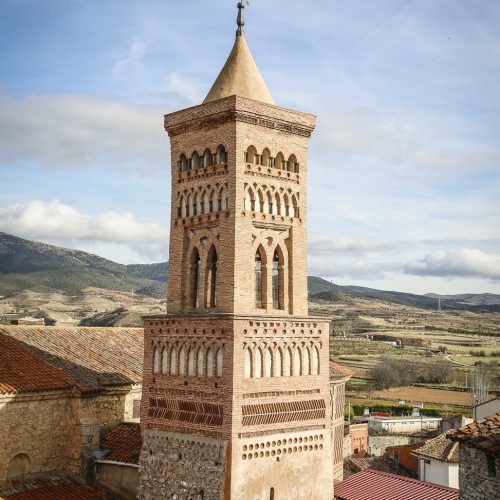
A clear example of this type of fortified church is the Church of Santa María or Virgen de Tobed, declared a World Heritage Site by UNESCO in 2001 [1].

The context of its construction is linked to the main exponents of Aragonese patronage in medieval times, notably King Pedro IV, a great patron of Mudejar architecture. This project was made possible thanks to the king’s excellent relations with the Order of the Holy Sepulchre of Calatayud and Archbishop Lope Fernández de Luna. Likewise, Fray Martín de Alpartir played a key role as a link between all the promoters of the church, serving as canon of the Order of the Holy Sepulchre, commander of Tobed and San Cruz, treasurer and secretary to the archbishop of Zaragoza, Lope Fernández de Luna.

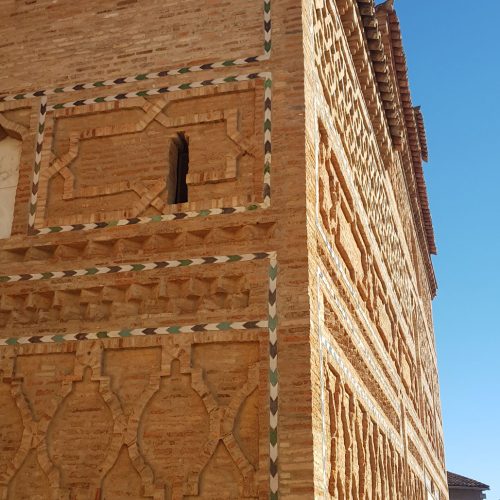
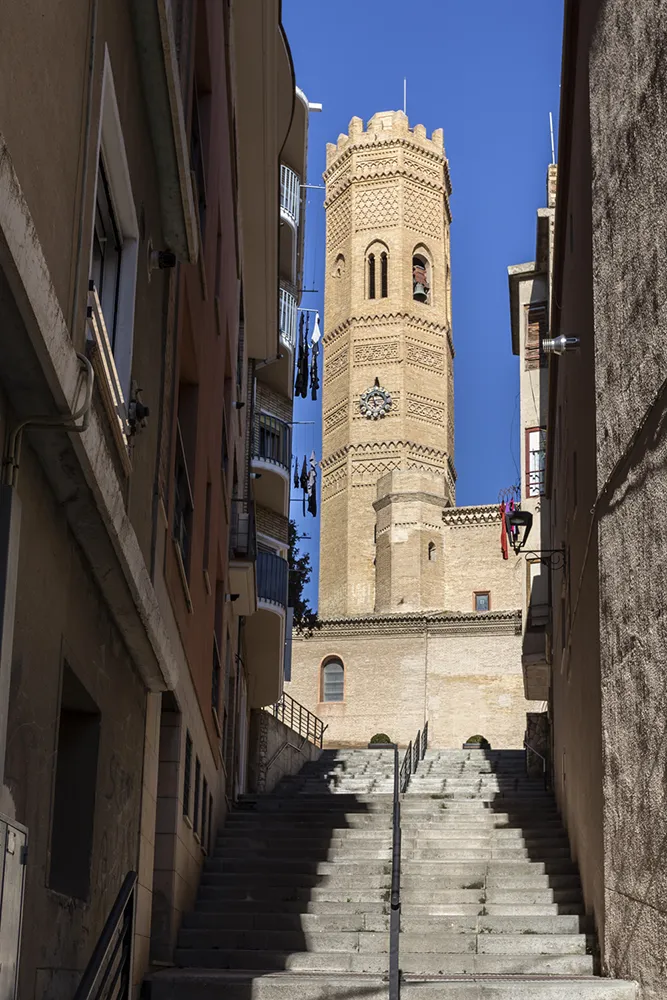
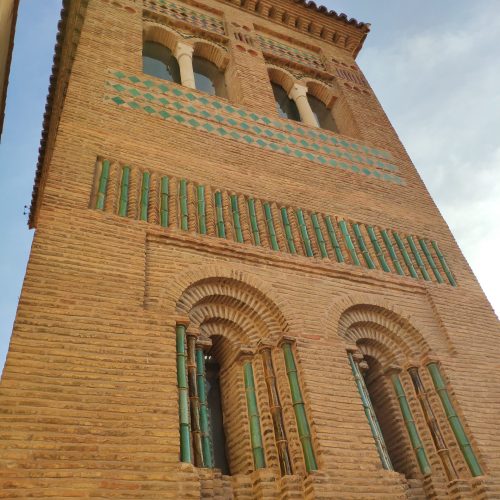
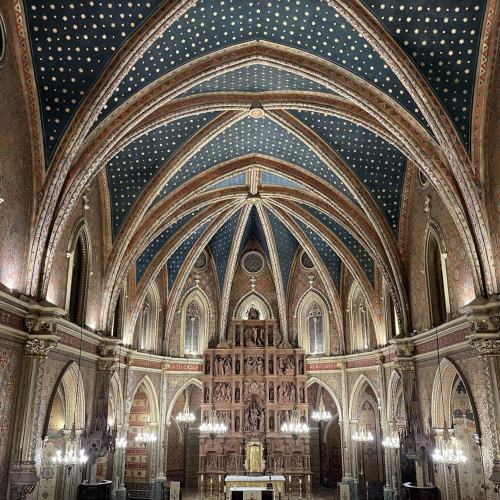
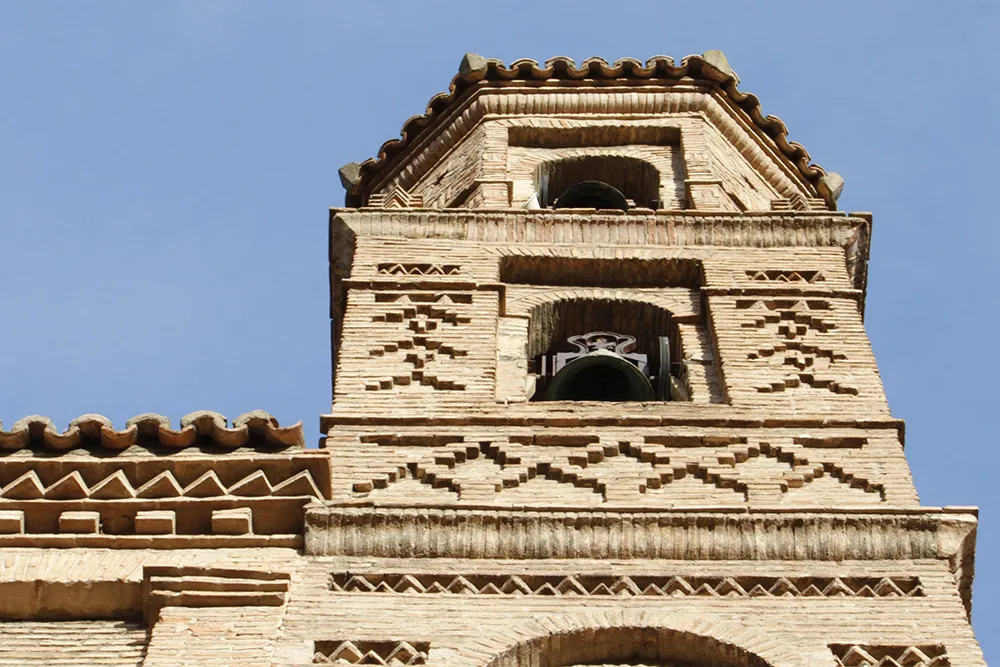
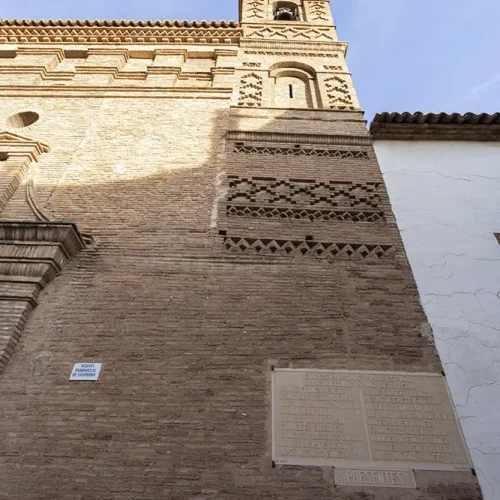
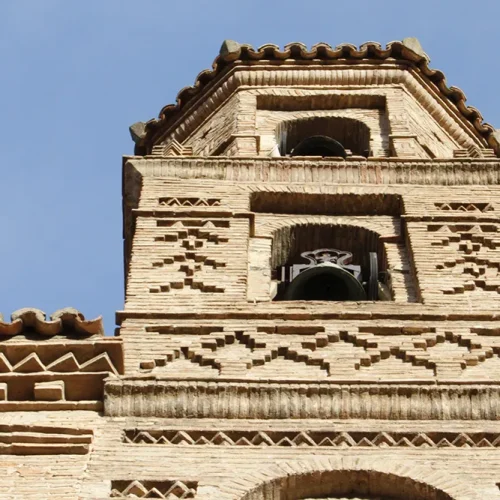
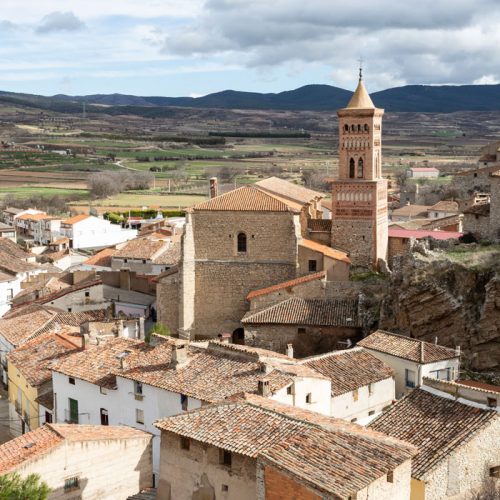
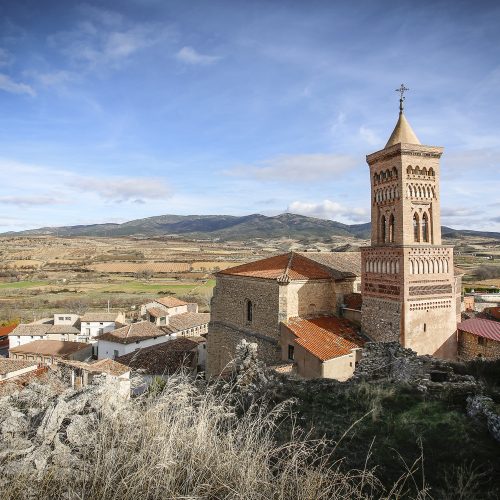
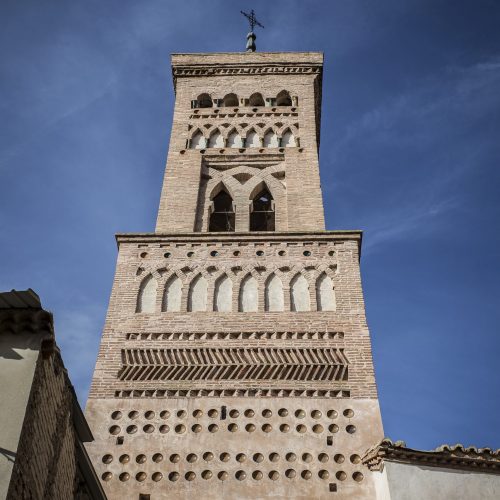
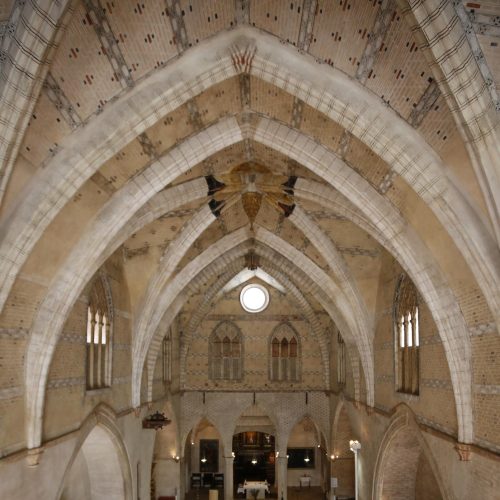
The church of Tobed stands out for its powerful and distinctive volume, but it is its interior that displays the typical characteristics of so-called fortress churches.

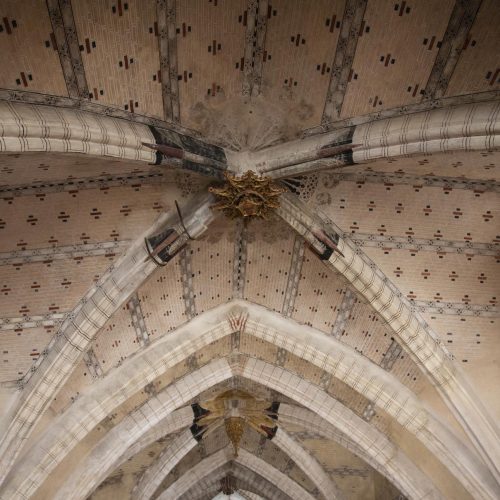
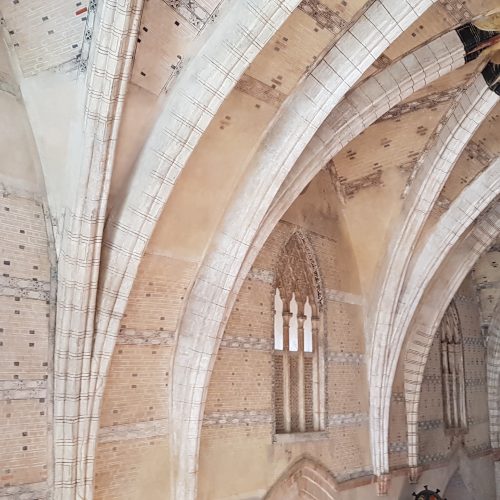
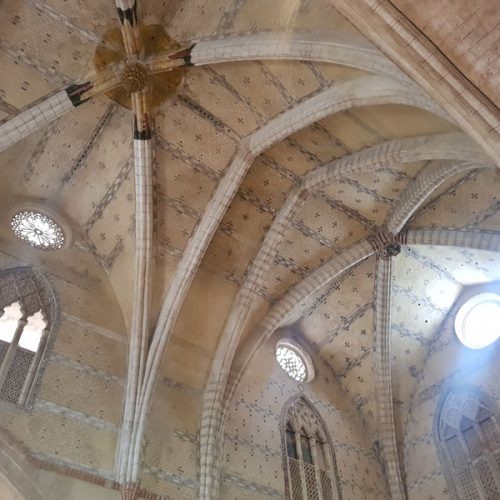
It consists of a single rectangular nave, which gives it a unified feel. The nave is divided into three sections covered with simple ribbed vaults with diagonal ribs. Between the sections of ribbed vaults are other shorter sections covered by pointed barrel vaults that project outward into buttress towers. [2] The chevet or apse is straight and consists of three square chapels, covered with simple ribbed vaults connected to each other laterally and open to the nave by three pointed arches on pillars. This triple apse chapel may correspond to the triple dedication of the church: to the Virgin, St. John the Baptist, and St. Mary Magdalene.

The side chapels located between the buttress towers are covered with pointed barrel vaults, and their width corresponds to that of the sections of the nave covered with pointed barrel vaults.

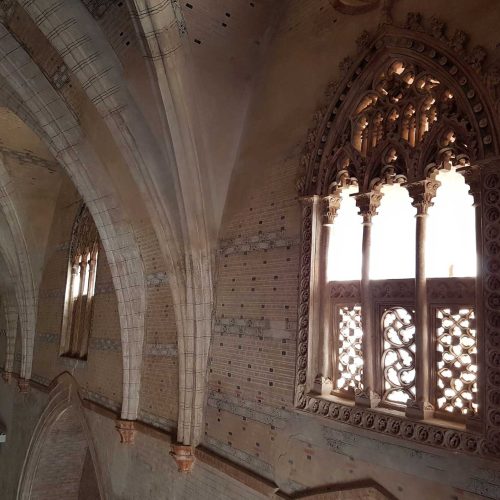
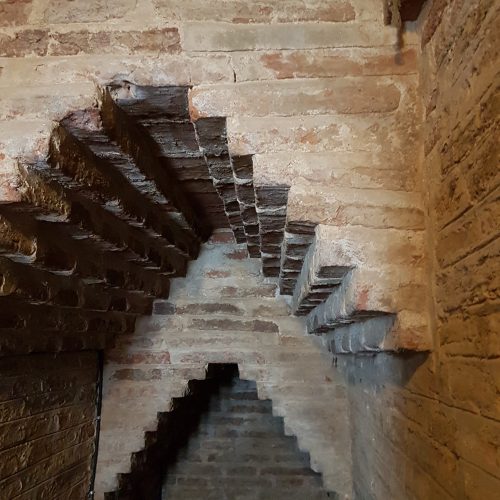
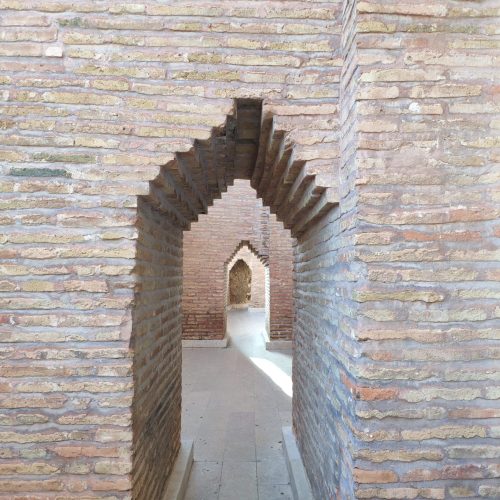
Above the side chapels and the chapels of the apse, and in keeping with this type of fortified church, there is a walkway that circles the perimeter of the church. It connects to the outside through large windows that facilitate visual control. Access to the walkway is through the buttress towers inside the church.

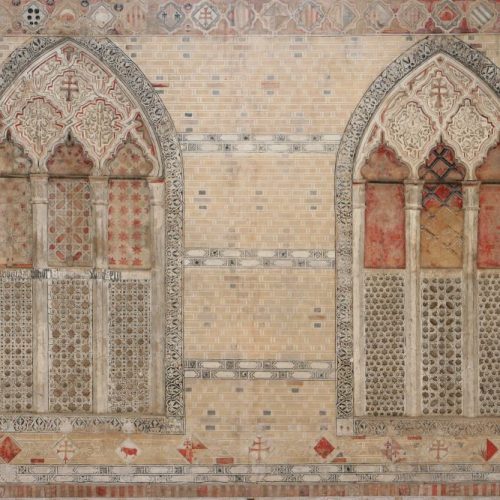
No less important is the interior decoration, since, taking into account the aesthetic principles of Islamic and Mudejar art, ornamentation is not an element that can be treated in isolation.

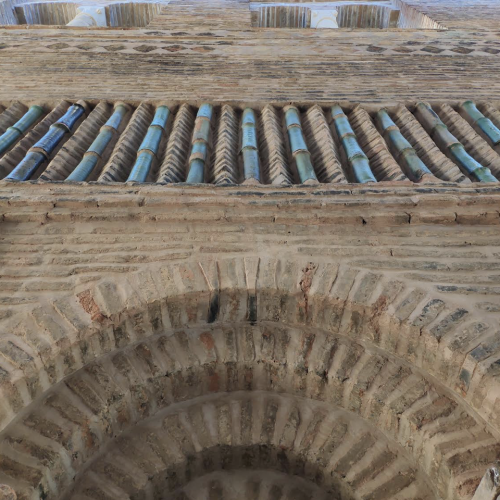
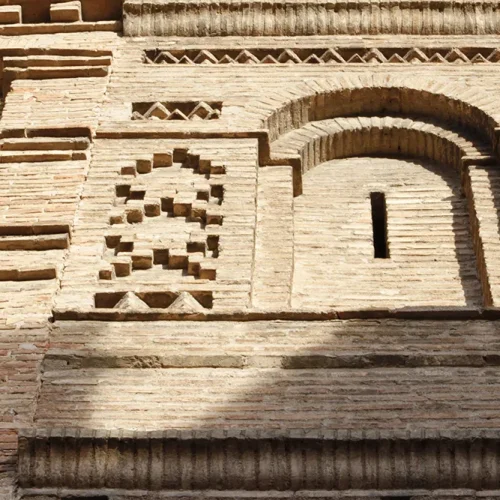
The decorative process is complex: on top of a previous layer of plaster covering the entire brick wall, a trompe l’oeil brick effect is created using the agramilado technique (incision with a tool called a gramil), which is then polychromed.

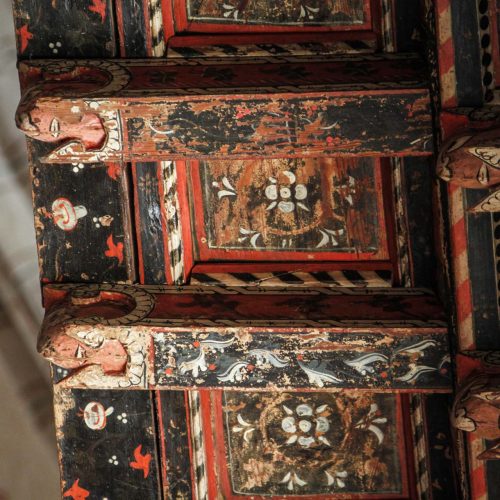
The interior of the temple is completed with the preservation of a coffered ceiling, which, in line with the walkway, serves as a space for communication between the liturgical area and the defensive area of the building.
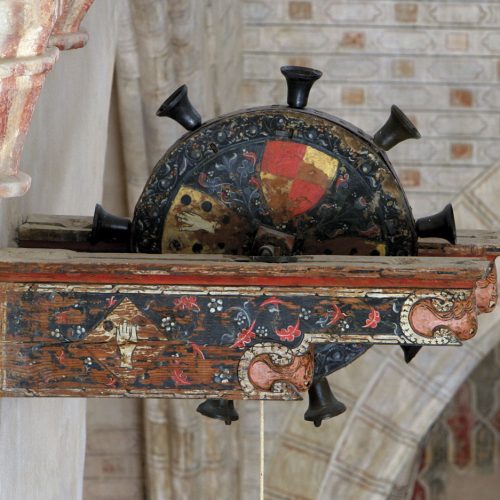
It is a flat roof with exposed beams of the beam-jaldeta type located in the last section of the church. The beams and footings that make up its structure have carved head finishes, while the pictorial motifs, in various shades, make up the entire classical iconography of the Aragonese Mudejar tradition: geometric motifs such as single or paired circles containing six-pointed stars, arabesque decoration, stylized flowers, rosettes and hexapetals, epigraphic motifs in Arabic and Spanish, and multiple heraldic elements.

That this building is one of the most important of the Middle Ages is attested to, finally, by the two master builders associated with its construction: Mahoma Calahorri, whose signature appears on one of the blind arches at the head of the church, is the master builder of the canons of the Holy Sepulchre and the principal master builder. Mahoma Rami is present in the last section of the church, under the patronage of Pope Benedict XIII.

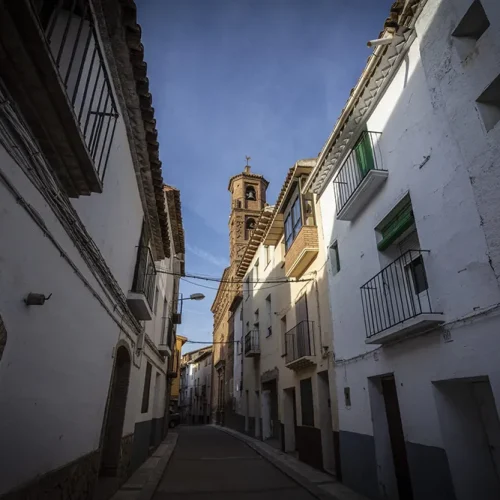
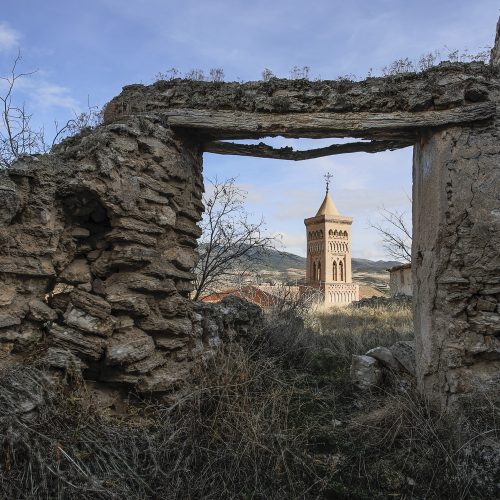
One important aspect of Mudejar fortress churches is their location. In the case of the church of the Virgin of Tobed, it can be deduced that it was built in a strategic location, not so much for defensive purposes, but rather with the aim of influencing the visual memory of the town. Its location seems to have a propagandistic purpose, related to presence and power, rather than a strict need for defense.

To fully understand the church, it is important to consider certain aspects. The decision to build a fortress church in a location that is neither defensive nor strategically relevant suggests that a military-style structure was not necessary in that context. This leads to the conclusion that the church was not erected for military-defensive purposes, but rather was built with a functional design to convey an image of strength and resistance, especially in relation to the threat from Castile.

Finally, there is a hybridization of two purposes: on the one hand, military defense, reflected in the building’s aesthetics and accompanying defensive elements, and on the other, liturgical and religious use.

This type of fortified church, characterized by a completely rational structure in which the support and counterforce systems are solid and simple, is unique among Aragonese Mudejar monuments.
Interventions

Restoration, 20th to 21st century

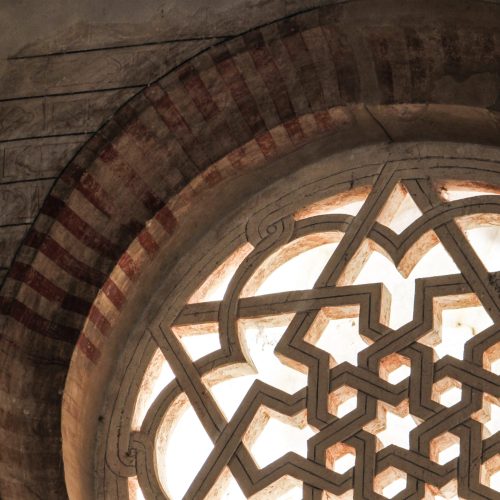
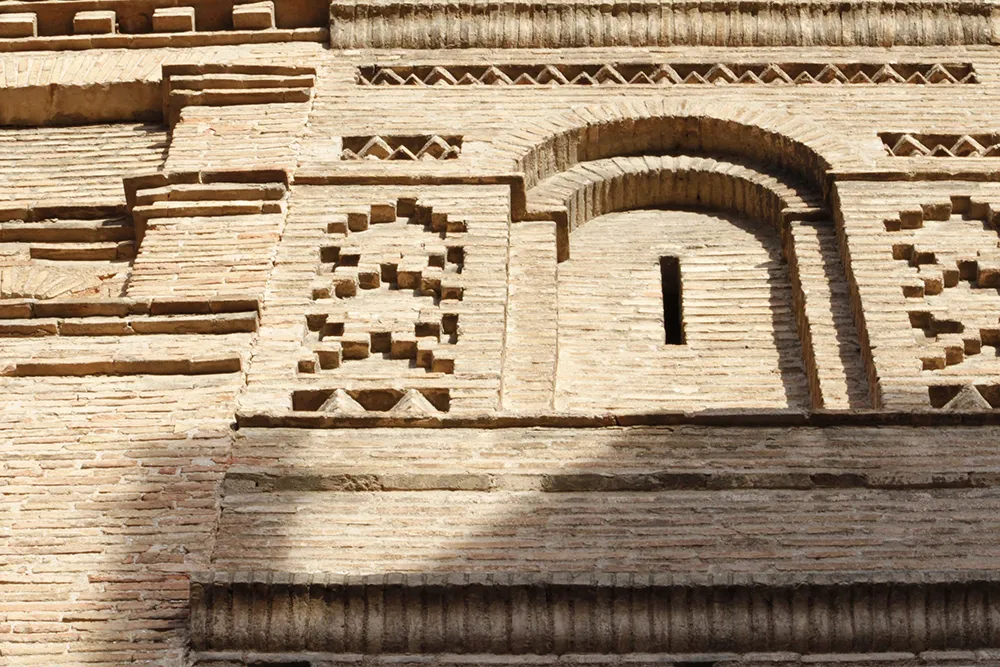
The building required some renovation work, and in 1984 the Town Hall, which was attached to the western side of the church, collapsed, revealing the western façade and opening up the original doorway. The oculus and the blind windows were restored to their former glory. Restored by architect Úrsula Heredia Lagunas.

Between 2001 and 2004, the Ministry of Education, Culture, and Sport and the Government of Aragon collaborated on the restoration of the mural painting inside the temple, plasterwork, Mudejar coffered ceiling, grille of the Chapel of the Virgin, tiles, and other wooden elements. The budget for the work was €1,027,888. In 2006, thanks to the collaboration of the Government of Aragon and Caja Inmaculada, the altarpiece of the Virgin in the main chapel, the altarpiece of Christ, and the altarpiece of Saint Joseph were restored.

Projects and interventions

Projects and interventions and their promoters define the history of monumental buildings as well as the perception of them.

The downloadable document presents the current status of the files under review, which will allow us to update our knowledge of each of the monumental buildings.

Declarations

Declaration, 21st Century

The church of Santa María de Tobed was declared a National Monument by Decree of the Ministry of Public Instruction and Fine Arts on June 3, 1931, published in the Gazette on June 4, 1931. The Official Gazette of Aragon of October 29, 2001, published the Order of October 3, 2001, of the Department of Culture and Tourism, which completes the original declaration of the Church of Santa María (of the Virgin of Tobed) in Tobed (Zaragoza) as a Site of Cultural Interest, in accordance with the First Transitional Provision of Law 3/1999 of March 10 on Aragonese Cultural Heritage. On December 14, 2001, UNESCO extended the declaration of the Mudéjar of Aragon as a World Heritage Site as a unique, universal, and irreplaceable asset for humanity. Among the assets that exemplify this declaration is the Church of Santa María de Tobed, considered one of the main examples of Aragonese Mudéjar art.

Bibliography

ALCALÁ PRATS, ICÍAR, REVILLA HERNANDO, ANA MARÍA AND RODRIGO GARZA, BEATRIZ. Guide to Mudejar Art in Aragon, Center for Mudejar Studies, Prames, 2005. BORRÁS GUALIS, GONZALO M. Islam. From Córdoba to Mudejar, Ed.Sílex, Madrid, 2000. GALINDO PÉREZ, SILVIA (COORD.). Restored Cultural Heritage of Aragon. 1984/2009. Movable property, Government of Aragon, Zaragoza, 2010.

BORRÁS GUALIS, GONZALO M., Arte Mudéjar Aragonés, Caja de Ahorros y Monte de Piedad de Zaragoza Aragón y Rioja and the Colegio Oficial de Aparejadores y Arquitectos técnicos de Zaragoza, Zaragoza, 1985.

CRIADO MAINAR, Jesús. Cult and images of the Virgin of La Cama in Western Aragon [On line]: The Transitus of Mary and the Assumptionist devotion in the Community of Calatayud. Calatayud: Centro de Estudios Bilbilitanos, 2015.

CRIADO MAINAR, Jesús. Romanesque sculpture in the region of Calatayud and its area of influence [Online]. Calatayud: Centro de Estudios Bilbilitanos, 2013.

GALINDO PÉREZ, Silvia (ed.). Aragón. Restored cultural heritage. 1984/2009: Movable property. Zaragoza: Government of Aragón, 2010.

HERMOSO CUESTA, Miguel. Aragonese art outside Aragon. A scattered heritage. Zaragoza: Government of Aragon, 2009.

MÉNDEZ DE JUAN, JOSÉ FÉLIX, GALINDO PÉREZ, SILVIA, AND LASHERAS RODRÍGUEZ, JAVIER. Restored Cultural Heritage of Aragon. 1984/2009. Real estate, Government of Aragon, Zaragoza, 2010.

MOGOLLÓN CANO-CORTÉS, Pilar. The restoration of brick buildings. Reflections on Mudejar walls and their artistic expression. In ALVARO ZAMORA, María Isabel; LOMBA SERRANO, Concepción; PANO GRACIA, José Luis. (coord.). Art History Studies: Tribute book to Gonzalo M. Borrás Gualis. Fernando el Católico Institution, 2013.p. 529-541. MÉNDEZ DE JUAN, José Félix et al. (coord.). Aragón. Restored cultural heritage. 1984/2009: Real estate. Zaragoza: Government of Aragón, 2010.

PIEPER, KATHARINA. Aragonese Mudejar plasterwork. Characteristics of the plaster windows and oculi of a master craftsman active in Tobed, Torralba de Ribota, and Maluenda, in XII International Symposium on Mudejarism (Teruel, 2005): Proceedings. Institute of Teruel Studies, 2007. p. 177-192.

SANMIGUEL MATEO, AGUSTÍN. Towers of Islamic origin in the regions of Calatayud and Daroca, Bilbilitan Studies Center, Fernando el Católico Institution. Calatayud, 1998.

Appendixes

Church of Santa María

Plaza de San Pedro,
50325 Tobed (Zaragoza)

Church of Santa María, Tauste

Church of Santa María, Tauste

Plaza de Santa María, Tauste

CURRENT PROTECTION CATEGORY: BIC

TYPE OF PROPERTY: Real estate

CATEGORY: Religious

ARCHITECTURAL STYLE: Mudejar

DATE OF CONSTRUCTION: 13th – 14th centuries

The church of Santa María de Tauste is the most important church in the town. It dates from between the end of the 13th century and the beginning of the 14th century. It is contemporary to the church of San Pablo in Zaragoza. In this town there is a second Mudejar tower, the tower of San Antón, which dates from a later period.

It was originally a church with a single nave divided into three bays flanked by chapels between the buttresses of the wall. The chevet had a semicircular apse on the inside and a five-sided polygonal apse on the outside. Two small octagonal towers were built at the base, between which there is also an octagonal bell tower, popularly known as “la bien plantá”.

The tower of the church of Santa María stands out for being a magnificent example of the architecture of Aragonese Islamic descent, being not only the great architectural element of the town and its most famous symbol, but also the landmark or image par excellence of the whole town and its surroundings. In this town we find a second Mudejar tower, the tower of San Antón, of later chronology.

It has an octagonal ground plan and, according to Gonzalo M. Borrás, its structure is that of an Almohad minaret, i.e. it has an inner tower inside an outer tower and between the two is the staircase. The inner tower is divided into four superimposed rooms covered by eight-sided schiffed vaults.

The entrance is at the height of the choir, at a height of about seven metres, leading to the first room (underneath there was a circular moat that was filled in during its restoration in the 80s of the 20th century).

It is located at the foot of the church of Santa María. However, we are talking about two independent buildings, and according to Jaime Carbonel’s research, when the church was built the tower already existed and it would have originally been a free-standing building.

On the outside, the decoration seems to divide the tower into several sections, but the representation on the outside does not match its structure on the inside. The decoration begins at a certain height, with each decorative panel repeated equally on each of the eight sides, framed by bands of angled brickwork. When viewed from bottom to top, the panels contain the following motifs: interlaced mixtilinear arches, loops of four octagonal arches, epigraphic decoration, a band of mixtilinear lozenges and interlaced round arches. The battlements and merlons on the terrace and the top turret complete the building, which reaches a total height of 47 metres.

Particularly singular is the panel of epigraphic decoration below the belfry windows, where Arabists have discovered the message of the Shahada (“There is no god but God and Muhammad is his envoy”), in this case “There is no god but the Just”, according to F. J. Navarro Cabeza.

Gonzalo M. Borrás dated the construction of the church and tower to around 1300, which is the most widely accepted date among historians. However, other studies carried out in recent years suggest that the tower of Santa María could have been the minaret (reused as a bell tower) of an 11th-century mosque, replaced towards the end of the 13th century by the Mudejar church we know today.

In 2020 a large necropolis of Islamic origin was found in the town. Probably Tauste, in Islamic times, was a large town, with a sufficient number of inhabitants to have had a mosque and a minaret.

Interventions

Restoration, 20th Century to 21st Century

Between 1982 and 1986 the tower was restored by the Directorate General of Fine Arts of the Ministry of Culture. The restoration work consisted of recovering the original roof system and replacing the lost decoration. It was directed by the architect J. Manuel Pérez Latorre.

Between 1992 and 1994, the Government of Aragon and the Tauste Town Council signed a collaboration agreement for the restoration of the exterior wall of the back of the church and the adaptation of the main façade.

In 2004, minor works and a geotechnical study of the tower were contracted.

tauste-W7
tauste-W6

Projects and interventions

Projects and interventions and their promoters define the history of monumental buildings as well as the perception of them.

The downloadable document presents the current status of the files under review, which will allow us to update our knowledge of each of the monumental buildings.

Declarations

Declaration, 21st Century

The Church of Santa María de Tauste was declared an Asset of Cultural Interest by Decree of the Ministry of Public Instruction and Fine Arts on 3 June 1931, published in the Gaceta of 4 June 1931.

The Official Gazette of Aragon of 14 November 2001 publishes the Order of 15 October 2001, of the Department of Culture and Tourism, which completes the original declaration of the Church of Santa María in Tauste (Zaragoza) as an Asset of Cultural Interest, in accordance with the First Transitional Provision of Law 3/1999, of 10 March, on Aragonese Cultural Heritage.

Bibliography

ALCALÁ PRATS, ICIAR AND REVILLA HERNANDO, ANA MARÍA. “Mudéjar art in the region of the Cinco Villas”, Territory Collection no 25, Department of the Presidency and Institutional Relations of the Government of Aragon, Zaragoza, 2007.

CASTILLO MONTOLAR, MARGARITA (COORD.). Artistic treasures of the town of Tauste, Parroquia de Santa María de Tauste, 2003.

CHIRIBAY CALVO, RAFAEL. The” Repairing Temples” series of the Diocesan Archive of Zaragoza (1st part), Aragonia Sacra. 1996, no XI, p. 185-220.

MÉNDEZ DE JUAN, JOSÉ FÉLIX, GALINDO PÉREZ, SILVIA AND LASHERAS RODRÍGUEZ, JAVIER. Aragón Patrimonio Cultural Restaurado.1984/2009. Real estate, Government of Aragon, Zaragoza, 2010.

MIÑANA RODRIGO, MARÍA LUISA; SARRIÁ ABADÍA, FERNANDO. The main altarpiece of the parish church of Santa María de Tauste, Suessetania. 1998 , no 17, p. 10-19.

MORTE GARCÍA, C. and CASTILLO MONTOLAR, M. El retablo mayor renacentista de Tauste, Instituto Fernando el Católico, Zaragoza, 2012.

ROMERO SANTAMARÍA, ALFREDO (COORD.). Joyas de un patrimonio: Restauraciones de arte mueble en la provincia de Zaragoza, 1995-1999, Diputación Provincial de Zaragoza, Zaragoza, 1999.

VALERO SUÁREZ, JOSÉ MARÍA (DIR.). Joyas de un patrimonio IV: Restauraciones de la Diputación Provincial de Zaragoza (2003-2011), Diputación de Zaragoza, Zaragoza, 2011.

VV.AA. Cinco Villas, Colección RUTASCAI por Aragón no 44, Zaragoza, 2006.

VV.AA. Aragonese Mudejar Art. Patrimonio De La Humanidad, Institución Fernando el Católico, Zaragoza, 2002.

VV.AA. Tierra mudéjar: El Mudéjar Aragonés, world heritage, Heraldo de Aragón, D.L. 2002.

VV.AA. Artistic Heritage in the Region of Cinco Villas, Zaragoza, 1998.

Appendixes

Church of Santa María

Plaza de Santa María
50660 Tauste (Zaragoza)

Visit Tauste

Town Hall: 976 854 950
tauste.es
WANT TO KNOW A LITTLE MORE?
www.turismodezaragoza.es

Church of Santa Ana, Mainar

Church of Santa Ana, Mainar

CURRENT PROTECTION STATUS:

TYPE OF ASSET: Property

CATEGORY: Religious

ARCHITECTURAL STYLE: Mudejar

CONSTRUCTION DATE: 16th century
Considered an example of late Mudejar religious architecture, it was built by order of archbishop Hernando de Aragon in 1544. At that time, an earlier church was modified, expanding the chapels of San Antonio and Santa Ana. The construction work progressed slowly, concluding with the expansion of the west end bay. From 1544 to 1550, the east end and the first bay of the nave were completed and, finally, in 1576 the west end bay and choir were built.
The construction material used for the church was brick, arranged into a single nave with a five-sided polygonal apse and pronounced buttresses. The minimal protruding brick decoration is limited to a strip of diamond shapes below the round-arched arcade that runs around the entire perimeter of the church. Esthetically, it looks like a large civilian compound.

The west end bay built during the 16th century has a more complex, modified arched passageway featuring double arches. It also has a lower row of three arches that allow light into the choir.

The tower is attached to the Gospel side at the west end. This is an octagonal- plan tower with solid attached buttresses. On the exterior, it is divided into six sections that narrow as they go up. The decoration also changes according to the height: the first section bears the least amount of decoration, just three strips of angled bricks arranged in a saw tooth or staggered fashion. The second section is more detailed, with protruding brick decoration, forming diamond combinations, double-frame openings, angled brick motifs and a ceramic frieze in the top section. In each panel of this second section there is a double frame filled with concentric diamond shapes. The buttresses are not decorated until they reach the upper part, where they have angled brick details.

The interior has a central buttress with a stairwell that winds around it, covered by brick vaults. The stairway was added in the second half of the 17th century.

Interventions

Restoration, 20th to 21st century

1990-1993 Catalog number: ES/AACAA – 001436 Restoration (Phase 1): administrative record. Mainar. Parish church of Santa Ana

1991-1993 Catalog number: ES/AACAA – 001436 Restoration (Phase 2): administrative record. Mainar. Parish church of Santa Ana

1993-1994 Catalog number: ES/AACAA – 001436 Restoration (Phase 3): administrative record. Mainar. Parish church of Santa Ana

2001-2004 Catalog number: ES/AACAA – 010668 Restoration (Phase 4): Projects. Mainar. Parish church of Santa Ana

2001-2004 Catalog number: ES/AACAA – 010669 Restoration (Phase 4): administrative record. Mainar. Parish church of Santa Ana

Projects and interventions

Projects and interventions, and the driving forces behind them, define the history of monumental buildings and how they are perceived.

Declarations

Declaration, 21st century

The Official Gazette of Aragon (BOA) from November 21, 2001 published Decree 274/2001, of November 6, by the Government of Aragon, declaring the Church of Santa María in Mainar (Zaragoza) an Asset of Cultural Interest, Monument category.

Bibliography

ESTEBAN LORENTE, Juan Francisco; Mañas Ballestín, Fabián. Inventario artístico del partido judicial de Daroca. Inventario inédito, Ministerio de Cultura, 1980 y 1999. 

GALIAY, J. Arte mudéjar aragonés, Institución Fernando el Católico, Zaragoza, 2002. VV.AA. Tierra Mudéjar. El Mudéjar Aragonés, Patrimonio Mundial, Heraldo de Aragón, D.L. 2002

ROCHE, Carlos; Royo, Lorena. Actualización del Inventario de Patrimonio Cultural de la Comarca Campo de Daroca. Inventario inédito, Comarca Campo de Daroca, 2021.

Church of Santa Ana

C/ Letra A, 2
50368 Mainar (Zaragoza)

Visit Mainar

City Hall: 976 807 001
WOULD YOU LIKE TO KNOW MORE?
www.turismodezaragoza.es

Church of San Pedro, Zuera

Church of San Pedro, Zuera

CURRENT PROTECTION STATUS:

TYPE OF ASSET: Property

CATEGORY: Religious

ARCHITECTURAL STYLE: Mudejar

CONSTRUCTION DATE: Original construction, 14th century. Classified as proto-Mudejar. Zuera is a key location in the discussion of the early development of the style.
The construction of the church was made possible thanks to the Islamic cultural groundwork, which culminated in the church of San Pedro. Although it cannot be considered strictly Mudejar, due to the date of its construction, it does represent a transition between Romanesque and Mudejar architecture. It could be said that this is one of the earliest examples of a Cistercian structure built of brick.

The parish church building dates from the second quarter of the 13th century and experts such as Gonzalo M. Borrás have linked its construction to Lamberto, master builder of La Seo in Zaragoza.

The original floor plan probably consisted of three naves and a three-part semi- circular apse at the east end. It fits the definition of a western medieval space but is made of brick and the interior is covered with painted brick designs on mortar. There is also abundant plant and geometric decoration.

The three naves are divided into two parts with different architectural compositions. The part nearest to the east end has two bays with pointed barrel vaults over transverse arches of a similar shape. The central nave is connected to the side aisles through two large pointed supporting arches in such a way that the central transverse arches rest on corbels above the keystone of the supporting arch. The rear part is composed of three bays, all of which are covered by rib vaults over all three naves, with rectangular ribs that rest on cruciform columns.
Flanking the side aisles, round arches between the buttresses lead to shallow chapels covered by barrel vaults withe lunettes.

On the exterior, the medieval structure of the church is concealed by the addition of the sacristies and other added elements. Moreover, in the 19th century a historicist three-section tower topped with a spire was built at the west end. It has a square footprint resting on an open portico on three sides affording access to the temple.

Interventions

Restoration, 20th to 21st century

Between 2000 and 2002, the restoration of the temple tower was carried out, sponsored by the Provincial Government of Zaragoza, the Zaragoza Diocese and the Villafeliche City Council. The investment amounted to 120,202 euros.

Projects and interventions

Projects and interventions, and the driving forces behind them, define the history of monumental buildings and how they are perceived.

Declarations

Declaration, 21st century

The church of San Pedro in Villar de los Navarros was declared a provincial monument of historical and artistic interest under the Ministry of National Education Order dated May 31, 1961, which was published the Official State Gazette of August 19, 1961.

The Official Gazette of Aragon dated August 14, 2002 published the Department of Culture and Tourism Order of July 9, 2002, whereby the original declaration of the church of San Pedro in Villar de los Navarros (Zaragoza) is supplemented pursuant to Transitional Provision One of Aragonese Cultural Heritage Act 3/1999, of March 10.

Bibliography

BORRÁS GUALIS, Gonzalo. El arte mudéjar en la comarca de Zaragoza [En línea]. En ONA GONZÁLEZ, José Luis; AGUILERA ARAGÓN, Isidro. . Delimitación Comarcal de Zaragoza. Gobierno de Aragón, 2011.p. 193-208. <https://comarcas.es/pub/documentos/documentos_193_208_de8244c4.pdf>. 

CHIRIBAY CALVO, Rafael. La serie “Reparación de Templos” del Archivo Diocesano de Zaragoza (1a parte). Aragonia Sacra. 1996 , no XI, p. 185-220.

CHIRIBAY CALVO, Rafael. La serie “Reparación de Templos” del Archivo Diocesano de Zaragoza (2a parte). Aragonia Sacra. 1997 , no XII, p. 207-241.

GARCÍA GUINEA, Miguel Ángel; Pérez González, José María. (dir.). Enciclopedia del Románico en Aragón: Zaragoza. Aguilar de Campoo: Fundación Santa María la Real, 2010.

SAN MARTÍN MEDINA, Andrés. El órgano de la iglesia parroquial de Zuera. Aragonia Sacra. 1999 , no XIV, p. 119-123.

SAN MARTÍN MEDINA, Andrés. Iglesia de San Pedro de Zuera. En los orígenes del mudéjar. En CRIADO MAINAR, Jesús. (coord.). Arte mudéjar aragonés. Patrimonio de la Humanidad: Actas del X Coloquio de Arte Aragonés. Institución Fernando el Católico, 2002.p. 167-181.

SEVILLA CONDE, Alberto; Martín Bueno, Manuel. La iglesia de San Pedro de Zuera (Zaragoza). Recuperación patrimonial. Salduie. 2007 , no 7, p. 345-355.

TRASOBARES RUIZ, VICTORIA E., RUIZ BAZÁN, IRENE., “Territorio Mudéjar. Claves de un estilo, los orígenes”, La magia de viajar por Aragón, número 125, mayo – junio 2021, pp. 50-57.  

The church of San Pedro

50800 Zuera (Zaragoza)

Visit Zuera

City Hall: 976 680 002 wwww.ayunzuera.com WOULD YOU LIKE TO KNOW MORE? www.turismodezaragoza.es

Iglesia de San Pedro, Villar de los Navarros

Church of San Pedro,
Villar de los Navarros

Plaza de la Iglesia. 50156 Villar de los Navarros

CURRENT PROTECTION CATEGORY: BIC

TYPE OF PROPERTY: Real estate

CATEGORY: Religious

ARCHITECTURAL STYLE: Mudejar

DATE OF CONSTRUCTION:

Original construction, 15th century
In the 15th century the Mudejar temple and the tower attached to its feet were built, which is one of the most outstanding elements of the church. The last four bays of the central nave, the choir raised at the foot of the church, some remains of paintings and scribing inside the church and the curious bell tower are preserved from this primitive phase.

Enlargement, 16th century
During the first half of the 16th century, the first reform of the church was carried out, in which the central nave was enlarged by a section towards the chancel, a new polygonal apse was built and the sacristy was constructed.

Enlargement, 18th century
The third phase or Baroque reform, carried out at the beginning of the 18th century, completely modified the initial state of the church, as it went from a single-nave church to a three-nave church with the construction of two side naves, as well as the construction of new service rooms attached to the chancel.

Destruction, 20th century (1936-1939)

In the centre of the village of Villar de los Navarros stands the parish church of San Pedro, which dates back to the 15th century. The current construction is the result of two extensions to the original Mudejar building in the 16th and 18th centuries.

The church of San Pedro has a polygonal apse chevet covered by a star-shaped ribbed vault, to which are attached on the east and south sides the rooms used for services and on the north side the sacristy. The body is made up of three naves, of which the central nave, taller and wider than the side naves, is divided into five bays, the last four of which are covered by simple ribbed vaults with diagonal ribs resting on irregular cruciform pillars, while the first bay is covered by a star-shaped ribbed vault with tercelets and cambered vaults.

The side naves are divided into four bays covered by domes on pendentives with lanterns, opening onto the central nave through semicircular arches. The choir is located at the foot of the nave, the walls of which have preserved the remains of Mudejar stonework in which motifs of mixtilinear loops and interlaced Gothic quadrilobes can be distinguished.

On the outside, the simple façade of the church is made up of two sections: the lower section has a semicircular entrance arch and the upper section has a niche with a carving of the patron saint as the central motif. The bell tower, attached to the foot of the church and built in the first decades of the 15th century, has a curious layout; it is a main tower with the function of a bell tower to which is attached a secondary tower of smaller proportions that houses the stairwell with a spiral structure.

The main tower, with a square floor plan, has a Christian internal structure, that is, a hollow tower divided into five superimposed square-plan rooms, whose height decreases in elevation, covered with simple ribbed vaults with octagonal diagonal ribs and without keystones, and not connected to each other, which can only be accessed through the spiral staircase sheltered in the secondary tower. The ornamental elements on the exterior form large panels, especially at the top of the main tower. The most frequently used motifs include friezes of simple angled arches, double-thread zigzag strips, intertwined mixtilinear arches and crosses forming lozenges. This main tower has a crenellated top and a pyramidal spire.

Interventions

Restoration, 20th Century to 21st Century

During the years between 2000 and 2002 the restoration of the church tower was carried out, which was promoted by the Diputación de Zaragoza, the Diocese of Zaragoza and the Villafeliche Town Council. The investment amounted to 120,202 euros.

Projects and interventions

Projects and interventions and their promoters define the history of monumental buildings as well as the perception of them.

The downloadable document presents the current status of the files under review, which will allow us to update our knowledge of each of the monumental buildings.

Declarations

Declaration, 21st Century

The church of San Pedro in Villar de los Navarros was declared a provincial monument of historic-artistic interest by Order of the Ministry of National Education on 31 May 1961, published in the Official State Gazette of 19 August 1961.

The Official Gazette of Aragon of 14 August 2002 published the Order of 9 July 2002, of the Department of Culture and Tourism, which completes the original declaration of the Church of San Pedro in Villar de los Navarros (Zaragoza) as an Asset of Cultural Interest, in accordance with the First Transitional Provision of Law 3/1999, of 10 March, on Aragonese Cultural Heritage.

Bibliography

BORRÁS GUALIS, GONZALO M. Aragonese Mudejar Art , Aragonese Basic Collection, Guara, Zaragoza, 1987, pp. 192.

BORRÁS GUALIS, GONZALO M., Arte Mudéjar Aragonés, Caja de Ahorros y Monte de Piedad de Zaragoza Aragón y Rioja and the Colegio Oficial de Aparejadores y Arquitectos técnicos de Zaragoza, Zaragoza, 1985.

SANMIGUEL MATEO, AGUSTÍN. Torres de ascendencia islámica en las comarcas de Calatayud y Daroca, Centro de estudios bilbilitanos, Institución “Fernando el Católico”, Calatayud, 1998.

VV.AA. Mudéjar Land. El mudéjar Aragonés, Patrimonio Mundial, Heraldo de Aragón, D.L. 2002.

Appendixes

The church of San Pedro

Church Square
50156 Villar de los Navarros

Visit Villar de los Navarros

Town Hall: 976 14 28 01

DO YOU WANT TO KNOW MORE?
www.turismodezaragoza.es

The church of San Pedro, Teruel

The church of San Pedro, Teruel

C/ de Hartzenbusch, 44001 Teruel CURRENT PROTECTION STATUS: Asset of Cultural Interest (ACI)

TYPE OF ASSET: Property

CATEGORY: Religious

ARCHITECTURAL STYLE: Mudejar

CONSTRUCTION DATE:

  • Original construction, 14th century. The current church of San Pedro dates from the 14th century. It was built over a previous Romanesque temple documented in 1196.
  • Remodeling, 14th to 18th century. After the construction of the Mudejar tower at the west end in the 13th century, the church was remodeled between 1319 and 1392. The cloister dates from 1383. The tower is also from the 13th century, with a Neo-classical top from 1795.
  • Fire, 19th century. The church caught fire in 1873.
  • Remodeling, 19th century. After the fire, the interior was remodeled in the Neo-Gothic style.
The church of San Pedro belongs to the group of fortified churches. It is adapted for defensive purposes through the creation of a gallery running above the side chapels. Thus, the church has a typical Mudejar structure with a single

nave opening onto chapels between the buttresses and a polygonal east end, entirely covered by quadripartite rib vaults. There is also a gate tower erected at the west end, based on a Christian structure that is related to the cathedral tower, decorated on the exterior with intertwining arches and round-arched embrasured openings.

The temple has a single nave divided into three rectangular bays with a seven- sided polygonal east end. A ring of chapels set between the buttresses surrounds the entire nave and even the east end. Both the chapels and nave are covered by a quadripartite rib vault with triple torus molding on the ribs, which rest on columns in the apse and on corbels along the nave walls. The second story consists of a gallery that surrounds the east end of the church above the chapels opening onto it, the sections of which are connected through openings between the buttresses that are topped by narrowing courses of bricks.

This gallery, covered by a quadripartite rib vault, does not continue above the chapels that open onto the nave, as might be expected in a church of this kind. However, it is possible to walk around the temple on top of the chapel roofs, passing through the openings created in the buttresses. The exterior of the apse is the most lavishly decorated area, featuring panels of intertwined mixtilinear arches set between strips of angled brick at the bottom and a frieze of ceramic eight-point stars at the top of the wall. In addition, the apse buttresses extend

vertically by means of narrow octagonal towers that give the church an Orientalized appearance, imitating those of the parish church in Montalbán.
The church has an attached cloister with a square floor plan, the bays of which are divided into five sections covered by a rib vault.

The gate tower stands at the west end of the church, leading from the street to the church at the bottom through a pointed arch with two rows of voussoirs and a pointed barrel vault. Structurally, the tower can be categorized as a Christian tower, with its interior divided into different levels. The exterior decoration consists of a frieze of intertwining round arches with brick voussoirs; a cornice

of brick corbels separates the lower section from the upper, which features pairs of round-arched embrasured openings, over which there is a strip of green ceramic cylinder shapes.

The belfry, which was reconstructed in the restoration carried out by the architect Manuel Lorente after the Spanish Civil War, is pierced with two pairs of round-arched coupled windows resting on a central colonette, and this upper section is decorated with green and manganese Mudejar ceramic ornamentation.

This is an example of a fortified church. The present-day church was under construction by around 1319 and references to the construction of the cloister date back to 1383. The tower erected at the west end of the church may date from around 1350, based on its similarities to that of the cathedral of Teruel.

Interventions

Restoration, 20th to 21st century

From 1993 to 2005, the Government of Aragon and Ibercaja undertook restoration work affecting the tower, church and cloister as a whole. To this end, a budget in excess of 3 million euros was allocated.

Renovation, 21st century

In June 2008, the cloister of San Pedro opened to the public after a complete renovation funded by the Department of Regional Policy, Justice and the Interior, which provided 1.6 million euros. Fundación Amantes, consisting of the Government of Aragon, the Provincial Government of Teruel, the Teruel City Council, the Archbishopric of Teruel and Ibercaja, organized an open house with guided tours. The Government of Aragon continues to pursue its goal of enhancing and spotlighting the cultural heritage of the city of Teruel through new initiatives including a call for proposals for the Plaza de los Amantes restoration project. The public square to be renovated is an emblematic space in which the church of San Pedro and the Mausoleum of the Lovers of Teruel converge. The aim of the restoration is to improve access to the Fondero cistern and the mausoleum, to renovate the façade of Casa Hinojosa and to spotlight the church of San Pedro and its tower.

Declarations

Declaration, 20th to 21st century

The church of San Pedro in Teruel was declared a Historical and Artistic Monument under the Ministry of Public Instruction and Fine Arts Decree of June 3, 1931, published in the Madrid Gazette on June 4, 1931.

On November 28, 1986 UNESCO added the Mudejar architecture of Teruel to its World Heritage list, in which four of its most important monuments are included: the tower, ceiling and lantern tower of the Santa María de Mediavilla Cathedral, the tower and church of San Pedro, the El Salvador church tower and the tower of the church of San Martin.
The Official Gazette of Aragon dated July 2, 2004 published the Department of Education, Culture and Sport Order of June 16, 2004, whereby the original declaration of the church of San Pedro as an Asset of Cultural Interest is supplemented pursuant to Transitional Provision One of Aragonese Cultural Heritage Act 3/1999, of March 10, including the environment affected by the declaration.

Current condition

After the fire sparked by lightning in 1873, the church required serious renovation work in the early 20th century: the cloister was remodeled by Pablo Monguió Segura in 1901, continuing with the interior of the church some years later, in 1909, who transformed the Mudejar interior into the Neo-Gothic space seen today with the assistance of the painter Salvador Gisbert. The tower has also been modified throughout its history: the original belfry was filled in in 1795 in order to add a new Neo-classical top section, which was removed after the Spanish Civil War during the restoration work led by Manuel Lorente Junquera, thus bringing back the original belfry.

Bibliography

ALCALÁ PRATS, ICÍAR, PÉREZ SÁNCHEZ, ANTONIO Y SANZ ZARAGOZA, JOSÉ MARÍA. La arquitectura mudéjar de Teruel: balance de veinte años como Patrimonio Mundial (1986-2006), en Turia (revista cultural) nº80 (nov. 2006 – feb. 2007), Instituto de Estudios Turolenses, Teruel, 2007, p. 361-377.

ALCALÁ PRATS, ICÍAR, REVILLA HERNANDO, ANA MARÍA Y RODRIGO GARZA, BEATRIZ. Guía del arte mudéjar en Aragón, Centro de Estudios Mudéjares, Prames, 2005.

ARCE OLIVA, E. Una obra desconocida del taller de Gabriel Joly: las imágenes de los santos Cosme y Damián en la ig, Revista Artigrama, Nº 11, 1994. pp 381-388.

BENITO MARTÍN, F. Patrimonio Histórico de Aragón. Inventario Arquitectónico de Teruel, Gobierno de Aragón, Zaragoza, 1991, pp.122-123.

BORRÁS GUALIS, G. Arte Mudéjar Aragonés, Caja de Ahorros de Zaragoza, Aragón y La Rioja, Zaragoza, 1990.

  • GALIAY, J. Arte mudéjar aragonés, Institución Fernándo el Católico, Zaragoza, 2002.
  • LABORDA YNEVA, J. Teruel, Guía de Arquitectura, Caja de Ahorros de la Inmaculada, Zaragoza, 1996.
  • MÉNDEZ DE JUAN, JOSÉ FÉLIX, GALINDO PÉREZ, SILVIA Y LASHERAS RODRÍGUEZ, JAVIER. Aragón Patrimonio Cultural Restaurado. 1984/2009. Bienes inmuebles, Gobierno de Aragón, Zaragoza, 2010.
  • AA. Teruel Mudéjar. Patrimonio de la Humanidad, Caja de Ahorros de Zaragoza, Aragón y Rioja, Zaragoza, 1991.
  • AA. Tierra Mudéjar. El mudéjar aragonés, Patrimonio Mundial, Heraldo de Aragón, D.L. 2002.
  • ALCALÁ PRATS, Icíar. El arte mudéjar en la Comunidad de Teruel. En LOSANTOS SALVADOR, Antonio. (coord.). Comunidad de Teruel. Diputación General de Aragón, 2010.p. 185-196.
  • ARCE OLIVA, Ernesto. Círculo de Gabriel Joly. Flagelación. En MORTE GARCÍA, Carmen. (dir.). El esplendor del Renacimiento en Aragón : Museo de Zaragoza: febrero-mayo de 2010. Gobierno de Aragón, 2009.p. 202-203.
  • ARCE OLIVA, Ernesto. Una obra desconocida del taller de Gabriel Joly: las imágenes de los santos Cosme y Damián en la iglesia de San Pedro de Teruel. Artigrama. 1994-1995 , nº 11, p. 381-388.
  • BARLÉS BÁGUENA, Elena. La iglesia parroquial de San Pedro. En El Mudéjar de Teruel. Patrimonio de la Humanidad. Instituto de Estudios Turolenses, 1989.p. 35-37.
  • BARLÉS BÁGUENA, Elena; Calvo Ruata, José Ignacio. Torre de San Pedro. En El Mudéjar de Teruel. Patrimonio de la Humanidad. Instituto de Estudios Turolenses, 1989.p. 24-25.
  • BENITO, Félix. Patrimonio histórico de Aragón: Inventario arquitectónico.Teruel. Zaragoza: Diputación General de Aragón, 1991
  • BORRÁS GUALIS, Gonzalo. Arte mudéjar aragonés. Zaragoza: CAZAR, 1985. CABAÑERO SUBIZA, Bernabé. Las torres mudéjares aragonesas y su relación con los alminares islámicos y los campanarios cristianos que les sirvieron de modelo. Turiaso. 1995 , nº XII, p. 11-51. Encargada la obra para cerrar la restauración de San Pedro. Heraldo de Aragón. 18/12/2012 p. 17. FRANCO, Leonor. El coro y los púlpitos de la iglesia de San Pedro protegidos contra la carcoma. Heraldo de Aragón. 04/07/2018 p. 21.
  • GALINDO PÉREZ, Silvia. (coord.). Aragón. Patrimonio cultural restaurado. 1984/2009: Bienes muebles. Zaragoza: Gobierno de Aragón, 2010.
  • HERNANDO SEBASTIÁN, Pedro Luis. Cofres y arcas medievales en Aragón: Referencias documentales y estudio de su significado a partir del cofre de bodas italiano de la iglesia de San Pedro de Teruel. Artigrama. 2008 , nº 23, p. 427-441.
  • HERNÁNDEZ MARTÍNEZ, Ascensión. La actuación de la Dirección General de Bellas Artes en Aragón (1938-1958): la labor de los arquitectos conservadores Manuel Lorente Junquera y Fernando Chueca Goitia. En GARCÍA CUETOS, María del Pilar; ALMARCHA NUÑEZHERRADOR, María Esther; HERNÁNDEZ MARTÍNEZ, Ascensión. (coord.). Restaurando la memoria: España e Italia ante la recuperación monumental de posguerra. Trea, 2010.p. 41-66.
  • JIMÉNEZ MARTÍNEZ, Antonio; Silvestre Adivinación, María. La restauración de bienes muebles desarrollada por la Fundación Santa María de Albarracín. Compendio general. Rehalda. 2014 , nº 20, p. 207-223.
  • LABORDA YNEVA, José. Teruel. Guía de Arquitectura. Zaragoza: Caja de Ahorros de la Inmaculada, 1996. MORENO, María Ángeles. Restauran un retablo de la iglesia de San Pedro obra de Gabriel Joly dañado por la carcoma. Heraldo de Aragón. 11/11/2018 p. 25.
  • MORENO, María Ángeles. San Pedro de Teruel recupera el retablo de la capilla donde fueron hallados los Amantes. Heraldo de Aragón. 14/01/2019 p. 57.
  • MÉNDEZ DE JUAN, José Félix et al. (coord.). Aragón. Patrimonio cultural restaurado. 1984/2009: Bienes inmuebles. Zaragoza: Gobierno de Aragón, 2010.
  • NOVELLA MATEO, Angel. La transformación urbana de Teruel a través de los tiempos. Teruel: Instituto de Estudios Turolenses, 1988.
  • PÉREZ SÁNCHEZ, Antonio. El Claustro de San Pedro. En LOSANTOS SALVADOR, Antonio. (coord.). Comunidad de Teruel. Diputación General de Aragón, 2010.p. 197-198.
  • SEBASTIÁN, Santiago. Inventario artístico de Teruel y su provincia [En línea]. Madrid: Ministerio de Cultura, 1974.[Consulta: 11 de junio de 2021].
  • SERRANO PELLEJERO, Lucía . (dir.). Tierra mudéjar: el mudéjar aragonés. Patrimonio mundial. Zaragoza: Heraldo de Aragón, 2002.

The church of San Pedro

C/ de Hartzenbusch,
44001 Teruel

Visit Teruel

City Hall: 978 61 99 00 wwww.teruel.es WOULD YOU LIKE TO KNOW MORE? www.turismo.teruel.es

Church of San Pedro Apóstol, Saviñán

Church of San Pedro Apóstol, Saviñán

CURRENT PROTECTION CATEGORY: BIC

TYPE OF PROPERTY: Real estate

CATEGORY: Religious

ARCHITECTURAL STYLE: Mudejar

DATE OF CONSTRUCTION: 16th century

Built in the 16th century, it is a simple brick construction with an arcade in the upper part in the style of an Aragonese market. The tower is particularly noteworthy, built entirely of brick, with four sections, the first three of which are square in plan, culminating in a final octagonal section.

The walls are decorated with brickwork based on friezes of angled bricks and lozenges; the use of angled bricks dates back to the 13th century, with a Caliphate precedent, surviving until the later examples, with the staggered arrangement being introduced in the 16th century; on the other hand, the multi-armed crosses were widespread and used until the end of the 16th century, with the use of the atizonado brick and the diamond-shaped arrangement from the beginning of the 14th century onwards.

The second and third sections also have semicircular openings, with the second section being closed off, while the third and fourth sections house the bells. The sections are separated by a brick fascia with a pearly brick fascia.

Interventions

Restoration, 20th Century to 21st Century

Declarations

Declaration, 21st Century

The Official Gazette of Aragon of 16 August 2002 published the Order of 30 July 2002, of the Department of Culture and Tourism, by which the Church of San Pedro Apóstol in Saviñán (Zaragoza) was declared a Listed Asset of Aragonese Cultural Heritage.

Bibliography

VV.AA. Comunidad de Calatayud and El Monasterio de Piedra, Routes Colection Cai by Aragón no 12, Zaragoza, 2004.

VV.AA. Mudéjar Land. El mudéjar Aragonés, Patrimonio Mundial, Heraldo de Aragón, D.L. 2002.

Church of San Pedro Apóstol

C/ Mayor, 26
50299 Saviñán (Zaragoza)

Visit Saviñán

Town Hall: 976 826 043
www.sabinius.org
WANT TO KNOW MORE?
www.turismodezaragoza.es

Church of San Miguel, Maluenda

Church of San Miguel, Maluenda

Cerro del Castillo, Maluenda

CURRENT PROTECTION STATUS:Site of Cultural Interest

TYPE OF ASSET: Property

CATEGORY: Religious

ARCHITECTURAL STYLE: Mudejar

CONSTRUCTION DATE: 14th – 15th century, reusing elements from previous constructions as well as the terrain itself.
The town of Maluenda spreads out around the hill on which the castle stands, overlooking the plains of the Jiloca river valley. Specifically, the church of San Miguel is perched high on the hillside, with panoramic views of the town’s dwellings.

The church of San Miguel in Maluenda has a single nave with a polygonal apse and thick buttresses. Side chapels are set between the buttresses. The nave is divided into four bays and was originally covered by a rib vault; the vaults over the first two bays are now gone but the pointed barrel vaults over the side chapels still exist.

The church features certain construction elements typical of Mudejar churches built in the 14th century: a single nave with a quadripartite rib vault, a polygonal apse of the same width and height as the nave, with no external buttresses, and side chapels covered by a pointed barrel vault running perpendicular to the nave axis. Furthermore, the heptagonal, or seven-sided, apse has no buttresses on the exterior, lending it a solid appearance of a civil or military nature.

There are traces of plaster rammed earth walls on the exterior, where an arched passageway was constructed. In addition, the west end façade has chamfered corners and an upper level with four pointed arches. In the corner of the right- hand façade, there is a brick tower with angled brick decoration and decorative arches at the top.

The main construction material used was plaster-based mortar. The lack of ornamental elements and the use of plaster in the construction lends the building an appearance typical of the local Mudejar style.

Interventions

Restoration, 20th to 21st century

Projects and interventions

Projects and interventions, and the driving forces behind them, define the history of monumental buildings and how they are perceived.

Declarations

Declaration, 21st century

On January 8, 2003, the Government of Aragon published the Order dated November 28, 2002 declaring the church of San Miguel in Maluenda (Zaragoza) a Listed Asset of Aragonese Cultural Heritage.

The Official Gazette of Aragon (BOA) from September 16, 2014 published Decree 145/2014, September 9, by the Government of Aragon, declaring the Defense System of Maluenda (Zaragoza) a Historical Site. The church of San Miguel is part of that defense system. With its inclusion in the Historical Site, the Order declaring this church a Listed Asset of Aragonese Cultural Heritage was revoked.

Bibliography

BORRÁS GUALIS, G., M. Arte mudéjar aragonés, Colección Básica Aragonesa, Guara, Zaragoza, 1987, pp. 120. 

BORRÁS GUALIS, G., M. Arte Mudéjar Aragonés, CAMPZAR, Colegio Oficial de Arquitectos Técnicos y Aparejadores de Zaragoza, Zaragoza, 1985, Tomo I. 

MILLÁN GIL, JULIÁN Y SANMIGUEL MATEO, AGUSTÍN (COORD.). Comarca de la Comunidad de Calatayud, Colección Territorio nº 20, Departamento de Presidencia y Relaciones Institucionales del Gobierno de Aragón, Zaragoza, 2005. 

VV.AA. Comunidad de Calatayud y El Monasterio de Piedra, Colección RutasCai por Aragón nº 12, Zaragoza, 2004.

 VV.AA. Tierra Mudéjar. El mudéjar Aragonés, Patrimonio Mundial, Heraldo de Aragón, D.L. 2002

Church of San Miguel

Cerro del Castillo
50340 Maluenda (Zaragoza)

Visit Maluenda

City Hall www.maluenda.es WOULD YOU LIKE TO KNOW MORE? www.turismodezaragoza.es

Church of San Miguel, Borja

Vista lateral de la ex colegiata de Santa María de Borja con su imponente torre mudéjar al atardecer.

Church of San Miguel, Borja

Plaza de San Francisco 50540 Zaragoza

CURRENT PROTECTION STATUS: Listed asset

TYPE OF ASSET: Property

CATEGORY: Religious

ARCHITECTURAL STYLE: Mudejar

CONSTRUCTION DATE

Construction of the original building began in the 12th century and was completed in the 13th century. From this period, only the apse, covered by a semi-dome, and the bay containing the presbytery remain standing.

In the 14th and 15th centuries, expansion, renovation and reconstruction work took place, bringing the number of naves to four, separated by diaphragm arches, and adding a wood ceiling structure. A side portico was built, located along the third and fourth bays of the nave on the Gospel side and opening through two pointed brick arches, now covered over. The chapel located in the second bay on the Epistle side, which may have originally been built as the lower section of a bell tower, was also completed.

Remodeling work was done in the 15th and 16th centuries. The portico was closed off, transformed into two chapels dedicated to Nuestra Señora de las Nieves and San Juan de Porta Latina, and two new chapels were built: in the second bay on the Gospel side and in the third bay of the Epistle wall. During this period, quadripartite rib vaults were also raised over the east end, first bay and side chapels.

Further remodeling was done in the 18th century. The ancient structure was concealed when the number of bays was raised to six, underpitch vaults resting on surbased arches were built over the nave, an impost molding line was installed at the height of the vault springing line and the entrance to the temple was moved to the west end wall.
The ancient church of San Miguel, a unique construction due to the changes rendered over the years, currently houses the Archeological Museum. The construction phases sustained by this building span from the 13th century to the 17th century. The north façade was created during the Mudejar expansion of the previous Romanesque temple, where the arches framing the original entrance portico can still be seen.

We know that the first construction was from the mid-13th century in the Romanesque style, the main building material being masonry.

This is a single nave temple with five bays and a semicircular apse, with a presbytery and five chapels attached to the sides of the nave. In the 14th and 15th centuries, three bays were added to the original 13th-century nave, covered by a wood ceiling structure divided by pointed diaphragm arches. It is actually a false roof structure, given that each side is a slanted alfarje system, as is also the case in the side aisle of the church of the Magdalena in Tarazona, for example. This ceiling was covered over in the remodeling done in the late 17th or early 18th century, when an underpitch vault was built over the bays of the nave and the walls were adorned with pilasters, capitals and moldings in the Baroque style. The ceiling structure was revealed again in the restoration and the original beams were replaced, so only the structure is original.
A small exterior space opens off of the church in the apse area, offering a partial view, in which the only decorative element is a line of scroll modillions under the eaves, while one side of the first section of the Mudejar tower is decorated with a strip of angled brick and a line of corbels that appear to define the transition to the next level. This tower, like the extension of the nave to five bays and the aforementioned portico with two arches, was built during the expansion of the church which took place in the late 14th or early 15th century.

The Romanesque structure at the east end consists of a semicircular apse covered by a semi-dome reinforced with ribs that join together in a boss and the adjacent bay with a pointed rib vault. A pointed arch opening with a wide splay leads to the interior at the center of the apse cylinder.

In the Baroque era, the springing lines of the ribs in the first bay and the first transverse arch were decorated with rectangular capitals displaying scroll motifs. They rest on a narrow impost molding that runs around the apse and the south side. Stepped molding runs over the capitals and along the south side of this bay.

Interventions

Restoration, 20th to 21st century

In July 1999, the restoration of the church of San Miguel that had begun in 1988 was completed. Conversion into a museum, 21st century. This religious building currently houses the Archeological Museum of Borja.

Projects and interventions

Projects and interventions, and the driving forces behind them, define the history of monumental buildings and how they are perceived.

Declarations

Declaration, 21st century

The Official Gazette of Aragon dated December 2, 2002 published the Department of Culture and Tourism Order of November 5, 2002 declaring the church of San Miguel in Borja (Zaragoza) a Listed Asset of Aragonese Cultural Heritage.

Bibliography

CASANOVA, Mariano. Restauración de monumentos en Borja. Boletín Informativo del Centro de Estudios Borjanos. 1991 , nº 52, p. 4-5.

FERRER, Pablo. Un poco de historia y de clausura franciscana, pared con pared. Heraldo de Aragón. 22/06/2020 , nº 42.195, p. 13.

HERNANDO SEBASTIÁN, Pedro Luis; Sancho Bas, José Carlos. Del arte medieval al Neoclasicismo en el Campo de Borja [En línea]. En AGUILERA ARAGÓN, Isidro; BLASCO SANCHO, Mª Fernanda. . Comarca del Campo de Borja. Gobierno de Aragón, 2004.p. 179-200.

HERNANDO SEBASTIÁN, Pedro Luis; Sancho Bas, José Carlos. El arte mudéjar en la comarca del Campo de Borja [En línea]. En AGUILERA ARAGÓN, Isidro; BLASCO SANCHO, María Fernanda. (coord.). Comarca del Campo de Borja. Gobierno de Aragón, 2004.p. 201-219. [Consulta: 18 de diciembre de 2020]. 

La iglesia de San Miguel de Borja. Boletín Informativo del Centro de Estudios Borjanos. 1988 , nº 48, 

Appendixes

Church of San Miguel

Plaza de San Francisco
50540, Borja (Zaragoza)

Visit Borja

City Hall: 976 852 001
www.borja.es
WOULD YOU LIKE TO KNOW MORE?
www.turismodezaragoza.es

Church of San Miguel, Belmonte de Gracián

Church of San Miguel, Belmonte de Gracián

Plaza de Baltasar Gracián, s/n. 50332 Belmonte de Gracián (Zaragoza)

CURRENT PROTECTION STATUS: Asset of Cultural Interest (ACI)

TYPE OF ASSET: Property

CATEGORY: Religious

ARCHITECTURAL STYLE: Mudejar

CONSTRUCTION DATE:
Original construction, 16th century. Constructed mainly in the 16th century in the late Gothic style adjacent to a Mudejar tower. Only the apse remains from this period.

Expansion, 16th century. In the 16th century, the previous 14th-century church was expanded, of which only the apse remains. The new phase can be seen above all in the switch from the use of brick to stone.
The church of San Miguel in Belmonte de Gracián was constructed in two phases. The original construction from the 14th century was a Mudejar church, of which only the tower and apse (in addition to the Gothic addition) remain standing today.

The lower part of the church is considered a Mudejar construction whereas the upper part is late Gothic. The difference between the two architectural styles can be seen above all in the materials used, given that the entire temple is made of stone except for the apse and tower, erected in brick.
The apse is polygonal in shape and lacks buttresses, with decorative motifs based on diamond shapes and angled brick. Most Mudejar apses were designed without buttresses so as not to interrupt the strips of decoration.

The construction materials are mainly brick and gypsum (or plaster). Its ornamentation is clearly Mudejar: panels of protruding brick detail work combined with diamond and crisscrossing shapes separated by angled brick friezes.

Projects and interventions

Projects and interventions, and the driving forces behind them, define the history of monumental buildings and how they are perceived.

Declarations

21st century (2001) The Official Gazette of Aragon (BOA) from October 26, 2001 published Decree 232/2001, of October 2, by the Government of Aragon, declaring the apse and tower of the church of San Miguel in Belmonte de Gracián (Zaragoza) an Asset of Cultural Interest, Monument category.

Current condition

Of the original Mudejar construction of this parish church, the only part remaining is the free-standing tower erected in the early 14th century and the apse, dating from the early 18th century. The tower is located on the south side of the church. The rest of the building was replaced in the 17th century using ashlars and masonry in the classical Baroque style.

Bibliography

CABAÑERO SUBIZA, BERNABÉ. Las torres mudéjares aragonesas y su relación con los alminares islámicos y los campanarios cristianos que les sirvieron de modelo, Turiaso. 1995 , nº XII, p. 11-51.

CRIADO MAINAR, JESÚS. La escultura romanista en la comarca de la Comunidad de Calatayud, Institución Fernando el Católico, Zaragoza, 2013.

GALIAY, JOSÉ. Arte mudéjar aragonés, Institución Fernándo el Católico, Zaragoza, 2002.

MILLÁN GIL, JULIÁN Y SANMIGUEL MATEO, AGUSTÍN (COORD.). Comarca de la Comunidad de Calatayud, Colección Territorio nº 20, Departamento de Presidencia y Relaciones Institucionales del Gobierno de Aragón, Zaragoza, 2005.

NAVAL MAS, ANTONIO. Arte de Aragón emigrado en coleccionismo USA, Huesca: [s.n.], 2015. SANMIGUEL MATEO, A. Torres de ascendencia islámica en las comarcas de Calatayud y Daroca, Centro de estudios bilbilitanos, Institución Fernando el Católico, Calatayud, 1998.

VV.AA. Comunidad de Calatayud y El Monasterio de Piedra, Colección RutasCai por Aragón nº 12, Zaragoza, 2004.

VV.AA. Tierra Mudéjar. El Mudéjar Aragonés, Patrimonio Mundial, Heraldo de Aragón, D.L. 2002.

Appendixes

Church of San Miguel

Plaza de Baltasar Gracián, s/n. 50332 Belmonte de Gracián (Zaragoza)

Visit Belmonte de Gracián 

City Hall
www.belmontedegracian.es
WOULD YOU LIKE TO KNOW MORE?
www.turismodezaragoza.es