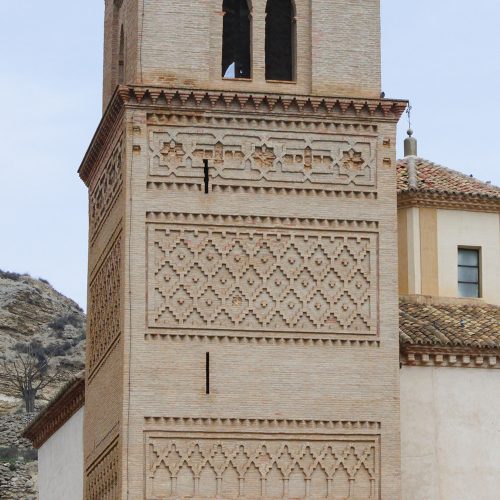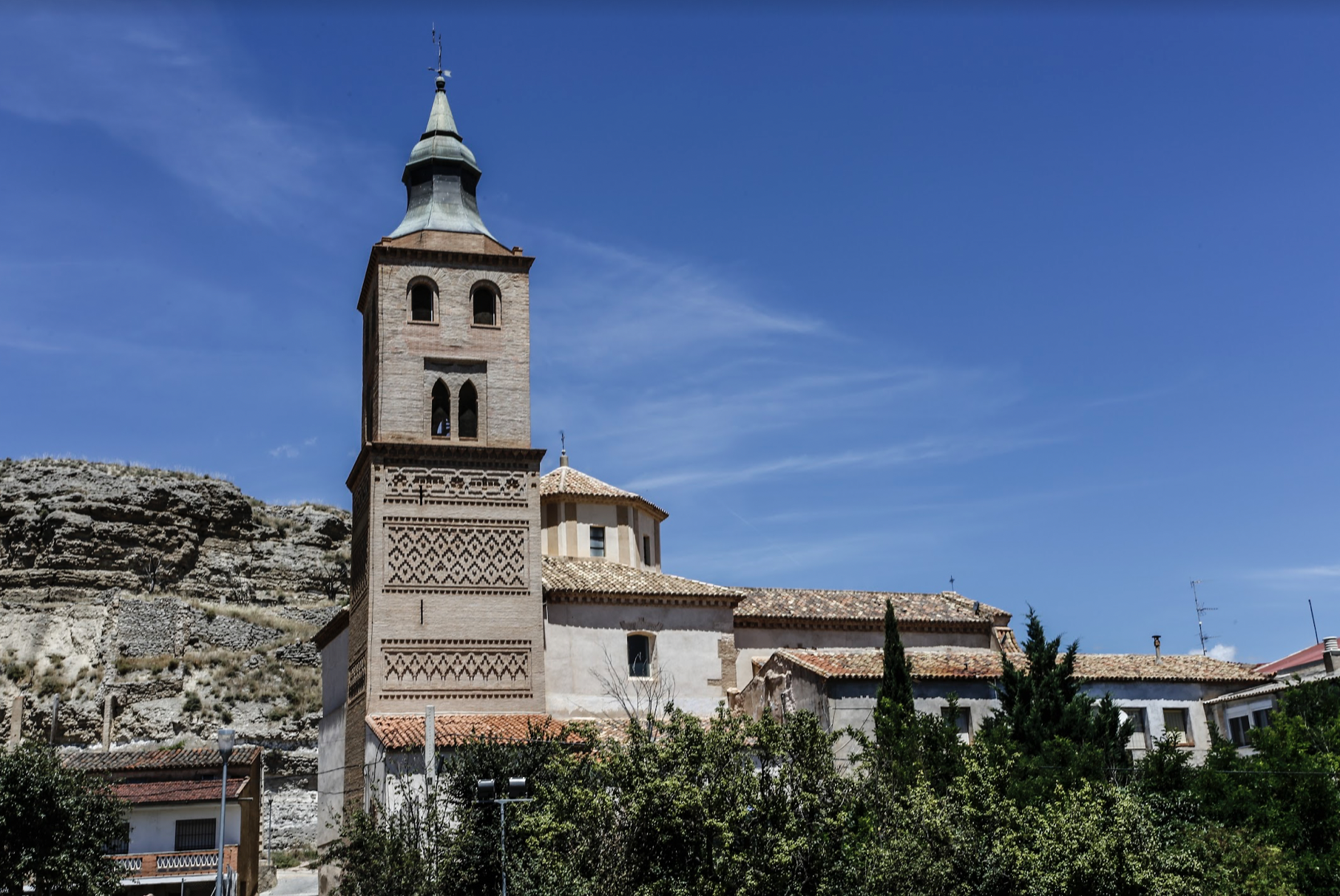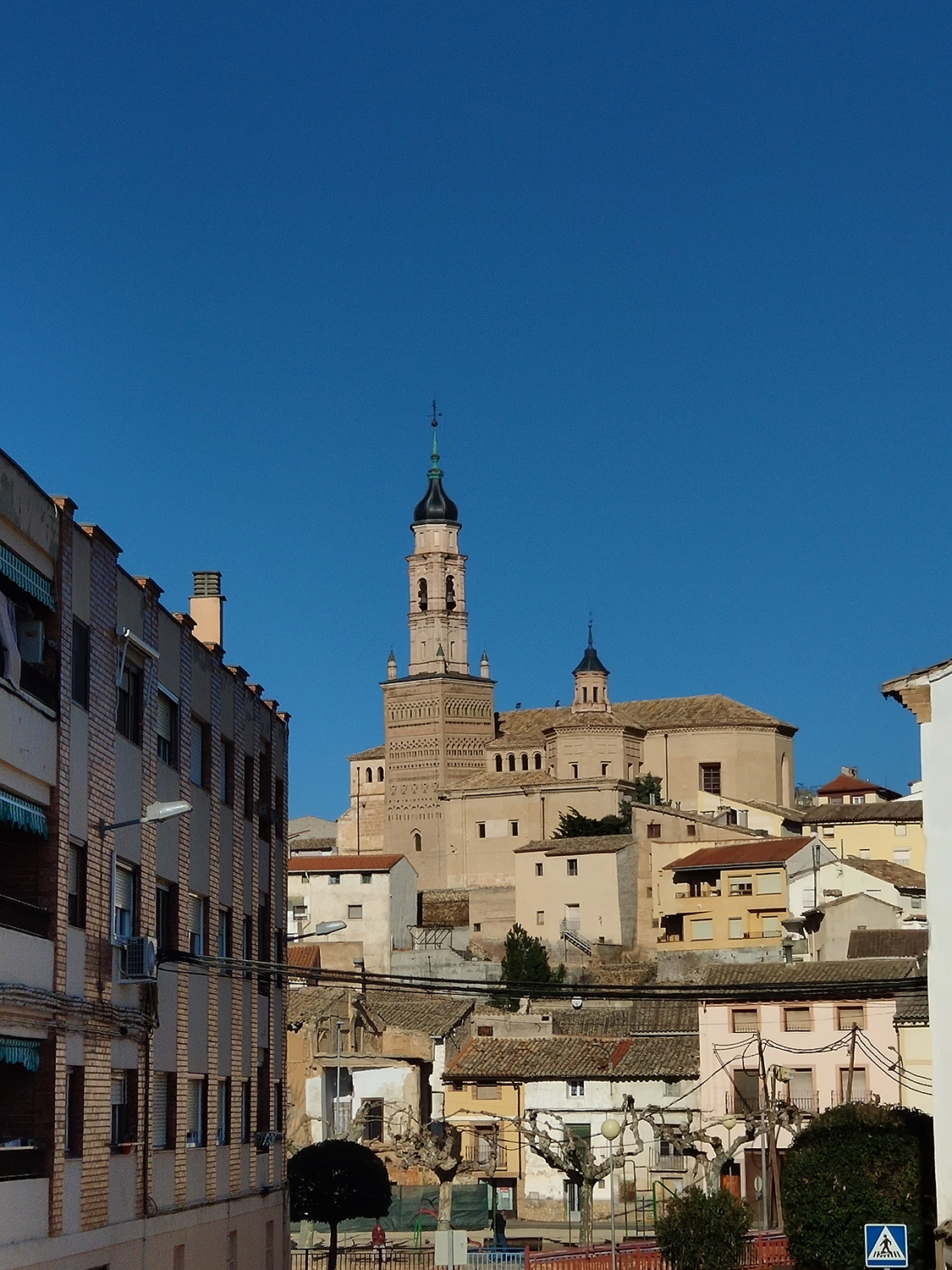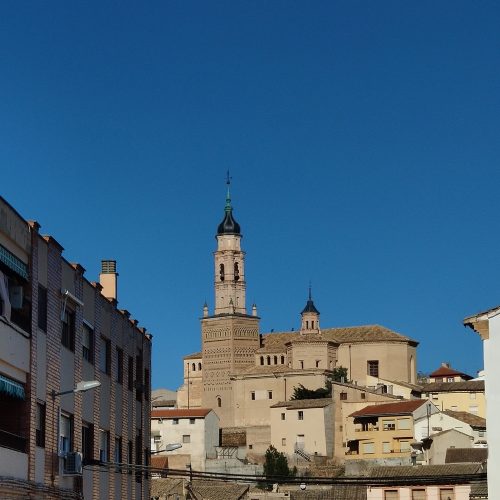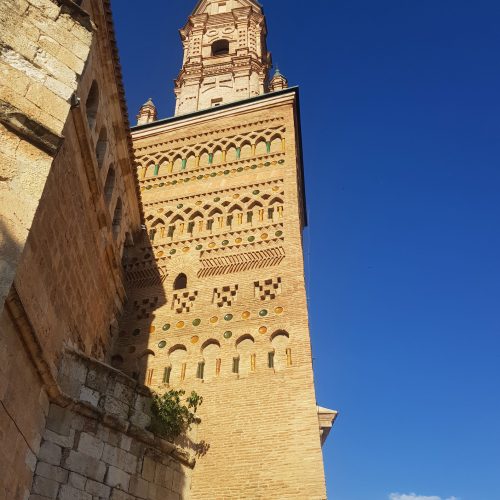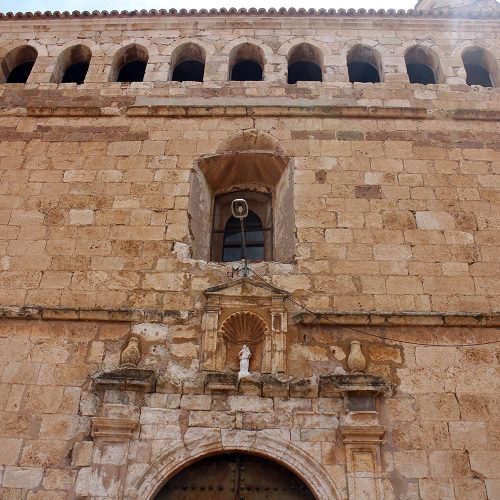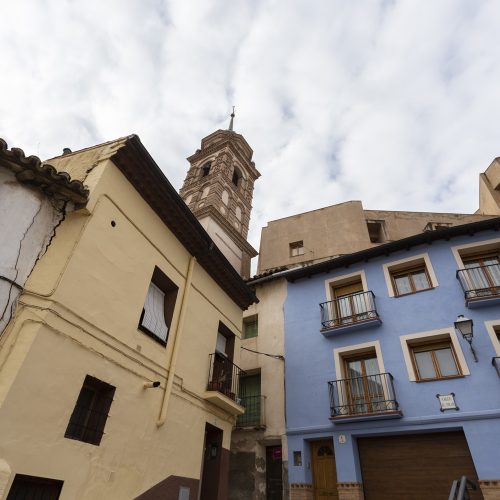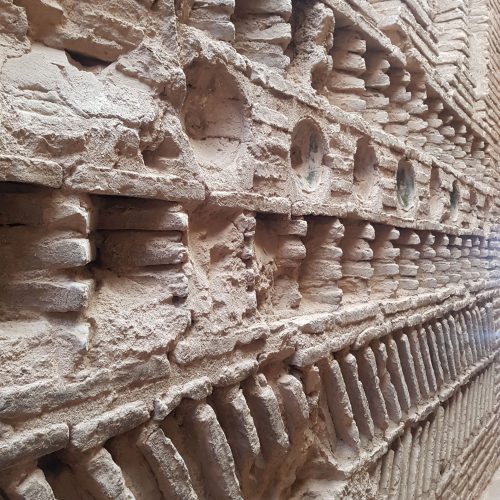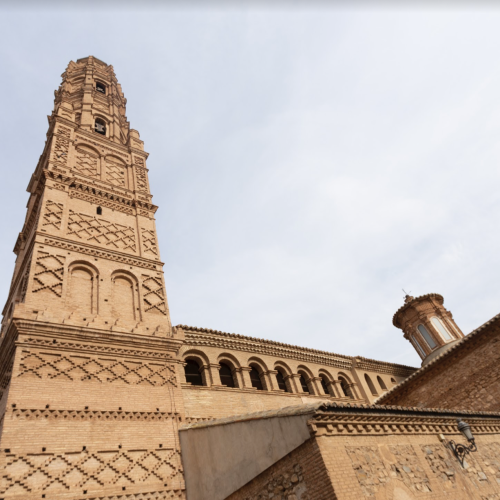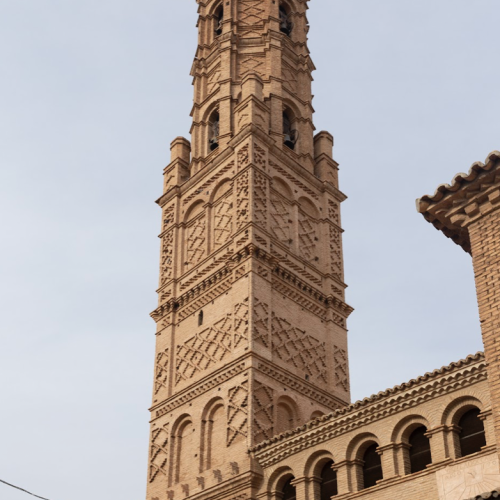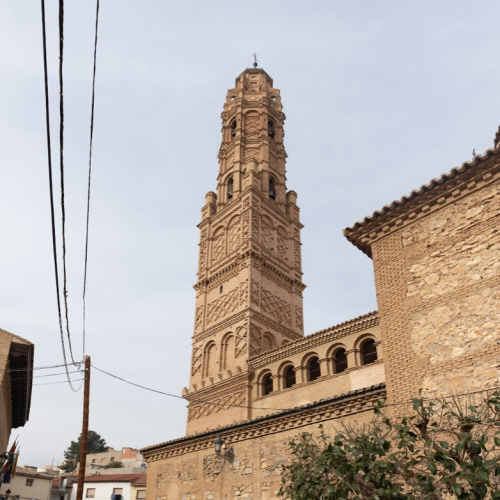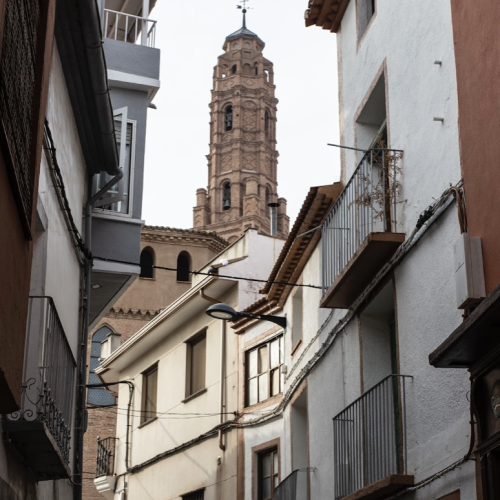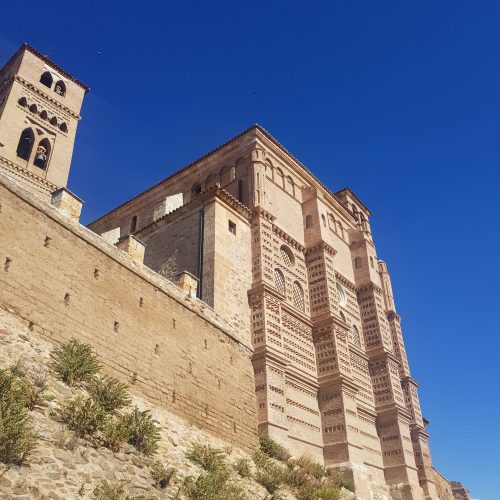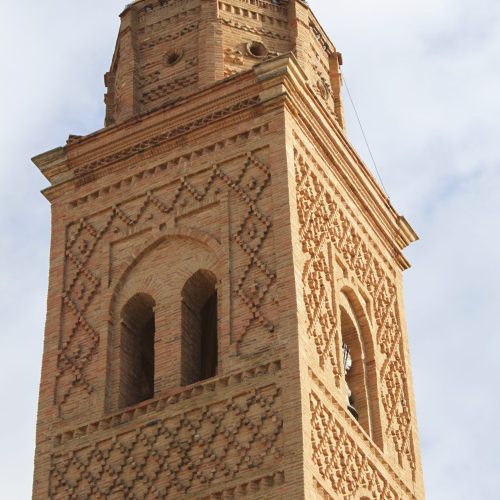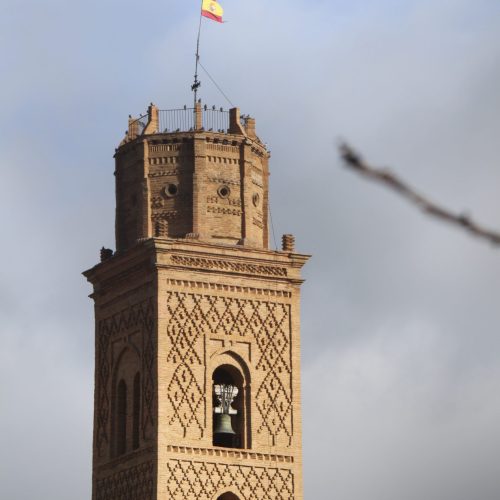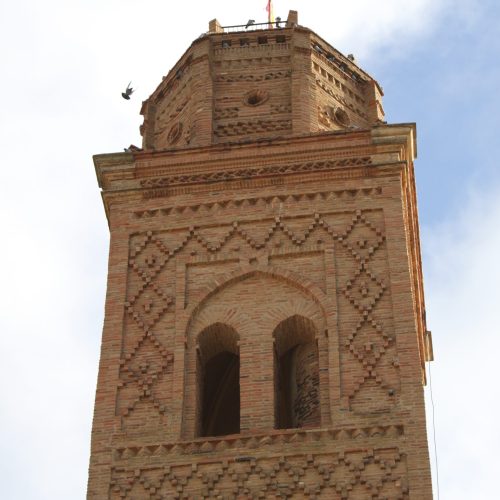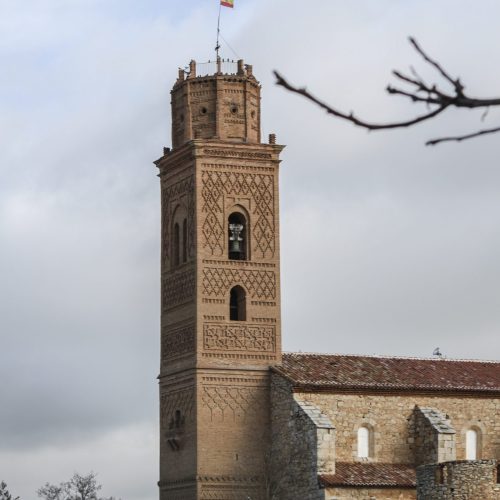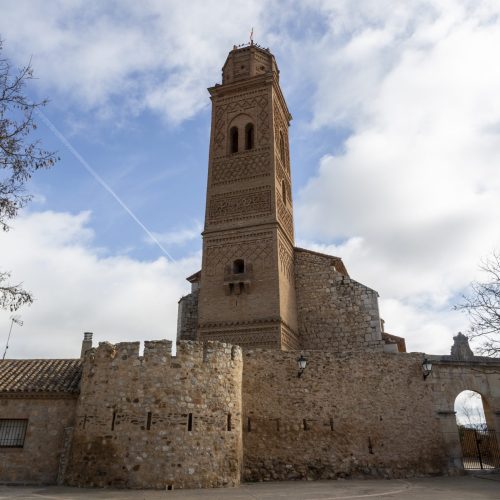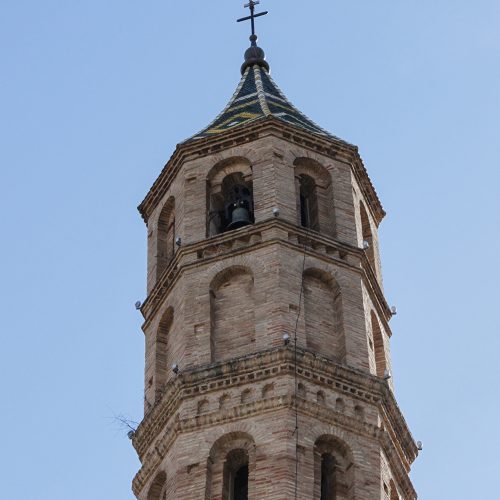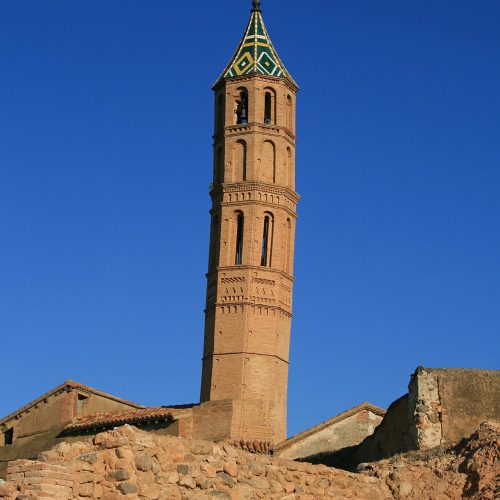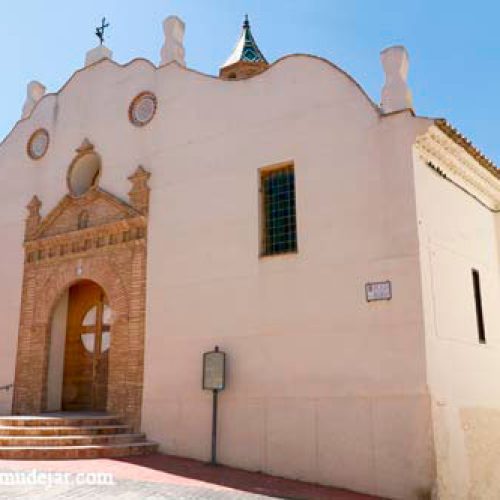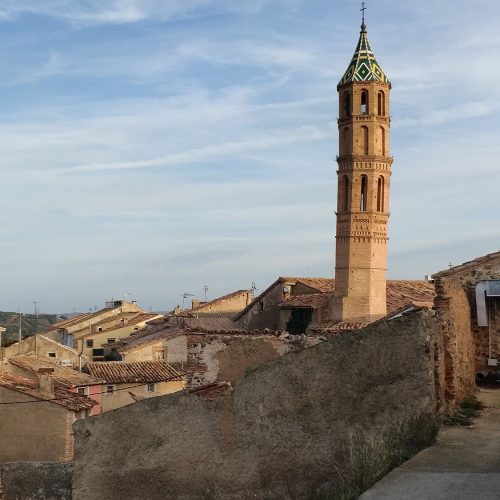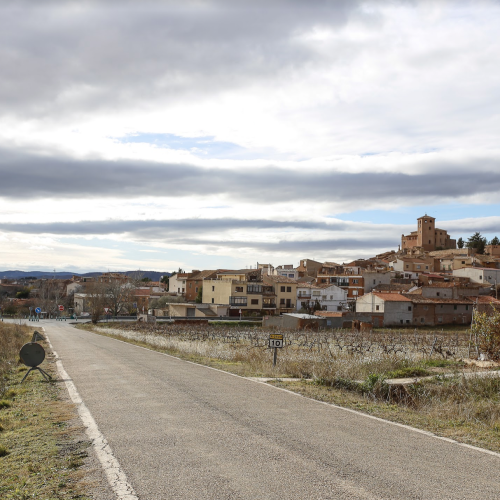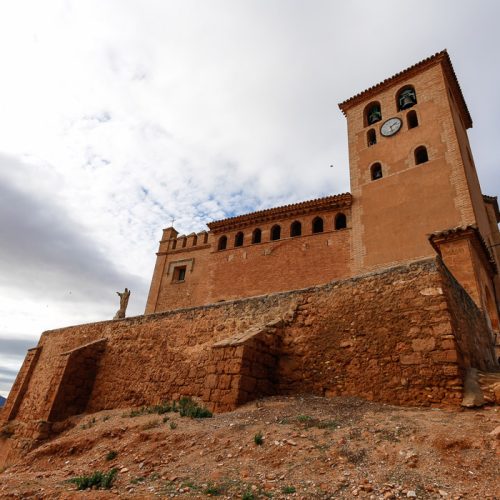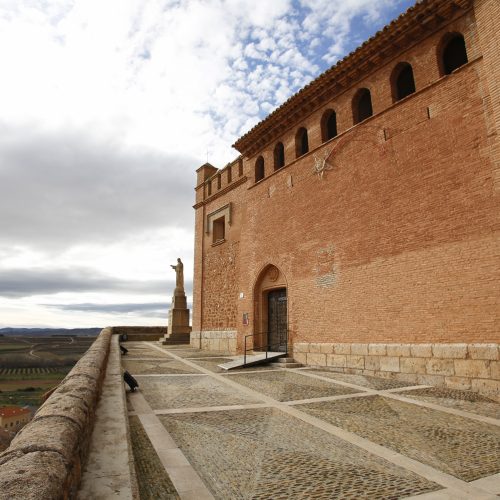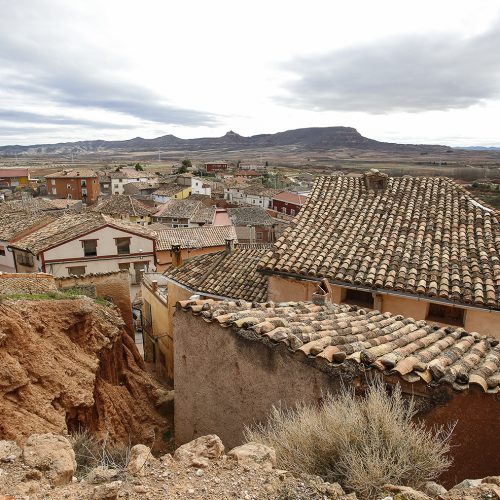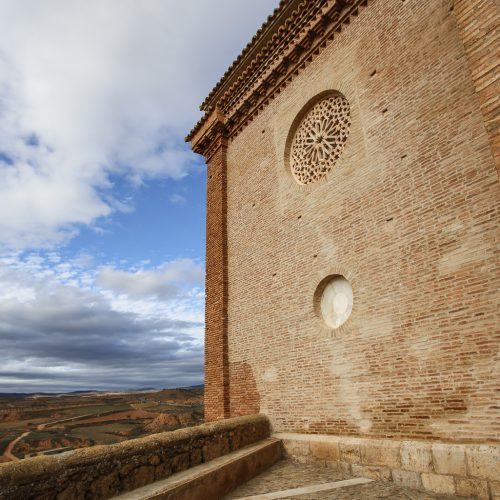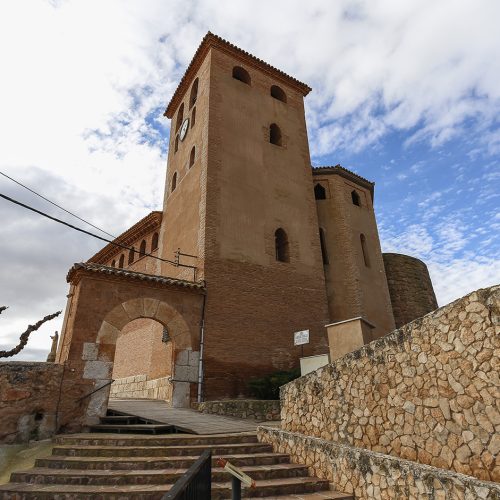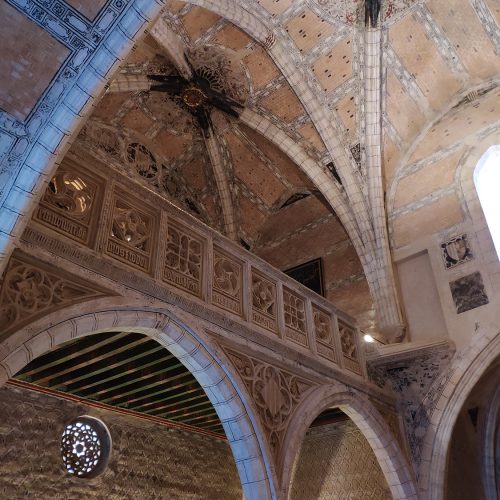
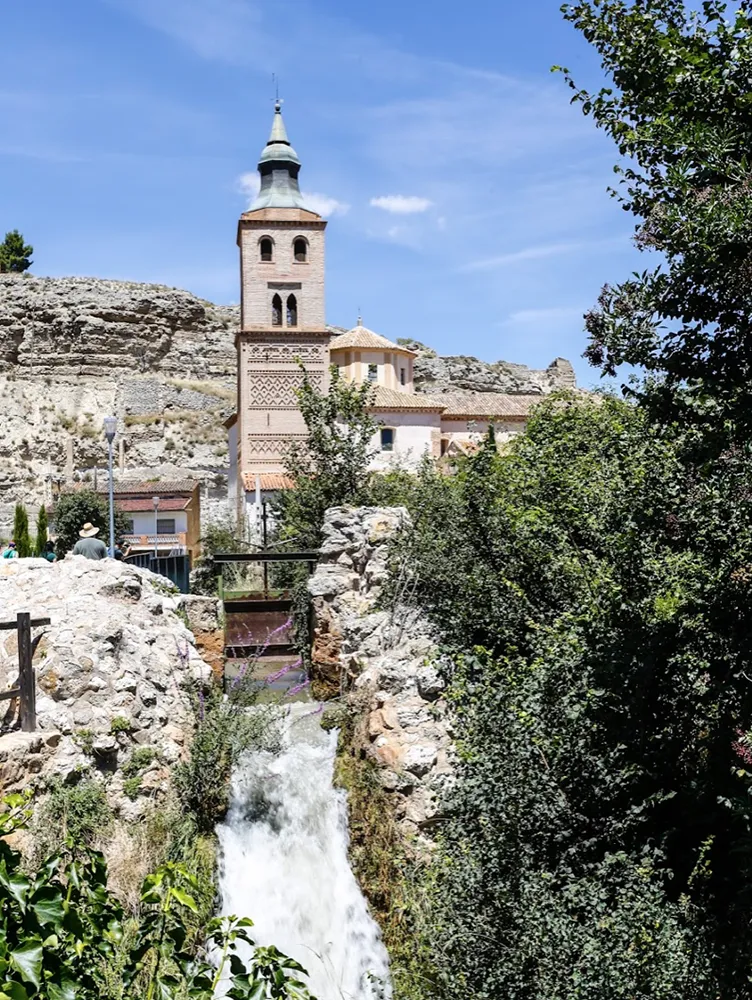
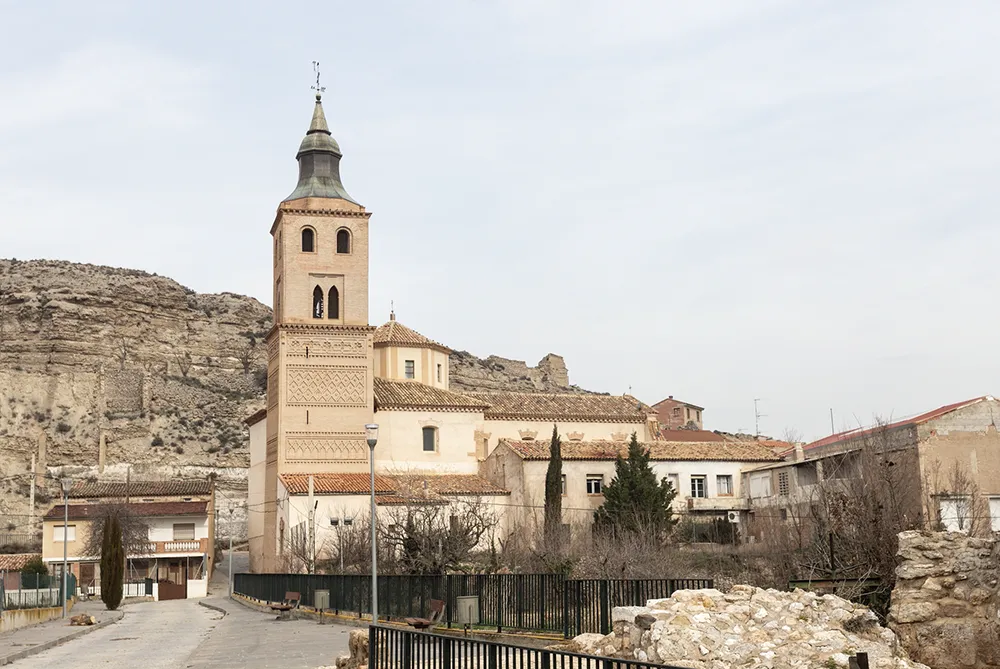
Tower and apse of the church of La Asunción de Nuestra Señora, Terrer

Tower and apse of the church of La Asunción de Nuestra Señora, Terrer

Plaza Bajo el Olmo, 1, 50293 Terrer, Zaragoza

CURRENT PROTECTION CATEGORY: BIC

TYPE OF PROPERTY: Real estate

CATEGORY: Religious

ARCHITECTURAL STYLE: Mudejar and Baroque

DATE OF CONSTRUCTION:

The construction of the church dates back to the 14th and 15th centuries. The Mudejar tower has been dated ca. 1400.

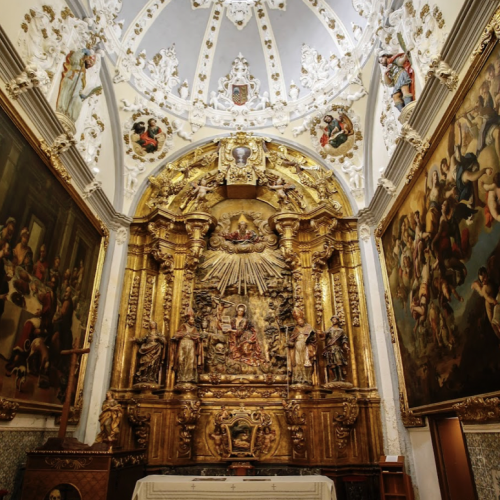
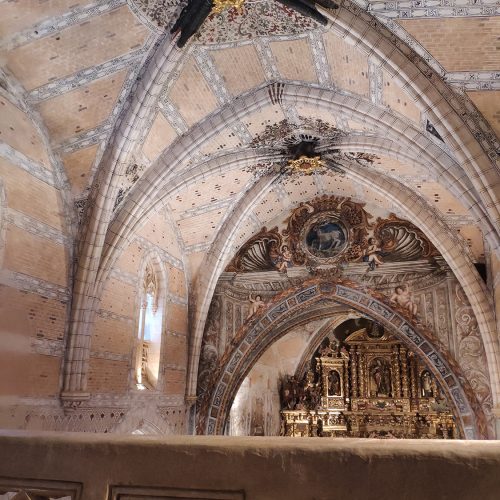
In the 18th century , the church underwent a Baroque renovation, as well as the enlargement of the bell tower and the construction of the spire of the tower.

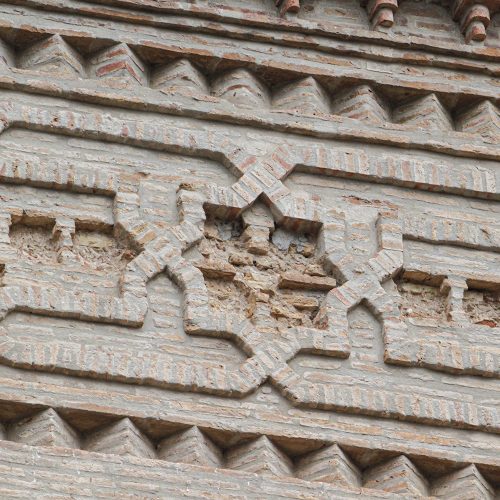
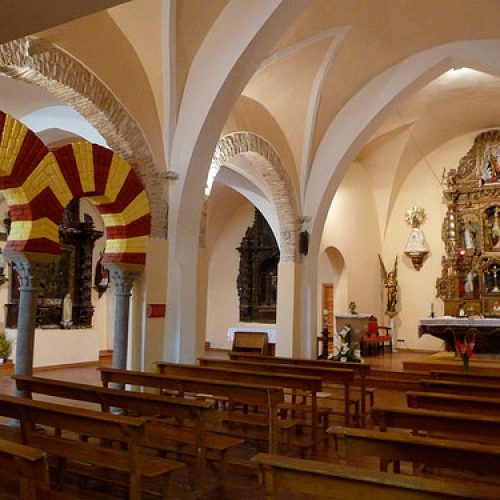
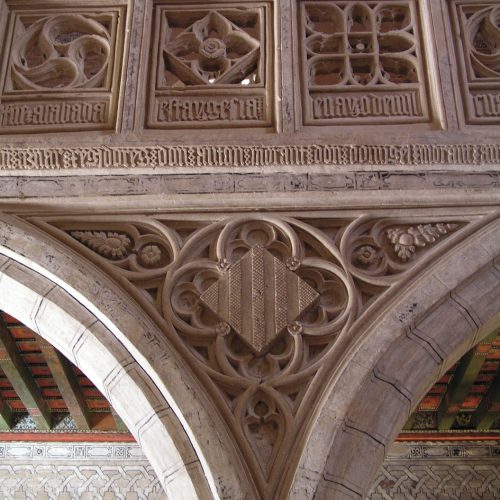
The result of a profound transformation in the Baroque period, only the tower and part of the polygonal apse remain of the original Mudejar-style construction, which has arches in the Islamic tradition and a decoration of scribblework with a theme related to that of the churches of Tobed, Cervera de la Cañada and Torralba de Ribota.

The tower, dating from the beginning of the 15th century, is attached to the south side of the chancel of the current parish church. Sturdy and ornate, it rises next to the water of the irrigation channels and between fields of crops. We could be talking about possible patronage links with Benedict XIII, Pope Luna.

It has a square floor plan. Inside, it is divided into two superimposed bodies; the lower one has a Hispano-Muslim structure, with a central buttress enveloped by the external tower. The upper one, hollow, was designed to house the bell tower. It is topped by a spire with a mixed profile from the Baroque period.

On the outside, the lower body concentrates all the brick ornamentation in highlighting , lacking only the applied ceramics (in this case there was , as we know from the documentation), it was domestic crockery reused, in this case, for ornamentation.

Interventions

Restoration, 20th Century to 21st Century
Projects and interventions

Projects and interventions and their promoters define the history of monumental buildings as well as the perception of them.

The downloadable document presents the current status of the files under review, which will allow us to update our knowledge of each of the monumental buildings.

Declarations

Declaration, 21st Century

On 14 December 2001, the 25th Official Session of the World Heritage Committee, held in Helsinki (Finland), agreed to recognise and declare the Mudejar architecture of Aragon a World Heritage Site.

On 14 August 2002, the Official Gazette of Aragon published the Order of 22 July 2002, of the Department of Culture and Tourism, declaring the Tower and apse of the Church of the Assumption of Our Lady of Terrer, in the province of Zaragoza, to be a listed asset of Aragonese Cultural Heritage.

Bibliography

BORRÁS GUALIS, G.M. Arte Mudéjar Aragonés, CAMPZAR and Colegio Oficial de Arquitectos Técnicos y Aparejadores de Zaragoza, Zaragoza, 1985.

SANMIGUEL MATEO, A. Towers of Islamic descent in the regions of Calatayud and Daroca. Aragón (Spain). Estructuras, decoración y relaciones con otras torres islámicas de Oriente y Occidente, Centro de Estudios Bilibilitanos (Institución Fernando el Católico), Calatayud, 1998, pp. 292-295.

SANMIGUEL MATEO, AGUSTÍN. “El arte mudéjar”, in Comarca de la Comunidad de Calatayud, Colección Territorio 20, Zaragoza, 2005.

TRASOBARES RUIZ, VICTORIA E., RUIZ BAZÁN, IRENE, “Territorio Mudéjar. Las torres, técnica y creatividad”, La magia de viajar por Aragón, number 126, July – August 2021, pp. 16-23.

Appendixes

Visit Terrer

Town hall: 976 898 002

DO YOU WANT TO KNOW MORE?
www.turismodezaragoza.es

Tower of the church of Santa María, Ateca

Tower of the church of Santa María, Ateca

Plaza de Jesús, 10. Ateca (Zaragoza)
TYPE OF ASSET: Property

CATEGORY: Religious

ARCHITECTURAL STYLE: Mudejar

CONSTRUCTION DATE:

Middle Ages: Second half of the 13th century

Modern Era, 17th century: The second section of the Baroque tower replaced the original Mudejar tower.
This is a square-plan tower with two distinct sections, based on typology. It is attached to the last bay at the west end of the church of Santa María in Ateca, on the Epistle side of the temple. The tower was originally free-standing and traces of an ancient minaret can be seen in the lowest section. It was attached in an irregular manner in the 16th century to this final bay of the church.

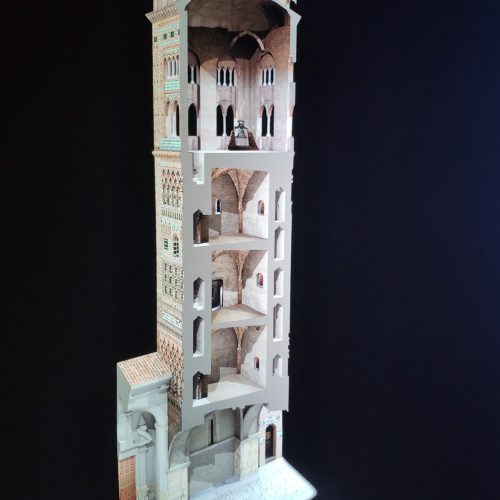
The first section of the tower has a square floor plan and was built in the style of the Mudejar towers featuring an inner tower structure, around which another tower is wrapped, with a stairway between the two. The tower is divided rooms on four levels, one above the other, covered by barrel vaults. The stairway provides access to these rooms.

It is worth noting that, as one ascends the tower, the lower part of the stairway is covered by eight small barrel vaults made of brick laid in a sardinel bond arrangement. There follow six small quadripartite rib vaults and, finally, this roofing system, which is rather “experimental” in nature, is completed with a system of narrowing courses of brick like that seen in other towers such as the one in the church of Santa María in Tobed, which is the most widespread system in the second half of the 14th century and the 15th century.
The strong Muslim influence is noticeable on the tower exterior, which boasts protruding brick and ceramic decorative motifs. Pointed horseshoe arches, cross shapes and ceramic discs are some of the ornamental features that were widely used in Aragonese Mudejar art.

The lower part of the first section has apertures to allow light into the stairway. This light was subsequently blocked when the tower was attached to the church at a later date. The openings were built at the level where the stairs provide access to the rooms in the inner tower, with an ogee arch of oriental influence in the south wall while the west wall features a surbased arch with voussoirs that are split at the center and thick perpends between those near the impost molding.

At the top of this first section of the tower, there is a series of decorative horizontal friezes forming large panels filled with seven blind pointed horseshoe arches resting on cylindrical honey-colored and green shafts with ceramic discs of the same colors and stamped fleurs-de-lis within the spandrels of the arches; a frieze of five cross shapes inscribed within a square to form a fishbone pattern; and a frieze of angled bricks adorning discs, as well as friezes of intertwined pointed arches resting on brick pilasters, flanked by ceramic shafts.

Interventions

RESTORATION, 20th CENTURY
The ceramic decorative work on the exterior was restored in 1970. The belfry, spire, façades and interior of the different sections have undergone diverse types of restoration work in recent years.

RESTORATION PROJECT, 20th CENTURY The restoration project was carried out in two phases, spanning from 1985 to 1994. A second restoration project was completed in 2001.

Projects and interventions

Projects and interventions, and the driving forces behind them, define the history of monumental buildings and how they are perceived.

Declarations

DECLARATION, 20th TO 21st CENTURY (1983-2001)
The church and tower of Santa María in Ateca were declared an Asset of Cultural Interest under the Ministry of Culture Decree dated January 12, 1983, which was published the Official State Gazette of March 5, 1983.
The Official Gazette of Aragon (BOA) dated October 22, 2001 published the Department of Culture and Tourism Order of September 25, 2001, whereby the original declaration of the church and tower of Santa María in Ateca (Zaragoza) is supplemented pursuant to Transitional Provision One of Aragonese Cultural Heritage Act 3/1999, of March 10.
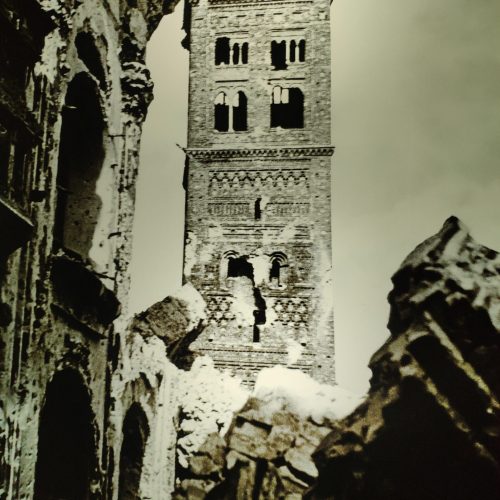
Current condition

The tower of Santa María in Ateca is currently in ideal conditions of restoration and cleanliness after the successive phases of restoration work indicated above. One wise decision in this restoration work was to leave the interior wall of the tower leading to the arcade inside the church bare, without replacing the ceramic pieces, thus affording a view of the tower in its original condition prior to the restoration.

Bibliography

BORRÁS GUALIS, GONZALO M., Arte Mudéjar Aragonés, Caja de Ahorros y Monte de Piedad de Zaragoza Aragón y Rioja y el Colegio Oficial de Aparejadores y Arquitectos técnicos de Zaragoza, Zaragoza, 1985. 

GALIAY, JOSÉ. Arte mudéjar aragonés, Institución Fernando el Católico, Zaragoza, 2002.

MARTÍNEZ GARCÍA, FRANCISCO J. Ateca, desde sus orígenes hasta el año 1500, Institución Fernando el Católico, Zaragoza, 2015.

MILLÁN GIL, JULIÁN Y SANMIGUEL MATEO, AGUSTÍN (COORD.). Comarca de la Comunidad de Calatayud, Colección Territorio nº 20, Departamento dePresidencia y Relaciones Institucionales del Gobierno de Aragón, Zaragoza, 2005.

SANMIGUEL MATEO, AGUSTÍN. Torres de ascendencia islámica en las comarcas de Calatayud y Daroca, Centro de estudios bilbilitanos, Institución“Fernando el Católico”, Calatayud, 1998.

  • VV. AA. Tierra Mudéjar. El Mudéjar Aragonés, Patrimonio Mundial, Heraldo de Aragón, D.L. 2002.
  • VV. AA. Comunidad de Calatayud y El Monasterio de Piedra, Colección RutasCai por Aragón nº 12, Zaragoza, 2004.
  • VV. AA. Las supuestas características almohades de la torre de Ateca, IV Encuentro de Estudios Bilbilitanos, I, Calatayud: Centro de Estudios Bilbilitanos, 1997.
  • MARTÍNEZ GARCÍA, Francisco José. Ateca, desde sus orígenes hasta el año 1500. Zaragoza: Institución Fernando el Católico, 2015.
  • SANMIGUEL MATEO, Agustín. Torres de ascendencia islámica en las comarcas de Calatayud y Daroca. Aragón (España). Calatayud: Centro de Estudios Bilbilitanos, 1998.

Appendixes

Tower of the church of Santa María

Plaza de Jesús, 10.
Ateca (Zaragoza)

Visit Ateca

City Hall: 976 842 005 www.aytoateca.es WOULD YOU LIKE TO KNOW MORE? www.turismodezaragoza.es

Tower and church of Nuestra Señora de la Asunción, Ricla

Tower and church of Nuestra Señora de la Asunción, Ricla

CURRENT PROTECTION STATUS: ACI

TYPE OF ASSET: Property

CATEGORY:
Religious

ARCHITECTURAL STYLE: Mudejar

CONSTRUCTION DATE:

Original construction, 15th to 16th century
The Mudejar church was built between the 15th and 16th centuries. Of this Mudejar structure, the apse and the first bay, with its chapels and gallery, remain standing.

Expansion, 16th century
In the 16th century, the second bay of the nave and two side chapels on either side were built. The tower was erected in a single phase in the 16th century. In the 18th century, the Magdalena chapel was added around 1720 and the interior was decorated. Some of the vaults were also replaced and an entrance portal over the apse was added.

Change of orientation, 18th century
In 1773, the temple orientation was shifted, the entrance was moved to the apse and part of the original Mudejar construction was concealed. A Neo- classical portal in stone was added to the apse.
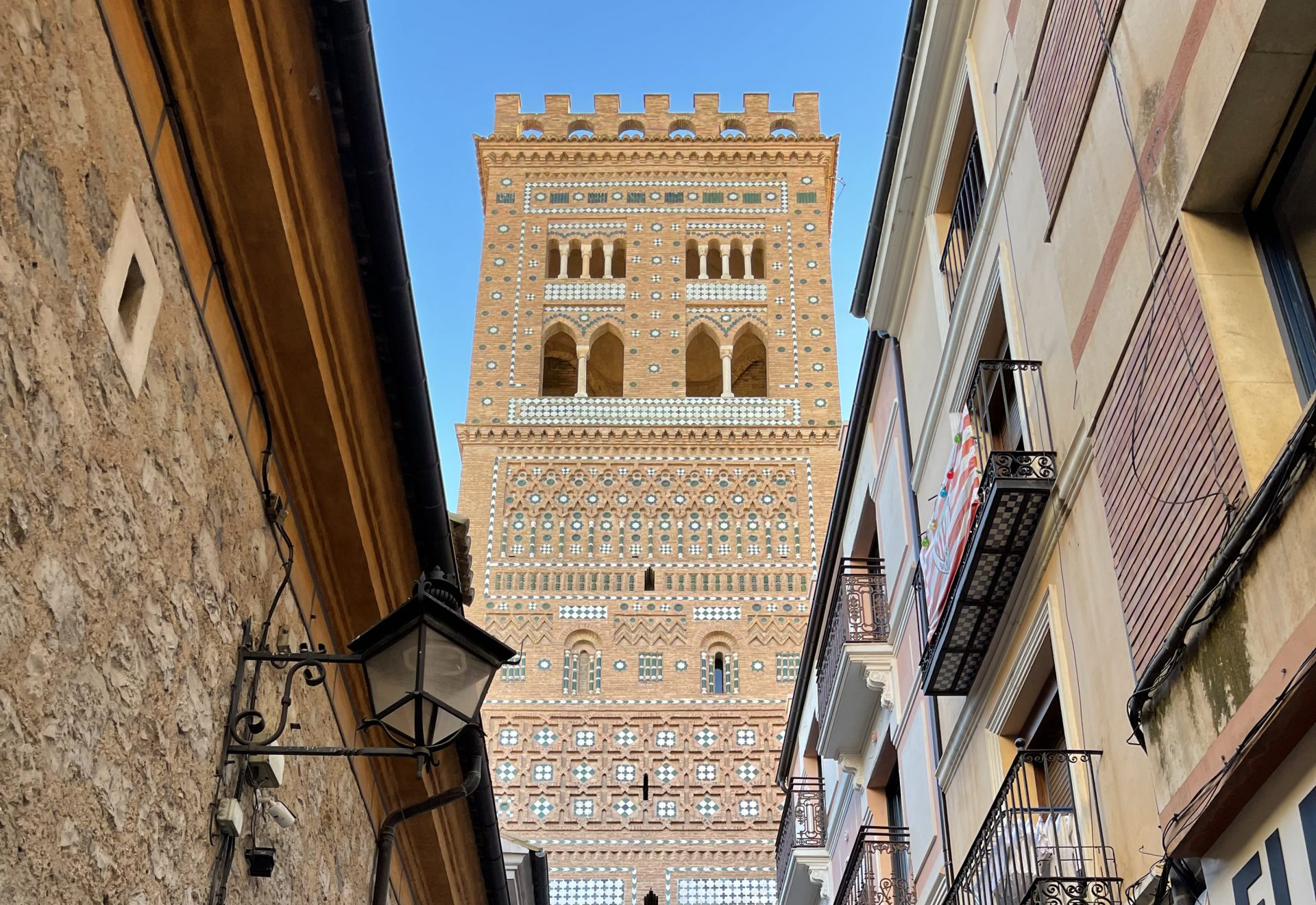
The church of Nuestra Señora de la Asunción in Ricla is of interest for its important Mudejar tower, which stands at a height of 55 meters, thus representing one of the slenderest mixed-type towers in the province of Zaragoza.

The Mudejar tower now stands at the west end of the church, in the southwest corner. When the church was renovated in the 18th century, its orientation was shifted and the current entrance was opened up in the Mudejar apse. The entire construction is the result of a design rendered in the mid-16th century, except for the top, added during the 20th century, to which a cross made by Cristóbal Freislera in 1584 is attached.

As mentioned above, the tower in Ricla is a mixed-type tower, with a square- plan base and an octagonal upper section. The interior structure consists of one tower inside another (an exterior tower wrapped around an inner tower). The entire inner tower is hollow, and it acts as a support structure for the stairway. The stairway is not covered by narrowing courses of bricks, but rather by sections of vaulting with rampant arches.

The octagonal section serves as a bell tower. On the exterior, the transition from one level to another is achieved by means of small turrets at the corners, as is also the case with the tower in Utebo and the Lonja in Zaragoza.

The decorative work on the exterior includes protruding brick details in the shape of crisscrossing diamonds forming intertwined arches and strips of bricks arranged at angles.

The church was constructed in several stages, starting from the late 14th century to the 16th century. What we see today is a single nave made up of two bays and a polygonal apse covered with a rib vault decorated with painted geometric brickwork in the Mudejar tradition. Of the original construction, the five-sided polygonal apse and the first bay next to the apse, covered by a quadripartite rib vault, remain standing. Side chapels were also set between the buttresses and above that, an arcade open to the exterior with pointed arches. The second bay of the nave is from a later date, in the 16th century. It is covered by a stellar vault. Two chapels, one on each side, were attached to this space.
They house important altarpieces. The high altarpiece was done between 1688 and 1692 by Francisco de Asta. The polychrome wood carving of the Virgin and the polychrome wood sculptures of Saint Francis of Assisi, Saint John the Baptist, Saint Isidro and Saint Bartholomew in this altarpiece date from the 17th century, presumably created in the workshop of Manuel Ramírez in Zaragoza.

One of the most important altarpieces is that of the Virgen del Rosario, from the late 16th century, attributed to the workshop of the renowned sculptor Damián Forment. Other, less significant, altarpieces, from the 18th century, are those of Saint Michael, Saint Anne, the Virgin and Child and Holy Christ.

Other striking objects are the Virgen de Media Villa, a gilded and polychrome carving from the late 15th century, and an organ decorated in the Rococo style from the second half of the 18th century.

Interventions

Restoration, 20th to 21st century

The church was restored in 1992, focusing above all on the roofs, vaults and exterior brick construction. Work was also done on the south arcade of the temple, restoring its original 18th century plaster coat. In 2010 and 2011, restoration work was done on the tower after certain parts had become detached at the top.

Projects and interventions

Projects and interventions, and the driving forces behind them, define the history of monumental buildings and how they are perceived.

Declarations

Declaration, 20th century

The church was declared a National Monument on June 3, 1931, published in the Gazette on June 4, 1931. The Official Gazette of Aragon (BOA) dated November 30, 2001 published the Department of Culture and Tourism Order of October 30, 2001, whereby the original declaration of the church of Santa María (of Nuestra Señora de la Asunción) in Ricla (Zaragoza) is supplemented pursuant to Transitional Provision One of Aragonese Cultural Heritage Act 3/1999, of March 10.

Bibliography

ARTIGAS LAUSÍ, J. Ricla, islámica y cristiana. Esbozo socio-histórico desde el siglo X al XVII, 2004.

ESTEBAN Y ALLO. La Iglesia Parroquial de Nuestra Señora de Ricla, Revista Ador No 6, pp.143-156, 2001.

MÉNDEZ DE JUAN, JOSÉ FÉLIX ET AL. (COORD.). Aragón Patrimonio Cultural Restaurado. 1984/2009. Bienes inmuebles, Gobierno de Aragón, Zaragoza, 2010.

TRASOBARES RUIZ, VICTORIA E., RUIZ BAZÁN, IRENE., “Territorio Mudéjar. Las torres, técnica y creatividad”, La magia de viajar por Aragón, número 126, julio – agosto 2021, pp. 16-23.  

VV.AA. Ricla, Colección Territorio, Comarca del Valdejalón, DGA, p.284-287. 2003.

VV.AA. Tierra Mudéjar. El Mudéjar Aragonés, Patrimonio Mundial, Heraldo de Aragón, D.L. 2002.

ZARAGOZA AYARZA, F. La construcción del Retablo de la capilla Mayor de la Iglesia Parroquial de Ricla, Publicación “la Replazeta” No7, pp. 31-33, 2001.

Appendixes

Tower and church of Nuestra Señora de la Asunción

C. tras Iglesias, 3
50270 Ricla (Zaragoza)
Visit Ricla

City Hall: 976 600 106
www.ricla.es
WOULD YOU LIKE TO KNOW MORE?
www.turismodezaragoza.es

El Salvador tower, Teruel

El Salvador tower, Teruel

Calle el Salvador, 44001 Teruel

CURRENT PROTECTION STATUS: Asset of Cultural Interest (ACI)

TYPE OF ASSET: Property

CATEGORY: Religious

ARCHITECTURAL STYLE: Mudejar

CONSTRUCTION DATE:
  • Original construction, 13th to 14th century. Repair, 17th century to 20th century. The addition of the belfry led to structural problems for the tower as a whole.
  • 17th century, partial substitution. The adjacent church of El Salvador collapsed in 1677 and was replaced by a Baroque structure in the late 17th century.
This is the most recent Mudejar tower in Teruel. It has a rectangular floor plan with three vertical sections and an Almohad minaret structure featuring two concentric towers with a stairway nestled between the two. The exterior tower is built of brick, whereas the interior one is made of plaster and masonry and divided into three stories, one above the other, covered by a rib vault (the lowest one) and pointed barrel vaults (the upper two); over this, there is a belfry on the exterior.

The lower section of the tower is pierced by a gate in the longer two façades, creating a passageway with a pointed arch covered by a quadripartite rib vault. All the decorative motifs ornamenting the tower are found above this level, featuring series of strips, panels and patterns framed by lines of tile work and angled brick: thus, in the first section of the tower there is a frieze of simple angled brick with a panel of intertwined mixtilinear arches above it; the arches rest on ceramic colonettes alternating with ceramic star details in green and white. Two more friezes of simple angled brick are seen above this panel, framing two beautifully decorated rectangular panels of ceramic tile with a small opening between them topped by a corbelled arch.
The second section of the tower has a panel of interlacing eight-point stars inset with ceramic motifs, over which there are two round-arched openings, brick detail work in a zig-zag pattern and another frieze of intertwined mixtilinear arches. Finally, the third section, or belfry level, features two rows of openings, with two pairs of pointed arches below and two colonnades of four round arches each above.

Located adjacent to the now-lost Guadalaviar Gate, the western entrance to the medieval compound of the city of Teruel, the tower of San Salvador is the only existing remnant of the Mudejar church and bell tower of the same name.

Interventions

Restoration, 20th century

The tower was restored between 1990 and 1993 by the Government of Aragon, which invested a total of 1,057,875 euros in the restoration work. The project succeeded in returning the building to its original splendor and adapted it for tours of the inside. The restoration project stemmed from the tower’s declaration as a UNESCO World Heritage Site, and was designed by architects Antonio Pérez Sánchez and José María Saz.

Projects and interventions

Declarations

Declaration, 20th to 21st century

The tower of the church of San Salvador was declared a National Monument under the Order dated March 10, 1911 issued by the Ministry of Public Instruction and Fine Arts, published in the Madrid Gazette on March 19, 1911. The original declaration was supplemented by the Asset of Cultural Interest declaration issued in the Department of Education, Culture and Sport Order of May 10, 2004, whereby the original declaration of the tower of the church of San Salvador in Teruel as an Asset of Cultural Interest is supplemented pursuant to Transitional Provision One of Aragonese Cultural Heritage Act 3/1999, of March 10. On November 28, 1986 UNESCO added the Mudejar architecture of Teruel to its World Heritage list, in which four of its most important monuments are included: the tower, ceiling and lantern tower of the Santa María de Mediavilla Cathedral, the tower and church of San Pedro, the El Salvador church tower and the tower of the church of San Martin.

Current condition

Conversion into a museum, 21st century. The tower now houses the Mudejar Interpretation Center.

Bibliography

ALCALÁ PRATS, ICÍAR, PÉREZ SÁNCHEZ, ANTONIO Y SANZ ZARAGOZA, JOSÉ MARÍA. La arquitectura mudéjar de Teruel: balance de veinte años como Patrimonio Mundial (1986-2006), en Turia (revista cultural) nº80 (nov. 2006 – feb. 2007), Instituto de Estudios Turolenses, Teruel, 2007, p. 361-377.

ALCALÁ PRATS, ICÍAR, REVILLA HERNANDO, ANA MARÍA Y RODRIGO GARZA, BEATRIZ. Guía del arte mudéjar en Aragón, Centro de Estudios Mudéjares, Prames, 2005.´

BORRÁS GUALIS, GONZALO M. Arte Mudéjar Aragonés, Caja de Ahorros de Zaragoza, Aragón y La Rioja, Zaragoza, 1985.

GALIAY, JOSÉ. Arte mudéjar aragonés, Institución Fernándo el Católico, Zaragoza, 2002. MÉNDEZ DE JUAN, JOSÉ FÉLIX, GALINDO PÉREZ, SILVIA Y LASHERAS RODRÍGUEZ, JAVIER. Aragón Patrimonio Cultural Restaurado. 1984/2009. Bienes inmuebles, Gobierno de Aragón, Zaragoza, 2010.

  • SANMIGUEL MATEO, AGUSTÍN. Torres de ascendencia islámica en las comarcas de Calatayud y Daroca, Centro de estudios bilbilitanos, institución “Fernando el Católico”, Calatayud, 1998.
  • ALCALÁ PRATS, Icíar. El arte mudéjar en la Comunidad de Teruel. En LOSANTOS SALVADOR, Antonio. (coord.). Comunidad de Teruel. Diputación General de Aragón, 2010.p. 185-196.
  • BENITO, Félix. Patrimonio histórico de Aragón: Inventario arquitectónico. Teruel. Zaragoza: Diputación General de Aragón, 1991. BORRÁS GUALIS, Gonzalo. Arte mudéjar aragonés. Zaragoza: CAZAR, 1985.
  • CABAÑERO SUBIZA, Bernabé. Las torres mudéjares aragonesas y su relación con los alminares islámicos y los campanarios cristianos que les sirvieron de modelo. Turiaso. 1995 , nº XII, p. 11-51.
  • HERNÁNDEZ MARTÍNEZ, Ascensión. La actuación de la Dirección General de Bellas Artes en Aragón (1938-1958): la labor de los arquitectos conservadores Manuel Lorente Junquera y Fernando Chueca Goitia. En GARCÍA CUETOS, María del Pilar; ALMARCHA NUÑEZ-HERRADOR, María Esther; HERNÁNDEZ MARTÍNEZ, Ascensión. (coord.). Restaurando la memoria: España e Italia ante la recuperación monumental de posguerra. Trea, 2010.p. 41-66.
  • LABORDA YNEVA, José. Teruel. Guía de Arquitectura. Zaragoza: Caja de Ahorros de la Inmaculada, 1996.
  • MORENO, María Ángeles. La reposición de azulejos de la torre del Salvador arrancará en abril. Heraldo de Aragón. 21/03/2018 p. 21.
  • MÉNDEZ DE JUAN, José Félix et al. (coord.). Aragón. Patrimonio cultural restaurado. 1984/2009: Bienes inmuebles. Zaragoza: Gobierno de Aragón, 2010.
  • NOVELLA MATEO, Angel. La transformación urbana de Teruel a través de los tiempos. Teruel: Instituto de Estudios Turolenses, 1988.
  • SEBASTIÁN, Santiago. Inventario artístico de Teruel y su provincia [En línea]. Madrid: Ministerio de Cultura, 1974.[Consulta: 11 de junio de 2021].
  • SEPÚLVEDA SAURAS, María Isabel. Torre de El Salvador. En El Mudéjar de Teruel. Patrimonio de la Humanidad. Instituto de Estudios Turolenses, 1989.p. 29- 31.
  • SERRANO PELLEJERO, Lucía . (dir.). El Mudéjar Aragonés, Patrimonio Mundial: Tierra Mudéjar. Zaragoza: Heraldo de Aragón, 2002.

El Salvador tower

Calle el Salvador,
44001 Teruel

Visit Teruel

City Hall: 978 61 99 00
wwww.teruel.es
WOULD YOU LIKE TO KNOW MORE?
www.turismo.teruel.es

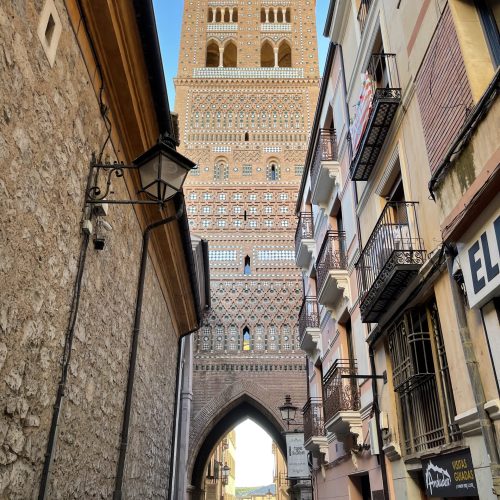
Clock tower, Ateca

Clock tower, Ateca

C. Cambra, 13, 50200 Ateca

CURRENT PROTECTION STATUS: Listed

TYPE OF ASSET: Property

CATEGORY: Religious

ARCHITECTURAL STYLE: Mudejar

CONSTRUCTION DATE: 1560
The tower was built in 1560 by the master builder Domingo and the Morisco Meçot to house the clock, probably influenced by the Torre Nueva clock tower in Zaragoza. The clock was designed by Johan Escalante in Zaragoza and installed in 1561. Following the Mudejar tradition, the tower consists of two sections plus an octagonal volume at the top.

The lower section was built of plaster-based mortar and its smooth façades are punctuated by a projecting brick cornice. The upper section also has a square plan, though smaller in size, and is made of brick, arranged on two levels, the lower one featuring the clock on one side, while the others have double blind round arches.

Finally, the drum and spire were erected, designed and built by the aforementioned masters, in addition to Meçot’s son, who was hired as an apprentice. In early 1561, the tile detail work was done, consisting of some 3400 tiles covering the spire, plus eight medallions and a stained glass window.

When the work was nearly finished, it was decided to replace the old clock, commissioning master clockmaker Johan Escalante, of Zaragoza, to design the new one. The bells were also designed and installed during this phase. In 1723, the masonry in the lower section had to be reinforced after one of the corners became detached, seriously endangering the integrity of the entire tower.

The tower has a square plan, and the rich ornamentation on the second section is quite striking. The transition from the masonry section to the brick section is achieved by means of a cornice of molded brick pieces.

In turn, the second section is divided into two levels. On one side of the lower level is a large modern clock with a white face installed in 2005 after the previous clock had been out of order for several years. The old clock machinery, along with its counterweights, has been preserved as a museum artifact, dating from 1854. When the 16th century clock ceased to operate and could not be repaired, the city council was forced to replace it, as the only public clock in the town.
It was agreed that the new clock should have features similar to the old one, with bells ringing every quarter hour and on the hour; the larger bell was reused, but the smaller one, which had been changed in 1801, was replaced. Francisco Echecoín was commissioned to build it and the contract contained a warranty period and a person tasked with maintenance during this period. In 1855, the job was given to Pedro Ibarreta, primary school teacher, who was also in charge of the upkeep of another clock that had been installed in the Capuchin convent. In exchange, he received a sum of 200 reals per year, and he and his son Vicente were exempt from military enlistment obligations.

On all the other sides of this level there are double round-arched openings with a blind oculus in the parapet. The protruding brick decorative work includes strips of angled brick in which a sawtooth pattern alternates with a staggered pattern. A strip of this latter type, in addition to a dentil molding, mark the transition to the upper level.

The upper level of this second section is divided vertically into three parts by means of impost moldings that reach halfway up the side of the openings and the springing line of the arches. The decorative work on this section is also made of protruding brick featuring recessed crisscrossing patterns at the bottom, which are combined with narrow strips of staggered angled bricks in the center and two strips of staggered angled bricks in the upper part; the first of these strips combines two rows of double sawtooth patterns with three rows of staggered patterns in the center, while the upper strip has a staggered pattern. The cornice at the top of this section is decorated with a strip of staggered angled brick work and a line of inverted pyramid-shaped corbels.

In addition, there are turrets with a square base and circular top on all four corners of the tower. In the center of each side of the drum there is a small oculus.

The spire is an 18th century addition that replaced the original spire covered in green tiles with the slate shingles seen today.
Interior de iglesia en Longares con bóvedas de crucería estrellada y retablo mayor dorado al fondo.

Projects and interventions

Projects and interventions, and the driving forces behind them, define the history of monumental buildings and how they are perceived.

Declarations

Declaration, 21st century Under the Department of Culture and Tourism Order dated September 6, 2002, which was published in the Official Gazette of Aragon on September 30, 2002, the tower was declared a Listed Asset of Aragonese Cultural Heritage.

Bibliography

BLASCO SÁNCHEZ, JESÚS. Pasado y presente de la Muy Ilustre Villa de Ateca: historia, geografía, arqueología, Asociación para la Defensa del Patrimonio de Carenas ASPACAR, 2010. MILLÁN GIL, JULIÁN Y SANMIGUEL MATEO, AGUSTÍN (COORD.). Comarca de la Comunidad de Calatayud, Colección Territorio nº 20, Departamento de Presidencia y Relaciones Institucionales del Gobierno de Aragón, Zaragoza, 2005. 

VV.AA. Comunidad de Calatayud y El Monasterio de Piedra, Colección RutasCai por Aragón nº 12, Zaragoza, 2004.

Appendixes

Clock tower

C. Cambra, 13.
50200 Ateca (Zaragoza)

Visit Ateca

City Hall: 976 842 005
www.aytoateca.es
WOULD YOU LIKE TO KNOW MORE?
www.turismodezaragoza.es

Tower of the parish church of Nuestra Señora del Castillo, Aniñón

Tower of the parish church of Nuestra Señora del Castillo, Aniñón

Placeta de la Iglesia. 50313 Aniñón (Zaragoza)
CURRENT PROTECTION STATUS:

Asset of Cultural Interest (ACI)

TYPE OF ASSET: Property

CATEGORY: Religious

ARCHITECTURAL STYLE: Mudejar

CONSTRUCTION DATE: Original construction, 14th to 16th century. This was originally a Mudejar monument from the 14th century, which underwent extensive remodeling in the 16th century when the church was expanded and the gables and top part of the tower were built.
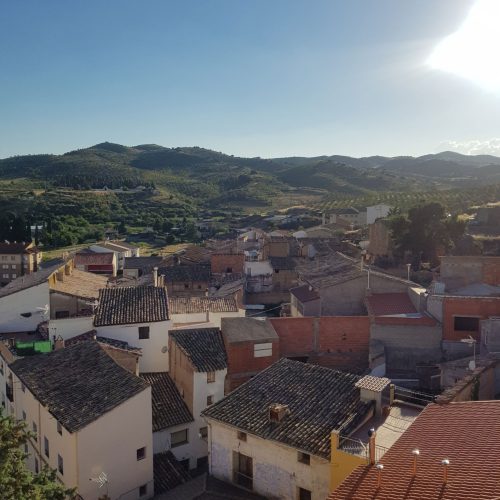
The defensive nature of the fortified church of Nuestra Señora del Castillo in Aniñón is highly pronounced, due to its position in the terrain and its imposing façade, which is completely covered in ornamentation. While it is unusual to find such profuse decoration on the façades of churches, this is more commonly seen on towers. Other examples of this type of façade can be found on the churches in Morata de Jiloca and Tobed.

The tower is attached to a side chapel on the Gospel side of the parish church. It has a square floor plan and a completely solid, square central buttress inside. The stairway is set between the inner and outer volumes.

What makes the tower in Añinón unique is the vaulting system, featuring pointed barrel vaults in this case, which are rare in Aragonese Mudejar towers, apparently, since no other examples have been found to date; its Gothic origins are clear.
The decorative elements found on the tower of the church in Aniñón include diamond or lozenge shapes, zig-zags and intertwined mixtilinear arches, all created using protruding bricks.

This tower and the west end gable wall were built prior to the current church, which dates from the second half of the 16th century; they belong to a previous building for which, on June 17, 1283, the bishop of Tarazona granted forty days of indulgence to anyone who assisted in the construction work, which extended for a very lengthy amount of time. It may date from between the end of the 14th century and the first half of the 15th century.

Interventions

20th-21st century: In 1985 and 2005, restoration work was done in several phases, encompassing the entire building.

Projects and interventions

Projects and interventions, and the driving forces behind them, define the history of monumental buildings and how they are perceived.

Declarations

20th century: The church of Nuestra Señora del Castillo in Aniñón was declared an Asset of Cultural Interest under the Ministry of Culture Decree dated June 5, 1981, which was published the Official State Gazette of August 10, 1981.
The Official Gazette of Aragon (BOA) dated November 30, 2001 published the Department of Culture and Tourism Order of November 9, 2001, whereby the original declaration of the church of Nuestra Señora del Castillo in Aniñón (Zaragoza) is supplemented pursuant to Transitional Provision One of Aragonese Cultural Heritage Act 3/1999, of March 10.

Bibliography

BORRÁS GUALIS, GONZALO M., Arte Mudéjar Aragonés, Caja de Ahorros y Monte de Piedad de Zaragoza Aragón y Rioja y el Colegio Oficial de Aparejadores y Arquitectos técnicos de Zaragoza, Zaragoza, 1985. 

CRIADO MAINAR, JESÚS. La escultura romanista en la comarca de la Comunidad de Calatayud, Institución Fernando el Católico, Zaragoza, 2013.

MÉNDEZ DE JUAN, JOSÉ FÉLIX ET AL. (COORD.). Aragón Patrimonio Cultural Restaurado. 1984/2009. Bienes inmuebles, Gobierno de Aragón, Zaragoza, 2010.

SANMIGUEL MATEO, AGUSTÍN. Torres de ascendencia islámica en las comarcas de Calatayud y Daroca, Centro de estudios bilbilitanos, Institución “Fernando el Católico”, Calatayud, 1998. VV.AA. Tierra Mudéjar. El mudéjar Aragonés, Patrimonio Mundial, Heraldo de Aragón, D.L. 2002.

MORTE GARCÍA, CARMEN. Damián Forment: Escultor del Renacimiento. Zaragoza: Caja de Ahorros de la Inmaculada, 2009.

Appendixes

Tower of the parish church of Nuestra Señora del Castillo

Placeta de la Iglesia. 50313
Aniñón (Zaragoza)

Visit Aniñón

City Hall: 976 899 106
www.aninon.es
WOULD YOU LIKE TO KNOW MORE?
www.turismodezaragoza.es

Tower of the church of San Pedro Apóstol, Romanos

Tower of the church of San Pedro Apóstol, Romanos

Plaza Mayor, s/n. 50491 Romanos (Zaragoza)

CURRENT PROTECTION STATUS: ACI

TYPE OF ASSET: Property

CATEGORY: Religious

ARCHITECTURAL STYLE: Mudejar

CONSTRUCTION DATE: 15th century

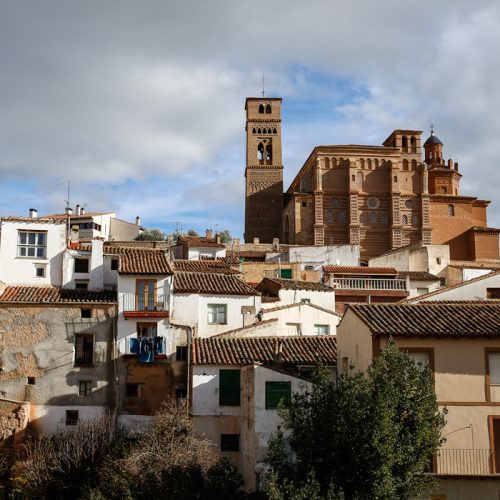
One of the most interesting examples of Mudejar art in Aragon is the tower of the church of San Pedro Apóstol in Romanos. It is considered the purest

archetype of a Christian tower structure deriving from the noble defensive towers in the region of Aragon. The entrance was originally raised, clearly influenced by military architecture. The tower is located on the plains of Campo de Romanos, standing at a height of some 30 meters.

It has a square floorplan and a hollow interior divided into rooms on different levels that are connected to each other. The lower rooms are covered by pointed barrel vaults, the second to last of which runs perpendicular to the rest. The uppermost room, which currently houses the belfry, features a rib vault with diagonal nerves, liernes and ridge ribs. The belfry has just one opening on the south side, whereas the other three sides have twin pointed arches; above them, there is a knot motif at the keystone of the arch, and the openings are set into an alfiz frame, a detail widely used in Aragonese Mudejar art.

The bottom section of the tower exterior originally featured a gate, like those of the towers in Teruel, which has now been covered over but is a clear sign of the connection to the defensive compound. While there is nothing to document the date of construction, its ornamental nature indicates that it was probably built around 1400. It displays certain innovative decorative motifs such as three courses of staggered angled bricks (also seen in other locations, like Herrera de los Navarros and Alfajarín). The upper part is octagonal in shape and dates from the 16th century, probably added after the construction of the church of San Pedro.
In the second section of the tower, right above the gate that has been covered over, there is a machicolation interrupting the decorative scheme, which would have been used as a vertical defense for the gate. The third section is decorated with panels of interlacing figure eights, a Muslim decorative motif rarely used on Mudejar towers, but also present on the towers of Santa María in Calatayud and in Quinto de Ebro.

Interventions

Restoration, 20th to 21st century

The restoration work was led by Javier Ibargüen, who left the addition at the top in place.

Declarations

Declaration, 20th century

The Official Gazette of Aragon (BOA) from October 26, 2001 published Decree 233/2001 October 2, by the Government of Aragon, declaring the tower of the church of San Pedro Apóstol in Romanos (Zaragoza) an Asset of Cultural Interest.
Bibliography

GALIAY, J. Arte mudejar aragonés, Institución Fernándo el Católico, Zaragoza, 2002.

SANMIGUEL MATEO, A. Torres de ascendencia islámica en las comarcas de Calatayud y Daroca, Centro de Estudios Bilbilitanos, Institución “Fernando el Católico”.

Tierra Mudéjar. El mudéjar Aragonés, Patrimonio Mundial, Heraldo de Aragón, D.L. 2002

TRASOBARES RUIZ, VICTORIA E., RUIZ BAZÁN, IRENE., “Territorio Mudéjar. Las torres, técnica y creatividad”, La magia de viajar por Aragón, número 126, julio – agosto 2021, pp. 16-23.  

Appendixes

Tower of the church of San Pedro Apóstol

Plaza Mayor, s/n.
50491 Romanos (Zaragoza)

Visit Romanos

City Hall: 976 803 909

WOULD YOU LIKE TO KNOW MORE?
www.turismodezaragoza.es

Tower of the church of San Martín de Tours, Torrellas

Tower of the church of San Martín de Tours, Torrellas

Plaza de la iglesia, s/n. 50512 Torrellas

CURRENT PROTECTION STATUS: ACI

TYPE OF ASSET: Property

CATEGORY: Religious

ARCHITECTURAL STYLE: Mudejar

CONSTRUCTION DATE: 16th century
The Mudejar tower of the church of San Martín de Tours in Torrellas was built in two phases: from 1540 to 1550 the section up to the belfry was erected, and the upper section was completed around 1580. This austere, simply built tower is attached to one of the corners of the ancient Romanesque church. The church has three naves with three bays each, along with three chapels built into the flat east end wall of the apse in varying sizes and arrangements.

The tower of San Martín de Tours in Torrellas is octagonal in shape and the interior has a Caliphal minaret structure, with a cylindrical central buttress around which a spiral staircase ascends, covered by an overhanging brick vault. On the exterior, it appears highly stylized due to its pronounced verticality. The tower is divided into three sections by means of light-weight impost moldings and its simple decorative work is more aligned with the Renaissance style that had a heavy influence at that time than with the Mudejar style properly speaking.

The lower section of the tower, the oldest part, has smooth walls lacking any ornamentation except at the top, where there is a row of recessed box shapes. The second section is divided into two parts: the lower part has decorative brick detail work featuring two strips of simple and staggered angled bricks with a line of triangles between them while the upper part has double round-arched openings on each side, topped by an arcade of small blind round arches with a double impost molding featuring strips of angled bricks in between. The two parts can be distinguished by their round arches, blind in the lower part and open, with double arches, in the upper part.
The second phase dates from 1580, when the upper section of the tower was built.

Interventions

Restoration, 20th to 21st century

Several restoration projects were carried out on the tower of the church of San Martín de Tours in Torrellas during the 20th century: in 1991, the first phase of restoration of the church tower took place, and in 1996, restoration and renovation projects were carried out in the church and tower.

Projects and interventions

Projects and interventions, and the driving forces behind them, define the history of monumental buildings and how they are perceived.

Declarations

Declaration, 21st century

On December 14, 2001, the 25th Official Session of the World Heritage Committee held in Helsinki (Finland) resolved to recognize and declare the Mudejar architecture of Aragon as World Heritage.

On August 14, 2002, the Department of Culture and Tourism Order from July 8, 2002 was published in the Official Gazette of Aragon, declaring the tower of the church of San Martín de Tours in Torrellas (Zaragoza) a Listed Asset of Aragonese Cultural Heritage.

Bibliography

AINAGA ANDRÉS, MARÍA TERESA, CRIADO MAINAR, JESÚS (COORD.). Comarca de Tarazona y el Moncayo, Colección Territorio, 11, Diputación General de Aragón, 2004.

BORRÁS GUALIS, GONZALO M. Arte mudéjar aragonés, Tomo II, Zaragoza, 1985, pp. 435-437.

Tower of the church of San Martín de Tours

Plaza de la iglesia, s/n.
50512 Torrellas (Zaragoza)

Visit Torrellas

City Hall: 976 199 210
www.torrellas.es
WOULD YOU LIKE TO KNOW MORE?
www.turismodezaragoza.es

Santa Tecla, Cervera de la Cañada

Santa Tecla, Cervera de la Cañada

Cuatro Esquinas. 50312 Cervera de la Cañada (Zaragoza)

CURRENT PROTECTION STATUS: Asset of Cultural Interest (ACI)

TYPE OF ASSET: Property

CATEGORY: Religious

ARCHITECTURAL STYLE: Mudejar

CONSTRUCTION DATE: ca. 14th c., completed in 1426
The church of Santa Tecla in Cervera de la Cañada is perched above the town over the site of the ancient castle, of which there are still traces: an ashlar stone block in the presbytery and a square tower of rammed earth.

The military nature of the temple must be highlighted, as it bears numerous similarities to the ‘fortified churches’ of Tobed, Torralba de Ribota, Morata de Jiloca and La Peña de Calatayud. In addition, this is one of the buildings included within the scope of the Aragonese Mudejar World Heritage classification in 2001, which features 6 buildings in the province of Zaragoza.

While the exterior is rather austere, the inside offers surprising ornamentation in the form of painted brick designs typical of the Aragonese Mudejar style as well as black dragons decorating the ribbed vaults and large rose windows.

The church has a single nave with a polygonal presbytery that is offset from the longitudinal axis. The nave has three bays, the last of which, at the west end, features a raised choir over a polychrome wood alfarje ceiling structure resting on two slightly pointed arches supported by an octagonal column.

The three bays in the nave are covered by a quadripartite rib vault with diagonal arches and they are separated by transverse arches. Furthermore, the side chapels in the first two bays are deeper on the Epistle side than they are on the Gospel side.
The date and designer of the choir are known thanks to an inscription on the choir parapet, which reads:

“En nombre de: dios todo: poderoso seyor: fue acabada: esta iglesia: cuatro çietos: e vint seys: fueron: jurados: de aqueste: dito: ayo: don: pascual: verdejo: don joan: Aznar: regidores: don: anton: morant: don: domigel: morant: anton: cuynillo: mateu: cubero: percurador: migel: fraye: con dios”.

Below that, in one of the pendentives between the edge of the choir parapet and the Gospel wall of the church, another inscription also sculpted in plaster can be seen, which indicates the name of the master bricklayer: “obra y (=et) dificada: por: mahoma: rami: con dios”.

Thanks to this inscription, it is known that the work was done by Mahoma Rami, the favorite master bricklayer of Papa Luna, after the pope’s death.

The octagonal column holding up the choir is another significant feature. It is decorated with crockets, an ornamental motif typical of the master builder Mahoma Rami. Preceding the choir there is a parapet sculpted in plaster with decorative motifs that can be considered a forerunner for the plasterwork in the main hall of the palace of the Count of Argillo in Illueca. Because they can be dated so precisely, they represent important examples in the study of the evolution of decorative Mudejar plasterwork elements in the 15th and 16th centuries.

Interventions

Restoration, 20th century

The church of Santa Tecla was restored in various phases, running from 1994 to 2001. The building was restored by Alfredo San Gil Lapuerta following the design of Miguel Ángel Bordejé. This restoration consisted in stabilizing the walls, rebuilding the entire wood roof and restoring the north gallery. In the second phase, the work focused on the interior, restoring the choir staircase and rearranging the baptismal font. The plasterwork and plinths were also restored and the painted decoration and altarpiece were retouched.

The south façade was remodeled by Fernando Chueca Goitia, who added the crenelated top and a window framed by a stone cornice in the section housing the stairway that leads to the choir and gallery. It has been restored to bring back some of the Mudejar motifs and to stabilize others, such as the original 15th century paintwork covering the entire nave.

Projects and interventions

Projects and interventions, and the driving forces behind them, define the history of monumental buildings and how they are perceived.

Declarations

20th to 21st century

The church of Santa Tecla in Cervera de la Cañada was declared an Asset of Cultural Interest under the Ministry of Culture Decree dated July 27, 1943, which was published the Official State Gazette of August 3, 1943.

The Official Gazette of Aragon (BOA) dated October 29, 2001 published the Department of Culture and Tourism Order of October 3, 2001, whereby the original declaration of the church of Santa Tecla in Cervera de la Cañada is supplemented pursuant to Transitional Provision One of Aragonese Cultural Heritage Act 3/1999, of March 10.
On December 14, 2001, UNESCO expanded its declaration of the Mudejar art of Aragon as World Heritage, declaring it an asset that is unique, universal and irreplaceable for Humanity. One of the assets listed in this declaration is the church of Santa Tecla, considered one of the best examples of the Mudejar art of Aragon.

The fortified church of La Asunción or Santa Tecla in Cervera de la Cañada was declared a UNESCO World Heritage site, included in this list for its unique style, well-preserved condition and unmatched beauty.

Bibliography

ALCALÁ PRATS, ICÍAR, REVILLA HERNANDO, ANA MARÍA Y RODRIGO GARZA, BEATRIZ. Guía del arte mudéjar en Aragón, Centro de Estudios Mudéjares, Prames, 2005.

BORRÁS GUALIS, GONZALO M. Arte Mudéjar Aragonés, Caja de Ahorros de Zaragoza, Aragón y La Rioja, Zaragoza, 1985.

CABAÑAS BOYANO, A. Aragón, una tierra de castillos, Edit. Prensa Diaria Aragonesa S.A. (El Periódico de Aragón. Grupo Z), Zaragoza, 1999.

  • GALIAY, JOSÉ. Arte mudejar aragonés, Institución Fernándo el Católico, Zaragoza, 2002. GALINDO PÉREZ, SILVIA (COORD.). Aragón Patrimonio Cultural Restaurado. 1984/2009. Bienes muebles, Gobierno de Aragón, Zaragoza, 2010.
  • IÑIGUEZ ALMECH, FRANCISCO. Iglesia parroquial de Santa Tecla, de Cervera de la Cañada (Zaragoza), En BORRÁS GUALIS, Gonzalo. (ed.). Estudios de arte mudéjar aragonés. Institución Fernando el Católico, 2001.p. 39-59.
  • MÉNDEZ DE JUAN, JOSÉ FÉLIX, GALINDO PÉREZ, SILVIA Y LASHERAS RODRÍGUEZ, JAVIER. Aragón Patrimonio Cultural Restaurado. 1984/2009. Bienes inmuebles, Gobierno de Aragón, Zaragoza, 2010.
  • VV.AA. Tierra Mudéjar. El mudéjar Aragonés, Patrimonio Mundial, Heraldo de Aragón, D.L. 2002

Appendixes

Santa Tecla

Cuatro Esquinas. 50312 Cervera de la Cañada (Zaragoza)

Visit Cervera de la Cañada

San Pedro de los Francos, Calatayud

San Pedro de los Francos, Calatayud

Plaza de España 1. 50300 Calatayud

CURRENT PROTECTION STATUS: ACI

TYPE OF ASSET: Property

CATEGORY: Religious

ARCHITECTURAL STYLE: Mudejar

CONSTRUCTION DATE: First third of the 14th century
The Mudejar structure of San Pedro de los Francos dates from the 14th century, representing a type of church with three naves of nearly the same height, a crossing that is barely noticeable in plan view but somewhat more pronounced in elevation due to the small difference in height between the three naves and the three-part polygonal apse at the east end. Unlike most Mudejar single-nave churches in Aragon, the apses here have buttresses, which can be considered an archaic trait.

The central nave is almost twice as wide as the side aisles, and they are separated by clustered columns whose section results from attaching half columns to the center of each side of a square pier, plus smaller diameter shafts at the corners, in the manner of torus molding. The half columns at the center of each side of the square piers bear the loads of the supporting arches that separate the naves and of the transverse arches separating the bays, whereas the torus molding at the corners bears the weight of the diagonal ribs of the triple-beaded quadripartite rib vaults.
The three naves have three bays and the three apses are seven-sided polygons; the vaulting over the side apses has two bosses while the central apse has just one.

To the right of the west façade, attached to the south nave wall, the square-plan Mudejar tower stands, its structure consisting of a single tower on the exterior, wrapped around a solid square central buttress with a stairway built between the two and a system of brick vaults made of narrowing courses of bricks. In 1840 the original belfry on the tower was lost, coinciding with the visit of the queen regent to the city of Calatayud, who stayed at the palace of the baron of Warsage opposite the church.

On the south side of the church there was a square Mudejar cloister similar to that in the collegiate church of the Santo Sepulcro. The organ console features striking Mudejar carpentry work and has been preserved inside the church.

Interventions

Restoration, 20th to 21st century

In 2006 the restoration and renovation work of certain spaces was completed, jointly funded by the national and regional governments and the city council of Calatayud.

In January 2006, the work was completed and the church was opened to the public as a cultural center, after remaining closed for twenty years. In 2008, the last phase of the intervention took place, consisting in repairing damp patches infiltrated from adjacent buildings and completing the restoration of the furnishings (high altarpiece and foot of the organ).

Projects and interventions

Projects and interventions, and the driving forces behind them, define the history of monumental buildings and how they are perceived.

Declarations

Declaration, 21st century

The church of San Pedro de los Francos in Calatayud was declared an Asset of Cultural Interest under the Ministry of Public Instruction and Fine Arts Decree dated June 3, 1931, which was published in the Gazette of June 4, 1931.

The Official Gazette of Aragon (BOA) dated April 22, 2002 published the Department of Culture and Tourism Order of April 2, 2002, whereby the original declaration of the church of San Pedro de los Francos in Calatayud (Zaragoza) is supplemented pursuant to Transitional Provision One of Aragonese Cultural Heritage Act 3/1999, of March 10.

Bibliography

BORRÁS GUALIS, G. Arte Mudéjar Aragonés, Caja de Ahorros de Zaragoza, Aragón y La Rioja, Zaragoza, 1985. 

BORRÁS GUALIS, GONZALO M. Y LÓPEZ SAMPEDRO, GERMÁN. Guía monumental y artística de Calatayud, Ministerio de Educación y Ciencia, Madrid, 1975. CRIADO MAINAR, JESÚS. La escultura romanista en la comarca de la Comunidad de Calatayud, Institución Fernando el Católico, Zaragoza, 2013. GALIAY, JOSÉ. Arte mudéjar aragonés, Institución Fernándo el Católico, Zaragoza, 2002.

BUSTAMANTE MONTORO, Rosa; Sánchez de Rojas, María Isabel. Estudio de los enlucidos de yeso de la iglesia de San Pedro de los Francos de Calatayud. Materiales de Construcción [En línea]. 2007 , nº 286, p. 53-64. 

CRIADO MAINAR, Jesús. La escultura romanista en la comarca de la Comunidad de Calatayud y su área de influencia [En línea]. Calatayud: Centro de Estudios Bilbilitanos, 2013.

GARRIS FERNÁNDEZ, Álex. La tutela del patrimonio aragonés [En línea]: La Comisión Provincial de Monumentos Históricos y Artísticos de Zaragoza (1835-1957). Zaragoza: Institución Fernando el Católico, 2017.

MÉNDEZ DE JUAN, José Félix et al. (coord.). Aragón. Patrimonio cultural restaurado. 1984/2009: Bienes inmuebles. Zaragoza: Gobierno de Aragón, 2010. Nueva inyección económica para la iglesia de San Pedro. Heraldo de Aragón. 19/08/2014 p. 12. Obras en las calles y mejoras en la iglesia de San Pedro. Heraldo de Aragón. 04/02/2012 p. 12. 

SANMIGUEL MATEO, Agustín. Torres de ascendencia islámica en las comarcas de Calatayud y Daroca. Aragón (España). Calatayud: Centro de Estudios Bilbilitanos, 1998.

SANMIGUEL MATEO, Agustín. Inclinación y antigüedad de la torre de San Pedro de los Francos de Calatayud. En Calatayud y comarca: Actas. Centro de Estudios Bilbilitanos, 1997.p. 259-270. URZAY BARRIOS, José Ángel. (coord.). Calatayud. Historia, arte, arquitectura y urbanismo: Una guía para salvaguardar la ciudad. Calatayud: Centro de Estudios Bilbilitanos, 2019.

ZORRAQUÍN, Jorge. El retablo de San Pedro de los Francos luce de nuevo con la música como invitada. Heraldo de Aragón. 10/03/2018 p. 18. 

ZORRAQUÍN, Jorge. Recta final de la restauración del retablo mayor de San Pedro de los Francos de Calatayud. Heraldo de Aragón. 09/12/2017 p. 18.

Appendixes

San Pedro de los Francos

Plaza de España, 1
50300 Calatayud (Zaragoza)

Visit Calatayud

City Hall: 976 881 700
www.calatayud.es
WOULD YOU LIKE TO KNOW MORE?
www.turismodezaragoza.es