Circular from the rural school

The “Circular from the rural school” project is a cooperation project between rural development groups led by the Asociación Territorio Mudéjar.

The following have participated in the project: ADRI Calatayud-Aranda, ADRI Jiloca-Gallocanta, FEDIVALCA -Valdejalón and Campo de Cariñena-, ASOMO Tarazona and el Moncayo, CEDEMAR -Bajo Aragón Caspe and Ribera Baja del Ebro-, ADRAE -Ribera Alta del Ebro- and ADEFO Cinco Villas.

The objective is to develop educational materials around the Mudejar identity of the towns, placing rural schools and the educational community of the towns as the center of the project.

Based on the work developed, for almost three years, the students of fifteen schools have designed a walk through their town in which we can learn about the main points of interest and their connection with the Mudejar culture.

Terrer

The route has been carried out following the working model of the schools that participated in the project and adapted to the locality of Terrer.

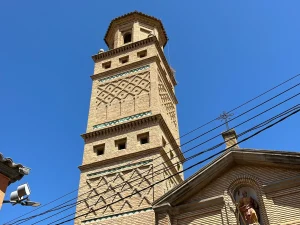
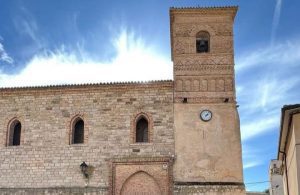
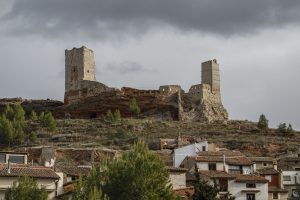
The town of Terrer was the seat of one of the most important noble families of the medieval period, the Luna family. High up, Terrer dominates the fertile plain of the river Jalón and has a Muslim castle from the 9th century. Another of the town’s significant features is the parish church of the Asunción de la Virgen, of which the original Mudejar-style tower stands out.

1. History of the town

There is a known Celtiberian settlement in the locality, which later became Roman. The ancient name of the town was Tarta. The locality is located in an area where communication routes have predominated since ancient times. The remains of the old Muslim castle from the 9th century stand on the top of a small hill. The mark of Islamic tradition can be seen in the trades related to water, an essential element in Islam, linked to the existing population of Terrer.

This point is linked to the didactic activity 1.

2. Coexistence of cultures

After the arrival of the Christians in the territory in 1120, we can say that the Mudejar period began. The Christians allowed the Muslims, previous settlers, to remain in the territory, as they were necessary to sustain the local economy. In Terrer there coexisted, on the one hand, the inhabitants of the Muslim aljama (Moorish quarter), vassals of the Lord of the castle and, on the other, the direct subjects of the king.

This point is linked to the didactic activity 2

3. Patrons

The main patrons of Mudejar art were the monarchy (kings), the Church (in the case of Aragon we even have papal patronage, in the person of Benedict XIII or Pope Luna), noble families (such as the Luna lineage) and military orders.

This point is linked to the didactic activity 4

4. Construction materials

The materials used by the Mudejars are materials that can be found in the surroundings, what we would call, of proximity. In this way, we will see how commonly used monuments and constructions are made with the same materials and construction techniques. The most common are clay, plaster, wood and alabaster.

This point is linked to the didactic activity 3

5. Mudejar architecture

The Mudejars built many types of buildings, the most important of which were fortress churches and towers. Towers have a very complex chronological and structural development. We find towers with different constructive and decorative solutions.

This point is linked to the didactic activity 7

6. Water and agriculture

Water is the most important principle of the universe according to the Koran. It is a divine symbol, since water is necessary for life. It is also present in the Muslims’ idea of their Paradise. For the Mudejars, who were also Muslims, water was fundamental. Muslims pioneered the introduction of irrigation techniques in the rural world. Some examples are waterwheels (in Terrer we have one), waterwheels, cisterns and the most common, irrigation ditches.

This point is linked to the didactic activity 6

Related Works