Circular from the rural school
The “Circular from the rural school” project is a cooperation project between rural development groups led by the Asociación Territorio Mudéjar.
The following have participated in the project: ADRI Calatayud-Aranda, ADRI Jiloca-Gallocanta, FEDIVALCA -Valdejalón and Campo de Cariñena-, ASOMO Tarazona and el Moncayo, CEDEMAR -Bajo Aragón Caspe and Ribera Baja del Ebro-, ADRAE -Ribera Alta del Ebro- and ADEFO Cinco Villas.
The objective is to develop educational materials around the Mudejar identity of the towns, placing rural schools and the educational community of the towns as the center of the project.
Based on the work developed, for almost three years, the students of fifteen schools have designed a walk through their town in which we can learn about the main points of interest and their connection with the Mudejar culture.
Maluenda
The route has been carried out following the working model of the schools that participated in the project and adapted to the locality of Maluenda.
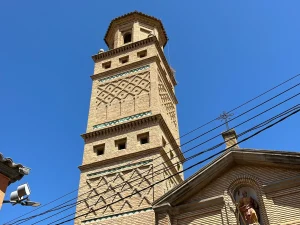
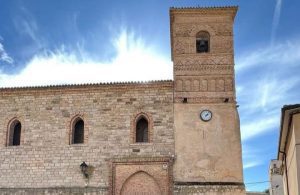
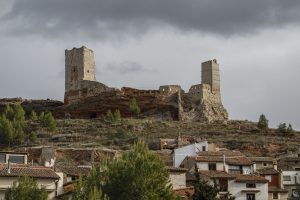
The town of Maluenda is one of the places where Mudejar architecture acquires a powerful personality of its own. Its monumental complex is made up of three imposing churches: Santa María, Santas Justa y Rufina and San Miguel. All of them have a common characteristic: the use of plaster mortar to finish their walls. Added to all this is the survival of a magnificent urban complex from the 15th century, which grows on the slopes of the hillock where the 4th century rammed-earth castle and its watchtower stand.
1. History of the town
The church of Santas Justa and Rufina is located in the upper part of the southern part of Maluenda. It was built between the second half of the 14th century and the first decade of the 15th century. The altarpiece is by Domingo Ram, of Gothic style, and is one of the best examples we have preserved. It is dedicated to Saints Justa and Rufina, two sister saints of Sevillian origin.
This point is linked to the didactic activity 1.
2. Construction materials
Another important monument in the town is the church of San Miguel, which is in a state of ruin. Here the building materials can be appreciated very well. The materials used by the Mudejars can be found in the surrounding area. In this way, we will see how commonly used monuments and constructions are made with the same materials and construction techniques. These materials are: clay, plaster, wood and alabaster.
This point is linked to the didactic activity 3
3. Importance of water and agriculture
The Arabs, when they came to the territory, brought with them fruits and vegetables from the place where they lived, being pioneers in the introduction of irrigation techniques in the rural world. Some examples are waterwheels, waterwheels, cisterns and the most common, irrigation ditches.
They also generated the idea of the agricultural landscape that we enjoy today, and which is fundamental for understanding our town. The river Jiloca flows through Maluenda.
This point is linked to the didactic activity 6
4. Coexistence of cultures
The albarrana tower is coeval with the castle, from the Islamic period. It was one of the defensive points of the town. After the arrival of the Christians to the territory in the 12th century, we can say that the Mudejar period began. The Christians allowed the Muslims, the previous settlers, to stay in the territory, as they carried out work that was in great demand at the time, including crafts, agriculture and construction.
This point is linked to the didactic activity 2
4. Mudejar Architecture
The Church of Santa María or the Church of the Assumption of Our Lady is a Mudejar building, but it has undergone a great deal of work due to the fire it suffered inside at the beginning of the 20th century, in which all the plasterwork was lost. Only the imposing alfarje at the entrance to the church was saved, where the name of the master builder, Yusaf Aldomalih, is preserved.
This point is linked to the didactic activity 5.
4. Reminiscences
Mudejar art came to an end in the 17th century, when the Moors were expelled. However, we have a style that has survived through the centuries. This is why, in several later constructions, we find elements and materials that remind us of the Mudéjar style. In Maluenda we find several examples that inherit construction techniques, ornamental elements and materials from the Mudejar style.
This point is linked to the didactic activity 7