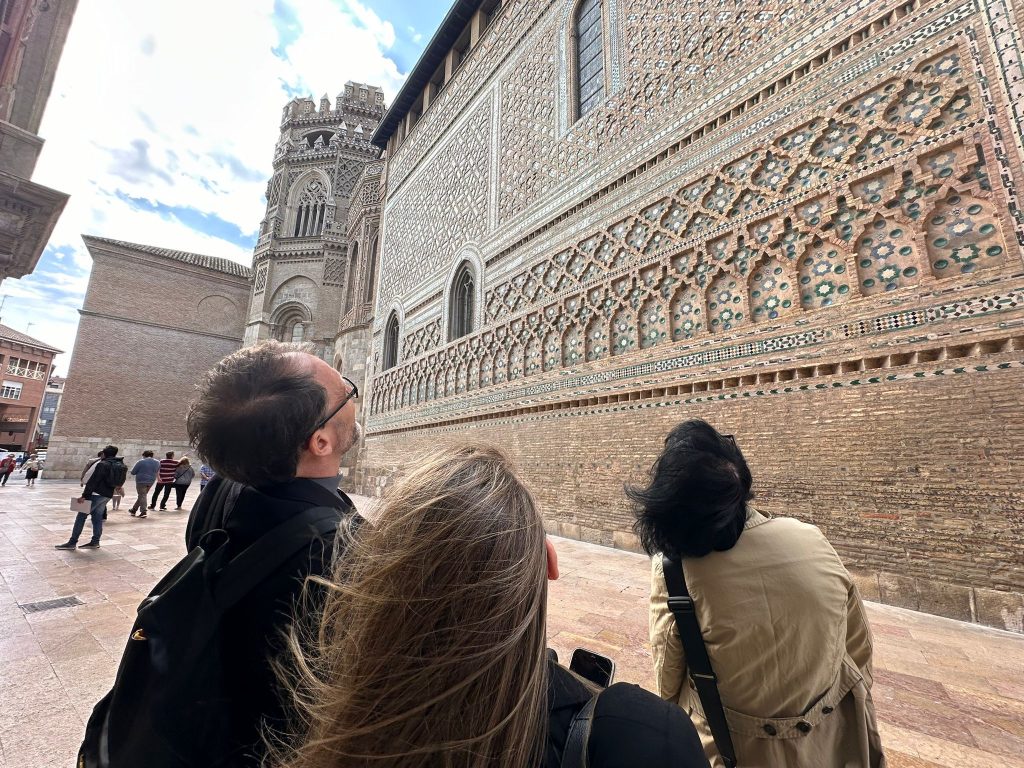
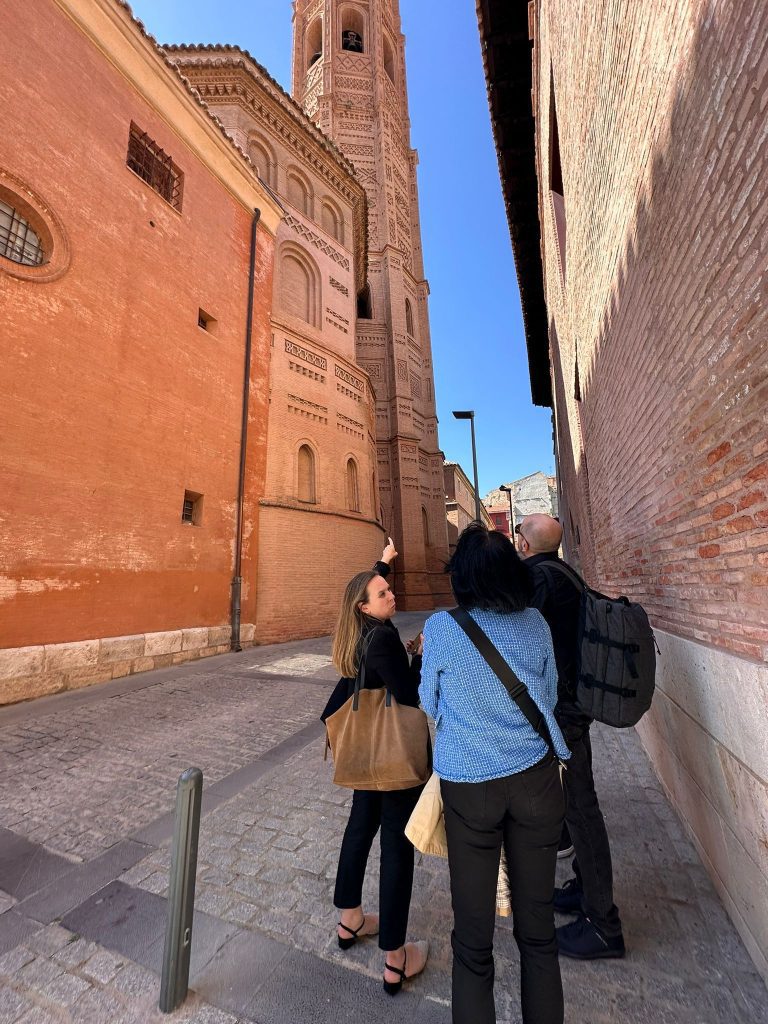
Territorio Mudéjar is once again a training territory. Once again this year, we are participating in the Desafío and UNITA internship programmes of the Diputación de Zaragoza and the University of Zaragoza, which allow us to train university students and recent graduates with internships in rural areas.
Four young people – Maria, Ruben Ester and Carmen Fatima – are already installed and will work in all the partner localities. Here they will be trained in key areas of the management of heritage resources in rural areas from all perspectives: data collection, financial management, dissemination… In addition, they will carry out specific work related to the special agreements of our organisation with Ricla, Fuentes de Ebro and San Mateo de Gállego.
In this first phase they will be trained in the collection of data from the partner towns in order to evaluate the infrastructures from the point of view of heritage and the services they offer. This will allow us to make progress in the preparation of a catalogue of each village in which scientific and international travellers, or those looking for à la carte experiences, can find out what is on offer.
We will be introducing you to each of them in the coming days, but here is a small preview:
María Sánchez Martín, a graduate in Art History (UZ), is currently studying for a master’s degree in cultural heritage management.
Rubén Santiago Martínez Moreno, graduate in History (UZ), master’s degree in Secondary Education. He is studying for a master’s degree in Contemporary History.
Ester Pardina Morlanes, graduate in Technical Architecture (EUPLA-UZ), Master’s degree in cooperation for development, university expert in intangible cultural heritage in Spain and Latin America, Master’s degree in geographic information technologies for land use planning. She is currently studying for a master’s degree in cultural heritage management.
Carmen Fatima Marino, graduate in Modern Languages and Cultures, languages for business (University of Pavia, Italy). She is studying for a Master’s degree in foreign languages for international communication (University of Turin).
Territorio Mudéjar travels to Antequera (Málaga) to attend the 18th Meeting of World Heritage Managers. The director of Territorio Mudéjar, Victoria Trasobares, participates in this technical forum that the Ministry of Culture organises annually to promote the meeting, analysis and discussion of the problems that managers of sites inscribed on the World Heritage List encounter on a daily basis.
Its aim is to improve the conservation of these assets and to create a network of contacts between all the managers working on these assets, in order to share experiences, address challenges and find common solutions.
The meeting will be held until 26 June with activities both in the Museum of the City of Antequera and in the headquarters of the Royal Academy of Noble Arts, as well as in Antequera Town Hall, where the official reception was held this afternoon.
The meeting was opened by the Mayor of Antequera, Manolo Barón; the Deputy Mayor for Tourism and World Heritage, Ana Cebrián; the Councillor for Culture and Heritage, José Medina; the Deputy Director General for the Management and Coordination of Cultural Heritage, María Agúndez; Miriam Ugarte, from the UNESCO Conventions Department of the Ministry of Culture; Carmen Mora, Director of the Dólmenes de Antequera Archaeological Site; Alicia Castillo, lecturer at the Complutense University of Madrid;
During their stay, participants have the opportunity to visit the main monuments of the city such as the Dolmens, the Torcal, the Alcazaba and the Royal Collegiate Church of Santa Maria.
In total, more than 70 World Heritage managers are sharing experiences in this XVIII Meeting of World Heritage Managers in Antequera.
In the first workshop on social participation and world heritage we exchanged ideas on how to work on the uses of the space between the dolmens and the polygon.
We continued with a visit to the Museo de la Ciudad (MVCA), the Museo Sitio Dólmenes de Antequera and the Alcazaba.
The World Heritage Managers Meeting ended after a session on the evaluation of visitors to the Antequera Dolmens World Heritage Site and the presentation of the conclusions on social participation as the key to a management focused on people, on the inhabitants of the heritage.
On the last day, the director of Territorio Mudéjar, Victoria Trasobares, participated as coordinator of the working group “Dolmen Museum, inhabitants and visitors. Analysis and diagnosis of needs” together with the directors and managers of the sites: Menorca Talayotica (Consell de Menorca), Colonia Guell (Consortium), Risco Caido and the sacred mountains of Gran Canaria and the Historic Sanctuary of Machu Pichu in Cuzco (Peru).
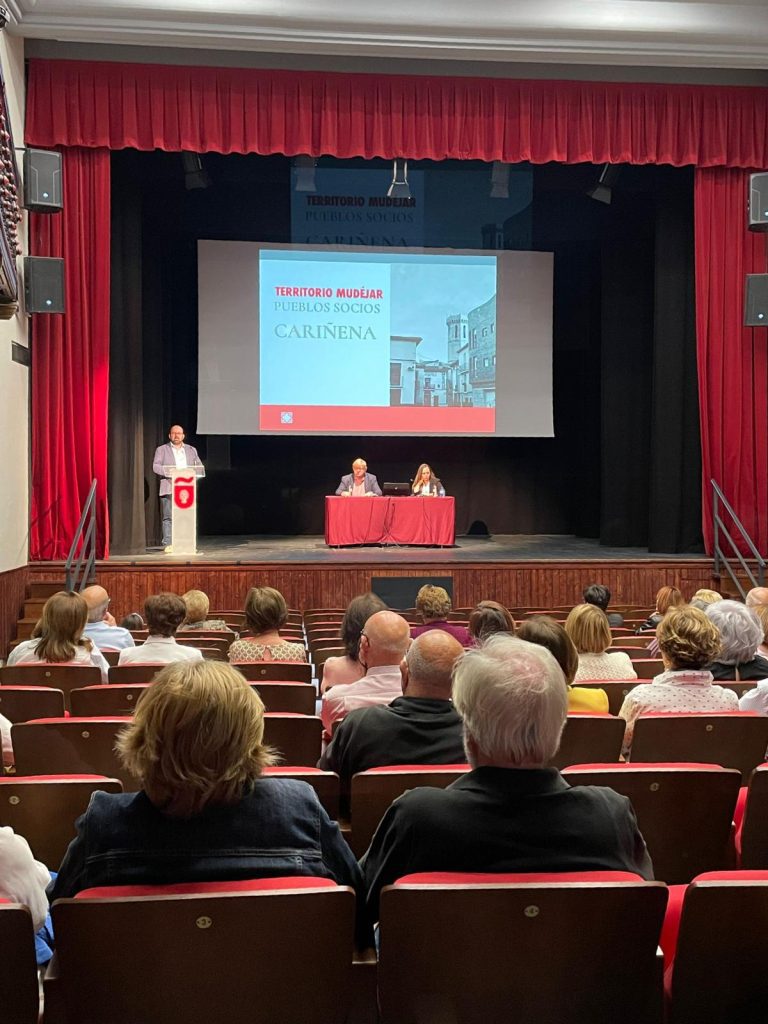
Territorio Mudéjar presented this Tuesday in Cariñena the exhibition “Territorio Mudéjar. The guide”. The exhibition can be seen in the Santo Cristo del Santo Cristo chapel until 30 June from 9.00 to 13.00 from Monday to Sunday. The inauguration included a guided tour of the exhibition and coincided with the conference given by Victoria Trasobares at the closing of the Universidad Popular course on the role of Cariñena in the Territorio Mudéjar network. This was held in the Olimpia Theatre in the town. The activity was presented by the mayor of Cariñena, Sergio Ortiz, and the teacher in charge of the history course, José Luis Begué.
Territorio Mudéjar is taking part for the sixth year in the ARATUR tourism fair in Argon and we are doing so with our heritage projects developed with our partner town councils.
Our stand will once again become a space to show what Mudejar is through the monuments, town planning, houses, landscape, trades and services of each locality.
In our stand you can make ‘visits to the Mudejar’ with historical-artistic explanations of the localities (each one in a schedule) and also of the projects that we develop there, such as the routes or the projects on route, among others.
At the end of each presentation, participants can take part in a draw for three trips to one or two partner locations.
During the fair, our stand was visited by the Minister for the Environment and Tourism, Manuel Blasco; the Director General of Tourism, Jorge Moncada; the Deputy for Tourism of the DPZ, Cristina Palacín; the Councillor for Culture and Tourism of Zaragoza City Council, Sara Fernández; the Member of the Aragonese Parliament, Leticia Soria; the Councillor of Zaragoza City Council, Armando Martínez, and Manuel Teruel, President of the Zaragoza Trade Fair, among others.
We were also visited by @huescalamagia @Livehuesca @Megustazaragoza @Franlujanzgz @Zaragozaguia
Timetable for guided tours of our stand:
SATURDAY 25 MAY
11:30. Route 4: Mestizo and frontier: Mudejar villages
Guided tour’ through Fuentes de Ebro and Rodén, Velilla de Ebro, Gelsa and Quinto with its Mummy Museum.
12:15 h. Route 5: Keys to a style, the origins. Mudejar in Illueca, Villarroya de la Sierra and Torralba de Ribota.
13:00 h. Route 6: Keys to a style, the origins. Mudejar in Zuera, Magallón and Tauste.
SUNDAY 26 MAY
11:30 Route 10: A bird’s eye view of the towers
Mudejar in Romanos, Villarreal de Huerva, Mainar, Herrera de los Navarros and Villar de los Navarros.
12:15 Route 11: A bird’s eye view of the towers
Mudejar in Utebo, Villamayor de Gállego and Muel.
13:00 Route 12: The construction of space. Light and matter
Mudejar art in Maluenda, Morata de Jiloca and Acered.
17:00 Route 13: The construction of space. Light and matter
Mudejar in Borja, Castejón de Valdejasa and San Mateo de Gállego.
17:30 h. Route 1: Mestizo and frontier: Mudejar villages
Territorio Mudéjar has completed the first phase of the preliminary studies for the drafting of the management plan for the Mudejar architecture of Aragon as a UNESCO World Heritage Site. In this phase of the project, which is funded by the Ministry of Culture*, working groups have been held with the different stakeholders, field visits and working meetings with a full list of collaborators.
Territorio Mudéjar is responsible for the development and drafting of the study and diagnostic work necessary for the drafting of the Management Plan for the Mudéjar Architecture of Aragon property. The aim is to have an instrument that will enable all areas of management to be addressed in a comprehensive, sustainable and effective manner: protection, preservation, research, dissemination and territorial and social impact.
The work of Territorio Mudéjar has included the creation of working groups by areas of work that have enabled the analysis, diagnosis and drafting of preliminary documents to compose the management plan.
In this sense, the organisation has held a round of meetings with the different actors involved: managers, town councils and competent administrations.
As an example, an initial meeting-visit was held at the beginning of February in the church of San Pablo (Zaragoza), followed by another analysis and diagnosis visit. In these meetings, the parish and Sergio García, head of management, collaborated.
Two meetings were held in La Seo: an initial working group and a diagnostic one, in which Daniel Granada, canon of La Seo and of the Cabildo and parish priest of La Seo, took part.
In Calatayud, the meetings were held with José Manuel Gimeno as representative of the City Council and with Salvador Esteras, technical expert.
In Cervera de la Cañada there have been meetings with the town and parish councils. In addition.
In the case of Tobed, work has been carried out with the Town Council’s management team through the Mahoma Calahorrí Museum.
There has also been a meeting with the Directorate General for Patrimony and a round table with the heads of service of this directorate.
In April, a European visit-meeting was organised in Calatayud, Tobed and Cervera de la Cañada with a team from the University of Zaragoza, the Politecnico di Torino and the Politecnico di Milano.
In addition, there have been meetings with ZaragozaCity Council, the Diocese of Tarazona and the different interlocutors of the Administration.
There have also been technical visits. For example, one of them, held in April, was attended by participants at European level, specifically from the Politecnico di Torino.
In addition, some of the issues diagnosed and worked on during these months were presented at the technical conference of the Alliance of Cultural Landscapes and Related Places held on 25 and 26 April in Tobed, Cervera de la Cañada and Calatayud. This issue was presented as part of the knowledge of the host property.
LIST OF COLLABORATORS:
During this first phase of the project , the collaboration of:
Area of collaboration: State of the art in terms of research.
Esteban Sarasa Sánchez. PhD in Philosophy and Letters (History) from the University of Zaragoza, professor emeritus and director of the J. Zurita Chair of History at the Fernando el Católico Institution in Zaragoza.
Mar Vals Fusté. PhD in History from the Rovira i Virgili University and researcher on the Territorio Mudéjar project “Reading the Mudejar: Arabic inscriptions in medieval Aragonese churches (13th-15th centuries). Based on this stay and her speciality in Art History from the inscriptions, she has collaborated in approaching the monument as a document.
Ascensión Hernández. Professor in the Department of Art History at the University of Zaragoza. She has collaborated on the state of the question of the authenticity criticism of buildings declared World Heritage, taking as a reference the work carried out on the parish church of La Seo a few years ago.
Luis Alberto Longares. PhD in Geography and lecturer in the Department of Geography and Territorial Planning at the University of Zaragoza. The area of collaboration has been the palaeoenvironmental evolution of the landscape and its knowledge for a correct management of the environment.
José Castillo Ruiz. Professor of Art History at the University of Granada. He contributes from the point of view of agrarian heritage, that is, how people have intervened in the landscape in which the monuments declared World Heritage by UNESCO are contextualised.
Area of collaboration: building management
Daniel Granada, secretary of the Cabildo de La Seo and parish priest of the parish of La Seo, and Sergio Blanco, heritage delegate of the Diocese of Zaragoza and manager at San Pablo.
Jesús Vicente Bueno, abbot of the Collegiate Church of Calatayud and heritage delegate of the Diocese of Tarazona.
Pedro Luis Hernando, professor of art history at the University of Zaragoza in Teruel and heritage delegate of the Diocese of Teruel-Albarracín.
Victoria Trasobares Ruiz, Director of Territorio Mudéjar and art historian. Manager of Tobed Mudéjar.
Working groups were held with them to analyse and diagnose aspects to be taken into account for the diagnosis of management, the state of conservation, the state of research, signposting and dissemination.
Area of collaboration: Dissemination
Irene Ruiz Bazán, professor at the Politecnico di Torino; Gianluca Vita, professor at the Fine Arts Academy of Urbino in the Department of Applied Heritage Technologies, have collaborated on digitisation strategies applied to diagnosis, dissemination and communication.
Patricia Ciria. Multimedia journalist specialising in strategic communication and marketing. She has collaborated in the diagnosis of communication, audience analysis, positioning and strategic lines of communication.
Estudio Mique. Graphic design studio specialising in branding, logos, labels, packaging, advertising and communication. He has collaborated in the analysis of branding and signage analysis of the Mudejar architecture of Aragon.
* This project of Territorio Mudéjar has been selected in the 2023 call for grants for projects for the conservation and dissemination of World Heritage properties of the Ministry of Culture and Sport. Territorio Mudéjar is thus part of a group of more than 20 Spanish organisations working to promote and improve the application of the World Heritage Convention and its guidelines. These grants are financed by the Ministry of Culture and aim to promote the development of projects for the management, protection and conservation of these assets, as well as to promote their accessibility, visibility and dissemination at national and international level.
This Thursday we successfully opened the exhibition: “Mudejar: the guide” in Utebo. Eugenia Gallego also guided us on a mini urban tour of the palatial houses in the historic centre of Utebo.
The exhibition can be seen from 2 to 9 May and from 16 to 23 May at the Mariano Mesonada Centre.
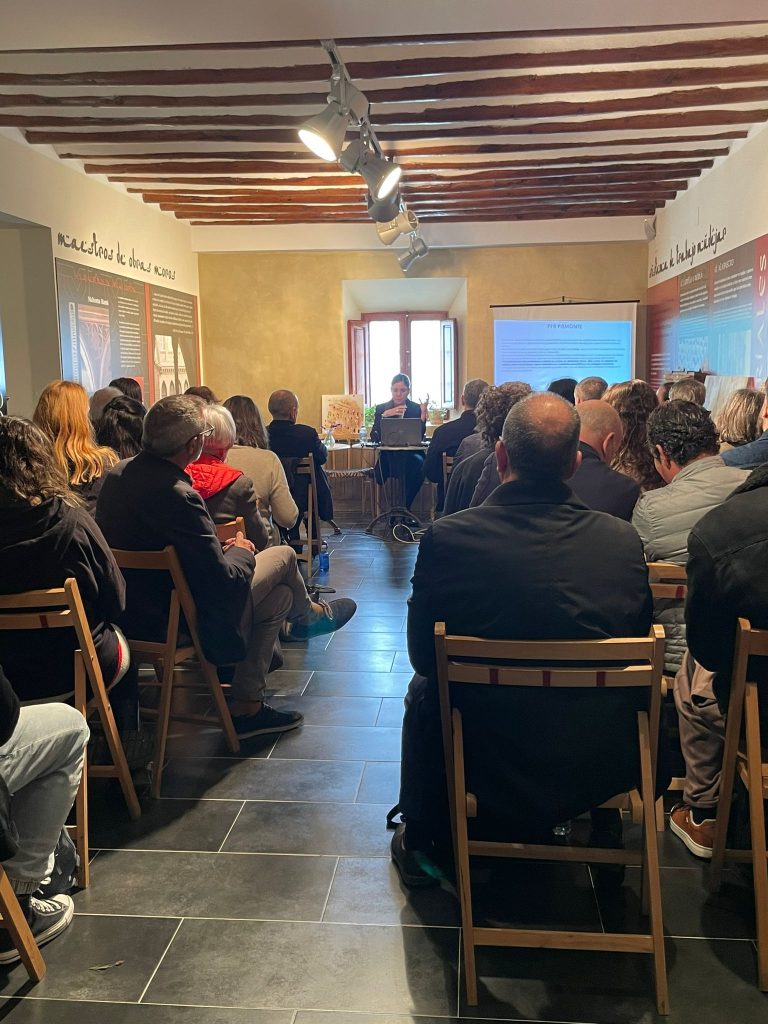
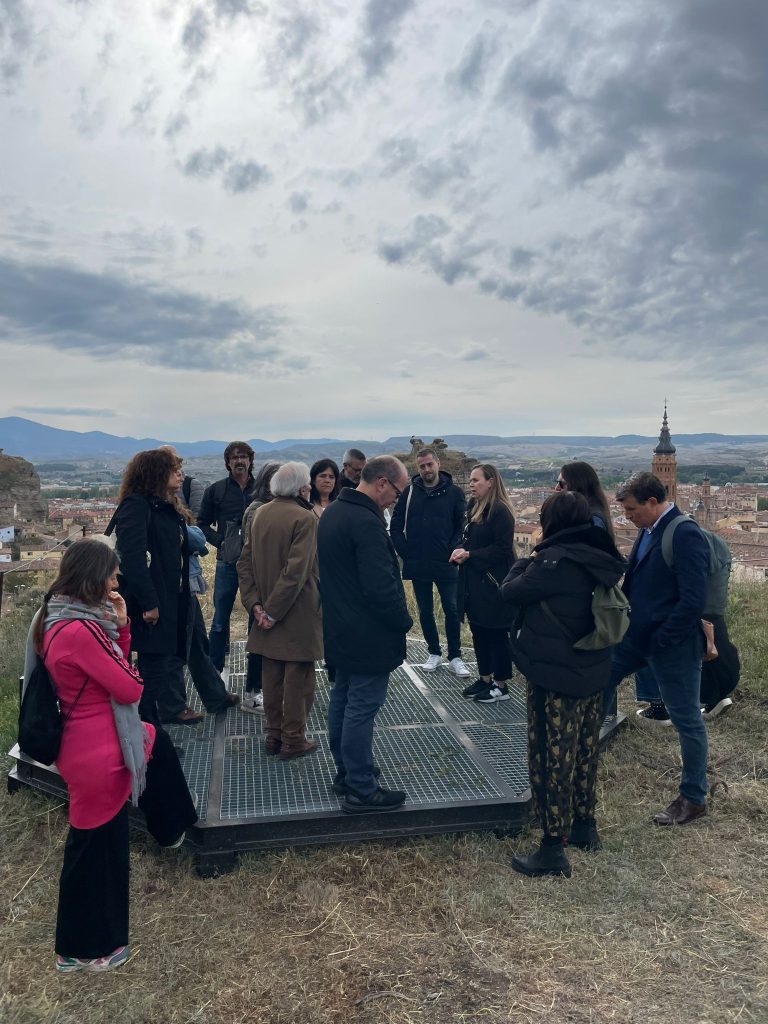
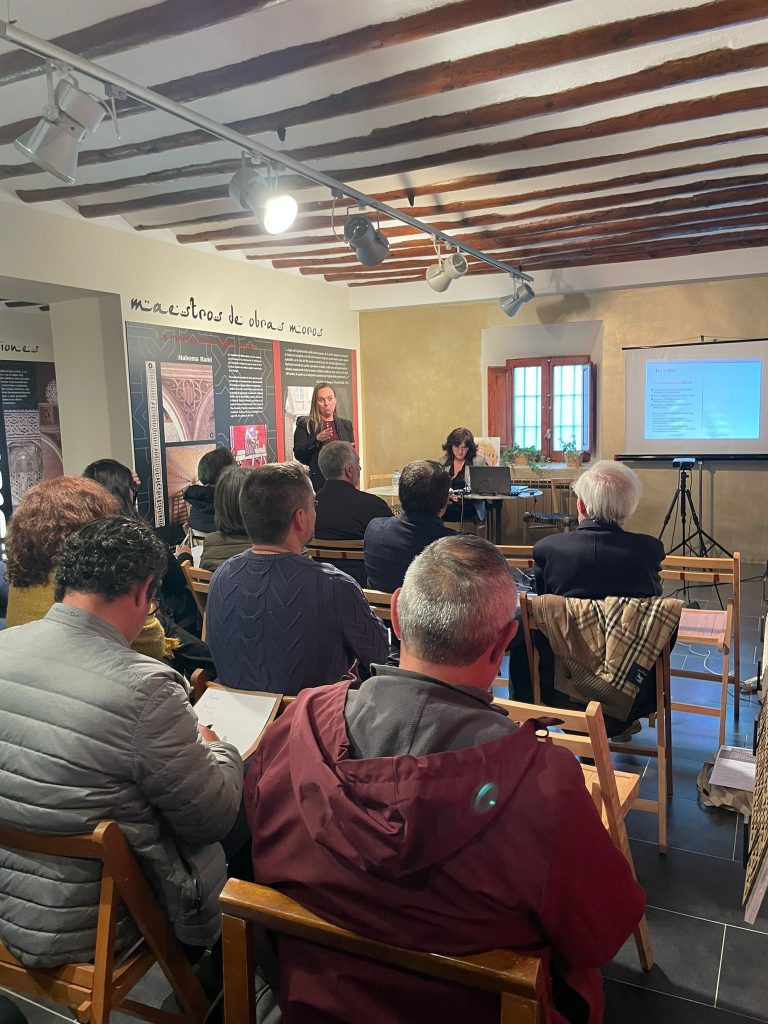
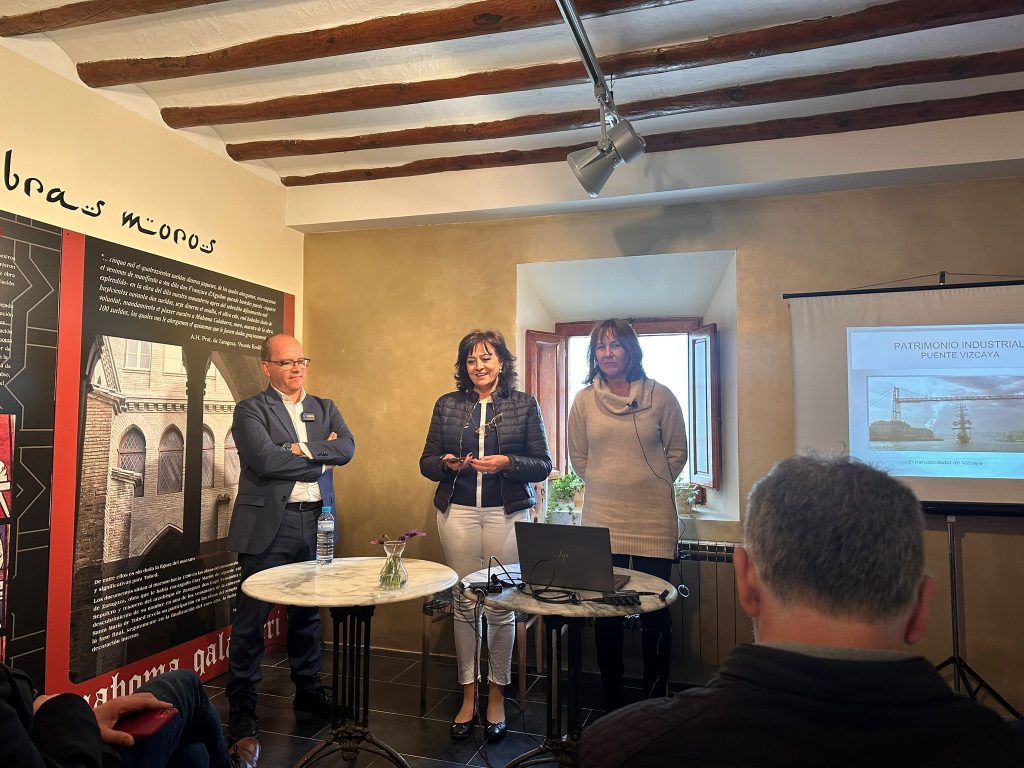
The Alliance of Cultural Landscapes and Related World Heritage Sites has held its biannual assembly in several towns of Territorio Mudéjar: Calatayud, Cervera de la Cañada and Tobed. The assembly included a technical conference for members organised around the theme “Cultural landscape and management plans for UNESCO World Heritage sites”, which was attended by speakers and members from Spain, Andorra, Portugal and Italy. On this occasion, Territorio Mudéjar organised a European meeting-visit in Calatayud, Tobed and Cervera de la Cañada with a team from the University of Zaragoza, the Politecnico di Torino and the Politecnico di Milano, which has served to advance the preliminary study for the drafting of a management plan for the Mudéjar Architecture of Aragon.
* This project of Territorio Mudéjar has been selected in the 2023 call for grants for projects for the conservation and dissemination of World Heritage properties of the Ministry of Culture and Sport. Territorio Mudéjar is thus part of a group of more than 20 Spanish organisations working to promote and improve the application of the World Heritage Convention and its guidelines. These grants are financed by the Ministry of Culture and aim to promote the development of projects for the management, protection and conservation of these assets, as well as to promote their accessibility, visibility and dissemination at national and international level.
Territorio Mudéjar and the Alliance of Cultural Landscapes and Related World Heritage Sites are holding their biannual assembly on 25 and 26 April in Calatayud, Tobed, Cervera de la Cañada and Zaragoza. The meeting, entitled “Cultural Landscape and Management Plans for UNESCO World Heritage Sites ” will be attended by speakers from Spain and Italy.
The Alliance, which brings together World Heritage properties in the categories of landscapes and sites or monuments, aims to serve as a link between landscapes and sites to share experiences, seek solutions to various common problems, train their technicians in specific areas and obtain resources to develop joint activities. Specifically, the following are part of the Alliance: the Cultural Landscape of Aranjuez, Ibiza-Biodiversity and Culture, the Cultural Landscape of the Sierra de la Tramuntana, the city of Sintra, the Palm Grove of Elche, the Alhambra and the Generalife, the Cultural Landscape of Las Médulas and the Hercules Lighthouse in A Coruña.
The meeting will begin on Thursday 25th with a study visit to Calatayud, the church of Santa Tecla in Cervera de la Cañada and the church of the Virgin of Tobed, monuments declared UNESCO World Heritage Sites.
In the afternoon, the technical sessions will begin at the Mudéjar Museum of Tobed, with the participation of experts from Icomos Spain, Complutense University of Madrid, Andalusian Heritage Institute, Landscape Observatory of Catalonia, University of Zaragoza, and Territorio Mudéjar (both from the direction and with the experiences of the artistic residencies).
On Friday, the talks will continue with specialists from the IPH-Heritage and Humanities Institute, the University of Granada, the Politecnico di Torino and the Landscape Alliance.
Victoria Trasobares, director of Territorio Mudéjar, highlighted the essential work to reconnect the monument with its context, especially that of the inhabitants of the villages. And she recalled that the priority objective is to ensure not only the conservation of the identity and uniqueness of the territories, but also to address the immediate future, in the medium term, the innovative and sustainable management of the villages.
It should be remembered that the General Assembly of the Alliance of Cultural Landscapes and Related World Heritage Sites approved in November in A Coruña the inclusion of Territorio Mudéjar as a new member.
Inclusion in the Alliance allows Territorio Mudéjar to participate jointly in national and international fairs, to seek funding for joint projects, to disseminate its activities among the other partners and to hold technical conferences to address challenges, opportunities and analysis of common problems.
The last technical conferences of the Landscape Alliance were held in November under the title ‘Landscapes and Sites. Participate to coexist’ and were organised by the Tower of Hercules and the Alliance of Landscapes and Related World Heritage Sites, with the support of the City Council of A Coruña and the Tourism and Congress Consortium. The Ministry of Culture and Sport and the Provincial Council of A Coruña also collaborated. The event addressed the role of society in the conservation of World Heritage landscapes and sites, inviting reflection on the participation of institutions, communities and associations to protect and enhance these places.
This assembly includes a technical conference for partners organised around the theme “Cultural landscape and management plans for UNESCO World Heritage Sites”, which will be attended by speakers and partners from Spain, Andorra, Portugal and Italy. On this occasion, Territorio Mudéjar organised a European visit-meeting in Calatayud, Tobed and Cervera de la Cañada with a team from the University of Zaragoza, the Politecnico di Torino and the Politecnico di Milano. This meeting served to present and reflect on the preliminary study for the elaboration of the management plan for Mudejar Architecture in Aragon.
* This project of Territorio Mudéjar has been selected in the 2023 call for grants for projects for the conservation and dissemination of World Heritage properties of the Ministry of Culture and Sport. Territorio Mudéjar is thus part of a group of more than 20 Spanish organisations working to promote and improve the application of the World Heritage Convention and its guidelines. These grants are financed by the Ministry of Culture and aim to promote the development of projects for the management, protection and conservation of these assets, as well as to promote their accessibility, visibility and dissemination at national and international level.
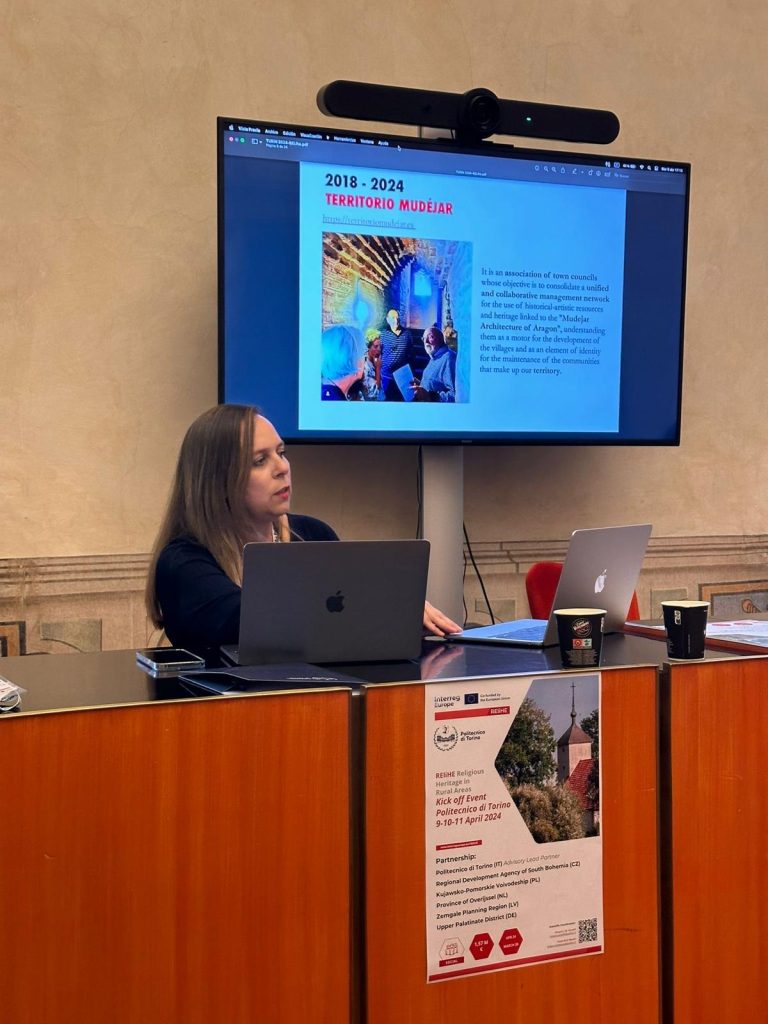
The director of Territorio Mudéjar, Victoria Trasobares, participated from 9 to 11 April in Turin (Italy) in the European technical meeting for the study of management plans:Religious Heritage in Rural Areas (REliHE Interreg Europe Project). There, different European models were studied that can contribute to the preliminary study for the elaboration of the management plan for Mudejar Architecture in Aragon*.
Participating in the kick off event on behalf of the Politecnico di Torino are: Silvia Barbero, Francesco Novelli, Enrica Asselle, Roberto Caterino, Giulia Assalve, Riccardo Rudiero, Silvia Beltramo and Riccardo Palma. On behalf of Territorio Mudéjar, its director Victoria Trasobares is taking part.
At this meeting, a tour of the city was held, in which examples of new uses of religious buildings were studied and, among other places, the Castello di San Valentino and the headquarters of the Politecnico were visited.
* This project of Territorio Mudéjar has been selected in the 2023 call for grants for projects for the conservation and dissemination of World Heritage properties of the Ministry of Culture and Sport. Territorio Mudéjar is thus part of a group of more than 20 Spanish organisations working to promote and improve the application of the World Heritage Convention and its guidelines. These grants are financed by the Ministry of Culture and aim to promote the development of projects for the management, protection and conservation of these assets, as well as to promote their accessibility, visibility and dissemination at national and international level.
The exhibition “Mudejar, the guide” travels this Friday to Ariza. Territorio Mudéjar will present this exhibition at 19.00 in the Palacio de los Marqueses. There will also be a guided tour.
???? It can be seen from 22nd to 24th March. ????At the Palacio de los Marqueses. ???? Friday 22nd from 19.00 to 20.30. Saturday 23rd from 12.00 to 13.30 and from 18.00 to 20.00. Sunday 24th will be open from 12.00 to 13.30.
Utilizamos cookies para asegurarte la mejor experiencia en nuestra web. Puedes consultar más detalles
Funcionales
Always active
El almacenamiento o acceso técnico es estrictamente necesario para el propósito legítimo de permitir el uso de un servicio específico explícitamente solicitado por el abonado o usuario, o con el único propósito de llevar a cabo la transmisión de una comunicación a través de una red de comunicaciones electrónicas.
Preferencias
El almacenamiento o acceso técnico es necesario para la finalidad legítima de almacenar preferencias no solicitadas por el abonado o usuario.
Estadísticas
El almacenamiento o acceso técnico que es utilizado exclusivamente con fines estadísticos.El almacenamiento o acceso técnico que se utiliza exclusivamente con fines estadísticos anónimos. Sin un requerimiento, el cumplimiento voluntario por parte de tu Proveedor de servicios de Internet, o los registros adicionales de un tercero, la información almacenada o recuperada sólo para este propósito no se puede utilizar para identificarte.
Marketing
El almacenamiento o acceso técnico es necesario para crear perfiles de usuario para enviar publicidad, o para rastrear al usuario en una web o en varias web con fines de marketing similares.