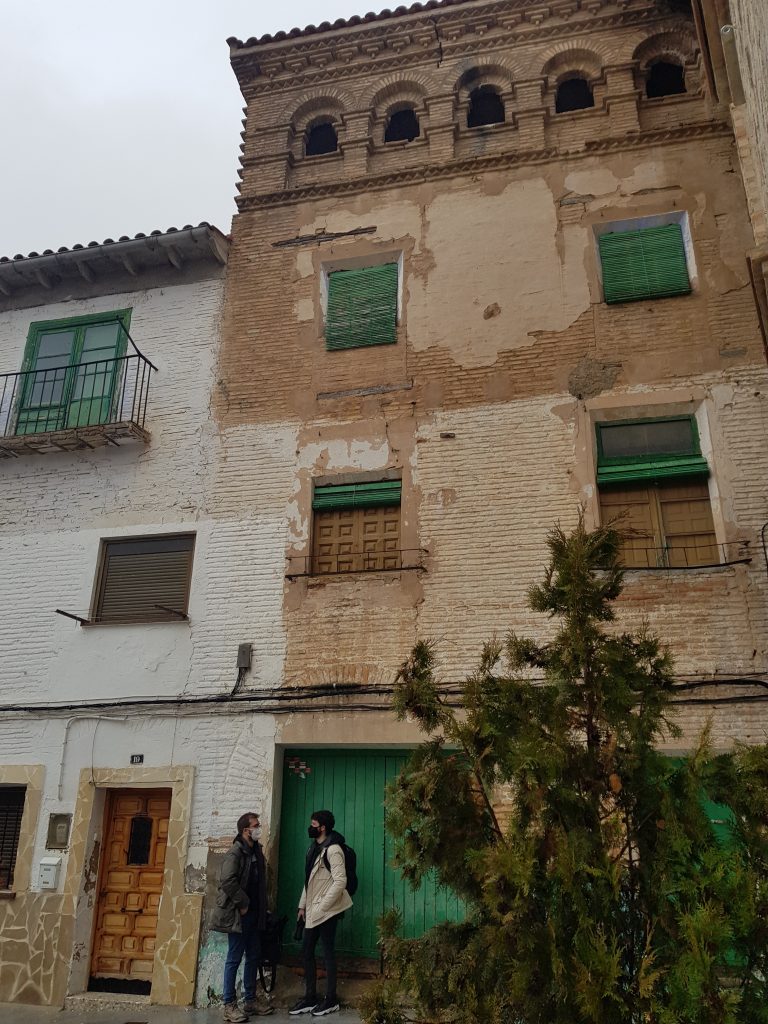
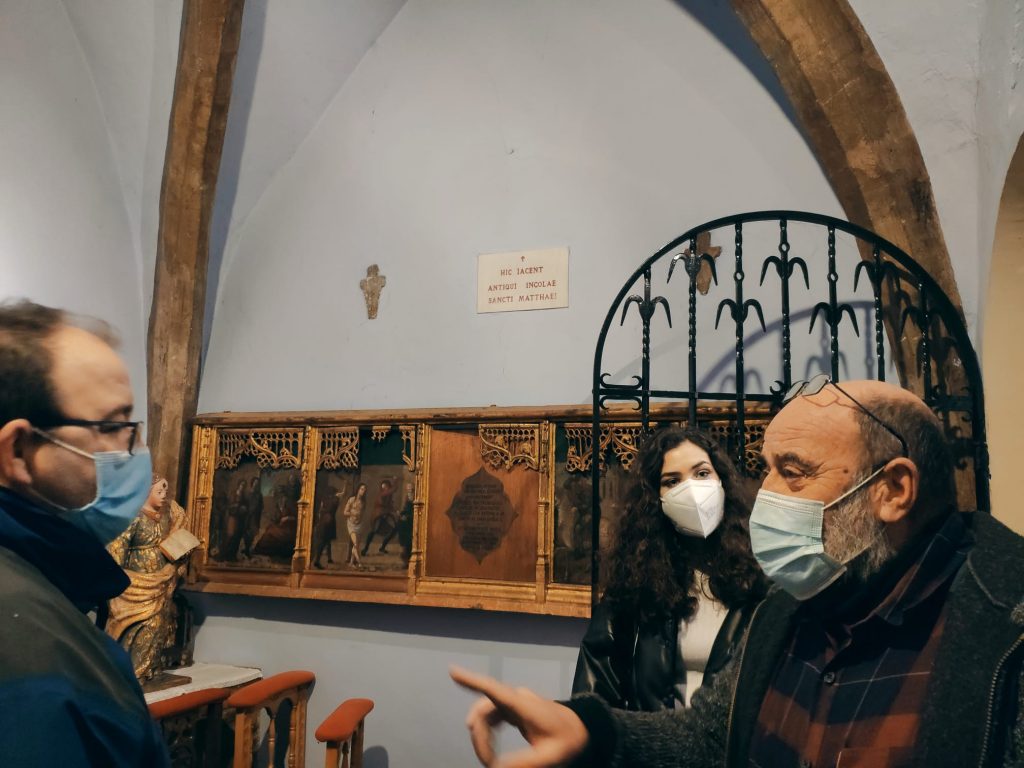
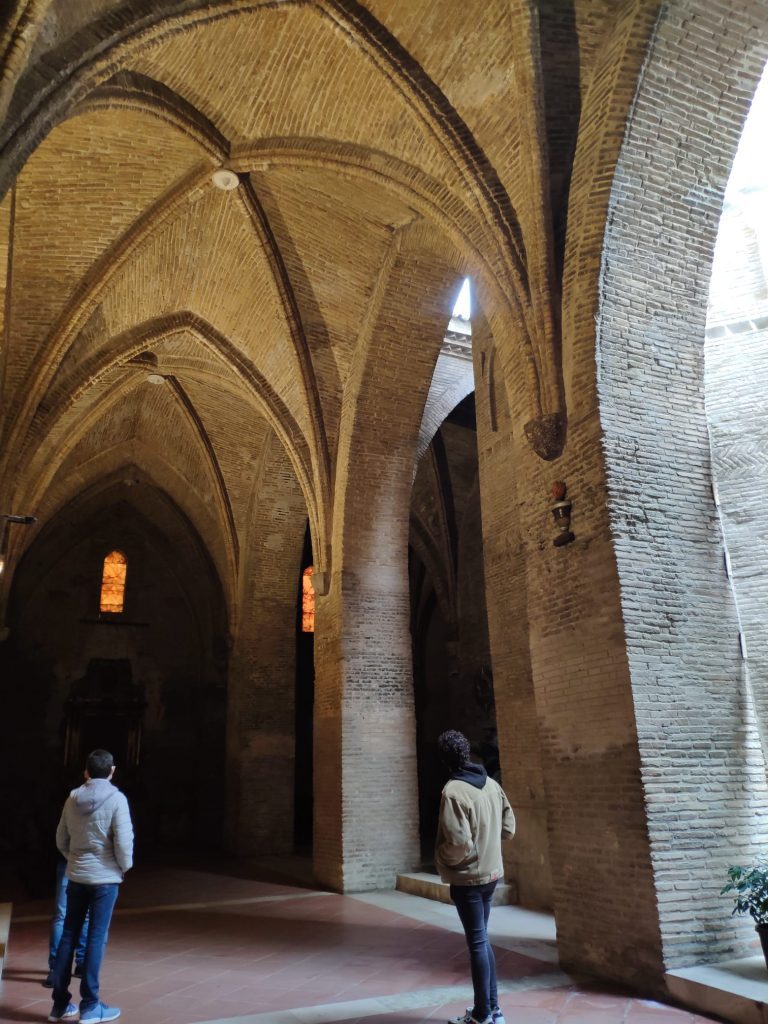
With the slogan “The future of museums: recovering and reimagining”, today Territorio Mudéjar joins the celebration of International Museum Day 2021.
The aim this year is to invite museums, their professionals and communities to create, imagine and share new practices of (co)creation of value, new business models for cultural institutions and innovative solutions to the social, economic and environmental challenges of today.
This commemoration was created in 1977 by the International Council of Museums (ICOM) to raise public awareness of what these centres contribute to the development of society.
We share with you the videos about some of the museums of our Territorio Mudéjar:
Territorio Mudéjar offers internships for students of the Art History Degree, the Master’s Degree in Cultural Heritage Management, Communication and
Geography and Territorial Planning thanks to the Challenge Programme, popularly known as ‘rural Erasmus’, financed by the Council of Zaragoza and
managed by the University of Zaragoza. This initiative aims to improve the learning and personal development of students, to facilitate that talent arrives and stays in rural areas and to implement policies and develop projects from a new perspective based on innovation and cooperation between institutions.
This is the third call in which we participate. “We work on projects focused on professional profiles linked to eritage in a transversal way. In other words, they are not only open to the humanities, but also cover other fields such as communication, architecture, engineering, education…”, explained the director of Territorio Mudéjar, Victoria Trasobares.
WHEN WILL THE INTERNSHIPS TAKE PLACE? From 15 July to 15 December 2021.
WHERE? The internships will take place in Tobed, the headquarters of Territorio Mudéjar, three days a week to be determined from 10.00 to 14.00, and two days
in the partner villages where they are assigned to carry out the tasks from 11.00
to 14.00.
HOW ARE THEY ORGANISED?
•The internships begin with a preparatory course of 40 hours of introduction to the management of historical-artistic monuments: strategy, conservation, accessibility, dissemination, etc.
• It continues with an applied project of 20 hours per week.
PURPOSES
• Participation in the pilot project “Territorio Mudéjar 20th anniversary World Heritage”.
• The student will learn to be responsible for the tasks involved in managing the accessibility and dissemination of different historical-artistic monuments linked to Territorio Mudéjar.
• Preparation of spatial itineraries, complementary dissemination activities, administrative management of materials necessary for the development of the
cultural information activity, economic management of activities, preparation of reports and quality control of the activity.
REQUIREMENTS
• Students enrolled in the 19/20 academic year, with 90 credits passed for undergraduate students (enrolment at https://universa.unizar.es/inscripcion-online/) or graduates in the last three years.
• Areas: Degree in Art History, History; Master’s Degree in Cultural Heritage Management, Master’s Degree in Advanced Studies in Art History, Master’s Degree in Territorial Planning and Environment.
• Knowledge of Mudejar art, Aragonese art, Islamic art, medieval art and architecture. Management and dissemination of cultural heritage or similar.
• Driving licence and available vehicle (important).
• Languages: English and/or French (desirable but not essential).
Territorio Mudéjar has launched this April, on the occasion of the Book Day, an initiative to deepen the learning of Mudejar culture through a compilation of bibliography on Mudejarism. Over the coming months, Territorio Mudéjar will publish a weekly bibliographical recommendation on the social networks that will serve as a tool for learning, research and dissemination. The list will also be updated on this website.
The first issue was “Arte mudéjar aragonés” (Aragonese Mudejar art) by José Galiay Sarañana, published in 2002 by the Institución Fernando el Católico. This work is a facsimile reproduction of Galiay’s 1950 edition and is edited by Gonzalo M. Borrás Gualis and Ricardo Centellas Salamero, who also wrote the prefaces to it.
In the first pages, Centellas writes about the Arabised Spaniards, Mudejars of the 20th century, and deals with the figure of José Galiay “between regenerationism and academic erudition”. For his part, Borrás provides a context for Mudejar historiography, both Spanish and Aragonese, so that the scholar has some elements of judgement to evaluate the book.
In Galiay’s facsimile we find details on the Christian Reconquest; the characteristics of Mudejar art; the particularities of the Aragonese branch; names of artists and dates of Mudejar works; architectural classification; ceramics as a decorative element; interior decoration of monuments; Mudejar wood; Mudejar art in bookbinding.
Facsimile reproduction of the book available here.
The second key work chosen to understand Mudejarism in our region was “El arte mudéjar aragonés” (Aragonese Mudejar art) by Gonzalo M. Borrás Gualis. Published by Guara Editorial and with drawings by Vicente González Hernández. This is an interpretative essay on Aragonese Mudejar art that includes in its essential lines the contribution of previous research, in some cases fundamental, such as that of Leopoldo Torres Balbás, Francisco Iñiguez Almech and Fernando Chueca Goitia, for example, as well as that of José Galiay. Moreover, it constantly points out aspects to be explored, seeking to serve as a spur and stimulus for new and long-awaited studies.
The book begins with a chapter on the Aragonese Mudejar in the context of the Hispanic Mudejar, continues with an analysis of Mudejar art and society (population, social status, master builders…), continues with an artistic characterisation of the Mudejar and deals with other topics such as religious Mudejar architecture, bell towers and Mudejar carpentry.
This week, the team and groups that make up the project “Rural school in motion” met in order to evaluate the results of the training course for rural school teachers that finished on March 22nd. The initiative has been a success in terms of participation and has allowed us to collect proposals for strategic lines to introduce the Mudejar heritage identity in schools beyond the artistic subjects.
This initiative has been made possible thanks to the teachers who have participated in this project and to the general directorate of education of the Government of Aragon through the Teacher Training programmes.The Government of Aragon,
which has given us support for the first action of the project at the Centro de Profesorado María de Ávila with the magnificent coordination of Minerva Salanova Muñoz.
We are still working to develop more actions within this initiative, which we will be detailing, among them: conferences for families and local agents and group visits.
“Rural school in motion” is a cooperation project between rural development groups coordinated by the ADRI Calatayud-Aranda group, together with Cedemar, Adefo Cinco Villas, Asomo Moncayo, Adrae Comarca Alta del Ebro, Fedivalca y Adri Jiloca Gallocanta, and financed by the Government of Aragon through the Leader programme and the Provincial Council of Zaragoza through the Territorio Mudéjar association, as a private collaborating entity that manages the implementation and execution of the initiative.
The pedagogical nature and the use of new technologies in the field of heritage management were the focus of the third interregional meeting of the European project MOMAr (IEEE3 From theory to practice.Experimental Models of Management Tested) in which we have participated this week as an attending “stakeholder”.
This event has allowed us to learn and be inspired by the initiatives that are being carried out in the field of Management of Singular Rural Heritage in all the countries participating in the project. This meeting has also allowed the use of cultural and natural spaces for the direct benefit and enjoyment of the population.
Thus, the Daroca Town Hall announced the International Early Music Festival, which, with almost half a century of history, has become a world reference. Both training courses and concerts are attended every year by hundreds of professionals and lovers of early music from all over the world. It is a meeting that brings together the immense local architectural and historical heritage with international art and culture. The festival’s director, Javier Artigas, took the opportunity to confirm that this year’s edition will take place from 3 to 10 August. The broadcast of this experience was made from the church of San Miguel.
Territorio Mudéjar continues with its routes.In January we offered a first panoramic approach in the magazine La magia de viajar por Aragón (The magic of travelling in Aragon); in this new issue, the “Mestizo Land and borderland” route takes us to visit the places where the Christian, Jewish and Muslim cultures developed in an extraordinary and lasting way.
We will be able to understand how this period of cultural fusion is still clearly reflected today in urbanism, the country houses and monuments of these villages that played an important role in the Aragonese territory during the 12th and 13th centuries.
We will discover it in the Jewish, Moorish and Christian quarters of large urban centres such as Calatayud, Daroca and Borja, as well as in more rural towns such as Villafeliche, Mesones de Isuela, Torrellas, Magallón and Tauste.
We invite you to take a leisurely stroll and a fresh look to recognise the vestiges of this rich coexistence of cultures, to understand their evolution, ways of life, trades and traditions, and to understand their historical importance and their reflection in the present day.
Nearly 50 teachers participate in the course “Rural school in motion” (Circular desde la escuela rural) to promote Mudejar identity and rural rootedness. Most of those enrolled are active teachers in rural schools in some 20 towns.
This is the first training action of a cooperation project between rural development groups coordinated by the ADRI Calatayud-Aranda; CEDEMAR Ribera Baja del Ebro and Bajo Aragón-Caspe; ADEFO Cinco Villas; ASOMO Moncayo; ADRAE Ribera Alta del Ebro; FEDIVALCA Valdejalón and Campo de Cariñena; and ADRI Jiloca-Gallocanta, with the participation of Territorio Mudéjar as a collaborating private entity responsible for the implementation of the project.
The project, which lasts 18 months, is financed by the Leader programme of the Government of Aragon and the Council of Zaragoza through the association Territorio Mudéjar.
The first session of this course – which links education, heritage and innovation – was held on 15 February and will continue on 22 February and 1, 8 and 15 March. In these sessions, participants will learn how to take the first steps in the development of educational materials around the Mudejar identity of the villages, placing the rural schools and the educational community of the villages at the centre of the project.
The initiative has received a good response from the public and includes teachers from towns of Territorio Mudéjar such as Quinto (CEIP Fernando el Católico) Calatayud (CEIP Salvador Minguijón), Ateca (CEIP Virgen de la Peana), Villarreal de Huerva and Romanos (CRA Fernando el Católico), Mainar (CEIP Santa Ana), Ricla (CRA Maestro Monreal); Aniñón, Cervera de la Cañada and Torralba de Ribota (CRA Río Ribota), Magallón (CRA La Huecha), San Mateo de Gállego (CEIP Galo Ponte), Alagón, Tobed and Mesones de Isuela (CRA Vicort Isuela). It has also been very well received throughout Aragon with teachers from the schools of Utrillas, Escucha, Híjar, Zaidín, Villarroya de la Sierra and Zaragoza. People linked to education who are interested in the project have also signed up.
At a global level, this initiative has a triple purpose: to work on the introduction of the Mudejar heritage identity in the work programmes of schools beyond the artistic or complementary areas; to involve the educational community in the valuation of the Mudejar heritage as part of their personal history, which favours the knowledge, conservation and dissemination of the identity of the towns; and to use the work carried out in schools as material for dissemination and tourist use on the Mudejar heritage of the villages for family and children audiences.
The starting point for this course is the working methodology and the results of the pilot project that was carried out in the CRA Vicort Isuela during the 2018-2019 academic year and which is the starting point for the implementation of the project in the schools of the villages of Territorio Mudéjar.
The course will be taught by Laura Castejón and Víctor Gumiel, teachers who carried out the design and testing of the pilot project, and Victoria E. Trasobares, director of Territorio Mudéjar who has extensive experience in the management and implementation of Mudéjar heritage management projects in rural areas.
Territorio Mudéjar has participated this Thursday in the second meeting of the European project MOMAr, a pioneering meeting with entities of the province linked to cultural heritage.
The event, with the aim of being a meeting point and a space to create new synergies within the sector, was held in an on-line format open to the public, with the participation of more than 50 professionals linked to heritage management and a streaming audience of more than 200 interested people.
In the session, we explained how we work to be a hub of rural innovation and follow strategies of:
Research: with stays and professional internships in rural areas.
Communication, dissemination and knowledge: with the inhabitants as protagonists, working to attract national and international entities to the territory, taking advantage of the World Heritage brand; and working carefully with the media.
Investment and future projects: Working with specialised teams in calls for funding and building virtual workspaces to strengthen collaboration strategies.
In addition, we have explained our role based on:
Use the heritage space from a disruptive point of view and directly linked to the local development of the communities.
The strengthening of historical-artistic heritage management thinking as a strategy, which affects multiple actions, and cultural management as a tool.
Attraction of professionals to the rural environment on a permanent basis, facilitating its implementation.
The evidence that the only way to have more significant results is through the strengthening of networking and the acquisition of roles within the network.
The need to exchange good practices without losing sight of the fact that it is not enough to replicate but to think about how it works in your territory and the assets on which your management is based.
And we talked about our commitment to professionalization understood as quality, projects and results.
In 2021, Mudejar architecture celebrates a double anniversary in its declaration as a World Heritage Site by UNESCO: 35 years since the recognition of Mudejar architecture of Teruel in 1986, and 20 years since the extension of the international brand to the entire Aragonese territory, with the incorporation of six buildings from the province of Zaragoza in 2001. This extension was key in order to understand the true dimension and significance of Mudejar art in Aragon.
With this in mind, we have started a series of printed trips, with the help of Prames and the magazine La Magia de Viajar por Aragón (The Magic of travelling in Aragón), in which every two months we will travel around the Mudejar heritage in the province of Zaragoza.
The trips will lead us to the month of December, when we will commemorate the twentieth anniversary of the declaration as World Heritage of some of its most outstanding examples.
The first of the articles, available in the January issue of the magazine La Magia de Viajar (The Magic of Travelling), allows us to explain the beauty of a genuine art form. That is to say, why Mudejar art, exclusive to the Iberian Peninsula and an enclave between Islamic and Christian art derived from the conditions of coexistence in medieval Spain, is the most genuine artistic manifestation of Spain and has its greatest exponent in Aragon, a land of frontiers and a melting pot of cultures.
At Territorio Mudéjar we make the most of our resources to generate professional fields of excellence, in which each area we develop is specialised and works to find solutions of innovative use for the “heritage space” as a space for professional development and learning.
These days we are finalising the different actions that are part of the practical study for the definition of a specialised professional profile for cultural heritage located in rural territories and that in our case coincides with the work that we actively carry out with the localities that hold the UNESCOWorld Heritage declaration.
This project, funded by the Ministry of Culture and Sport through its 2019 call of grants for projects for the conservation, protection and dissemination of World Heritage Sites, as well as by the Council of Zaragoza through its direct aid to Territorio Mudéjar, aims to make our entity a benchmark in terms of the quality applied to the development of projects linked to management and accessibility strategies, understanding that the quality and achievement of objectives of our projects must begin by strengthening the skills and abilities of the people who work on them on a daily basis.
In this line, we have developed different actions throughout the year 2020 through which we are working on the creation of synergies with entities of recognised prestige in our territory such as the Tarazona Monumental Foundation, the Santa Mª de Albarracín Foundation, the Association of Municipalities of the Camino de Santiago or the Sobrarbe-Pyrenees Geopark, among others.
In addition, we are in continuous contact with national and international entities that work to ensure that professionalization is the key to the future of our heritage as an economic agent and from different points of view, such as Icomos España or Aproha.
The richest and most stimulating actions are found in the incorporation of students, recent graduates and emerging professionals in the different projects that we carry out through the University of Zaragoza, for the Challenge Programme, for entities such as Cepyme that train for professionalization, or through the introduction of students in training period for the development of their Master’s or Bachelor’s Degree Final Project.
For this reason, students of Art History, History and other humanistic fields are training in Territorio Mudéjar to be able to build a learning process that takes into account the contexts: Mudejar art, Aragonese art and the general context, because no art is free of influences.
As an example of some of the initiatives we are working on:
-We have been in San Mateo de Gállego making a technical visit so that Sarai Salvo -student of the #ChallengeProgramme2020- gets to know the town and can start working on her Master’s Degree Final Project on the parish museum of San Mateo de Gállego, using the knowledge learned in the creation of focal points of heritage and cultural action for the town.During the visit we also visited the Mudejar pottery workshop Siglo XXI of Fernando Malo, a ceramics workshop specialising in the reproduction of Mudejar tiles for restorations, which will form an active part of our student’s project.
-We have also done technical visits to Magallón (town council) and Tarazona (Tarazona Monumental Foundation) with Derry Holgado and Alfredo Notivol, as part of the internships they are doing through the programme for recent graduates in the first case and through CEPYME in the second.
-With Derry Holgado we visited the Tarazona Monumental Foundation, the Santa María de Albarracín Foundation, the UNESCO Sobrarbe-Pyrenees World Geopark and the church of San Pablo in Zaragoza, one of the buildings declared UNESCO Mudejar World Heritage.
-Eugenia Gallego, another of our students, is working on her Final Master’s Degree Project on the management plan for towers in Villarreal de Huerva, Mainar and Romanos.
-María Foradada is studying different options within Territorio Mudéjar that allow her to develop her Bachelor’s Degree Final Project and finish her degree studies with a clear focus on Mudejar heritage and its practical application in rural areas.
With this project we contribute to training professionals with specific skills through the real application of the contents of the training programmes, who know how to detect what is essential in order for a project to be carried out and have a chance of success.
Likewise, with this work we are making progress in the project to define a professional profile for the management of historical-artistic heritage located in rural areas, financed by the Ministry of Culture and Sport and by the Council of Zaragoza through its direct aid to our organisation.
Utilizamos cookies para asegurarte la mejor experiencia en nuestra web. Puedes consultar más detalles
Funcionales
Always active
El almacenamiento o acceso técnico es estrictamente necesario para el propósito legítimo de permitir el uso de un servicio específico explícitamente solicitado por el abonado o usuario, o con el único propósito de llevar a cabo la transmisión de una comunicación a través de una red de comunicaciones electrónicas.
Preferencias
El almacenamiento o acceso técnico es necesario para la finalidad legítima de almacenar preferencias no solicitadas por el abonado o usuario.
Estadísticas
El almacenamiento o acceso técnico que es utilizado exclusivamente con fines estadísticos.El almacenamiento o acceso técnico que se utiliza exclusivamente con fines estadísticos anónimos. Sin un requerimiento, el cumplimiento voluntario por parte de tu Proveedor de servicios de Internet, o los registros adicionales de un tercero, la información almacenada o recuperada sólo para este propósito no se puede utilizar para identificarte.
Marketing
El almacenamiento o acceso técnico es necesario para crear perfiles de usuario para enviar publicidad, o para rastrear al usuario en una web o en varias web con fines de marketing similares.