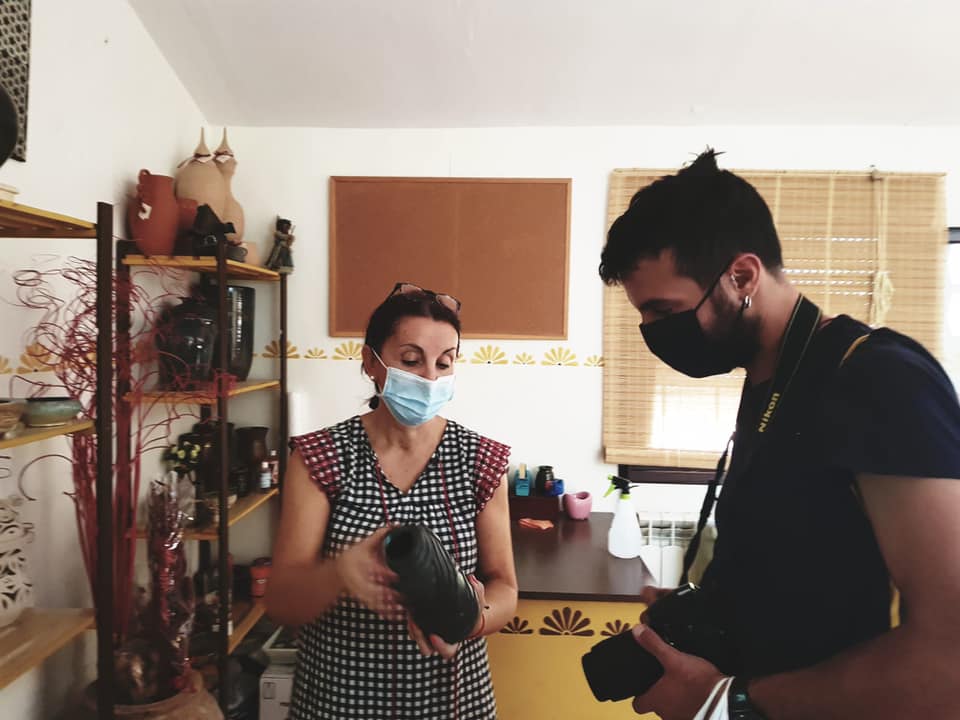
The exhibition “Mudejar, the intelligence of beauty. 20th anniversary of its declaration as UNESCO World Heritage” has arrived today in Tobed and can be visited until 12 September from 18.00 to 20.00.
From 4 to 8 September it will be at the Town Hall.
From 9 to 11 September it will be in the Church of the Virgin, declared a UNESCO World Heritage Site.
This travelling exhibition can be visited until the end of the year in the different partner towns of Territorio Mudéjar and is part of the commemorative events that we are celebrating on the occasion of the 20th anniversary of the declaration of the Zaragoza Mudejar as World Heritage Site.
Those interested will find intelligent signposting and an exhibition focused on in situ learning for all audiences.
The exhibition project has been made possible thanks to the collaboration of Adri Calatayud-Aranda and the Leader grants from the Aragon Rural Development Programme 2014-2020.
As we have told you on other occasions, we work with Adri Calatayud Aranda on different projects. Specifically, within the “Asociación Territorio Mudéjar Centro de Innovacion rural” we have worked on the signposting and the itinerant dissemination by means of mobile boards of the recently inaugurated exhibition.
This autumn, Territorio Mudéjar resumes its guided tours to discover the Mudejar heritage of the province of Zaragoza in its broadest sense – monuments, urbanism, landscape, trades… – always with scientific rigour and hand in hand with professionals. The initiative “Mudejar Territory: a journey to beauty”, promoted together with the Council of Zaragoza, includes 12 routes divided into five themes: cultural fusion, the origins of the artistic style, the towers and the fortress churches. It is a journey back in time through an artistic style that was present from the 13th to the 16th century and which left a legacy that has earned some of its monuments the UNESCO World Heritage designation.
The first routes begin in September:
The Mudejars: Mestizo Land and borderland: one through Magallón, Torrellas and Fréscano and another through Saviñán, Mesones de Isuela and La Almunia de Doña Godina. They will show how the period of fusion between the Christian, Jewish and Muslim cultures is still clearly reflected today in the country houses, urbanism and monuments of these towns.
Keys to a style: towers. You will visit Romanos, Villarreal de Hueva, Mainar and Villar de los Navarros. These routes immerse visitors in the origins of the style and explain how the Islamic tradition gradually gained ground, with its particular technical solutions, quality and attractive and captivating aesthetics. Specifically, these routes will visit the Mudejar towers, which characterise the ‘skyline’ of the territory and are one of the most exceptional representations of this style.
The Mudejar space: Tobed, Maluenda and Morata de Jiloca. This is a route through some of the most beautiful fortress-churches, temples of a clearly defensive style, with privileged locations, framed in beautiful country houses and integrated into the landscape.
This initiative is part of the commemoration of the 20th anniversary of the declaration of the Mudejar of the province of Zaragoza as a UNESCO World Heritage Site.
Territorio Mudéjar collaborates with the European university project UNITA- Universitas Montium in which the universities of Zaragoza; Turin (Italy), which acts as coordinator; Pau and Savoy Montblanc in France; West Timisoara in Romania, and Beira Interior in Portugal participate.
The project aims to strengthen the skills and improve the employability of university students, connecting public and private rural organisations with students who want to put their knowledge into practice.
In Territorio Mudéjar we have counted on Giacomo Pasini, an Italian student who is finishing a master’s degree in Cultural Anthropology and Ethnology at the University of Turin and who during these weeks has accompanied our students of the Challenge Programme.
Giacomo – originally from Sartirana Lomellina, in the province of Pavia (Lombardy) – is researching the impact of the climate crisis on local communities, with a special interest in the forms of adaptation and resistance to the crisis. “I work on two themes: environmental migrations and local ecological knowledge as a resource against climate change,” he explains.
Why did you choose Territorio Mudéjar for your internship? “I was interested in approaching an association that works with cultural heritage in rural areas and learning strategies to strengthen the connection between the villages that are part of the network developed by the entity”, he answers. And then adds: “I have settled in the town of Tobed together with Eugenia, Elena and Diego, and I am working with them on the different projects they are carrying out within Territorio Mudéjar”.
With this programme, we are reinforcing our Centro de Innovación Rural project through the management of heritage and the use of heritage space as a learning space.
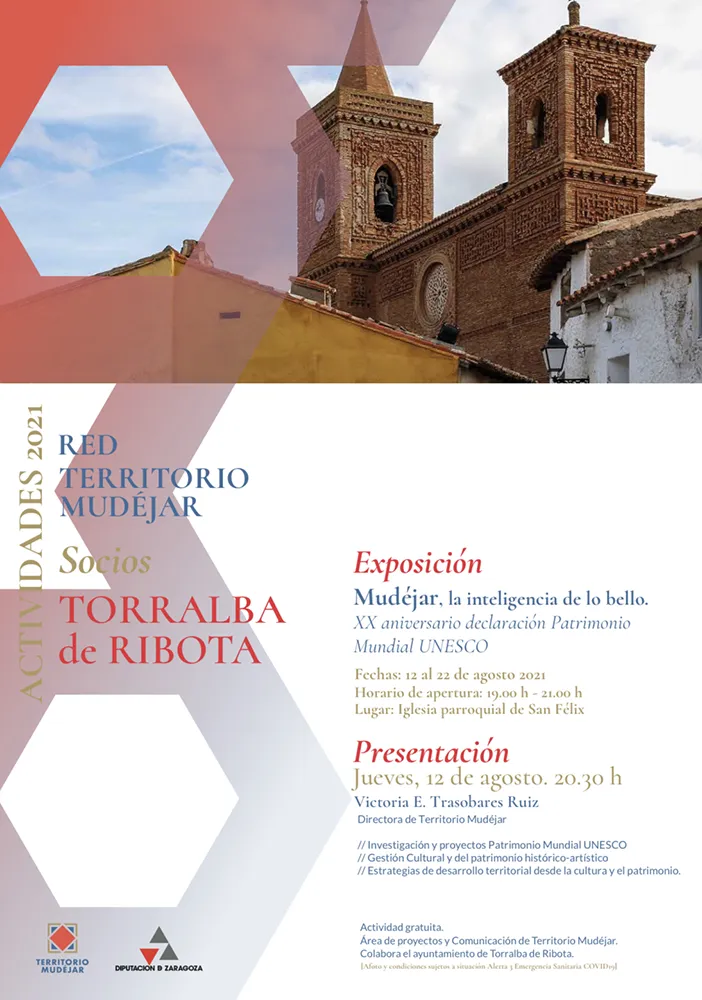
The temporary exhibition “Mudejar, the intelligence of beauty. 20th World Heritage Anniversary” arrives in Torralba de Ribota. The exhibition can be visited until 22 August in the church of San Félix from 19:00 to 21:00. Those interested will find intelligent signposting and an exhibition focused on in situ learning for all audiences. This exhibition also fulfils the objective of making the heritage space a global learning space for all audiences.
The exhibition project has been made possible thanks to the collaboration of Adri Calatayud-Aranda and the Leader grants from the Aragon Rural Development Programme 2014-2020. Our thanks to the town council of Torralba de Ribota, the Bishopric of Tarazona and the parish.
In addition, this Thursday at 20.30 there will be a presentation by the director of Territorio Mudéjar, Victoria Trasobares, who will talk about:
-Research and UNESCO World Heritage projects.
-Cultural and historical-artistic heritage management
-Territorial development strategies based on culture and heritage.
We will be accompanied by representatives of the Cultural Association Castillo de Torralba who will present the activities that will be carried out during the Medieval Days, which for the second year cannot be held in face-to-face and in full.
The temporary exhibition “Mudejar, the intelligence of beauty. 20th Anniversary World Heritage” arrives in Fréscano. This travelling exhibition commemorates the 20th anniversary of UNESCO World Heritage and will travel around our territory in the coming months. In Fréscano, it can be seen until 12 August from 18.30 to 20.00.
On the occasion of the exhibition and the incorporation of Fréscano to the Territorio Mudéjar network, during the weekend we will also make a presentation for all the inhabitants to know what it means to be part of the Territorio Mudéjar network and for them to get involved in our projects.
On Saturday 7th at 18.30 we will have a lecture on “Fréscano, Mudejar landscape” in the chapel of Nuestra Señora de la Huerta by Victoria E. Trasobares Ruiz, director of Territorio Mudéjar. The activity is free of charge.
Territorio Mudéjar participates one more year in the workshop of the Polytechnic of Milan and the Academy of Fine Arts of Brera: CortonaOpen3D. This is a course specialising in “SmartCityDesign” (smart city design) in a Cultural Heritage context and will be held from 1 to 10 August in the Italian town of #Cortona (in the province of Arezzo, Tuscany). Due to the health situation, there will be a combination of face-to-face and online training.
The workshop lasts approximately 100 hours divided between classroom lessons, lectures and project workshops in which between 50 and 100 international students participate. In this meeting, the participants develop a SmartCityDesigns project within the city of Cortona.
In this framework, Victoria E. Trasobares Ruiz, director of Territorio Mudéjar, will be one of the invited specialists. Her conference will focus on: “Territorio Mudéjar, a strategic example of heritage management: the project behind the projects”, as an example of innovative management of historical and artistic heritage in rural areas.
The director of Territorio Mudéjar will give this lesson from #Tobed (Zaragoza) through the digital platform set up for the workshop. It will also be the starting point of the many and varied activities to which the internship students of the #ChallengeProgramme 2021, the initiative financed by the Council of Zaragoza and managed through Universa, the Guidance and Employment Service of the University of Zaragoza, will be able to attend.
We continue to publicise Territorio Mudéjar and Mudejar heritage through our entity’s dissemination and communication actions. We have been in the Cultural Association El Allondero de Belchite where we talked about the importance of creating networks in rural areas and of counting on the inhabitants of our
villages, thus advancing in our mission to strengthen a unified and collaborative management network for the use of historical-artistic resources linked to the important Mudejar heritage, understanding them as an engine of development of the villages and as an element of identity for the maintenance of the communities that make up our territory.
The temporary and itinerant exhibition Mudejar 20th Anniversary World Heritage is already touring our Territorio Mudéjar. It will be inaugurated on 21 July in Ricla and can be visited until the end of the year in the different partner towns of Territorio Mudéjar. It is part of the commemorative events we are celebrating on the occasion of the 20th anniversary of the declaration of the Zaragoza Mudejar as World Heritage.
Those interested will find intelligent signposting and an exhibition focused on in situ learning for all audiences.
The first place where the exhibition will be on display is Ricla and it can be visited in the old consulting room of the strait (Doña Clara street, nº 12) from 18.00 to 20.00 until Sunday 27th. We will keep you informed about the next venues.
The exhibition project has been made possible thanks to the collaboration of Adri Calatayud-Aranda and the Leader grants from the Aragon Rural Development Programme 2014-2020.
As we have told you on other occasions, we work with Adri Calatayud Aranda on different projects. Specifically, within the “Asociación Territorio Mudéjar Centro de Innovacion rural” we have worked on the signposting and the itinerant dissemination by means of mobile boards of the recently inaugurated exhibition.
The Association for the Integral Rural Development of the Community of Calatayud and Comarca del Aranda (Adri Calatayud-Aranda) and Territorio Mudéjar already have the plaque that accredits their participation in the project “Asociación Territorio Mudéjar Centro de Innovación Rural”, framed in the Rural Development Programme 2014-2021.
Thanks to the help of this project we have:
Devised and implemented a virtual work platform that is a very good tool for networking through new technologies.
Designed at the headquarters of Territorio Mudéjar, in the Mudejar Museum of Tobed, a pilot interdisciplinary workspace and possible ‘coworking’ for the development of research and scientific projects and that can serve as a model and reference for the network studying municipal spaces that can be shared workplaces.
Worked on the signposting and dissemination of the travelling exhibition Mudejar 20th Anniversary World Heritage by means of mobile boards. This exhibition can be seen until Sunday 27th in the old consulting room of the Ricla strait from 18.00 to 20.00 and will be moved to the different towns of Territorio Mudéjar throughout the year.
If you would like to make the most of the summer to learn more about Mudejar art or deepen your knowledge of subjects related to our Territorio Mudéjar and its history and heritage, we invite you to participate in some of the extraordinary courses of the University of Zaragoza programmed or related to our towns.
It is coordinated by José Luis Cortés, tutor professor at the UNED Calatayud, with the collaboration of Victoria Trasobares Ruiz, director of Territorio Mudéjar.
The aim is to study first hand the Mudejar art of the regions of Aranda, Calatayud, Daroca and Valdejalón by means of detailed visits to all the most outstanding monuments, which are characterised by having preserved the original Mudejar spaces to the present day. The aim is to delve into the geographical, historical, ethnographic and artistic framework that allowed Aragonese Mudejar art to be declared a World Heritage Site in 2001.
The course addresses the different challenges that cultural heritage management faces today, with the new referential framework set by the Sustainable Development Goals and concepts such as “cultural rights”. For this purpose, a series of lectures and round tables have been programmed to address the problems, but above all the potentialities around very diverse issues that Cultural Heritage and its management as a tool for social change have in common: inclusion, universal accessibility, sustainability, local development, depopulation…
Victoria Trasobares Ruiz, director of Territorio Mudéjar, participates as a speaker.
The theory will have a practical application in the laboratory, with workshop sessions that will include work on the classification and analysis of skeletal and mummified remains exhumed from El Piquete de Quinto.
The aim of the course in Quinto is to approach the Museo de Momias, the first of its kind in Spain, through guided tours of the facilities and an exhibition of the preventive conservation methodology carried out by the Instituto de Estudios Científicos en Momias (IECIM).
It is coordinated by José Luis Cortés, tutor lecturer at the UNED in Calatayud and Fabián Mañas, PhD in Art History. The aim is to study and disseminate the artistic heritage of the towns that make up the Campo de Daroca region and the Community of Calatayud . Among them all, Bartolomé Bermejo stands out, whose entry into the artistic panorama of Daroca meant an aesthetic and technical revolution in the seventies of the 15th century.
Utilizamos cookies para asegurarte la mejor experiencia en nuestra web. Puedes consultar más detalles
Funcionales
Always active
El almacenamiento o acceso técnico es estrictamente necesario para el propósito legítimo de permitir el uso de un servicio específico explícitamente solicitado por el abonado o usuario, o con el único propósito de llevar a cabo la transmisión de una comunicación a través de una red de comunicaciones electrónicas.
Preferencias
El almacenamiento o acceso técnico es necesario para la finalidad legítima de almacenar preferencias no solicitadas por el abonado o usuario.
Estadísticas
El almacenamiento o acceso técnico que es utilizado exclusivamente con fines estadísticos.El almacenamiento o acceso técnico que se utiliza exclusivamente con fines estadísticos anónimos. Sin un requerimiento, el cumplimiento voluntario por parte de tu Proveedor de servicios de Internet, o los registros adicionales de un tercero, la información almacenada o recuperada sólo para este propósito no se puede utilizar para identificarte.
Marketing
El almacenamiento o acceso técnico es necesario para crear perfiles de usuario para enviar publicidad, o para rastrear al usuario en una web o en varias web con fines de marketing similares.