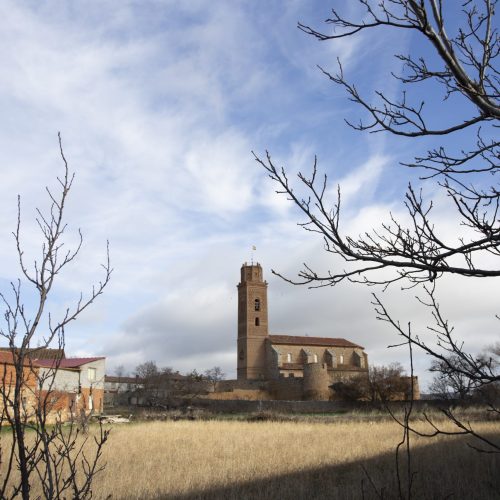
Santa Tecla, Cervera de la Cañada

Santa Tecla, Cervera de la Cañada

Cuatro Esquinas. 50312 Cervera de la Cañada (Zaragoza)

CURRENT PROTECTION STATUS: Asset of Cultural Interest (ACI)

TYPE OF ASSET: Property

CATEGORY: Religious

ARCHITECTURAL STYLE: Mudejar

CONSTRUCTION DATE: ca. 14th c., completed in 1426
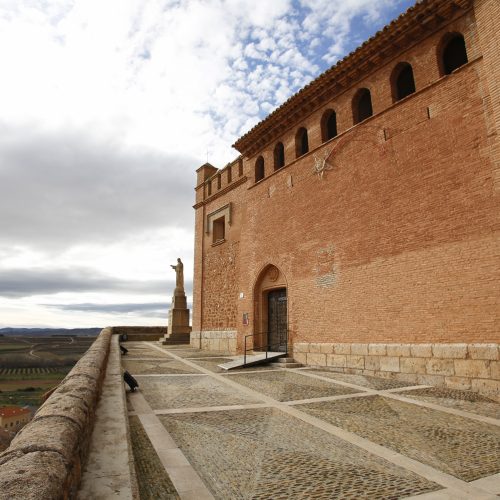
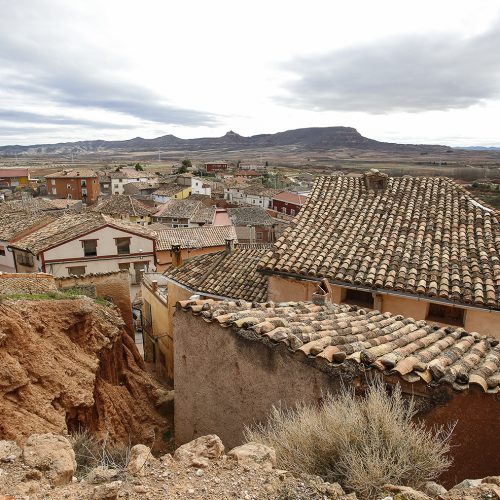
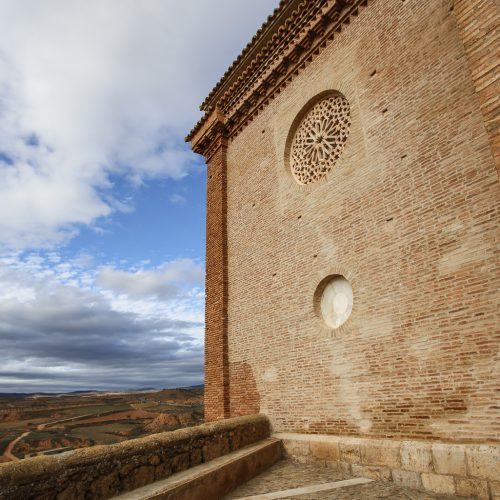
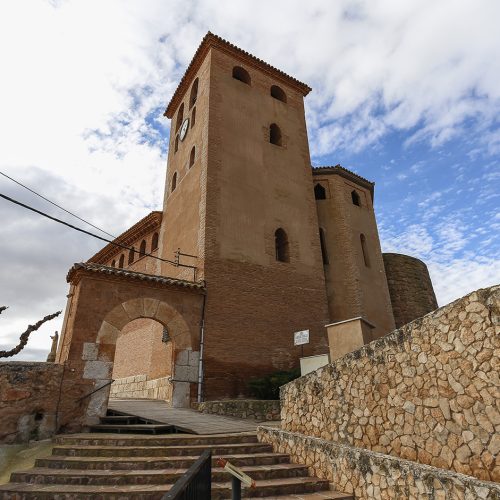
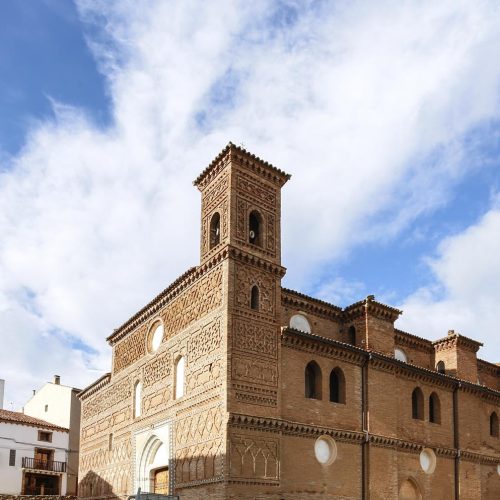
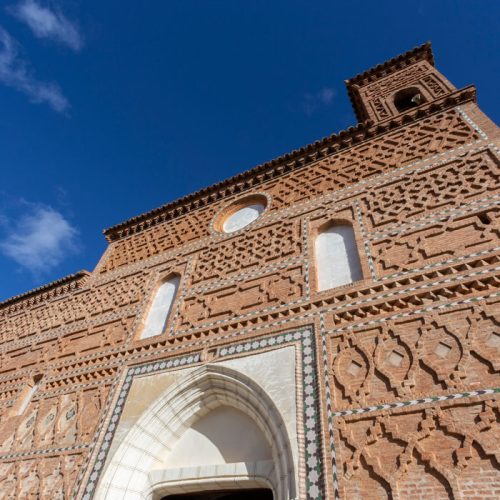
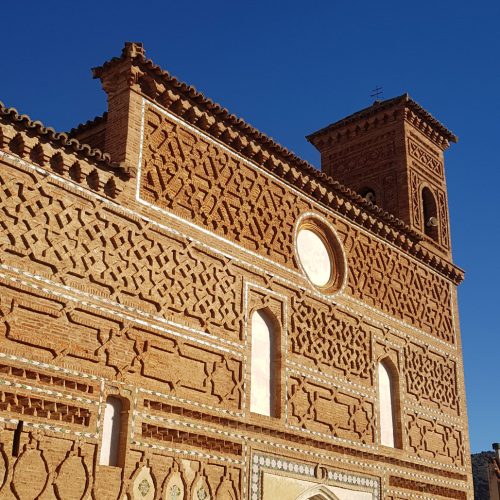
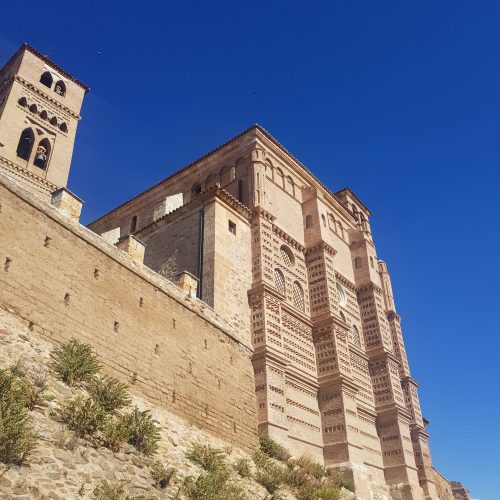
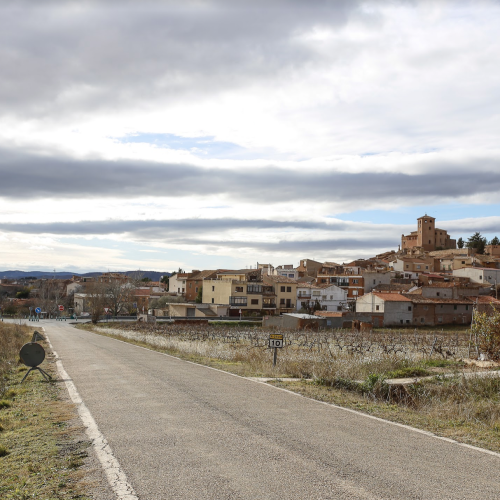
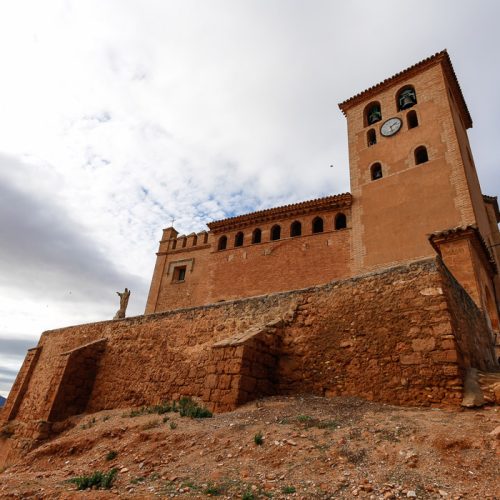
The church of Santa Tecla in Cervera de la Cañada is perched above the town over the site of the ancient castle, of which there are still traces: an ashlar stone block in the presbytery and a square tower of rammed earth.

The military nature of the temple must be highlighted, as it bears numerous similarities to the ‘fortified churches’ of Tobed, Torralba de Ribota, Morata de Jiloca and La Peña de Calatayud. In addition, this is one of the buildings included within the scope of the Aragonese Mudejar World Heritage classification in 2001, which features 6 buildings in the province of Zaragoza.

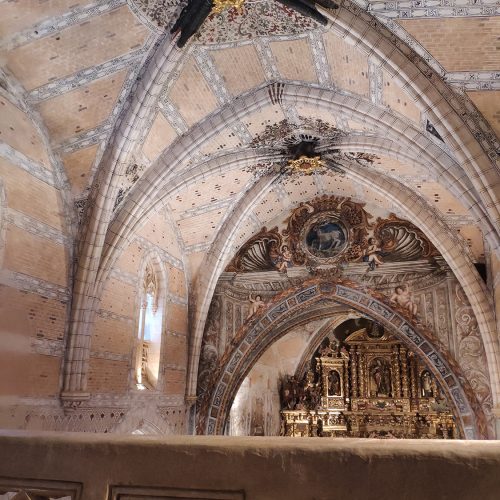
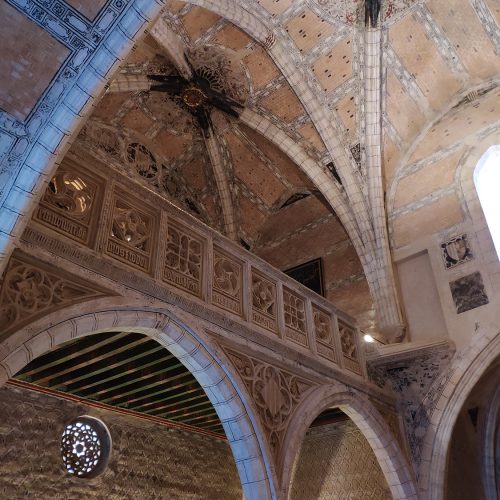
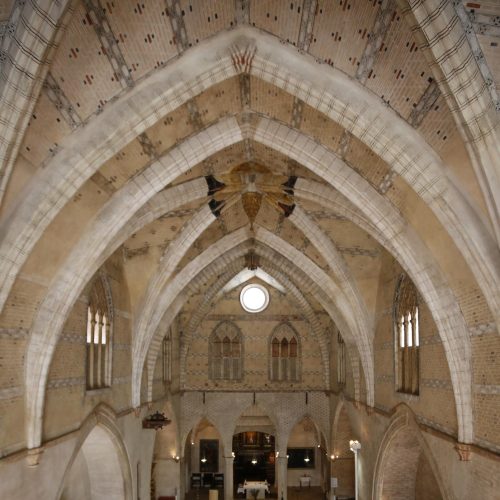
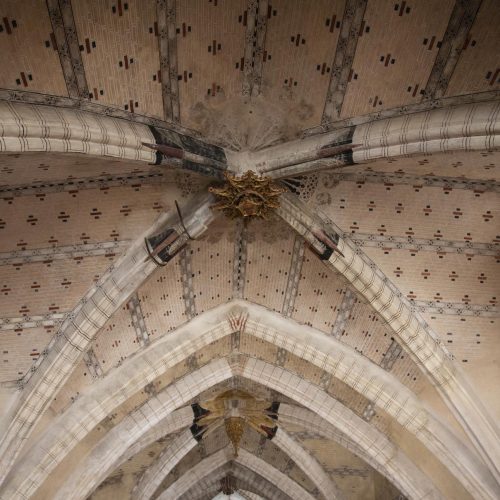
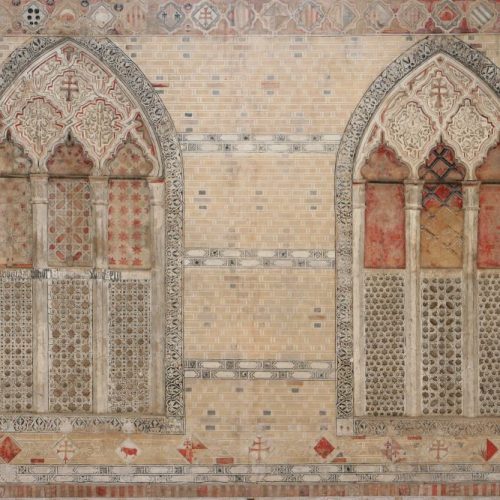
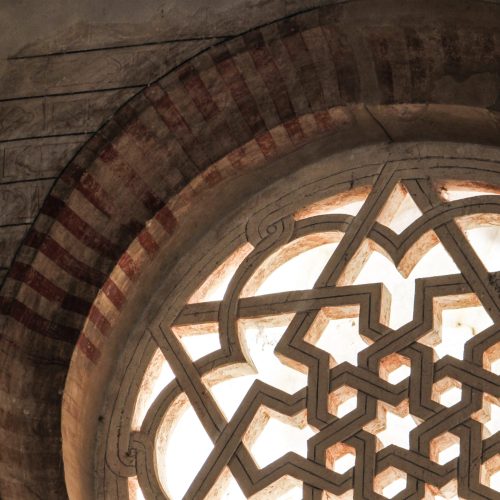
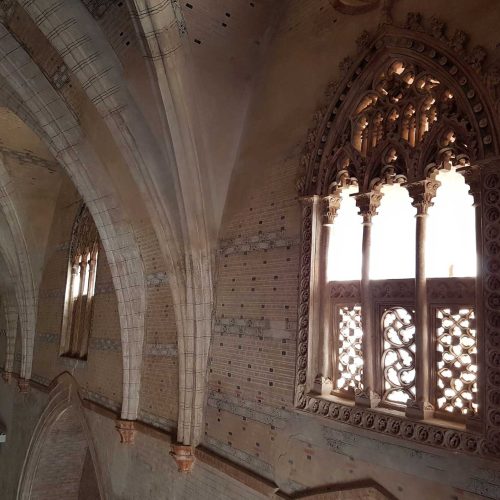
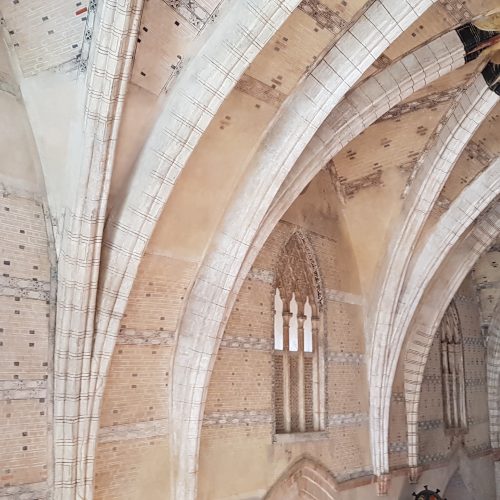
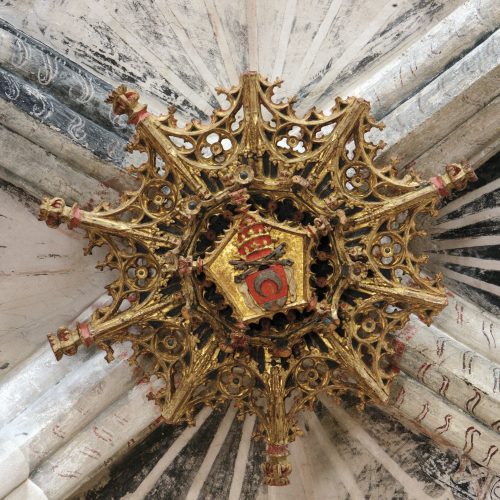
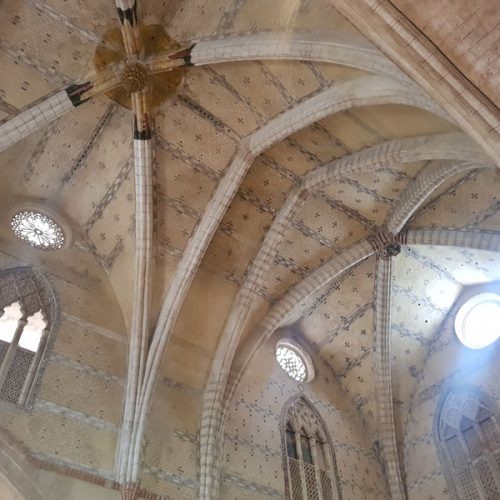
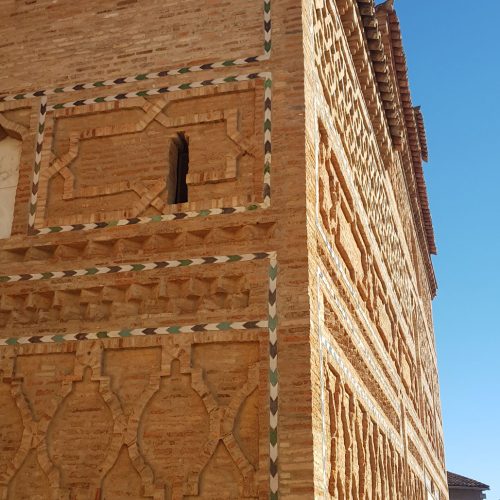
While the exterior is rather austere, the inside offers surprising ornamentation in the form of painted brick designs typical of the Aragonese Mudejar style as well as black dragons decorating the ribbed vaults and large rose windows.

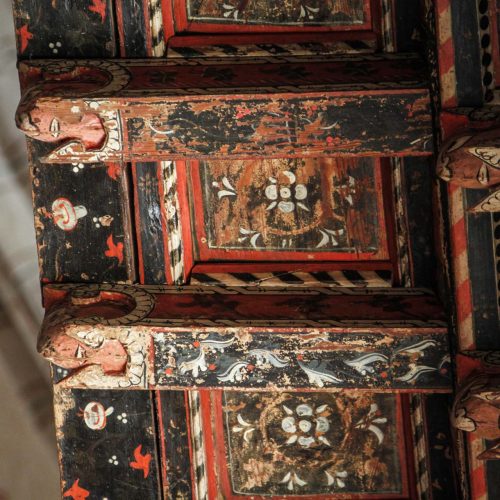
The church has a single nave with a polygonal presbytery that is offset from the longitudinal axis. The nave has three bays, the last of which, at the west end, features a raised choir over a polychrome wood alfarje ceiling structure resting on two slightly pointed arches supported by an octagonal column.

The three bays in the nave are covered by a quadripartite rib vault with diagonal arches and they are separated by transverse arches. Furthermore, the side chapels in the first two bays are deeper on the Epistle side than they are on the Gospel side.
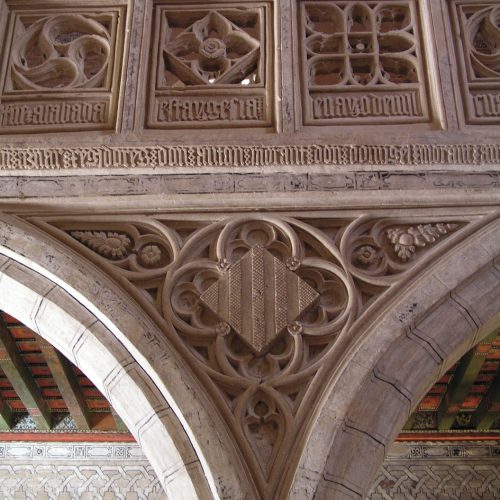
The date and designer of the choir are known thanks to an inscription on the choir parapet, which reads:

“En nombre de: dios todo: poderoso seyor: fue acabada: esta iglesia: cuatro çietos: e vint seys: fueron: jurados: de aqueste: dito: ayo: don: pascual: verdejo: don joan: Aznar: regidores: don: anton: morant: don: domigel: morant: anton: cuynillo: mateu: cubero: percurador: migel: fraye: con dios”.

Below that, in one of the pendentives between the edge of the choir parapet and the Gospel wall of the church, another inscription also sculpted in plaster can be seen, which indicates the name of the master bricklayer: “obra y (=et) dificada: por: mahoma: rami: con dios”.

Thanks to this inscription, it is known that the work was done by Mahoma Rami, the favorite master bricklayer of Papa Luna, after the pope’s death.

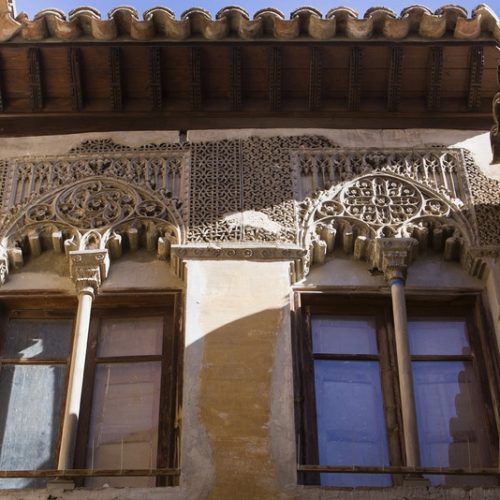
The octagonal column holding up the choir is another significant feature. It is decorated with crockets, an ornamental motif typical of the master builder Mahoma Rami. Preceding the choir there is a parapet sculpted in plaster with decorative motifs that can be considered a forerunner for the plasterwork in the main hall of the palace of the Count of Argillo in Illueca. Because they can be dated so precisely, they represent important examples in the study of the evolution of decorative Mudejar plasterwork elements in the 15th and 16th centuries.
Interventions

Restoration, 20th century

The church of Santa Tecla was restored in various phases, running from 1994 to 2001. The building was restored by Alfredo San Gil Lapuerta following the design of Miguel Ángel Bordejé. This restoration consisted in stabilizing the walls, rebuilding the entire wood roof and restoring the north gallery. In the second phase, the work focused on the interior, restoring the choir staircase and rearranging the baptismal font. The plasterwork and plinths were also restored and the painted decoration and altarpiece were retouched.

The south façade was remodeled by Fernando Chueca Goitia, who added the crenelated top and a window framed by a stone cornice in the section housing the stairway that leads to the choir and gallery. It has been restored to bring back some of the Mudejar motifs and to stabilize others, such as the original 15th century paintwork covering the entire nave.

Projects and interventions

Projects and interventions, and the driving forces behind them, define the history of monumental buildings and how they are perceived.

Declarations

20th to 21st century

The church of Santa Tecla in Cervera de la Cañada was declared an Asset of Cultural Interest under the Ministry of Culture Decree dated July 27, 1943, which was published the Official State Gazette of August 3, 1943.

The Official Gazette of Aragon (BOA) dated October 29, 2001 published the Department of Culture and Tourism Order of October 3, 2001, whereby the original declaration of the church of Santa Tecla in Cervera de la Cañada is supplemented pursuant to Transitional Provision One of Aragonese Cultural Heritage Act 3/1999, of March 10.
On December 14, 2001, UNESCO expanded its declaration of the Mudejar art of Aragon as World Heritage, declaring it an asset that is unique, universal and irreplaceable for Humanity. One of the assets listed in this declaration is the church of Santa Tecla, considered one of the best examples of the Mudejar art of Aragon.

The fortified church of La Asunción or Santa Tecla in Cervera de la Cañada was declared a UNESCO World Heritage site, included in this list for its unique style, well-preserved condition and unmatched beauty.

Bibliography

ALCALÁ PRATS, ICÍAR, REVILLA HERNANDO, ANA MARÍA Y RODRIGO GARZA, BEATRIZ. Guía del arte mudéjar en Aragón, Centro de Estudios Mudéjares, Prames, 2005.

BORRÁS GUALIS, GONZALO M. Arte Mudéjar Aragonés, Caja de Ahorros de Zaragoza, Aragón y La Rioja, Zaragoza, 1985.

CABAÑAS BOYANO, A. Aragón, una tierra de castillos, Edit. Prensa Diaria Aragonesa S.A. (El Periódico de Aragón. Grupo Z), Zaragoza, 1999.

  • GALIAY, JOSÉ. Arte mudejar aragonés, Institución Fernándo el Católico, Zaragoza, 2002. GALINDO PÉREZ, SILVIA (COORD.). Aragón Patrimonio Cultural Restaurado. 1984/2009. Bienes muebles, Gobierno de Aragón, Zaragoza, 2010.
  • IÑIGUEZ ALMECH, FRANCISCO. Iglesia parroquial de Santa Tecla, de Cervera de la Cañada (Zaragoza), En BORRÁS GUALIS, Gonzalo. (ed.). Estudios de arte mudéjar aragonés. Institución Fernando el Católico, 2001.p. 39-59.
  • MÉNDEZ DE JUAN, JOSÉ FÉLIX, GALINDO PÉREZ, SILVIA Y LASHERAS RODRÍGUEZ, JAVIER. Aragón Patrimonio Cultural Restaurado. 1984/2009. Bienes inmuebles, Gobierno de Aragón, Zaragoza, 2010.
  • VV.AA. Tierra Mudéjar. El mudéjar Aragonés, Patrimonio Mundial, Heraldo de Aragón, D.L. 2002

Appendixes

Santa Tecla

Cuatro Esquinas. 50312 Cervera de la Cañada (Zaragoza)

Visit Cervera de la Cañada

San Pedro de los Francos, Calatayud

San Pedro de los Francos, Calatayud

Plaza de España 1. 50300 Calatayud

CURRENT PROTECTION STATUS: ACI

TYPE OF ASSET: Property

CATEGORY: Religious

ARCHITECTURAL STYLE: Mudejar

CONSTRUCTION DATE: First third of the 14th century
The Mudejar structure of San Pedro de los Francos dates from the 14th century, representing a type of church with three naves of nearly the same height, a crossing that is barely noticeable in plan view but somewhat more pronounced in elevation due to the small difference in height between the three naves and the three-part polygonal apse at the east end. Unlike most Mudejar single-nave churches in Aragon, the apses here have buttresses, which can be considered an archaic trait.

The central nave is almost twice as wide as the side aisles, and they are separated by clustered columns whose section results from attaching half columns to the center of each side of a square pier, plus smaller diameter shafts at the corners, in the manner of torus molding. The half columns at the center of each side of the square piers bear the loads of the supporting arches that separate the naves and of the transverse arches separating the bays, whereas the torus molding at the corners bears the weight of the diagonal ribs of the triple-beaded quadripartite rib vaults.
The three naves have three bays and the three apses are seven-sided polygons; the vaulting over the side apses has two bosses while the central apse has just one.

To the right of the west façade, attached to the south nave wall, the square-plan Mudejar tower stands, its structure consisting of a single tower on the exterior, wrapped around a solid square central buttress with a stairway built between the two and a system of brick vaults made of narrowing courses of bricks. In 1840 the original belfry on the tower was lost, coinciding with the visit of the queen regent to the city of Calatayud, who stayed at the palace of the baron of Warsage opposite the church.

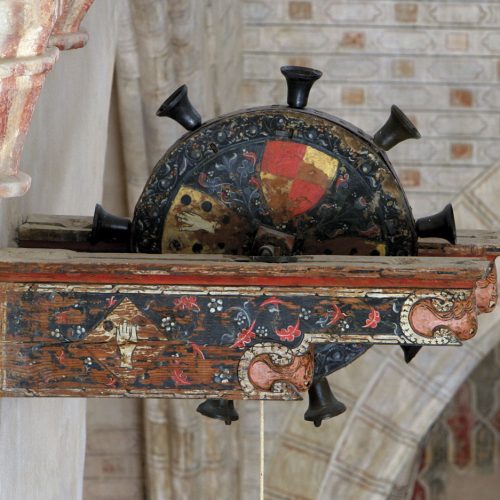
On the south side of the church there was a square Mudejar cloister similar to that in the collegiate church of the Santo Sepulcro. The organ console features striking Mudejar carpentry work and has been preserved inside the church.

Interventions

Restoration, 20th to 21st century

In 2006 the restoration and renovation work of certain spaces was completed, jointly funded by the national and regional governments and the city council of Calatayud.

In January 2006, the work was completed and the church was opened to the public as a cultural center, after remaining closed for twenty years. In 2008, the last phase of the intervention took place, consisting in repairing damp patches infiltrated from adjacent buildings and completing the restoration of the furnishings (high altarpiece and foot of the organ).

Projects and interventions

Projects and interventions, and the driving forces behind them, define the history of monumental buildings and how they are perceived.

Declarations

Declaration, 21st century

The church of San Pedro de los Francos in Calatayud was declared an Asset of Cultural Interest under the Ministry of Public Instruction and Fine Arts Decree dated June 3, 1931, which was published in the Gazette of June 4, 1931.

The Official Gazette of Aragon (BOA) dated April 22, 2002 published the Department of Culture and Tourism Order of April 2, 2002, whereby the original declaration of the church of San Pedro de los Francos in Calatayud (Zaragoza) is supplemented pursuant to Transitional Provision One of Aragonese Cultural Heritage Act 3/1999, of March 10.

Bibliography

BORRÁS GUALIS, G. Arte Mudéjar Aragonés, Caja de Ahorros de Zaragoza, Aragón y La Rioja, Zaragoza, 1985. 

BORRÁS GUALIS, GONZALO M. Y LÓPEZ SAMPEDRO, GERMÁN. Guía monumental y artística de Calatayud, Ministerio de Educación y Ciencia, Madrid, 1975. CRIADO MAINAR, JESÚS. La escultura romanista en la comarca de la Comunidad de Calatayud, Institución Fernando el Católico, Zaragoza, 2013. GALIAY, JOSÉ. Arte mudéjar aragonés, Institución Fernándo el Católico, Zaragoza, 2002.

BUSTAMANTE MONTORO, Rosa; Sánchez de Rojas, María Isabel. Estudio de los enlucidos de yeso de la iglesia de San Pedro de los Francos de Calatayud. Materiales de Construcción [En línea]. 2007 , nº 286, p. 53-64. 

CRIADO MAINAR, Jesús. La escultura romanista en la comarca de la Comunidad de Calatayud y su área de influencia [En línea]. Calatayud: Centro de Estudios Bilbilitanos, 2013.

GARRIS FERNÁNDEZ, Álex. La tutela del patrimonio aragonés [En línea]: La Comisión Provincial de Monumentos Históricos y Artísticos de Zaragoza (1835-1957). Zaragoza: Institución Fernando el Católico, 2017.

MÉNDEZ DE JUAN, José Félix et al. (coord.). Aragón. Patrimonio cultural restaurado. 1984/2009: Bienes inmuebles. Zaragoza: Gobierno de Aragón, 2010. Nueva inyección económica para la iglesia de San Pedro. Heraldo de Aragón. 19/08/2014 p. 12. Obras en las calles y mejoras en la iglesia de San Pedro. Heraldo de Aragón. 04/02/2012 p. 12. 

SANMIGUEL MATEO, Agustín. Torres de ascendencia islámica en las comarcas de Calatayud y Daroca. Aragón (España). Calatayud: Centro de Estudios Bilbilitanos, 1998.

SANMIGUEL MATEO, Agustín. Inclinación y antigüedad de la torre de San Pedro de los Francos de Calatayud. En Calatayud y comarca: Actas. Centro de Estudios Bilbilitanos, 1997.p. 259-270. URZAY BARRIOS, José Ángel. (coord.). Calatayud. Historia, arte, arquitectura y urbanismo: Una guía para salvaguardar la ciudad. Calatayud: Centro de Estudios Bilbilitanos, 2019.

ZORRAQUÍN, Jorge. El retablo de San Pedro de los Francos luce de nuevo con la música como invitada. Heraldo de Aragón. 10/03/2018 p. 18. 

ZORRAQUÍN, Jorge. Recta final de la restauración del retablo mayor de San Pedro de los Francos de Calatayud. Heraldo de Aragón. 09/12/2017 p. 18.

Appendixes

San Pedro de los Francos

Plaza de España, 1
50300 Calatayud (Zaragoza)

Visit Calatayud

City Hall: 976 881 700
www.calatayud.es
WOULD YOU LIKE TO KNOW MORE?
www.turismodezaragoza.es

San Martín de Tours, Morata de Jiloca

San Martín de Tours, Morata de Jiloca

CURRENT PROTECTION STATUS: ACI

TYPE OF ASSET: Property

CATEGORY: Religious

ARCHITECTURAL STYLE: Mudejar

CONSTRUCTION DATE: 15th century
The church of San Martín in Morata de Jiloca is located on the south side of a square, so that it can be viewed in its entirety. It can be classified as a Mudejar fortified church, typically featuring a single nave with chapels set between buttress towers and three chapels in the straight-sided east end, like the churches of Tobed and Torralba de Ribota.

The single nave is divided into two bays covered by a quadripartite rib vault and separated by three shorter bays with pointed barrel vaults supported by buttresses, two of which form buttress towers. The nave is 13.30 meters wide and the side chapels open onto the interior via pointed arches, with the central arch being larger than the side arches.

In addition, pilasters displaying decorative plant motifs and ending in elongated pinnacles with the same motifs are arranged between the arches. There are two round-arched openings in the sides of the presbytery, which are decorated with fretted plasterwork based on an eight-point star that is repeated so as to create radiating hexagons.

The interior is decorated with painted brick designs using a technique that imitates the shape of individual bricks. The transverse arches found inside this church also feature decoration that imitates the shape of ashlar stones.

The exterior of the church of San Martín features a striking main façade decorated with protruding brick and ceramic details. The left side covers what would have been the east end, first bay and second bay up to what would have been the original gable wall. The portal has a basket arch framed by embrasured pointed-arch archivolts resting on capitals. Particularly striking are the capitals, decorated with figures like the one on the right, in which a bearded bust of a male figure can be seen.
Two towers were erected on the west-facing façade, but only the foundations can be seen of the one to the north. The south tower has a rectangular footprint and the exterior is divided into two sections, the lower of which is decorated with a strip of angled bricks. The belfry has two openings on the wider sides and one on the narrower side. There are pointed arches over the openings. In the upper part of the nave there is protruding brick decoration featuring a strip of diamond shapes between two single strips of angled bricks. At the top there is a series of openings covered by narrowing courses of bricks. Finally, there is a pyramid-shaped spire also made of brick crowning the tower.

As part of the major remodeling done in the 16th century, the passageway of double round arches at the top was added, probably replacing the gallery typical of fortified churches, which would have extended above the side chapels and end wall to connect to the two buttress towers in the west end bay.

Interventions

Restoration, 20th to 21st century

The interior of the church has a single nave with chapels set between the buttresses and three chapels built into the flat east end, which was rebuilt during the restoration undertaken in 1982 by the Directorate General of Architecture, following the design by Ramiro Moya.

The main aim of this restoration was to return the church to its original canonical orientation, recovering the original presbytery, part of which had been converted into a choir. The current appearance of the church is the result of this restoration, which rendered it perhaps too “new” by reconstructing the parts that had been lost, including the painted decorative motifs and brick designs on all the surfaces except the vault over the south side, or Epistle side, chapel, traces of which remained intact there and in a few other parts of the church.

Based on these remnants, the other vaults, including the 16th-century vault over the presbytery, were painted as seen today.

During the final quarter of the 20th century, restoration work was done on the building overall and on the ceramic work of the façade.

One recent restoration project entailed recovering the structure of the original presbytery, which had been completely covered over, although the reorientation effected in the 16th century was left unchanged.

In 2000 and 2001, refurbishing work was done to treat some moisture issues. In 2007, the Romanist-style high altarpiece from the 16th century was restored, its color brought back to life through the work of restorer Enrique de las Casas.

Projects and interventions

Projects and interventions, and the driving forces behind them, define the history of monumental buildings and how they are perceived.

Declarations

Declaration, 21st century

The church of San Martín de Tours was declared a Historical and Artistic Monument under the Ministry of Public Instruction and Fine Arts Decree of June 3, 1931 published in the Gazette on June 4, 1931.

The Official Gazette of Aragon (BOA) dated January 8, 2003 published the Department of Culture and Tourism Order of November 28, 2002, whereby the original declaration of the church of San Martín de Tours in Morata de Jiloca (Zaragoza) is supplemented pursuant to Transitional Provision One of Aragonese Cultural Heritage Act 3/1999, of March 10.

Bibliography

ABBAD RIOS, FRANCISCO. Catálogo Monumental de España. Zaragoza, Consejo Superior de Investigaciones Científicas. Instituto Diego Velázquez. Madrid, 1958. 

BORRÁS GUALIS, GONZALO M. Arte mudéjar aragonés, Colección Básica Aragonesa. Ed. Guara, 1987.

BORRÁS GUALIS, GONZALO M. Arte Mudéjar aragonés, CAMPZAR y Col. Oficial de Arquitectos Técnicos y Aparejadores de Zaragoza, Zaragoza, 1985.

CANTOS MARTÍNEZ, Olga. Recursos plásticos en la escultura policromada aragonesa de la Contrarreforma (1550-1560). Tarazona: Centro de Estudios Turiasonenses, 2012. 

CRIADO MAINAR, Jesús. Culto e imágenes de la Virgen de la Cama en el Aragón occidental [En línea]: El Tránsito de María y la devoción asuncionista en la Comunidad de Calatayud. Calatayud: Centro de Estudios Bilbilitanos, 2015.

CRIADO MAINAR, Jesús. La escultura romanista en la comarca de la Comunidad de Calatayud y su área de influencia [En línea]. Calatayud: Centro de Estudios Bilbilitanos, 2013.

MÉNDEZ DE JUAN, José Félix et al. (coord.). Aragón. Patrimonio cultural restaurado. 1984/2009: Bienes inmuebles. Zaragoza: Gobierno de Aragón, 2010.

SANMIGUEL MATEO, Agustín. Torres de ascendencia islámica en las comarcas de Calatayud y Daroca. Aragón (España). Calatayud: Centro de Estudios Bilbilitanos, 1998.

Appendixes

San Martín de Tours

Pl. Marco Monge, 5
50344 Morata de Jiloca

Visit Morata de Jiloca

City Hall www.moratadejilocaturismo.es WOULD YOU LIKE TO KNOW MORE? www.turismodezaragoza.es

Papa Luna Palace, Illueca

Papa Luna Palace, Illueca

Plaza de España Illueca 50250 (Zaragoza)

CURRENT PROTECTION STATUS: Asset of Cultural Interest (ACI)

TYPE OF ASSET: Property

CATEGORY: Religious

ARCHITECTURAL STYLE: Mudejar

CONSTRUCTION DATE: Beginning in the 14th century, with subsequent alterations
Over the course of the 14th and 15th centuries, the palace was a fortress dominating the Aranda district, with all of its rooms arranged around an open courtyard in the center. From that era, the Sala Dorada, or Salón de Protocolos, and the private bedroom where Benedict XIII, known as Papa Luna, was born, still remain.

In the 16th century, Pedro Martínez de Luna, the first count of Morata and viceroy of Aragon, ordered the transformation of the fortress, giving it a more palatial appearance. At that time, the arched passageway running around the entire upper perimeter and the main portal were created. It may have been inspired by the main façade of the Ducal Palace of Urbino (Italy), extolling the influence of the Italian Renaissance in Aragonese territory.

During the 17th century, remodeling work on the castle-palace continued, funded by Francisco Sanz de Cortés, the first marquis of Villaverde, who ordered the main entrance to be remodeled, the castle bailey to be expanded, the medieval courtyard to be covered over with a monumental staircase and the mausoleum in the private chapel to be decorated. In the 19th century the castle became the property of the counts of Morata, later falling into the hands of the counts of Argillo and, finally, the Bordiú Nava family.

The compound is constructed of masonry and brick, arranged in an elongated rectangular floor plan. It is distributed into three levels, with the main rooms on the first floor, the second floor housing various bedchambers and the third floor consisting of a passageway of double round arches running around the entire outer perimeter of the castle-palace.

The Sala Dorada, or Salón de Protocolo, is one of the oldest rooms in the castle-palace and currently serves as the central hub for the rest of the compound. This highly interesting room was built in the 14th century and gets its name, Sala Dorada, or Golden Room, from the gold-colored decoration that has been preserved on the alfarje ceiling structure here, which is entirely decorated with heraldic motifs of the Luna family and Mudejar decorative motifs. Moreover, the Mudejar frieze that runs around its entire perimeter, consisting of polychrome fretted plasterwork, and the high quality alfarje are also striking.

The room where Benedict XIII is thought to have been born is a small space featuring a plaster frieze with intertwined pointed arch motifs painted in red, white and blue tones and a wood alfarje ceiling.
The room that is now the mausoleum was once the castle’s private chapel, remodeled in the 16th and 17th centuries. From the 15th century up to the events of the War of Spanish Succession, the remains of Papa Luna were laid to rest here. In the 16th century, the Renaissance portal leading into the room was built: a round arch resting on fluted columns and decorated with Renaissance-era motifs including festoons, griffins and cornucopia.

The mausoleum itself was constructed in the 17th century, featuring the heraldic representation of the coat of arms of Benedict XIII in polychrome plasterwork in the pediment. Upon entering the castle-palace, there is a monumental staircase erected in the 17th century in the space that had held the open medieval courtyard up to that time, which leads to the rooms surrounding the courtyard. This imposing staircase was built in 1665 and features a passageway of round arches at the top, resting on simple columns with a base and capital, covered by a large dome on pendentives topped by a lantern. There is also Baroque plaster decoration.

In the Sala de la Corona de Aragón, a space constructed in the 17th century, the most striking feature is the wood frieze decorated with leaf, egg and die motifs and turned colonettes. Covering this room is a simple flat ceiling with clad wood beams and plaster fill. On the exterior of this immense prism-shaped volume with four cube-shaped turrets at the corners is the portal, located on the main façade: broken down into three levels, like the rest of the building, it is framed by two circular turrets. Both are made of masonry up to the level of the arched passageway and contain three blind arches each, topped by six openings around the perimeter of the upper section.

Projecting some two meters beyond these turrets, the entrance consists of a round arch flanked by double pilasters with Tuscan capitals holding up a decorative frieze of mascarons and a broken pediment of volutes, also framed by Tuscan order pilasters. Over the entrance there is a second volume that is more severe and austere than the first but uses the same compositional

scheme, and above that is the third volume containing an undecorated opening featuring an architrave with an overhang.

In the 16th century, Pedro Martínez de Luna, the first count of Morata and viceroy of Aragon, ordered the transformation of the fortress, giving it a more palatial appearance and adding to this magnificent structure an arched passageway running around the entire upper perimeter and a no less elegant main portal which, according to experts, was inspired by the main façade of the Ducal Palace of Urbino (Italy), highlighting the influence of the Italian Renaissance in the territory of Aragon.

Interventions

Restoration, 20th to 21st century

In 1984-1985 and 1991-1996, the Government of Aragon and the Illueca city council sponsored several restoration projects with a total cost of 400,333 euros.

Projects and interventions

Projects and interventions, and the driving forces behind them, define the history of monumental buildings and how they are perceived.<br><br>

The downloadable file shows the current status of review proceedings in progress, making it possible to gradually update the knowledge about each monumental building.

Declarations

Declaration, 21st century

In 1931 the building was declared a Historical and Artistic Monument under the Ministry of Public Instruction and Fine Arts Decree of June 3, 1931 published in the Madrid Gazette on June 4 1931.

In 2003, the Official Gazette of Aragon (BOA) dated January 29, 2003 published the Department of Culture and Tourism Order of December 16, 2002, whereby the original declaration of the Palace of the Luna Family, also known as the Palace of the Morata Family, in Illueca (Zaragoza) is supplemented pursuant to Transitional Provision One of Aragonese Cultural Heritage Act 3/1999, of March 10. This Papa Luna Castle and Palace is also included in the list of castles considered Assets of Cultural Interest in accordance with the terms of Additional Provision Two of Aragonese Cultural Heritage Act 3/1999, of March 10. This list was published in the Official Gazette of Aragon on, May 22, 2006.

The Official Gazette of Aragon (BOA) dated March 11, 2002 published the Department of Culture and Tourism Order of February 22, 2002, whereby the original declaration of the church as an Asset of Cultural Interest is supplemented pursuant to Transitional Provision One of Aragonese Cultural Heritage Act 3/1999, of March 10, defining the movable assets and the environment affected by the declaration.

Bibliography

ABAD RÍOS, F. Catálogo Monumental de España, Zaragoza, CSIC-Instituto Diego Velázquez, Madrid, 1979

VV.AA. Comarca del Aranda, Colección RUTASCAI por Aragón nº 25, Zaragoza, 2005.

 VV.AA. Gran Enciclopedia Aragonesa (GEA) 2000, Vol. 11, El Periódico de Aragón-Prensa Diaria Aragonesa, Zaragoza, 2000. 

VV.AA. Guía de Museos de Aragón, Prensa Diaria Aragonesa S.A., Zaragoza, 2004. 

VV.AA. Tierra Mudéjar. El mudéjar Aragonés, Patrimonio Mundial, Heraldo de Aragón, D.L. 2002.

LÓPEZ ROJO, Pilar. La capilla del castillo del Papa Luna de Illueca se abre al público por primera vez. Heraldo de Aragón. 29/02/2012 p. 15. 

MÉNDEZ DE JUAN, José Félix et al. (coord.). Aragón. Patrimonio cultural restaurado. 1984/2009: Bienes inmuebles. Zaragoza: Gobierno de Aragón, 2010.

Appendixes

Papa Luna Palace

Plaza de España
50250 Illueca (Zaragoza)

Visit Illueca

City Hall: 976 820 005 www.ayuntamientodeillueca.com WOULD YOU LIKE TO KNOW MORE? www.turismodezaragoza.es

Palace of the Luna family, Daroca

Palace of the Luna family, Daroca

Calle Mayor, 44. 50360 Daroca (Zaragoza)

CURRENT PROTECTION STATUS: Asset of Cultural Interest (ACI)

TYPE OF ASSET: Property

CATEGORY: Residential OWNER:
  • From: Contemporary era- 21st century
  • To: Contemporary era- 21st century. Two thirds of the palace were purchased by Fundación Campo de Daroca with the aim of restoring it and using it for cultural purposes. The remaining third is still owned by a private owner and used as a residence.
ARCHITECTURAL STYLE: Mudejar

CONSTRUCTION DATE: 14th to 15th century
The palace of the Luna family in Daroca is an excellent example of Mudejar civil architecture in Aragon. Its construction dates back to the late 14th and early 15th century. It was commissioned by the Luna family, whose heraldic symbols can be seen throughout the building.

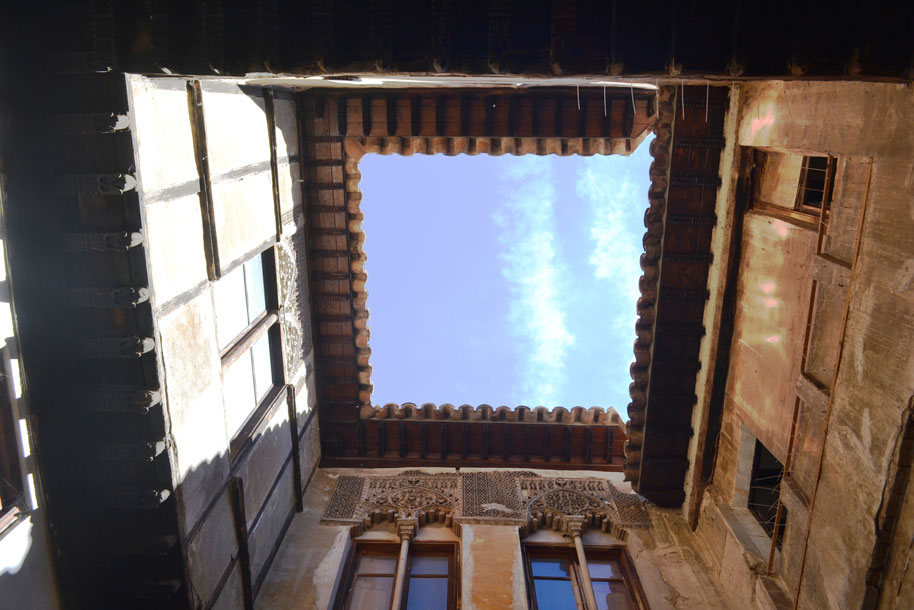
The original building had a U-shaped floor plan distributed on the ground floor, main floor and granaries, all arranged around a central interior courtyard.

On the ground floor, the original entrance to the palace was through a round arch in the façade facing Calle Mayor. Given the considerable height of the ground floor level, it was divided into two parts, thus creating a mezzanine level.

The ground floor is divided into three parts perpendicular to the façade to create a U-shaped floor plan wrapped around an inner courtyard.

This division is created by means of arcades resting on columns. Although their spans have been covered over, those on the left-hand side still exist and could be fully recovered, while the arcades to the right were replaced with Tuscan columns and wood lintels resting on bolsters when remodeling work was done in the late 16th century.
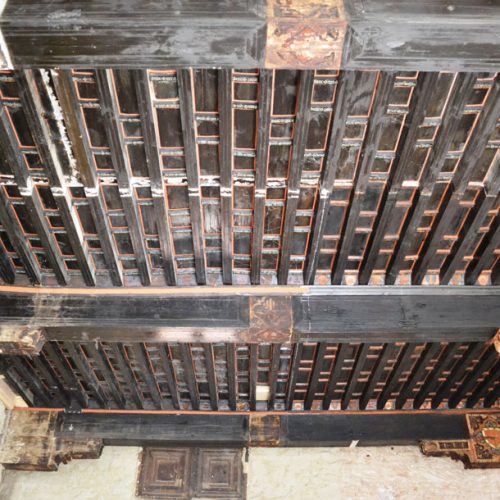
The main floor is the focus of great interest, covered almost entirely by a wood ceiling in which the alfarje structure displays painted decorative motifs of heraldic symbols. The ceiling can be dated between the 14th and 15th centuries thanks to an inscription of the word “BENEDICTUS”, directly referring to the papacy of Benedict XII (1397-1416).

The eaves found on both the exterior and interior of this level are striking, particularly those facing the exterior, which, like the ceiling inside, are decorated with highly deteriorated tempera paintings depicting heraldic symbols, coats of arms and references to the owners of those crests.

The upper level must have been used as a granary and features the thick frames holding up the roof.

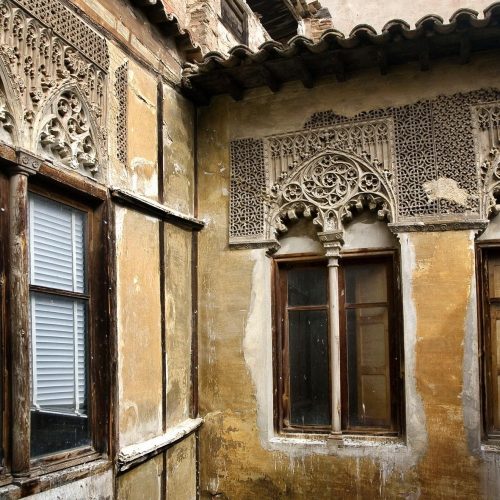
The main floor looks out onto the inner courtyard through three windows, one in the center and two on the left side, boasting colonettes and a surround featuring interlacing decorative motifs and Mudejar plasterwork.

Interventions

The property is currently divided into two residences, with commercial establishments on the ground floor.

The building has undergone several interventions in the 21st century. In the first phase, the Government of Aragon invested 300,000 euros in stabilizing the building. In June 2011, the second phase began, sponsored by Obra Social de Ibercaja with 150,000 euros. That work focused on restoring the coffered wood ceilings on the main floor.

After the purchase of two thirds of the original palace by Fundación Campo de Daroca, the architect Javier Ibargüen was entrusted with the restoration project. The work was broken down into two phases: in 2010, the focus was on cleaning and tearing down added elements, in addition to testing walls, architectural and pictorial features with a view to gathering information so as to plan other activities. One year later, in 2011, cleaning and debris removal tasks were carried out in two storerooms, besides restoring the coffered wood ceiling on the main floor.

Projects and interventions

Projects and interventions, and the driving forces behind them, define the history of monumental buildings and how they are perceived.

Declarations

DECLARATION (1931-2002)

The Palace of the Luna family was declared a National Monument on June 3, 1931 (published in the Gazette of June 4, 1931).
The Official Gazette of Aragon (BOA) dated March 22, 2002 published Decree 94/2002, March 6, by the Government of Aragon, declaring the Palace of the Luna Family in Daroca (Zaragoza) an Asset of Cultural Interest, Monument category.

Current condition

Currently, part of the palace constructed by the Martínez de Luna family in the late 14th century remains standing, including the load-bearing walls, several wood ceilings and certain decorative elements, mainly plasterwork.

It is divided into two private residences facing an inner courtyard dating from the 16th century, in addition to businesses on the ground floor.

Bibliography

MAÑAS BALLESTÍN, FABIÁN (COORD.). Comarca del Campo de Daroca, Colección Territorio 8, Diputación General de Aragón, 2003.

VV.AA. Campo de Daroca, Colección RUTASCAI por Aragón nº 27, Zaragoza, 2005.

VV.AA. Guía de Daroca, Centro de Estudios Darocenses, 1994.

VV.AA. Tierra Mudéjar. El mudéjar aragonés, Patrimonio Mundial., Heraldo de Aragón. D.L., 2002.

VV.AA. El Arte Mudéjar. La estética islámica en el arte cristiano, Madrid, 2000.

ADÁN, Cristina. El palacio de los Luna de Daroca recibe otra ayuda, pero aún queda medio millón de euros por invertir . Heraldo de Aragón. 01/11/2013 p. 14.

ADÁN, Cristina. El reto: devolver el esplendor a la casa de los Luna. Heraldo de Aragón. 28/02/2010 p. 20.

ADÁN, Cristina. La Fundación Campo de Daroca compra el palacio de los Luna para Heraldo de Aragón. 23/12/2009 p. 14.

ADÁN, Cristina. Nueva inyección económica para el palacio de los Luna. Heraldo de Aragón. 12/12/2010 p. 20.

Ibercaja colabora en la restauración del palacio de los Luna. Heraldo de Aragón. 25/03/2011 p.13.

Appendixes

Palace of the Luna family

Calle Mayor, 44
50360 Daroca (Zaragoza)

Visit Daroca

City Hall: 976 800 312
www.daroca.es
WOULD YOU LIKE TO KNOW MORE?
www.turismodezaragoza.es

Palace of the Condes de Argilllo, Saviñán

Palace of the Condes de Argilllo, Saviñán

Calle Laureles nº2, Saviñán

CURRENT PROTECTION STATUS: ACI

TYPE OF ASSET: Property

CATEGORY: Religious

ARCHITECTURAL STYLE: Mudejar

CONSTRUCTION DATE: 16th century
The palace of the Condes de Argilllo in Saviñán is located at the southern end of the town, its main façade facing the Plaza de la Muñoza, although the land pertaining to the building stretches along Calle Laureles and Calle Goya at the back, besides running adjacent to other properties outside the town limits in the area known as “Las Aladillas”. The palace gardens, orchards and threshing floors were located on this land, in addition to several ancillary buildings used for farming, livestock, handicraft and proto-industrial (e.g. milling) purposes related to the operation of the properties of the Muñoz de Pamplona family by their vassals and laborers, many of whom were Mudejares converted into Moriscos after 1610.

This is a sturdy structure made of brick and rammed earth, the result of several additions and significant changes in the layout of both the interior and the exterior; however, the building maintains its character as a palace or noble home, for the most part, as can be seen particularly on the façade facing Plaza de la Muñoza.

Without a doubt, the most striking feature of the entire property is the main façade, measuring some 34 m in length and made of brick over a base of ashlars. The main entrance consists of a round-arch portal made entirely of brick, over which there appears the coat of arms of the Muñoz de Pamplona family framed by an aedicule in the Classical style composed of two engaged columns with fluted shafts and Corinthian order capitals supporting an entablature that is now undecorated and topped by a cornice with two volutes and a central pinnacle.
The entire field of the coat of arms is checkered, crisscrossed and bordered by the chains of Navarre, crowned by a helmet with a plume and valances.

The property currently holds no furnishings of value inside, as the ones that were once there gradually disappeared over time, including the skull of Papa Luna, which was kept in the chapel there from the time of the War of Spanish Succession, according to some scholars, and from the Peninsular War, according to others. The skull was stolen and subsequently recovered in 2000 and is now under court custody.

Other than decorative items, the only significant element worth noting is the magnificent polychrome ceramic arista tile wainscoting that covers the lower part of the walls in the room known as ‘Salon de Reyes’ and some of the carpentry work and original wrought iron grille work.

In addition to the historical and artistic values described above, this building has the added value of being part of the collective memory of the town of Saviñán, where a few other examples of civilian architecture from the Renaissance still remain, but none as relevant or recognizable to successive generations of natives of Saviñán as this.

Interventions

Restoration, 20th to 21st century

In 2000, the Government of Aragon carried out restoration work on the building, allocating a budget of 29,949 euros.

After parts of the palace collapsed and the owners finally transferred the property to the Sabiñán city council, the Provincial Government of Zaragoza announced in 2014 the initial investment aimed at halting the deterioration of the building and stabilizing the structure of certain rooms such as the dining room, chapel and living room. Between March and October 2015, the most urgent activities were performed, focusing mainly on stabilizing structural elements, clearing debris and repairing the roofs.

Declarations

Declaration, 21st century

The Official Gazette of Aragon dated June 5, 2007 published the Department of Education, Culture and Sport Order of May 16, 2007, which included the Palace of the Condes de Argillo, also known as the Palace of the Muñoz de Pamplona family, located at Calle Laureles 2 in Saviñán (Zaragoza), in the Inventory of Aragonese Cultural Heritage.

Bibliography

MÉNDEZ DE JUAN, JOSÉ FÉLIX ET AL. (COORD.). Aragón Patrimonio Cultural Restaurado. 1984/2009. Bienes inmuebles, Gobierno de Aragón, Zaragoza, 2010.

MILLÁN GIL, JULIÁN Y SANMIGUEL MATEO, AGUSTÍN (COORD.). Comarca de la Comunidad de Calatayud, Colección Territorio no 20, Departamento de Presidencia y Relaciones Institucionales del Gobierno de Aragón, Zaragoza, 2005.

VV.AA. Comunidad de Calatayud y El Monasterio de Piedra, Colección RutasCai por Aragón no 12, Zaragoza, 2004.

Palace of the Condes de Argilllo

C/ Laureles, 2
50299 Saviñán (Zaragoza)

Visit Saviñán

City Hall: 976 826 043 www.sabinius.org WOULD YOU LIKE TO KNOW MORE? www.turismodezaragoza.es

San Andrés church and tower, Calatayud

San Andrés church and tower, Calatayud

CURRENT PROTECTION STATUS: ACI

TYPE OF ASSET: Property

CATEGORY: Religious

ARCHITECTURAL STYLE: Mudejar

CONSTRUCTION DATE: 12th-14th-16th centuries
In the church of San Andrés there are two distinct artistic styles present: on the one hand, the part constructed during the medieval era, with Mudejar art, and on the other, the large expansion of the east end undertaken in the early 16th century, in the late Gothic style.

What currently remains standing from the medieval Mudejar construction are the four bays at the west end of the three naves, the quadripartite rib vaults over them and the lower section of the octagonal bell tower, not including the belfry. Within this Mudejar part there are also two different phases, which occurred at very different moments in time: the first phase dates to around 1249, while the second must have taken place somewhere between 1410 and 1420.

It is likely that the original church of San Andrés had no vaults but rather a wood roof structure because the quadripartite rib vaults with round arches, which use unmolded bricks for the ribs, typical of the Mudejar architecture of that period, would have been too heavy for such thin walls and columns.
The octagonal Mudejar bell tower probably dates from around 1410 to 1420, except for the upper section containing the bells. This octagonal tower stands in the southwestern corner of the church of San Andrés, attached to the building’s perimeter wall in such a way that the wall acts as one of the sides of the octagon shape of the tower.

On the church of San Andrés, a beaded relief attached to the edges of the octagon has replaced the thick prismatic buttresses of the tower of the church of Santa María. The decorative elements are also different. Here, the apertures of the first belfry have been covered over with latticework to give a much more intimate, inward-looking appearance.

Interventions

Restoration, 20th to 21st century

From 1990 to 1992, a number of interventions took place, including repairing the temple roofs, repairing the façade of the west end gable wall and, in the interior of the church, the wood flooring and carpentry were replaced, the stairway in the tower was demolished and the sacristy was restored.

The structural stabilization of the apse took place from 2004 to 2005. These activities were sponsored by the Government of Aragon, the Calatayud city council and the archbishopric of Tarazona. The investment made by the Government of Aragon amounted to 466,061 euros.

Projects and interventions

Projects and interventions, and the driving forces behind them, define the history of monumental buildings and how they are perceived.

Declarations

Declaration, 21st century

The church of San Andrés in Calatayud (Zaragoza) was declared an Asset of Cultural Interest under the Ministry of National Education’s Decree dated March 31, 1966, which was published the Official State Gazette of April 19, 1966.

The Official Gazette of Aragon (BOA) dated April 22, 2002 published the Department of Culture and Tourism Order of April 2, 2002, whereby the original declaration of the church of San Andrés in Calatayud (Zaragoza) is supplemented pursuant to Transitional Provision One of Aragonese Cultural Heritage Act 3/1999, of March 10.

Bibliography

BORRÁS GUALIS, G. Arte Mudéjar aragonés, Caja de Ahorros de Zaragoza, Aragón y La Rioja., Zaragoza, 1985. 

BORRÁS GUALIS, G. Y LÓPEZ SAMPEDRO, G. Guía monumental y artística de Calatayud, Ministerio de Educación y Ciencia, Madrid, 1975. 

CABAÑERO SUBIZA, BERNABÉ. Las torres mudéjares aragonesas y su relación con los alminares islámicos y los campanarios cristianos que les sirvieron de modelo, Turiaso. 1995 , nº XII, p. 11-51. GALIAY, J. Arte mudéjar aragonés, Institución Fernándo el Católico, Zaragoza, 2002. MÉNDEZ DE JUAN, JOSÉ FÉLIX, GALINDO PÉREZ, SILVIA Y LASHERAS RODRÍGUEZ, JAVIER. Aragón Patrimonio Cultural Restaurado. 1984/2009. Bienes inmuebles, Gobierno de Aragón, Zaragoza, 2010. 

LACÁRCEL, Silvia. La iglesia de San Andrés de Calatayud cierra hasta julio para su restauración. Heraldo de Aragón. 08/04/2013 p. 13. Las obras en la iglesia de San Andrés, aprobadas. Heraldo de Aragón. 28/03/2013 p. 12. 

MÉNDEZ DE JUAN, José Félix et al. (coord.). Aragón. Patrimonio cultural restaurado. 1984/2009: Bienes inmuebles. Zaragoza: Gobierno de Aragón, 2010.

SANMIGUEL MATEO, A. Torres de ascendencia islámica en las comarcas de Calatayud y Dar…, Centro de estudios bilbilitanos, Institución “Fernando el Católico”. Calatayud 1998.

SANMIGUEL MATEO, A. Una pila y un modillón hallados en la iglesia de San Andrés de Calatayud, Calatayud y comarca: Actas, Vol. 1, 1997, pags. 239- 248. 

VV.AA. Tierra Mudéjar. El mudéjar aragonés, Patrimonio Mundial, Heraldo de Aragón, D.L. 2002.

Appendixes

San Andrés church and tower

Plaza San Andrés, 13
50300 Calatayud (Zaragoza)

Visit Calatayud

City Hall: 976 881 700
www.calatayud.es
WOULD YOU LIKE TO KNOW MORE?
www.turismodezaragoza.es

Parish church of Nuestra Señora del Castillo, Aniñón

Parish church of Nuestra Señora del Castillo, Aniñón

Placeta de la Iglesia. 50313 Aniñón (Zaragoza)

CURRENT PROTECTION STATUS: Asset of Cultural Interest (ACI)

TYPE OF ASSET: Property

CATEGORY: Religious

ARCHITECTURAL STYLE: Mudejar

CONSTRUCTION DATE: 14th to 16th century, expansion in the 17th and 18th centuries

Original construction, 14th to 16th century: This was originally a Mudejar monument from the 14th century, which underwent extensive remodeling in the 16th century when the church was expanded and the gables and top part of the tower were built.

Expansion, 17th to 18th century. In the 17th and 18th centuries, several Baroque chapels were added: the chapel of the Santísimo Misterio de Aniñón, located along the south wall, opposite the main entrance to the church, and the chapel of Nuestra Señora del Rosario, where the church entrance was originally located, before being moved to the south façade.
The parish church of Nuestra Señora del Castillo is a late Gothic building from the 16th century. The interior consists of a single nave church with four bays and chapels in the buttresses, in addition to a polygonal apse that houses an unpainted wood altarpiece by Gabriel de Joly. The choir is at the west end and the sacristy is arranged next to a volume that affords access to the tower.

The entire interior of the nave is covered by a stellar vault with tiercerons and liernes. It also features interesting Baroque decoration consisting in plasterwork of plant motifs.
The side chapels, like that of the Santísimo Misterio de Aniñón, dating from the 18th century and located on the south wall opposite the main entrance, can be accessed through the nave.<br><br> The west end gable wall was part of a 16th century expansion done in brick, divided into three sections separated vertically by large buttresses and into four levels by means of impost moldings. The decorative elements include strips of angled bricks combined with ceramic pieces. There is a passageway of blind round arches on the gable wall.

Interventions

20th-21st century

In 1985 and 2005, restoration work was done in several phases, encompassing the entire building.

Projects and interventions

Projects and interventions, and the driving forces behind them, define the history of monumental buildings and how they are perceived.

Declarations

DECLARATION, 20th CENTURY

The church of Nuestra Señora del Castillo in Aniñón was declared an Asset of Cultural Interest under the Ministry of Culture Decree dated June 5, 1981, which was published the Official State Gazette of August 10, 1981.
The Official Gazette of Aragon (BOA) dated November 30, 2001 published the Department of Culture and Tourism Order of November 9, 2001, whereby the original declaration of the church of Nuestra Señora del Castillo in Aniñón (Zaragoza) is supplemented pursuant to Transitional Provision One of Aragonese Cultural Heritage Act 3/1999, of March 10.

Bibliography

BORRÁS GUALIS, GONZALO M., Arte Mudéjar Aragonés, Caja de Ahorros y Monte de Piedad de Zaragoza Aragón y Rioja y el Colegio Oficial de Aparejadores y Arquitectos técnicos de Zaragoza, Zaragoza, 1985. 

CRIADO MAINAR, JESÚS. La escultura romanista en la comarca de la Comunidad de Calatayud, Institución Fernando el Católico, Zaragoza, 2013.

MÉNDEZ DE JUAN, JOSÉ FÉLIX ET AL. (COORD.). Aragón Patrimonio Cultural Restaurado. 1984/2009. Bienes inmuebles, Gobierno de Aragón, Zaragoza, 2010.

SANMIGUEL MATEO, AGUSTÍN. Torres de ascendencia islámica en las comarcas de Calatayud y Daroca, Centro de estudios bilbilitanos, Institución “Fernando el Católico”, Calatayud, 1998. VV.AA. Tierra Mudéjar. El mudéjar Aragonés, Patrimonio Mundial, Heraldo de Aragón, D.L. 2002.

MORTE GARCÍA, CARMEN. Damián Forment: Escultor del Renacimiento. Zaragoza: Caja de Ahorros de la Inmaculada, 2009.

Appendixes

Parish church of Nuestra Señora del Castillo

Placeta de la Iglesia. 50313
Aniñón (Zaragoza)

Visit Aniñón

City Hall: 976 899 106 www.aninon.es WOULD YOU LIKE TO KNOW MORE? www.turismodezaragoza.es

Parish church of Nuestra Señora de la Asunción, Longares

Detalle de esquinillas y trazado geométrico en ladrillo de un muro mudéjar en Longares.

Parish church of Nuestra Señora de la Asunción, Longares

Calle del Pilar, 50460 Longares

CURRENT PROTECTION STATUS: ACI

TYPE OF ASSET: Property

CATEGORY: Religious

ARCHITECTURAL STYLE: Mudejar

CONSTRUCTION DATE:
The church of La Asunción de Nuestra Señora was erected adjacent to a Mudejar tower from 1390. The temple seen today dates back to the Renaissance and features a hall church layout with three naves covered by a stellar vault of great artistic value. Of the original Mudejar construction, only the tower and a short section of the exterior wall remain.

The tower was built entirely of brick in the late 14th century with a square footprint. It is divided into six levels covered by pointed barrel vaults.

There is very little decoration on the exterior, featuring two apertures with pointed arches located at the top of the tower, set within a frame of protruding brick highlights forming interlacing four-part octagonal shapes combined with cartouches and finished with decorative ceramic elements consisting of spike- shaped strips and discs with white, blue and green pieces. The top of the tower is crenelated and has a small octagonal tower atop a terraced roof.

Interventions

Restoration, 20th to 21st century

Between the 1980s and 2010, work and interventions were done on a number of occasions, most importantly the restoration of the altarpiece of the Virgen del Pilar, the cleaning of the organ in Felsburg, Switzerland, and the tower restoration in 1998.

In 1997 and 2001, the Government of Aragon funded the restoration of part of the church, focusing the work on stabilizing and repairing cracks in the vaults, arches, ribs and bosses, repairing the roofs over the nave and the atrium façade.

Further activities were carried out under the biennial restoration schemes of the Provincial Government of Zaragoza: in 2004, cracks and breakage in the vaults were repaired and adjacent areas were cleaned, and in 2006, the lighting and electricity were updated and the temple interior was painted.

Over the past 30 years, nearly 800,000 euros have been invested in the restoration of the church, funded by diverse institutions and organizations.

In January 2006, the work was completed and the church was opened to the public as a cultural center, after remaining closed for twenty years. In 2008, the last phase of the intervention took place, consisting in repairing damp patches infiltrated from adjacent buildings and completing the restoration of the furnishings (high altarpiece and foot of the organ).
Vista de la torre mudéjar de la iglesia de la Asunción de Longares, desde una calle estrecha del casco urbano.
Interior de iglesia en Longares con bóvedas de crucería estrellada y retablo mayor dorado al fondo.

Projects and interventions

Projects and interventions, and the driving forces behind them, define the history of monumental buildings and how they are perceived.

Declarations

Declaration, 21st century

The church of La Asunción de Nuestra Señora in Longares was declared an Asset of Cultural Interest under the Ministry of Public Instruction and Fine Arts Decree dated May 11, 1967, which was published in the Official State Gazette of May 30, 1967. The Official Gazette of Aragon (BOA) dated December 21, 2001 published the Department of Culture and Tourism Order of November 30, 2001, whereby the original declaration of the church of La Asunción de Nuestra Señora in Longares is supplemented pursuant to Transitional Provision One of Aragonese Cultural Heritage Act 3/1999, of March 10.
Detalle de la ornamentación en cerámica vidriada y ladrillo de la torre mudéjar de Longares.

Bibliography

AINAGA ANDRÉS, María Teresa; Criado Mainar, Jesús. Enrique de Estencop (1387-1400) y el tránsito al estilo internacional en la pintura gótica aragonesa: El retablo de Nuestra Señora de los Ángeles en Longares. El Ruejo. 1998 , nº 4, p. 107-140. 

BEGUÉ GIMENO, José Luis. Una herencia identitaria: el arte mudéjar [En línea]. En SABIO ALCUTÉN, Alberto. . Comarca Campo de Cariñena. Gobierno de Aragón, 2010.p. 143-158. 

CABAÑERO SUBIZA, Bernabé. Los talleres de decoración arquitectónica de los siglos X y XI en el valle del Ebro y su reflejo en el arte mudéjar [En línea]. En LACARRA DUCAY, María del Carmen. (coord.). Arte mudéjar en Aragón, León, Castilla, Extremadura y Andalucía. Institución Fernando el Católico, 2006.p. 31-63. 

CABAÑERO SUBIZA, Bernabé. La recepción de los sistemas decorativos andalusíes en el arte mudéjar aragonés. En BORRÁS GUALIS, Gonzalo. (dir.). Mudéjar: El legado andalusí en la cultura española. Universidad de Zaragoza, 2010.p. 308-321. 

CANELLAS LÓPEZ, Ángel. La capilla de la Anunciación de la parroquial de Longares, fundación del arzobispo don Diego de Escolano. En Estudios en Homenaje al Dr. Eugenio Frutos Cortés. Universidad de Zaragoza, 1977.p. 81-92. 

CHIRIBAY CALVO, Rafael. La serie “Reparación de Templos” del Archivo Diocesano de Zaragoza (2ª parte). Aragonia Sacra. 1997 , nº XII, p. 207-241.

HERMOSO CUESTA, Miguel. El arte aragonés fuera de Aragón. Un patrimonio disperso. Zaragoza: Gobierno de Aragón, 2009.

LACARRA DUCAY, María del Carmen. La pintura gótica en los antiguos reinos de Aragón y Navarra (ca. 1379-1416). Artigrama [En línea]. 2011 , nº 26, p. 287-332.

LOZANO LÓPEZ, Juan Carlos. La capilla de la Anunciación en la iglesia parroquial de Longares (Zaragoza) y el pintor granadino Pedro Atanasio Bocanegra [En línea]. En ALVARO ZAMORA, María Isabel; LOMBA SERRANO, Concepción; PANO GRACIA, José Luis. (coord.). Estudios de Historia del Arte: Libro homenaje a Gonzalo M. Borrás Gualis. Institución Fernando el Católico, 2013.p. 479-492. [Consulta: 25 de febrero de 2021]. . Longares inicia la restauración de su iglesia. Heraldo de Aragón. 16/09/2013 Longares. Obras de urgencia en la fachada de la iglesia. Heraldo de Aragón. 01/03/2016 p. 15. MÉNDEZ DE JUAN, José Félix et al. (coord.). Aragón. Patrimonio cultural restaurado. 1984/2009: Bienes inmuebles. Zaragoza: Gobierno de Aragón, 2010. 

MÉNDEZ DE JUAN, JOSÉ FÉLIX, GALINDO PÉREZ, SILVIA Y LASHERAS RODRÍGUEZ, JAVIER. Aragón Patrimonio Cultural Restaurado. 1984/2009. Bienes inmuebles, Gobierno de Aragón, Zaragoza, 2010.

PANO GARCÍA, J.L. Iglesia Parroquial de Longares, Instituto Fernando el Católico, Zaragoza, 1990. RUIZ DOMINGO, A. La Parroquieta de Nuestra Señora de la Asunción de Longares. Notaas hco. artísticas y documentales, Instituto Fernando el Catolico, Zaragoza, 1981. 

RUIZ DOMINGO, A. La parroquia de Nuestra Señora de la Asunción de Longares (Zaragoza): Notas histórico-artísticas, Diputación Provincial, D.L. Zaragoza, 1981. 

SANMIGUEL MATEO, A. Torres de ascendencia islámica en las comarcas de Calatayud y Daroca, Centro de estudios bilbilitanos, institución “Fernando el Católico”, Calatayud, 1998. 

VV.AA. Tierra Mudéjar. El mudéjar Aragonés, Patrimonio Mundial, Heraldo de Aragón, D.L. 2002. 

VV.AA. Longares historia y patrimonio, Excmo. Ayuntamiento de Longares, Zaragoza, 2007.

Appendixes

Parish church of Nuestra Señora de la Asunción

Calle del Pilar
50460 Longares (Zaragoza)

Visit Longares

City Hall: 976 142 401
www.longares.com
WOULD YOU LIKE TO KNOW MORE?
www.turismodezaragoza.es

Fortified church of San Pedro Apóstol, Romanos

Fortified church of San Pedro Apóstol, Romanos

Plaza Mayor, s/n. 50491 Romanos (Zaragoza)

CURRENT PROTECTION STATUS: ACI

TYPE OF ASSET: Property

CATEGORY: Religious

ARCHITECTURAL STYLE: Mudejar

CONSTRUCTION DATE: Original construction, 16th century

The church of San Pedro Apóstol was built in the 16th century, completed in 1609, constructed over part of the castle compound built in the 14th century in this town. The church tower is somewhat older, dating from 1400.
Construction of the church of San Pedro in Romanos began in the 16th century and was completed in 1609. To build the church, part of the castle compound built in the 14th century in this town was demolished. A section of the wall and two circular towers are the only parts of the castle still standing. The remaining area of the castle was used as a cemetery. This is a Renaissance-Gothic church with influences from the eastern coast of the peninsula.

The interior contains a single nave covered by late Gothic stellar vaults and a polygonal apse at the east end. A stone arch frames the entrance to the church.
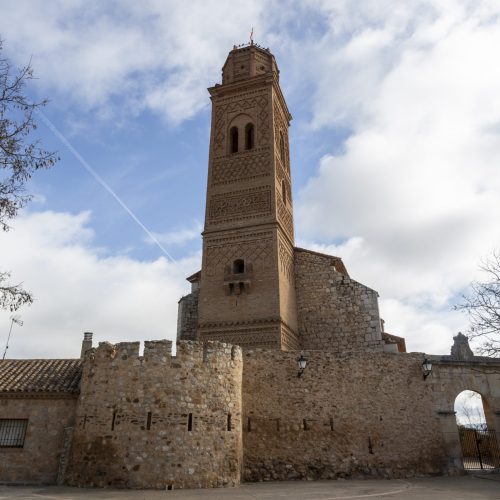
The church boasts a magnificent defensive tower that is somewhat older, dating from around 1400. At the bottom of the tower there is an entrance via a pointed arch. This entrance also provided access to the original church. The uppermost section of the tower was adapted to house the belfry.
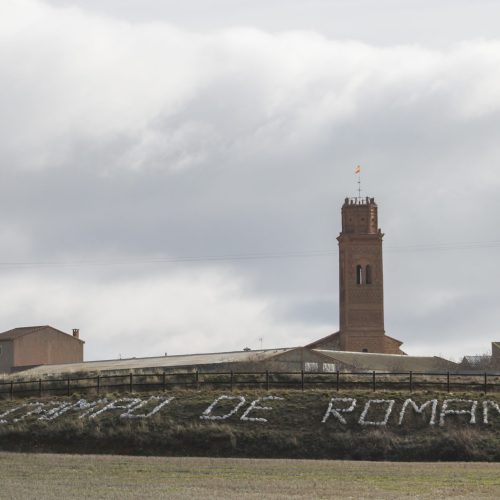
This tower is decorated with motifs that are common in Aragonese Mudejar art: bricks in zig-zag patterns, intertwining arches and angled brick patterns.

Interventions

Restoration, 20th to 21st century

The restoration mainly focused on the tower, with work being led by Javier Ibargüen, who left the addition at the top in place.

Declarations

Declaration, 20th century

Bibliography

Tierra Mudéjar. El mudéjar Aragonés, Patrimonio Mundial, Heraldo de Aragón, D.L. 2002

Fortified church of San Pedro Apóstol

Plaza Mayor, s/n.
50491 Romanos (Zaragoza)

Visit Romanos

City Hall: 976 803 909

WOULD YOU LIKE TO KNOW MORE? www.turismodezaragoza.es