Circular from the rural school

The “Circular from the rural school” project is a cooperation project between rural development groups led by the Asociación Territorio Mudéjar.

The following have participated in the project: ADRI Calatayud-Aranda, ADRI Jiloca-Gallocanta, FEDIVALCA -Valdejalón and Campo de Cariñena-, ASOMO Tarazona and el Moncayo, CEDEMAR -Bajo Aragón Caspe and Ribera Baja del Ebro-, ADRAE -Ribera Alta del Ebro- and ADEFO Cinco Villas.

The objective is to develop educational materials around the Mudejar identity of the towns, placing rural schools and the educational community of the towns as the center of the project.

Based on the work developed, for almost three years, the students of fifteen schools have designed a walk through their town in which we can learn about the main points of interest and their connection with the Mudejar culture.

Magallón

The route has been carried out following the working model of the schools that participated in the project and adapted to the town of Magallón.

Magallón has various traces of the different cultures that have inhabited the area in the past: Iberian, Roman, Arab and Jewish. One of its most outstanding symbols is the hermitage of Nuestra Señora de la Huerta, of which part of the perimeter walls and a beautiful seven-sided polygonal apse of which there are only two examples in the whole of Aragon.

1. History of the town

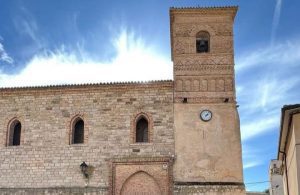
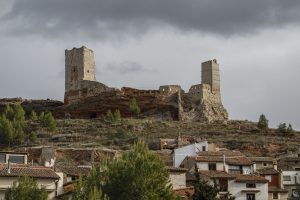
As has already been mentioned, different cultures have historically settled in the territory now occupied by Magallón. From this place we are going to explain its history: it was first an Iberian settlement and later a Roman settlement. We find the ancient Caravi on the promontories of the Castle and the Cabezo. Later this place was conquered by the Muslims and also populated by the Jews. The church where we find ourselves is called the church of San Lorenzo. The oldest part of this church is the bell tower, which would have been part of the tower of the 12th century medieval castle on the same site.

This point is linked to the didactic activity 1.

2. Coexistence of cultures

In Magallón we still have a Moorish and Jewish quarter. They are located on the slopes of what was once the castle and is now the church of San Lorenzo. The streets are narrow and winding, full of alleyways and lanes and the colour white predominates. The streets are white in colour in response to two reasons: on the one hand, to cope with the extreme weather conditions of the whole area, which are very hot in summer and very cold in winter. On the other hand, following the tradition of the Muslim dwelling, where life is lived indoors, thus preserving privacy. The Jewish quarter was located between the quarters that today are called Calentejo and San Miguel. The Moorish quarter was located in the vicinity of the church of Santa María de la Huerta.

This point is linked to the didactic activity 2

3. Importance of water and agriculture

For Islamic culture, water was a sacred asset. The abundance of water favoured the development of agricultural work and, therefore, the improvement and development of hydraulic engineering that can still be seen today: irrigation ditches, waterwheels, waterwheels and cisterns are some of the examples that we have preserved. In Magallón there is a fertile landscape bathed by the river Huecha.

This point is linked to the didactic activity 6

4. Construction materials

The materials used by the Mudejars are materials that can be found in the surroundings, what we would call, of proximity. The most common are clay, plaster, wood and alabaster. These materials appear in monuments, but they are also the ones used to build popular architecture, for example, in Magallón we have several examples of palaces that belonged to wealthy local families.

This point is linked to the didactic activity 3

5. Mudejar Architecture

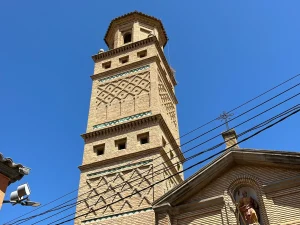
The church of Santa María de la Huerta was the temple of the convent that was located next door, and which today corresponds to the Casa de la Cultura building. The exterior is richly decorated, as the Mudejars needed decoration as a fundamental part of the construction of their spaces. Thus, they generated lights and shadows, which made the monument change depending on the light and weather conditions. It responded to a way of understanding the world based on their religion, which claimed that only God is permanent, and therefore all other things must be changeable and perishable. This is what we know as the aesthetics of “the mutable”. Today, the remains of the church have been restored as an auditorium because of its good acoustics.

This point is linked to the didactic activity 7

Related Works