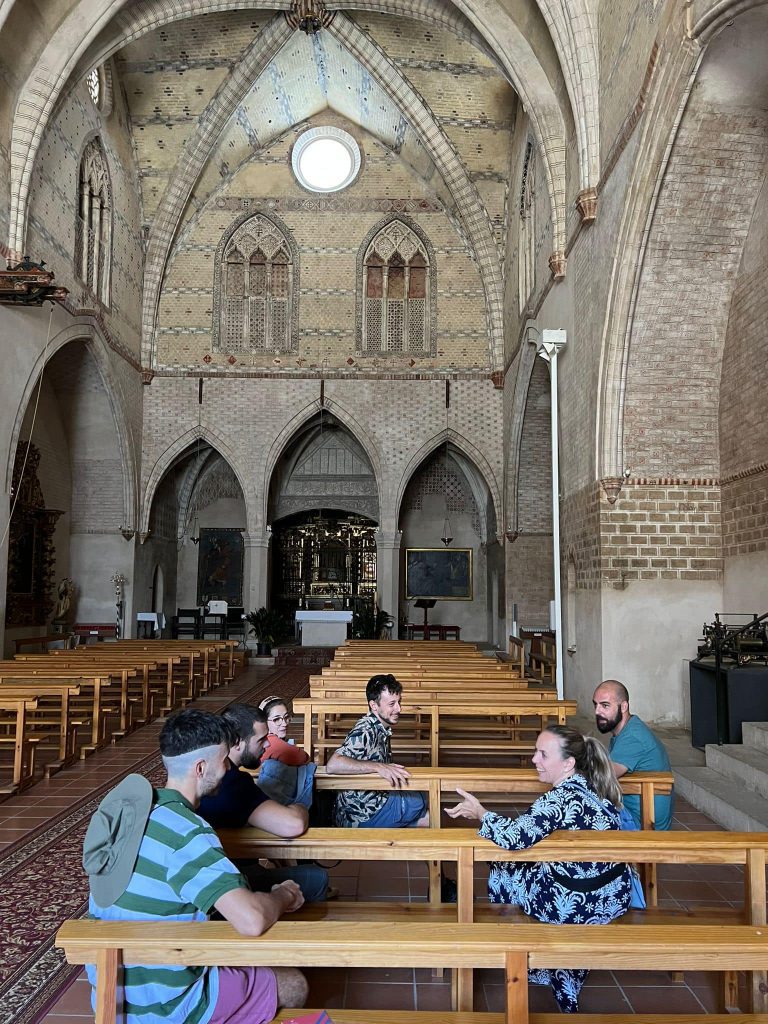
This weekend we have been in Cosuenda, in the open doors visit to the Torreón de La Lisalta, an activity financed by the City Council and with technical management of Territorio Mudéjar.
During the tour of the tower and the castle we also enjoyed a concert by “Camerata Patrimonio Sonoro”.
During the visit we remembered that the oldest medieval remains of Cosuenda are those of the castle, built in the 14th century to protect the town. It is called the Lisalta tower and is located in the highest part of the village, from where we can see the whole village and the Sierra de Algairén.
This weekend Ricla held its sixth Cherry and Tender Garlic Fair with tastings, samplings, producers’ stands and also Mudejar heritage.
We have been there with our travelling exhibition presenting the villages of Territorio Mudéjar and their heritage through two projects: an educational guide and walks for families and children, the result of the circular project.
Territorio Mudéjar is once again participating in the sixth edition of the Desafío programme – known as rural Erasmus -, an internship programme funded by the Diputación de Zaragoza and managed by the University of Zaragoza.
Thanks to this initiative, students and recent graduates will have work experience in rural areas of Zaragoza.
In this edition, six students from different fields of knowledge – all of them linked to heritage – will live and train in our partner towns.
Students will have the opportunity to work in the 43 partner locations and live for several months in our working environment.
Tobed, Daroca, Castejón de Valdejasa, Torrellas, Fréscano or Ricla could be one of the destinations, which will be evaluated with the selected students.
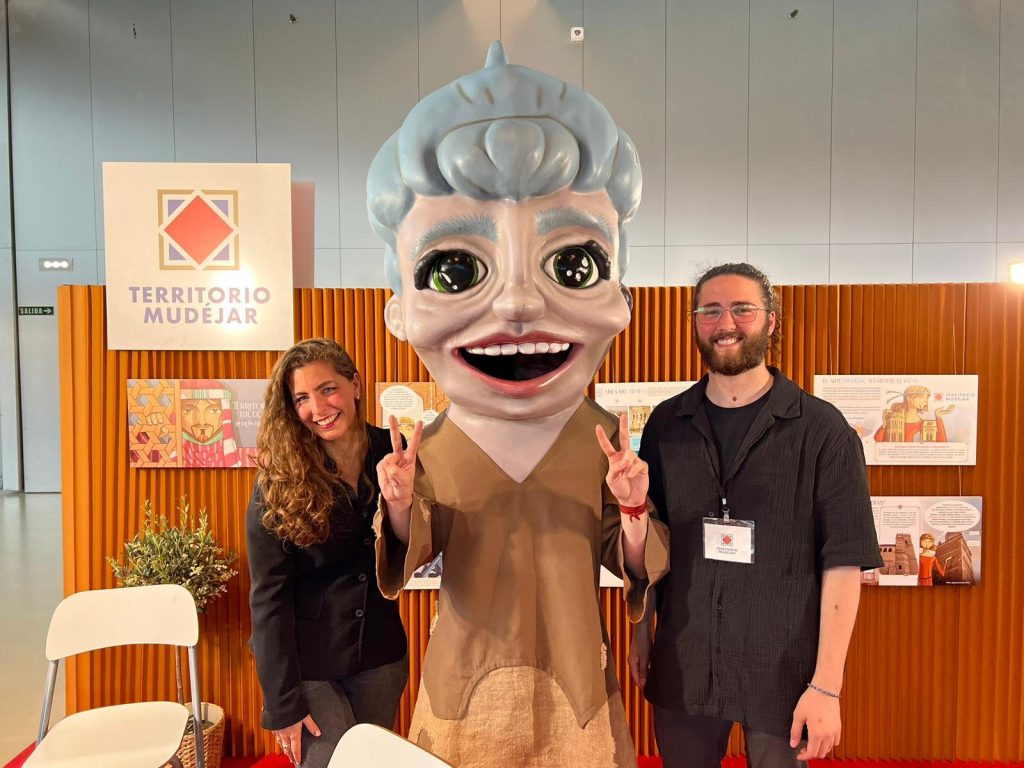
The Aragonese Tourism Fair, Aratur 2023, opened its doors this Friday, 12th May, at the Zaragoza Conference Centre, to offer the potential and wealth of the region at more than 60 promotional points, where Territorio Mudéjar is present, throughout the weekend until the 14th.
Our stand presents the villages through two projects:
– didactic guide
– walks for families and children, the result of the circular project.
We have been visited by the President of the Government Delegate, Rosa Serrano; the Deputy Mayoress of Zaragoza, Sara Fernández; the Director General of Tourism of the Government of Aragon, Gloria Pérez; the President of the Zaragoza Chamber of Commerce, Jorge Villarroya; and the President of the Zaragoza Trade Fair, Manuel Teruel.
The University of Zaragoza lecturers Pilar Biel, Pedro Luis Hernando and Jorge Jiménez also visited the stand. Also two students of the master’s degree in advanced studies
Admission is free and the opening hours are Friday, 12 May, and Saturday, 13 May, from 11.00 to 14.30 and from 16.30 to 20.30; and on Sunday, 14 May, from 11.00 to 14.30 and from 16.30 to 19.00.
We would like to share with you the festivals declared to be of tourist interest that are being celebrated these days in our partner towns.
Easter Week in ATECA is one of the 26 destinations in Aragon that have been declared a Festival of Tourist Interest in Aragon. The procession of the Holy Burial on Good Friday stands out with more than 300 people involved. The procession consists of 34 floats, including distinctive elements such as the skeleton of a woman symbolising Death. This is a human skeleton from the 17th century, about a metre and a half high, whose bones are strung together with wires, and which occupies the second place at the start of this central act.
Easter Week in TARAZONA is another of the celebrations recognised as a Festival of Regional Tourist Interest. The processions go through the intricate streets of this beautiful municipality. These days 12 processions will take place with more than a thousand brotherhoods and more than 50 official events.
CALATAYUD’s Holy Week, declared of Tourist Interest in Aragon, reaches its climax on Good Friday, when the very ancient procession of the Holy Burial, dating from the 15th century, sets off in the afternoon from the church of San Juan, el Real. Twenty-four processional floats made between the 17th and 20th centuries take part, carried by the 12 brotherhoods or penitential brotherhoods and more than 300 characters from the Old and New Testament. In the Plaza de España, the ancient Auto Sacramental del Entierro de Cristo is held.
Easter Week in TAUSTE has been declared a festival of tourist interest in Aragon and is impressive for the ceremonial richness of the rituals and the artistic excellence of the processions, some of which date back to the 17th and 18th centuries. During this week, processions such as the Encounter, the washing of the feet on Maundy Thursday, the procession of the Last Supper, the procession of the Proclamation or the Holy Burial take place.
These days we have visited Torralba de Ribota and Mesones de Isuela with the second year Art History group of the Conservation subject.
The people who will be the future of our profession experienced the use of real heritage for learning and enjoyed the architectural space as a classroom.
Thegroup was accompanied by teachers Gonzalo Preciado, Julio Gracia and María Ángeles Cejador.
In addition, Alfredo Notivol, guide of the Comarca del Aranda and former trainee of Territorio Mudéjar, was our cicerone in the castle of Mesones de Isuela.
The European project MOMAr (Models of Management for Singular Rural Heritage) led by the DPZ and in which we are a stakeholder has reached its goal with the last study visit.
It has done so after four years of work, with a meeting in the province of Zaragoza that has brought together more than 60 experts in the field of heritage management and political representatives from five participating countries (Spain, Romania, the Netherlands, the Czech Republic and Germany), as well as a large group of public and private entities from the province of Zaragoza that have been an active part of the project.
MOMAr has served to promote the exchange of good practices in heritage management in rural areas of the five partner countries, as well as the implementation of new management models in each of the participating territories.
Territorio Mudéjar has been an active part of this project, which has allowed us to expose our good practices in Europe, to meet very interesting initiatives and to participate in international projects.
The final MOMAr conference has given the opportunity to explore the challenges of managing cultural and natural heritage in rural areas and to discover how partners have successfully implemented different projects and strategies in response to the singularities of these territories.
At this meeting, the manual of good practices was presented and visits were made to the industrial salt heritage of the village of Remolinos, the Uncastillo Foundation, the ceramics workshop school in Muel, Fuendetodos – with the house where Goya was born and the museum of engravings – and Los Bañales.
It has been a pleasure to share this learning journey with all of you. The project ends, but we continue to stay in touch as allies.
Territorio Mudéjar and the Town Council of Fuentes de Ebro have signed the first special agreement between the entity and a partner town council to develop a strategic plan of sustainable tourism and heritage action through the insertion of emerging professionals and the development of a calendar of activities in that town.
The activities will consist of a recreational activity and a visit to Fuentes de Ebro guided by heritage professionals in which the Mudejar culture and its relationship with the town will be explored in depth. There will also be a dynamic of citizen participation to listen to the contributions that the neighbours want to make to the design of the strategic plan.
The agreement will last for six months. To develop it, the association Territorio Mudéjar has set up a work team made up of two young professionals who have been trained in the organisation thanks to the Desafío-Arraigo internship programme, better known as rural Erasmus, a pioneering project in Spain that the Diputación de Zaragoza and the University of Zaragoza launched in 2018 to enable university students to do internships in companies, institutions and associations in rural areas of Zaragoza. Territorio Mudéjar is collaborating with this project in 2019 and has made it possible to create a pool of emerging professionals with the necessary skills for the needs specified by the Fuentes de Ebro Town Council.
The team will be supervised by the project management area of the Territorio Mudéjar entity, which will define the strategic lines and integrate the locality’s own actions with the different innovation projects that Territorio Mudéjar has been developing since 2019 in its research stays and projects.
The mayoress of Fuentes de Ebro, María Pilar Palacín, explained that this agreement advances the local tourism strategy of the town, which seeks to make cultural resources, nature tourism and events visible to different target audiences. Among the heritage resources, she recalled that Fuentes de Ebro has the Gothic-Renaissance and Mudejar church of San Miguel, the Moorish and Jewish quarter in the town centre, vestiges of the civil war (trenches, machine gun nests) and the village of Rodén Viejo, declared a site of cultural interest; interesting post-war architecture and rationalist architecture (library), among others, to which are added the resources of landscape, gastronomy and nature.
The director of Territorio Mudéjar, Victoria Trasobares, added that this project is an interesting pilot model of collaboration with the partners that allows for progress in a line of work such as an “observatory” or “advisory committee” that the town councils can use to provide a strategic vision for their work in the management of local resources. Moreover, Trasobares added that “in the case of Fuentes de Ebro, the potential of the town and the great work done so far is evident, but also the intention to work with a vision of the future that would provide a link between the results of other previous projects such as: photography for different uses, the use of educational materials for families, the design of tourist awareness days or the impact of research actions on local development”.
This agreement will be a pilot test that could be extended to the rest of the partner municipalities that wish to incorporate emerging trained professionals who can be linked to the localities in the medium or long term, and introduce a way of working based on the quality and sustainability of the resources of the locality from a strategic and unitary supervision.
Calendar of activities:
The project began in January with various sectorial meetings and will continue with public activities from March with a calendar of conference-visits. The activities will have a fixed part (historical-artistic visit to the heritage of Fuentes -church and town planning- and to the historical complex of Rodén) and another thematic part that will change on each date with specialists or local experts:
Sunday 19 March: architecture and urban planning. Explanation of the urban development of Fuentes de Ebro and Rodén with specialists in the field linked to the town.
Sunday 16 April: Holy Week. Explanation of Easter Week linked to Fuentes de Ebro.
Sunday 7 May: Landscape and materials. Explanation of the extraction, work and use of the materials found in the area around Fuentes de Ebro, which are traditionally used for construction. Special emphasis will be placed on clay and alabaster. In addition, from the privileged enclave of Rodén, issues such as the explanation of the water resources and their importance in the configuration of the agricultural landscape that forms one of the signs of identity of Fuentes de Ebro and Rodén will be addressed.
Sunday 21 May: gastronomy and trade. Emphasis will be placed on local businesses and gastronomic traditions linked to the town of Fuentes de Ebro with various options such as micro-stops in invited businesses along the route and presentation of local products.
Sunday 11 June: activities for families. The visit will incorporate a didactic vision of the history of Fuentes de Ebro and Rodén through the different materials developed in the ‘Mudejar Pedagogy’ and ‘Mudejar Territory Circular’ projects.
Territorio Mudéjar currently has 40 member town councils in the province of Zaragoza and works to preserve and disseminate the Mudejar heritage as a driving force for local development.
We have the latest issue of Nsenzia magazine in which you can discover more about Territorio Mudéjar in a report that talks about our work and key projects.
Here is a sneak preview:
Montesquieu said that “happy are the people whose history is read with boredom”, because of the advantages of being aware of one’s roots and where we are going.
Nowadays it is something that is paraphrased but never put into practice, leading to a loss of identity and a host of petty mistakes. Fortunately, there is still a love of research and humanity.
Heritage, says Victoria Trasobares -director-, is the fourth pillar of development; this is how she conveys it in Territorio Mudéjar with an ambitious team in love with the possibilities of the historical identity of our territory.
A neat professional who knows the weight of the new generations, she offers an opportunity to students and professionals at different stages of their careers who are willing to reproduce such lessons, while discussing with them the best strategies to highlight the social function of the authentic spirit of each area.
The ‘Journey to Beauty’ route is a journey that faithfully traces the foundations of what rural evolution has presented and whose work has been adapted to the characteristics without leaving aside the present, as one of its objectives is to demonstrate – from the cultural fusion – how the chinks of the past are part of today. An ambitious work that not only deserves the recognition that characterises it: it is a clear example to follow in the protection of the echoes of a legacy.
Aragon conquered FITUR 2023 with its heritage and Territorio Mudéjar was there with our World Heritage brand that we were able to see in 360 degrees.
Once again this year, we attended the International Tourism Fair held at IFEMA (Madrid), one of the main international meetings of the tourism sector. The Aragonese stand this year focused on the cultural and natural assets of Aragon declared World Heritage by UNESCO: Aragonese Mudejar art, the Aragonese section of the Way of St. James, the Pyrenees-Monte Perdido and the Rock Art of the Mediterranean Arc.
In this way, the aim was to showcase the Community’s heritage and, at the same time, the wide range of leisure and active tourism activities and products such as ecotourism, wine tourism, astro-tourism, family tourism, gastronomy, slowdriving, etc.
The director of Territorio Mudéjar, Victoria Trasobares, attended the fair and accompanied the European Heritage Institute in the presentation of the network of medinas.
Utilizamos cookies para asegurarte la mejor experiencia en nuestra web. Puedes consultar más detalles
Funcionales
Always active
El almacenamiento o acceso técnico es estrictamente necesario para el propósito legítimo de permitir el uso de un servicio específico explícitamente solicitado por el abonado o usuario, o con el único propósito de llevar a cabo la transmisión de una comunicación a través de una red de comunicaciones electrónicas.
Preferencias
El almacenamiento o acceso técnico es necesario para la finalidad legítima de almacenar preferencias no solicitadas por el abonado o usuario.
Estadísticas
El almacenamiento o acceso técnico que es utilizado exclusivamente con fines estadísticos.El almacenamiento o acceso técnico que se utiliza exclusivamente con fines estadísticos anónimos. Sin un requerimiento, el cumplimiento voluntario por parte de tu Proveedor de servicios de Internet, o los registros adicionales de un tercero, la información almacenada o recuperada sólo para este propósito no se puede utilizar para identificarte.
Marketing
El almacenamiento o acceso técnico es necesario para crear perfiles de usuario para enviar publicidad, o para rastrear al usuario en una web o en varias web con fines de marketing similares.






 Luis Manuel García Vicén.


