Territorio Mudéjar: history from all its perspectives in the magazine Nsencia

We have the latest issue of Nsenzia magazine in which you can discover more about Territorio Mudéjar in a report that talks about our work and key projects.

Here is a sneak preview:

Montesquieu said that “happy are the people whose history is read with boredom”, because of the advantages of being aware of one’s roots and where we are going.

Nowadays it is something that is paraphrased but never put into practice, leading to a loss of identity and a host of petty mistakes. Fortunately, there is still a love of research and humanity.

Heritage, says Victoria Trasobares -director-, is the fourth pillar of development; this is how she conveys it in Territorio Mudéjar with an ambitious team in love with the possibilities of the historical identity of our territory.

A neat professional who knows the weight of the new generations, she offers an opportunity to students and professionals at different stages of their careers who are willing to reproduce such lessons, while discussing with them the best strategies to highlight the social function of the authentic spirit of each area.

The ‘Journey to Beauty’ route is a journey that faithfully traces the foundations of what rural evolution has presented and whose work has been adapted to the characteristics without leaving aside the present, as one of its objectives is to demonstrate – from the cultural fusion – how the chinks of the past are part of today. An ambitious work that not only deserves the recognition that characterises it: it is a clear example to follow in the protection of the echoes of a legacy.

Special interview on the anniversary of the declaration of the Mudejar as World Heritage in Nsencia magazine.

January brings us a special interview with the director of Territorio Mudéjar, Victoria Trasobares, in the latest issue of Nsencia, in which we take a closer look at the work of the organisation.

“We work on designing and developing strategies and implementing projects designed from a deep understanding of heritage resources as part of the development of rural communities and their inhabitants. We work in dispersed and sparsely populated places and with tailor-made models It’s no use copying what has been successful elsewhere, because it’s not the same to manage heritage in a town of 700,000 inhabitants as in another town of 100″, explains Victoria Trasobares.

And when asked if we still have a lot to know, he says: “Of course. The monuments and the context in which they are located influence the development of the communities and the territory. It is more necessary than ever to continue researching, but incorporating new visions, showing the work processes, the results, the people behind them and the proximity to the field”.

“We have launched 45 projects, 23 of which have arisen from the Gonzalo M. Borrás Gualis research stays and projects, an example of innovation inside and outside Spain. This initiative implements actions in pilot mode and offers results in research, communication and development-investment-financing. As an example, we have studied topics such as materials and techniques from the permanence of the trade, the conservation of buildings from the design of new uses while respecting historical uses, the communication of heritage and its social function, education and digitisation,” explains Victoria Trasobares.

How can projects be made to have an impact on the territory?

“With constant work, thinking strategically to highlight the uniqueness of our localities from the heritage point of view and looking for common lines of work. We try to connect with all the economic activities of the territory, generating high quality dynamics applied through professional networks. Perhaps our best skill is to find people with a forward-looking approach, who work in the medium or long term without losing sight of the present,” he adds.

One of your main actions to raise awareness of the Mudejar style has been the “Rutas Territorio Mudéjar, viaje a la belleza” (Mudejar Territory Routes, a journey to beauty). What does this temporary journey offer?

“The project is an example of the vision we have of heritage and its use for tourism. They are heritage routes to cultivate the spirit and to show a cultural leisure designed to suit the localities we visit, counting on the people. With our trainees, we are looking for a way to connect with new audiences. In this way, travellers find a heritage shown by professionals, with very careful logistics and personalised attention”.

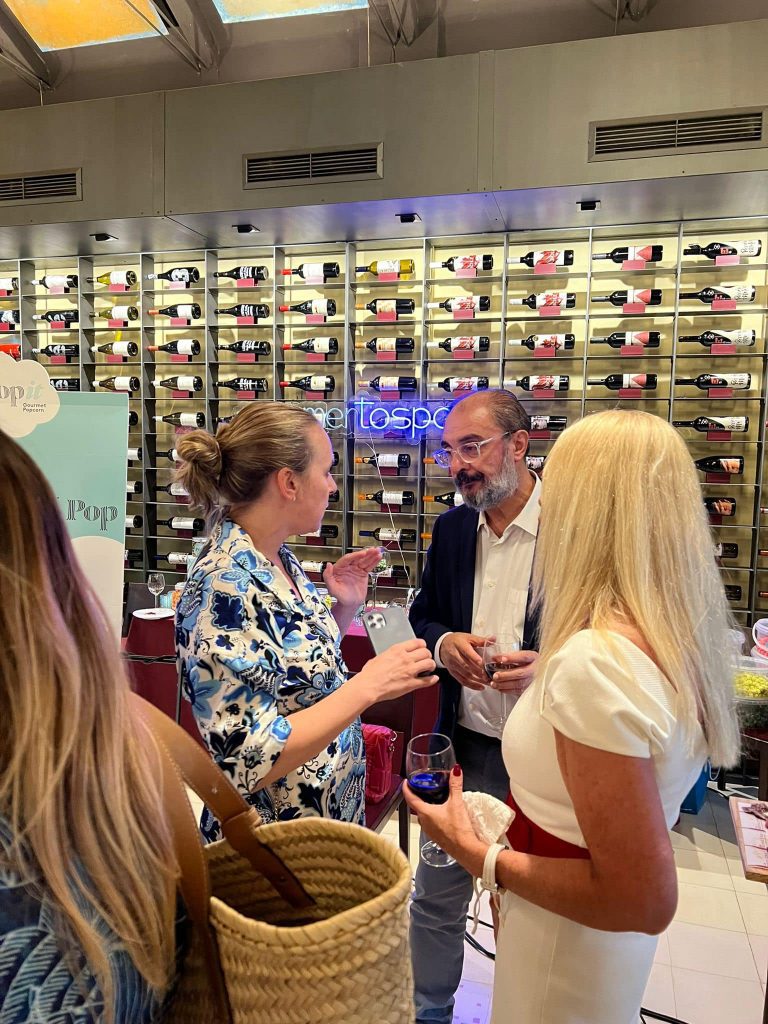
Territorio Mudéjar explores new collaborations in the event Atardecer con Zaragoza Nsencia in Ejea

It has been a pleasure to participate in ‘Atardecer con Zaragoza Nsencia’, an event held on the 28th of July at La Botillería in Ejea de los Caballeros. ?

There we explored new broadcasting collaborations and enjoyed the performance of the violagambist, vocalist and composer Pilar Almalé, and the Rondalla Cinco Villas, the best BSO for an afternoon of networking.

The event was attended by Javier Lambán, President of Aragón; Ros Cihuelo, Deputy for Culture of the DPZ; Elena Guinda, Director of INAEM, councillors from Ejea Town Council, businessmen and journalists, among others.