
Romanos
Village Territorio Mudéjar
Romanos field
Romanos holds within its firm medieval walls a rich history whose story unfolds in the shelter of the Alto Huerva, in an extensive high plateau.
One of the best examples of Mudejar architecture is preserved there, the tower of the church of San Pedro Apóstol. The church stands on the site of what was once the castle, a fortress whose three cylindrical towers and parapet can still be seen.
The tower is about 30 metres high and its characteristics date it to around 1400. It was used as a defensive watchtower, an example of the role played by the town during the Reconquest. Specifically, it belongs to the group of so-called gate towers.
Access to the interior is from the first floor, which reinforces its defensive function. The interior is divided into superimposed rooms covered with pointed barrel vaults.
Romanos holds within its firm medieval walls a rich history whose story unfolds in the shelter of the Alto Huerva, in an extensive high plateau.
One of the best examples of Mudejar architecture is preserved there, the tower of the church of San Pedro Apóstol. The church stands on the site of what was once the castle, a fortress whose three cylindrical towers and parapet can still be seen.
The tower is about 30 metres high and its characteristics date it to around 1400. It was used as a defensive watchtower, an example of the role played by the town during the Reconquest. Specifically, it belongs to the group of so-called gate towers.
Access to the interior is from the first floor, which reinforces its defensive function. The interior is divided into superimposed rooms covered with pointed barrel vaults.

Projects Territorio Mudéjar in Romanos
Monuments | View the project
Education | View the project
Project Mudetrad | View the project
Mudéjar educational, the guide | View the project
Urban planning preventive | View the project
“Circular” Walks with the family | View the project
Projects Territorio Mudéjar en Tobed
Recognition and promotion of traditional architecture through a a series of itineraries.
More information
Town hall: 976 803 909
Association for the Integral Rural Development of the lands of Jiloca and Gallocanta adri.es
VISIT ROMANOS
976 633 296
WOULD YOU LIKE TO FIND OUT MORE?
Tourism in Aragón
turismodearagon.com
Tourism in the Daroca region
turismo.comarcadedaroca.com
Centre for Darocan Studies Darocenses
ifc.dpz. es
Centre for Studies of Jiloca
www.xiloca.org
Territorio Mudéjar Network
The town council has been a founding member of Territorio Mudéjar since 13 September September of 2018.


Defense tower
The decoration of the tower is very rich and differentiates the different parts of the tower. The first, with almost smooth walls, is ornamented only at the top with a line of angled, zigzag and checkerboard patterns. The second has interlacing mixtilinear arches knotted at the top. On the west side of this second body there is a cantilevered balcony or matacán, which interrupts the decoration and reinforces its defensive function. The third section is decorated with a band of loops of eights, a Muslim decorative motif rarely used in Mudéjar towers and which also appears in the towers of Santa María de Calatayud and the tower of Quinto.
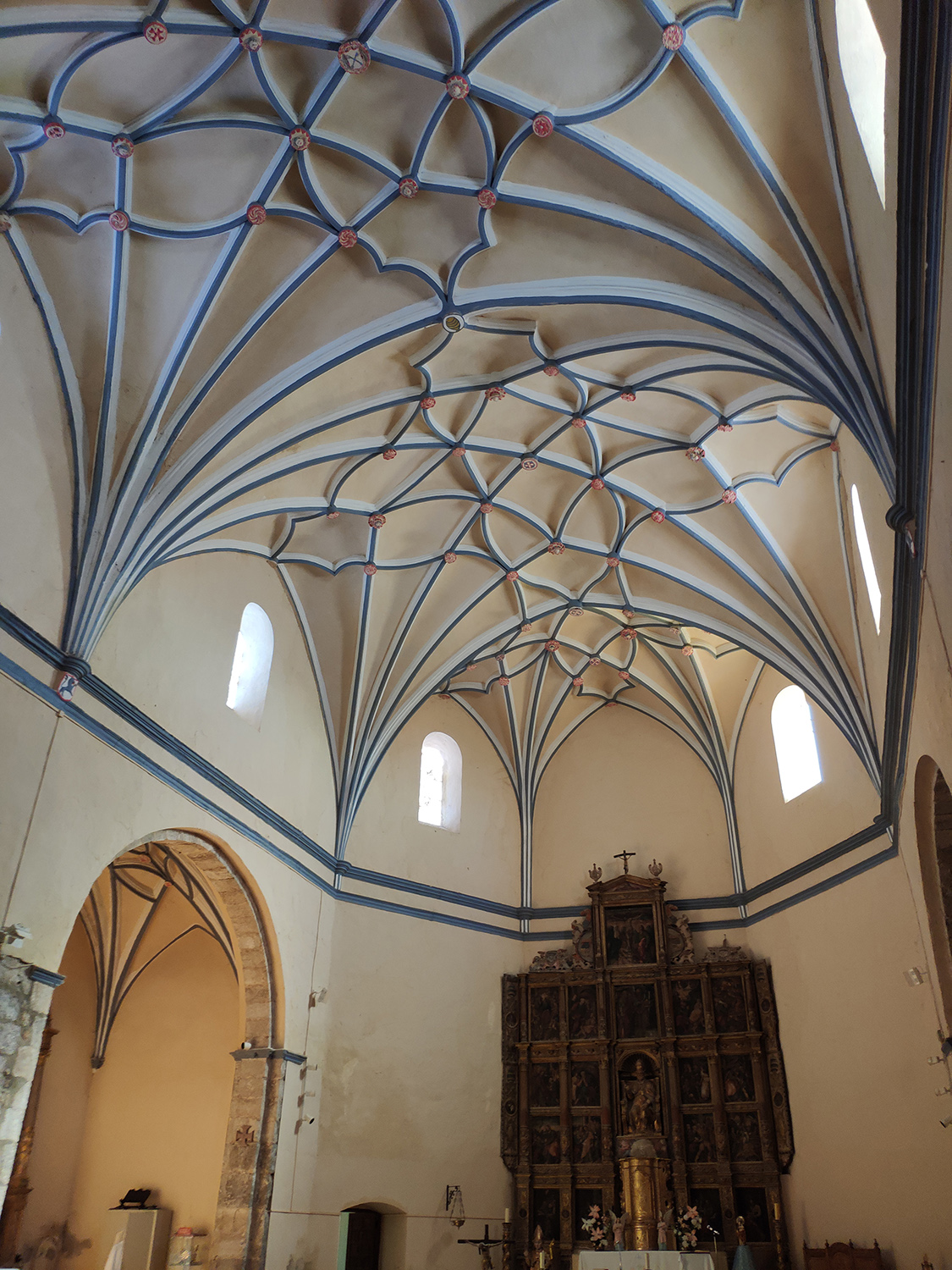
The church to which it is attached was built in masonry with ashlar stone reinforcements. Inside, it has a single nave with a polygonal apse and side chapels, and contains altarpieces from the 16th, 17th and 18th centuries, including the Renaissance main altarpiece dedicated to Saint Peter.
Romanos also has a hermitage dedicated to Nuestra Señora de los Remedios, a fountain from the Roman period and several peirons: the Virgen del Pilar and San Antonio de Padua.
The decoration of the tower is very rich and differentiates the different parts of the tower. The first, with almost smooth walls, is ornamented only at the top with a line of angled, zigzag and checkerboard patterns. The second has interlacing mixtilinear arches knotted at the top. On the west side of this second body there is a cantilevered balcony or matacán, which interrupts the decoration and reinforces its defensive function. The third section is decorated with a band of loops of eights, a Muslim decorative motif rarely used in Mudéjar towers and which also appears in the towers of Santa María de Calatayud and the tower of Quinto.
The church to which it is attached was built in masonry with ashlar stone reinforcements. Inside, it has a single nave with a polygonal apse and side chapels, and contains altarpieces from the 16th, 17th and 18th centuries, including the Renaissance main altarpiece dedicated to Saint Peter.
Romanos also has a hermitage dedicated to Nuestra Señora de los Remedios, a fountain from the Roman period and several peirons: the Virgen del Pilar and San Antonio de Padua.