
The first students of the Desafío 2020 Programme arrive at Territorio Mudéjar

The first students of the Desafío Programme, funded by the DPZ and managed by the University of Zaragoza, are already in Territorio Mudéjar learning and putting into practice applied cultural heritage management models. This is the third edition of an initiative that allows young university students to do work experience in towns in the province of Zaragoza and that seeks to help young people with ideas to reach – and stay – in rural areas.

“By showing students how we work with the heritage in these towns, we pave the way for them to choose how they want to focus their careers in the future, and we hope that this future is closely related to our region,” explains Victoria Trasobares, director of Territorio Mudéjar.

The team of Art History students participating in the Desafío Programme – María Foradada, María Domínguez, Elena López and Sarai Salvo – have been living since the beginning of August in the organisation’s headquarters, Tobed, where they are getting to know the work system. They are joined by Eugenia Gallego, María Irazabal and Derry Holgado, who are working from a distance.

The program’s first phase consists in an introduction to the entity and its working methods, familiarizing the students with the networking system and the partners involved: city councils, culture officials and individuals in charge of cultural and heritage dissemination programs, combining classroom learning with fieldwork. In addition, the students are being trained in the cultural heritage management project methodology by professionals in diverse disciplines such as project design and assessment, awareness of the applied management models implemented in our region, and in the fields of project dissemination management and communication.

The Challenge Programme – now in its third edition – is aligned with Territorio Mudéjar’s strategic objective of promoting curricular or training internships and professionalising profiles linked to heritage in order to boost employment in rural areas, attract professionals and develop projects that involve the conservation of our heritage and investment in our villages as a differentiating element.

What is special about Territorio Mudéjar? It is framed in the rural environment, it works in a network with 34 municipalities and with interdisciplinary professionals, it also works with an international brand such as the UNESCO World Heritage declaration of three of the monuments of its member towns and with a model that is committed to professionalism, scientific rigour, vanguard and sustainability and that makes the inhabitants of the villages an essential part of its projects.

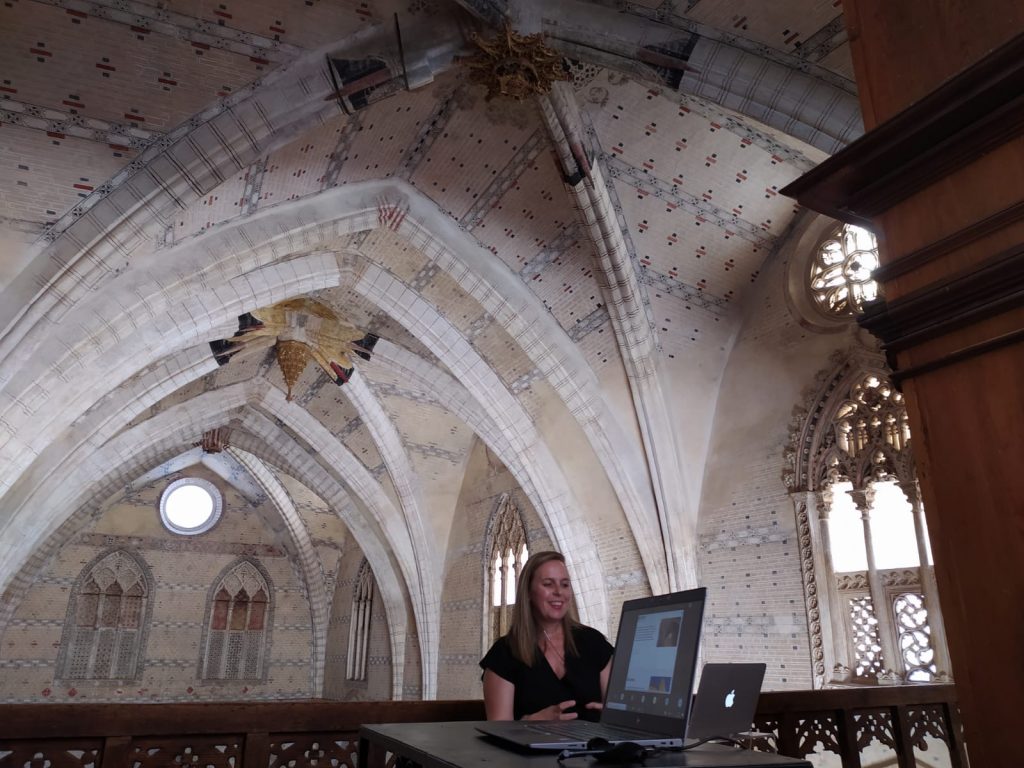
Territorio Mudéjar participates in the CortonaOpen3D workshop as an example of innovative heritage management

Territorio Mudéjar took part in the CortonaOpen3D workshop, a specialized course in computer graphics and smart city design applied to cultural heritage, which was held from August 1 to 10 in the Italian city of Cortona, in the province of Arezzo (Tuscany), to share its example of innovative management of artistic and historical heritage in a rural setting.

During this workshop, the participants work individually or as a group to develop an architectural design project or an art installation inserted into the context of the city of Cortona. To do this, they receive specialized training in different areas related to architecture.

In this regard, Victoria Trasobares, director of Territorio Mudéjar, gave a conference to explain the Territorio Mudéjar model “as a strategic example of heritage management: the project behind the projects”.

The lecture was streamed live from the town of Tobed and in it, Victoria Trasobares discussed how the Territorio Mudéjar network began and grew, outlined its activity program and, in line with the course contents, explained how a technological vision can guide the work of historical, artistic and cultural heritage management.

She also talked about the “Mudéjar Patrimonio Mundial 3D” (3D Mudejar World Heritage) project, a cross-disciplinary initiative led by Luis Agustín Hernández, architect and professor at the School of Engineering and Architecture of University of Zaragoza, aimed at revaluing Mudejar heritage. The project arose from the 2019 fieldwork grants and will continue in a major new cross-disciplinary, multi-university project between Spain and Italy. The University of Zaragoza (School of Engineering and Architecture, and the Art History department of the School of Humanities), the Polytechnic of Turin, Polytechnic of Milan and the University of Salerno will all take part.

In addition, the conference at CortonaOpen3D represented the first of numerous wide-ranging activities open to the students in the 2020 Challenge Program internships, an initiative funded by the Provincial Government of Zaragoza and managed by Universa, the job orientation and employment service of University of Zaragoza.

2019 Residencies: Mudejar Heritage and Learning, the pedagogical material: knowing the heritage to value it and devise rural development models

A multidisciplinary team of seven researchers has developed the research stay Landscape, cultural heritage and depopulation, which consists of the development of school materials that allow secondary school students to work in the classroom on the relationship between depopulation and cultural heritage in the villages of Territorio Mudéjar. The aim is for students to acquire skills that enable them to understand and value this heritage and to be able to formulate models and proposals for rural development that will enable them to tackle depopulation.

The materials are available in open access so that they can be used by other educational centres, thus promoting knowledge of Mudejar heritage outside the towns that form part of the Mudejar Territory. They can be accessed at: https://paisaje-patrimonio-cultural-y-despoblacin-cmzgz.hub.arcgis.com/

These materials introduce the use of ICT in the classroom, with tools similar to those already in widespread use in the professional world, and provide students with a tool for geographical analysis to work on the curricular content of the subject of Geography. Moreover, they are an educational resource that favours methodological and didactic renewal and the teacher can adapt them to the characteristics of his or her group or to specific students. All this with an online accompaniment, support and training in the use and development of this application during the course.

The materials produced are presented on a website organised into sections. On the one hand, there are multimedia applications on a specific thematic content that have been developed with Story Map Cascade, a template that allows combining narrative text, maps, images and multimedia content. In each application there are interactive maps to work with different layers of information and with activities and instructions for students. In addition, there are field project viewers for planning, capturing, analysing and presenting different field projects on intangible heritage, natural heritage, cultural heritage and landscape types. Finally, short explanatory videos on interactive maps and their tools have been added.

This project for Secondary completes Territorio Mudéjar’s initiative for Primary Education called “Rural school as the beginning of the circle” with which we want to introduce the way of working with heritage into the curricula of rural schools. The aim is for pupils to learn about and value the heritage that surrounds them and thus reinforce their roots and identity in their territory.

LINE OF RESEARCH (2) Mudejar Territory and cultural landscape

THE AUTHORS:

  • Carlos Guallart Moreno, coordinator of the project, graduate in Geography and History, master’s degree in Territorial and Environmental Organisation, Santa María del Pilar school (Zaragoza).
  • Noelia Cuartero Latorre, degree in Geography and Territorial Planning from the University of Zaragoza.
  • María Felisa Ferraz Gracia, PhD in Information and Documentation, Colegio Sagrado Corazón de Jesús (Zaragoza).
  • María Laguna Marín-Yaseli, PhD in Geography, Colegio El Salvador (Zaragoza).
  • Alfredo Ollero Ojeda, PhD in Geography, Zaragoza University
  • Beatriz Rodrigo Garza, BA in Art History and MA in Cultural Heritage Management, teacher at IES La Azucarera (Zaragoza).
  • Javier Velilla Gil, graduate in Geography and History and high school teacher at IES El Portillo (Zaragoza).

Stays 2019: Mudejar World Heritage 3D: digital graphic documentation and scholarly dissemination to revalue Mudejar architecture

The Mudejar World Heritage 3D project is a multidisciplinary initiative that proposes two complementary actions aimed at the revaluation of Mudejar heritage. On the one hand, a digital inventory has been carried out of several buildings and their virtual reconstruction using a combination of 3D scanning, photogrammetry and flight recording techniques – the Collegiate Church of Santa María in Calatayud, the church of Santa Tecla in Cervera de la Cañada, the church of the Virgin of Tobed, declared a UNESCO World Heritage Site, and the church of the Virgin of Tobed, declared a UNESCO World Heritage Site, the church of La Virgen de Tobed, declared UNESCO World Heritage Sites, which have completed a previous work carried out by the research group on the church of San Félix de Torralba and to which a previous phase of work on the church of Santas Justa y Rufina de Maluenda has been added. On the other hand, the materials have been designed to bring data collection and analysis techniques and technologies closer to the school environment in the villages of Territorio Mudéjar. The first action, of a scientific nature, has allowed the virtual reconstruction of these buildings, having a high impact on the scientific community. The second, of a participatory nature, has enabled the generation of value through the creation of a brand image, Territorio Mudéjar, with a high impact on the population of these towns.

The virtual survey of the 3D building consists of capturing the real geometry of the constructed building, with current point cloud technology, which allows buildings to be replicated with sufficient precision to guarantee its knowledge, at least virtually, in the event of any eventuality. Having a three-dimensional survey makes it possible to preserve a copy of the current state of the building with absolute precision that allows it to be replicated; it helps in its maintenance because, for example, through geometric knowledge it is possible to simulate structures, damp, etc. Furthermore, it is useful for the knowledge of the building and for its dissemination, as the three-dimensional model can be inventoried and placed in three-dimensional databases, allowing the building to be visible from anywhere in the world for its study. Even scale replicas can be made with a 3D printer.

As a second action, this project proposes initiatives to raise awareness among the inhabitants of the villages of Territorio Mudéjar that they possess emblematic assets of universal value. The most accurate way to create opinion and brand image – in this case the Territorio Mudéjar brand – is through schools, as the younger population is more apt to learn and more sensitive to the digital world. Therefore, in order to revalue Mudejar art, educational exhibitions and workshops are proposed in schools with the participation of teachers, AMPAs and researchers and through the project-based learning methodology.

LINE OF RESEARCH. (1) New perspectives on Mudéjar art.

THE AUTHORS:

  • Luis Agustín Hernández, architect, PhD in Mechanical Engineering and lecturer at the School of Engineering and Architecture of the University of Zaragoza.
  • Miguel Sancho Mir, architect, PhD in Architectural Graphic Expression and lecturer at the School of Engineering and Architecture of the University of Zaragoza.
  • Beatriz Martin Domínguez, architect and lecturer at the Polytechnic University School of La Almunia, University of Zaragoza.

Stays 2019: Mudejar plaster, its current use: searching the memory of craftsmen for the keys to traditional manufacture

The research stay El plaster mudéjar, su uso actual has been the continuation of Pedro Bel’s doctoral thesis in which he has been able to confirm that the manufacturing technique of Mudéjar plaster did not change until the middle of the 20th century. This research delves into the traditional plaster manufacturing process to gain an in-depth knowledge of it and to detect the catalysts and motivations that favoured the changes to the current plaster production system, which increases the quantity and decreases the quality. This project has located the old plaster craftsmen and has documented the technique and its current variables. To this end, quarries and old plaster kilns have also been visited, documenting their state and making a 3D photogrammetric survey of those of special interest; the buildings in the territory with Mudejar plaster in characteristic elements have been identified with files. The ultimate objective of the conclusions is to revitalise the work spaces linked to the construction trades by reactivating them through a local company dedicated to the manufacture of traditional or Mudejar plaster.

The research has been carried out in the towns of Aniñón, Borja, Calatayud, Daroca, Fuentes de Ebro, La Almunia de Doña Godina, Longares, Maluenda, Quinto de Ebro, Ricla, San Mateo de Gállego, Tauste, Terrer, Tobed, Villamayor, Villafeliche and Villar de los Navarros.

The study shows that until 1950, gypsum production processes were traditional and that after this date there was a continuous technological development of the quarries. Those which were not updated quickly became obsolete and went bankrupt, so that it is common to find undismantled baked gypsum kilns or warehouses with gypsum stored in the old Aragonese quarries. The semi-industrialisation that took place in the 1950s altered the traditional gypsum and the most influential variation was the replacement of manual crushing by mechanical crushing.

In terms of external factors, the high demography, which was linked to a favourable social and economic environment, led to a high demand for materials and therefore accelerated pre-industrialisation.

LINE OF RESEARCH. (1) New perspectives on Mudejar art.

THE AUTHOR. Pedro Bel Anzué is an architect and holds a PhD in Architectural Heritage Restoration from the University of Granada.

Stays 2019: Mudejar civil architecture, study of new uses with an impact on the territory

The project Mudejar civil architecture, study of new uses  is a multidisciplinary initiative in which a process of data collection has been developed with two main objectives. On the one hand, to obtain current and technologically advanced material on the civil architecture of the Mudejar Territory that preserves Mudejar elements. On the other hand, to propose phase 0 of a monumental management project that will allow these buildings to be put to use, thus contributing to their sustainability, their social function and their incorporation into the life of the villages.

This research is part of one of Territorio Mudéjar’s lines of action, which is to design new uses for heritage spaces: technical visits, teaching specific subjects, internship grants or other types of local activities.

The research is an analytical study, based on the management of Mudejar heritage, in order to establish a real action plan that will become a driving force for the cultural development of the population and an integrating element. To this end, the starting point of the study has been the original state of the cultural assets themselves, their subsequent development and action plans have been drawn up for each of the cases analysed. Specifically, the heritage of Daroca, Ateca, Illueca, Borja and Saviñán has been studied.

During the study, a methodology has been used to recreate monuments in 3D through photogrammetry: images have been taken with cameras and volumetric recordings using drones. Furthermore, the proposed action plans have been designed following the business model using Osterwalder’s Canvas model to develop the idea and Porter’s forces model for the competitive strategy.

In addition, the objectives of the European project “Heritage Houses for Europe. Exchange and Innovate” project based on measuring the positive impact of the preservation of family-owned heritage houses in Europe, analysing innovative and replicable business models, creating tools to support managers for the sustainable preservation of family-owned heritage houses, raising awareness of the family-owned heritage house sector and issuing recommendations to EU institutions to unlock the potential of the sectors.

LINE OF RESEARCH: (3) Cultural Heritage Management.

THE AUTHORS:

  • Ricardo Monreal Lafuente, art historian.
  • Alba Finol, art historian.
  • Daniel Finol, computer technician.

Stays 2019: Vernacular architecture in Mudejar villages: traditional techniques as a trade of the future in the rural world

The project Arquitectura tradicional vernácula, la técnica tradicional de construcción como oficio de futuro en el ámbito rural explains that monumental Mudejar architecture shares materials and techniques with the vernacular architecture of the villages. However, throughout the 20th century, industrial development has led to a strong process of transformation and destruction of vernacular buildings and the progressive abandonment of traditional construction systems. Faced with this situation, the importance of knowledge and appreciation of local traditional architecture and its materials has been raised in order to guarantee its protection by means of an inventory and general diagnosis of materials, techniques, architecture and current use.

This research project proposes that the understanding of local traditional architecture by users avoids its replacement by new buildings and favours the development of activities aimed at its conservation. Furthermore, the projection of this architecture outside the municipality reinforces its appreciation by the local population and favours the economic revitalisation of the villages, allowing them to offer cultural experiences of longer duration than a simple visit to their most outstanding monuments.

The work aims to contribute to the valuation of traditional architecture in the area of influence of Aragonese Mudejar art, promoting the perception of indigenous construction techniques as solvent and sustainable systems, and of the buildings constructed with them as a valuable cultural heritage that must be preserved and protected; to disseminate and enhance the work of the construction craftsmen present in the area, in order to facilitate the survival of the trades and encourage the use of traditional construction techniques in interventions on vernacular heritage; and to promote the conservation, restoration and compatible rehabilitation of the traditional architecture of the area and encourage the development of sustainable and culturally respectful tourism.

To this end, we have worked to identify and study the main construction techniques present in the traditional architecture of the Mudejar villages in the south of Zaragoza, to locate the construction craftsmen present in the area and document their work, to identify and study the dynamics of intervention in traditional architecture caused by tourism, and to draw up guidelines for the compatible intervention of traditional architecture in the area of influence of the Aragonese Mudejar.

The research has been carried out in Aniñón, Ateca, Belmonte de Gracián, Cervera de la Cañada, Cosuenda, Daroca, Longares, Maluenda, Romanos, Saviñán, Terrer, Tobed, Torralba de Ribota and Villafeliche.

LÍNEA DE INVESTIGACIÓN: (1) Nuevas Miradas sobre el arte Mudéjar.

THE AUTHOR: Javier Gómez Patrocinio is an architect with a Master’s degree in Architectural Heritage Conservation and a PhD in Building, Urban Planning and Landscape Architecture from the Polytechnic University of Valencia.