El Salvador tower, Teruel

El Salvador tower, Teruel

Calle el Salvador, 44001 Teruel

CURRENT PROTECTION STATUS: Asset of Cultural Interest (ACI)

TYPE OF ASSET: Property

CATEGORY: Religious

ARCHITECTURAL STYLE: Mudejar

CONSTRUCTION DATE:
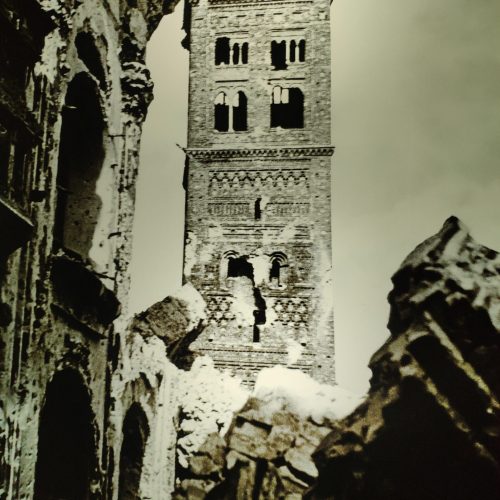
  • Original construction, 13th to 14th century. Repair, 17th century to 20th century. The addition of the belfry led to structural problems for the tower as a whole.
  • 17th century, partial substitution. The adjacent church of El Salvador collapsed in 1677 and was replaced by a Baroque structure in the late 17th century.
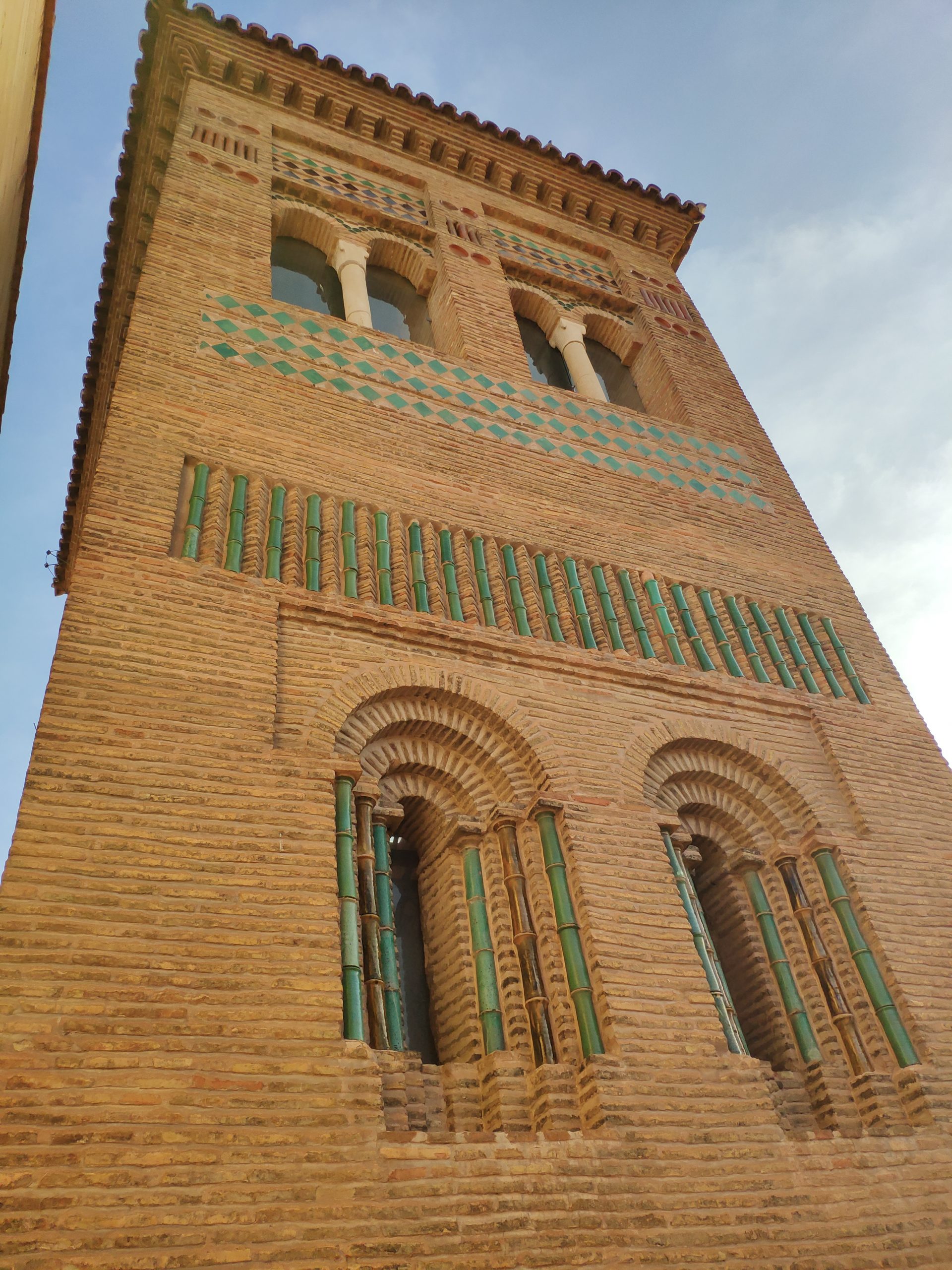
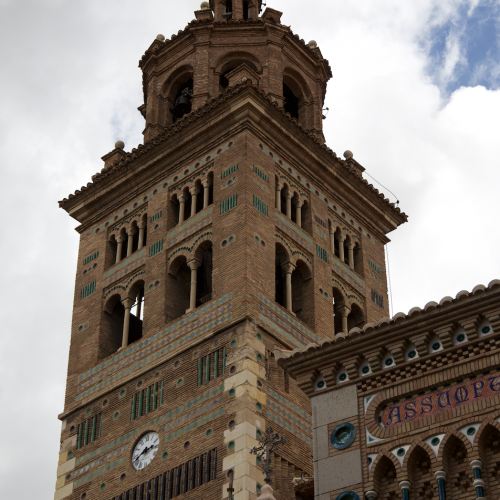
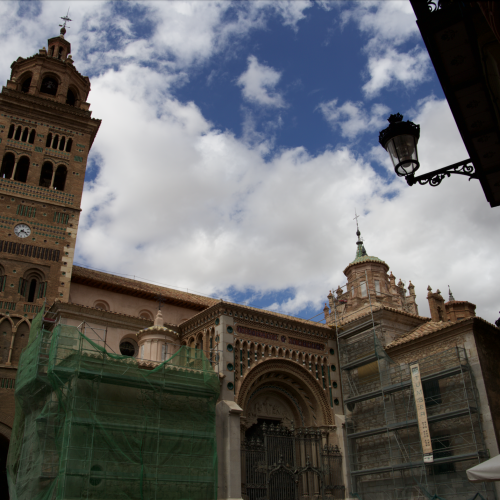
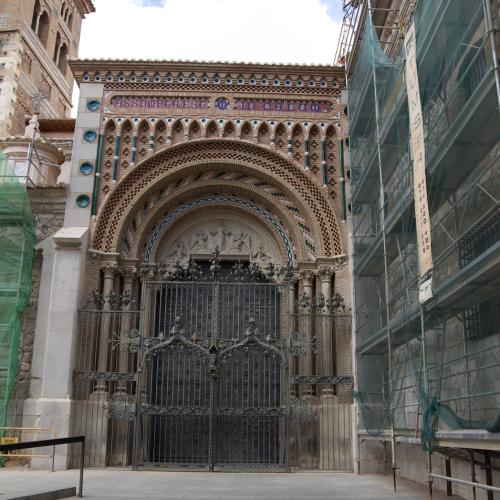
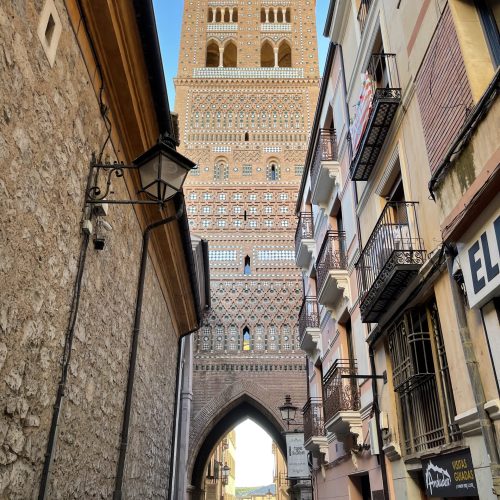
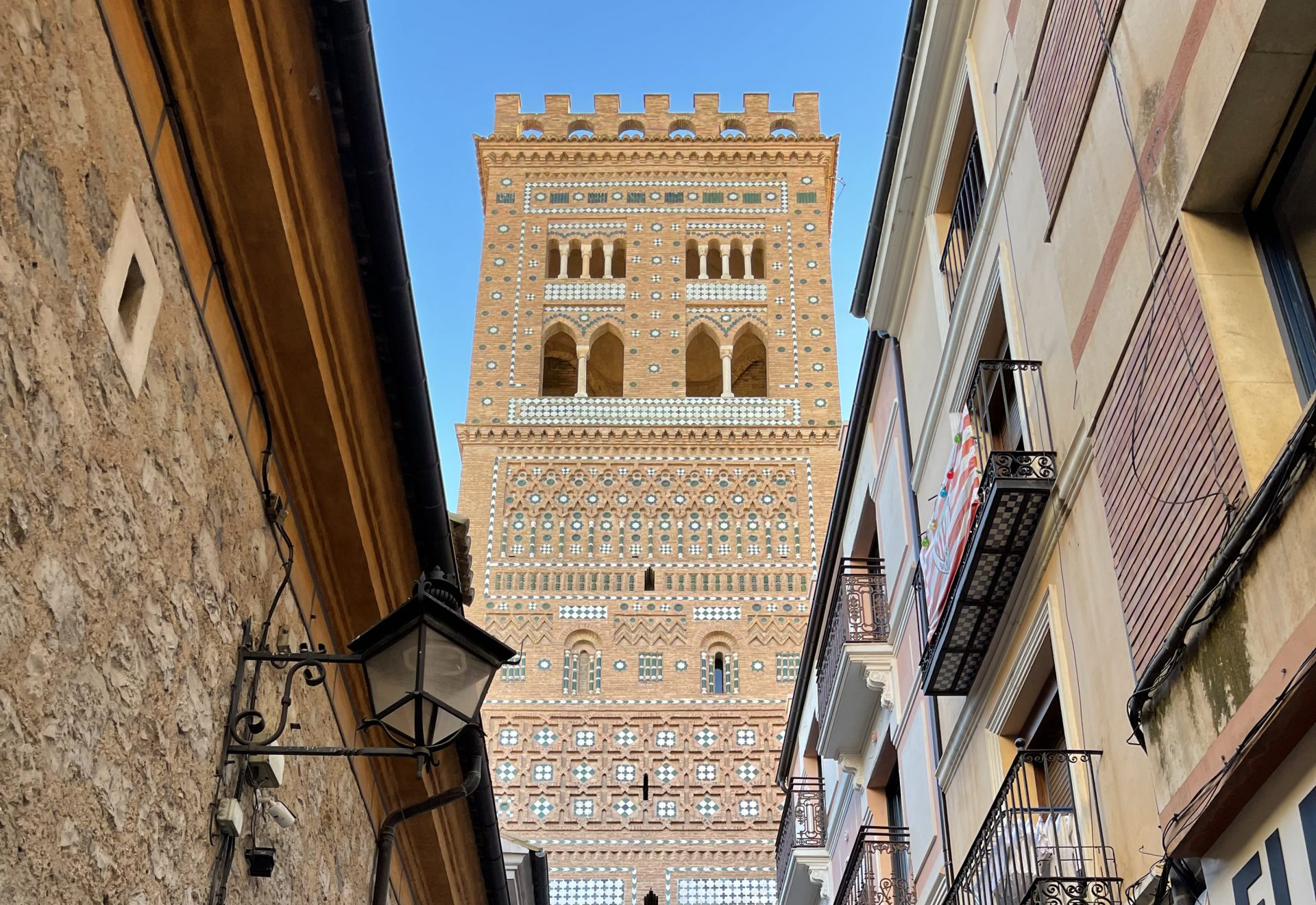
This is the most recent Mudejar tower in Teruel. It has a rectangular floor plan with three vertical sections and an Almohad minaret structure featuring two concentric towers with a stairway nestled between the two. The exterior tower is built of brick, whereas the interior one is made of plaster and masonry and divided into three stories, one above the other, covered by a rib vault (the lowest one) and pointed barrel vaults (the upper two); over this, there is a belfry on the exterior.

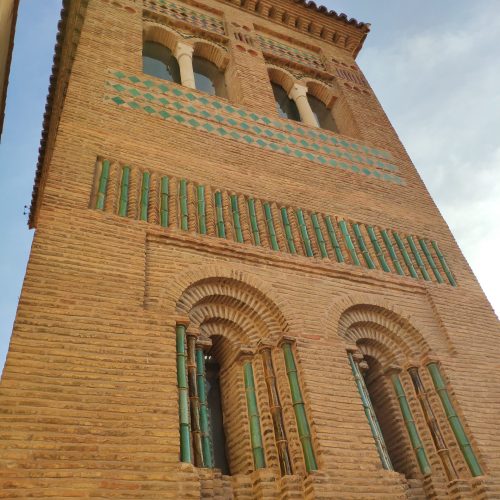
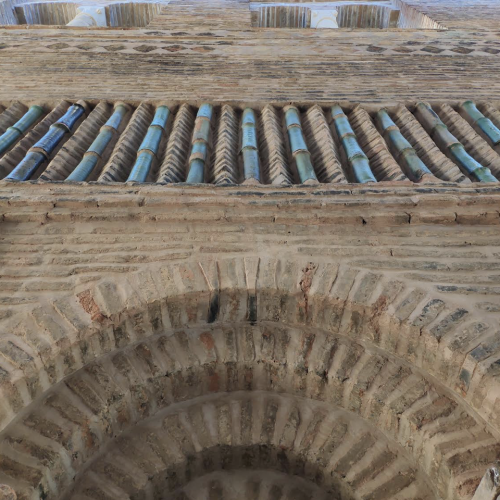
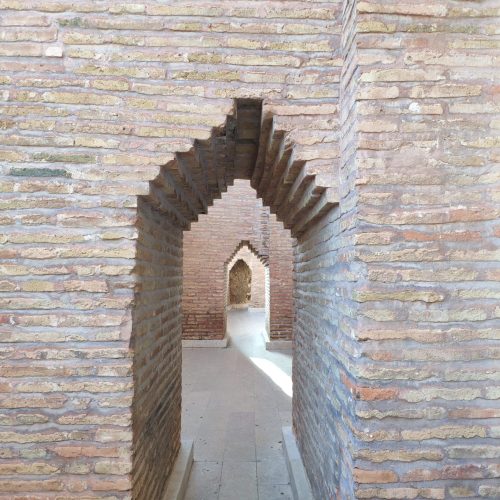
The lower section of the tower is pierced by a gate in the longer two façades, creating a passageway with a pointed arch covered by a quadripartite rib vault. All the decorative motifs ornamenting the tower are found above this level, featuring series of strips, panels and patterns framed by lines of tile work and angled brick: thus, in the first section of the tower there is a frieze of simple angled brick with a panel of intertwined mixtilinear arches above it; the arches rest on ceramic colonettes alternating with ceramic star details in green and white. Two more friezes of simple angled brick are seen above this panel, framing two beautifully decorated rectangular panels of ceramic tile with a small opening between them topped by a corbelled arch.
The second section of the tower has a panel of interlacing eight-point stars inset with ceramic motifs, over which there are two round-arched openings, brick detail work in a zig-zag pattern and another frieze of intertwined mixtilinear arches. Finally, the third section, or belfry level, features two rows of openings, with two pairs of pointed arches below and two colonnades of four round arches each above.

Located adjacent to the now-lost Guadalaviar Gate, the western entrance to the medieval compound of the city of Teruel, the tower of San Salvador is the only existing remnant of the Mudejar church and bell tower of the same name.
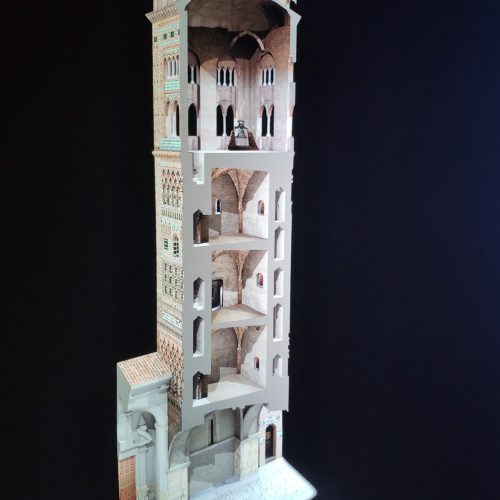
Interventions

Restoration, 20th century

The tower was restored between 1990 and 1993 by the Government of Aragon, which invested a total of 1,057,875 euros in the restoration work. The project succeeded in returning the building to its original splendor and adapted it for tours of the inside. The restoration project stemmed from the tower’s declaration as a UNESCO World Heritage Site, and was designed by architects Antonio Pérez Sánchez and José María Saz.

Projects and interventions

Declarations

Declaration, 20th to 21st century

The tower of the church of San Salvador was declared a National Monument under the Order dated March 10, 1911 issued by the Ministry of Public Instruction and Fine Arts, published in the Madrid Gazette on March 19, 1911. The original declaration was supplemented by the Asset of Cultural Interest declaration issued in the Department of Education, Culture and Sport Order of May 10, 2004, whereby the original declaration of the tower of the church of San Salvador in Teruel as an Asset of Cultural Interest is supplemented pursuant to Transitional Provision One of Aragonese Cultural Heritage Act 3/1999, of March 10. On November 28, 1986 UNESCO added the Mudejar architecture of Teruel to its World Heritage list, in which four of its most important monuments are included: the tower, ceiling and lantern tower of the Santa María de Mediavilla Cathedral, the tower and church of San Pedro, the El Salvador church tower and the tower of the church of San Martin.

Current condition
Conversion into a museum, 21st century. The tower now houses the Mudejar Interpretation Center.

Bibliography

ALCALÁ PRATS, ICÍAR, PÉREZ SÁNCHEZ, ANTONIO Y SANZ ZARAGOZA, JOSÉ MARÍA. La arquitectura mudéjar de Teruel: balance de veinte años como Patrimonio Mundial (1986-2006), en Turia (revista cultural) nº80 (nov. 2006 – feb. 2007), Instituto de Estudios Turolenses, Teruel, 2007, p. 361-377.

ALCALÁ PRATS, ICÍAR, REVILLA HERNANDO, ANA MARÍA Y RODRIGO GARZA, BEATRIZ. Guía del arte mudéjar en Aragón, Centro de Estudios Mudéjares, Prames, 2005.´

BORRÁS GUALIS, GONZALO M. Arte Mudéjar Aragonés, Caja de Ahorros de Zaragoza, Aragón y La Rioja, Zaragoza, 1985.

GALIAY, JOSÉ. Arte mudéjar aragonés, Institución Fernándo el Católico, Zaragoza, 2002. MÉNDEZ DE JUAN, JOSÉ FÉLIX, GALINDO PÉREZ, SILVIA Y LASHERAS RODRÍGUEZ, JAVIER. Aragón Patrimonio Cultural Restaurado. 1984/2009. Bienes inmuebles, Gobierno de Aragón, Zaragoza, 2010.

  • SANMIGUEL MATEO, AGUSTÍN. Torres de ascendencia islámica en las comarcas de Calatayud y Daroca, Centro de estudios bilbilitanos, institución “Fernando el Católico”, Calatayud, 1998.
  • ALCALÁ PRATS, Icíar. El arte mudéjar en la Comunidad de Teruel. En LOSANTOS SALVADOR, Antonio. (coord.). Comunidad de Teruel. Diputación General de Aragón, 2010.p. 185-196.
  • BENITO, Félix. Patrimonio histórico de Aragón: Inventario arquitectónico. Teruel. Zaragoza: Diputación General de Aragón, 1991. BORRÁS GUALIS, Gonzalo. Arte mudéjar aragonés. Zaragoza: CAZAR, 1985.
  • CABAÑERO SUBIZA, Bernabé. Las torres mudéjares aragonesas y su relación con los alminares islámicos y los campanarios cristianos que les sirvieron de modelo. Turiaso. 1995 , nº XII, p. 11-51.
  • HERNÁNDEZ MARTÍNEZ, Ascensión. La actuación de la Dirección General de Bellas Artes en Aragón (1938-1958): la labor de los arquitectos conservadores Manuel Lorente Junquera y Fernando Chueca Goitia. En GARCÍA CUETOS, María del Pilar; ALMARCHA NUÑEZ-HERRADOR, María Esther; HERNÁNDEZ MARTÍNEZ, Ascensión. (coord.). Restaurando la memoria: España e Italia ante la recuperación monumental de posguerra. Trea, 2010.p. 41-66.
  • LABORDA YNEVA, José. Teruel. Guía de Arquitectura. Zaragoza: Caja de Ahorros de la Inmaculada, 1996.
  • MORENO, María Ángeles. La reposición de azulejos de la torre del Salvador arrancará en abril. Heraldo de Aragón. 21/03/2018 p. 21.
  • MÉNDEZ DE JUAN, José Félix et al. (coord.). Aragón. Patrimonio cultural restaurado. 1984/2009: Bienes inmuebles. Zaragoza: Gobierno de Aragón, 2010.
  • NOVELLA MATEO, Angel. La transformación urbana de Teruel a través de los tiempos. Teruel: Instituto de Estudios Turolenses, 1988.
  • SEBASTIÁN, Santiago. Inventario artístico de Teruel y su provincia [En línea]. Madrid: Ministerio de Cultura, 1974.[Consulta: 11 de junio de 2021].
  • SEPÚLVEDA SAURAS, María Isabel. Torre de El Salvador. En El Mudéjar de Teruel. Patrimonio de la Humanidad. Instituto de Estudios Turolenses, 1989.p. 29- 31.
  • SERRANO PELLEJERO, Lucía . (dir.). El Mudéjar Aragonés, Patrimonio Mundial: Tierra Mudéjar. Zaragoza: Heraldo de Aragón, 2002.

El Salvador tower

Calle el Salvador,
44001 Teruel

Visit Teruel

City Hall: 978 61 99 00
wwww.teruel.es
WOULD YOU LIKE TO KNOW MORE?
www.turismo.teruel.es

The church of San Pedro, Teruel

The church of San Pedro, Teruel

C/ de Hartzenbusch, 44001 Teruel CURRENT PROTECTION STATUS: Asset of Cultural Interest (ACI)

TYPE OF ASSET: Property

CATEGORY: Religious

ARCHITECTURAL STYLE: Mudejar

CONSTRUCTION DATE:

  • Original construction, 14th century. The current church of San Pedro dates from the 14th century. It was built over a previous Romanesque temple documented in 1196.
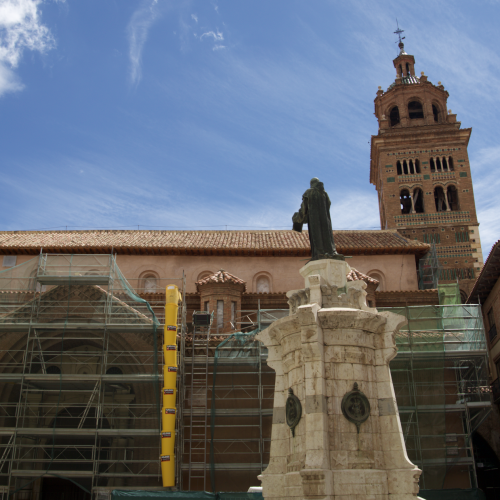
  • Remodeling, 14th to 18th century. After the construction of the Mudejar tower at the west end in the 13th century, the church was remodeled between 1319 and 1392. The cloister dates from 1383. The tower is also from the 13th century, with a Neo-classical top from 1795.
  • Fire, 19th century. The church caught fire in 1873.
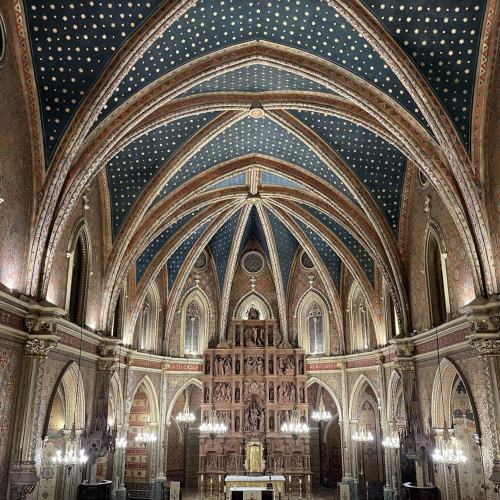
  • Remodeling, 19th century. After the fire, the interior was remodeled in the Neo-Gothic style.
The church of San Pedro belongs to the group of fortified churches. It is adapted for defensive purposes through the creation of a gallery running above the side chapels. Thus, the church has a typical Mudejar structure with a single

nave opening onto chapels between the buttresses and a polygonal east end, entirely covered by quadripartite rib vaults. There is also a gate tower erected at the west end, based on a Christian structure that is related to the cathedral tower, decorated on the exterior with intertwining arches and round-arched embrasured openings.

The temple has a single nave divided into three rectangular bays with a seven- sided polygonal east end. A ring of chapels set between the buttresses surrounds the entire nave and even the east end. Both the chapels and nave are covered by a quadripartite rib vault with triple torus molding on the ribs, which rest on columns in the apse and on corbels along the nave walls. The second story consists of a gallery that surrounds the east end of the church above the chapels opening onto it, the sections of which are connected through openings between the buttresses that are topped by narrowing courses of bricks.

This gallery, covered by a quadripartite rib vault, does not continue above the chapels that open onto the nave, as might be expected in a church of this kind. However, it is possible to walk around the temple on top of the chapel roofs, passing through the openings created in the buttresses. The exterior of the apse is the most lavishly decorated area, featuring panels of intertwined mixtilinear arches set between strips of angled brick at the bottom and a frieze of ceramic eight-point stars at the top of the wall. In addition, the apse buttresses extend

vertically by means of narrow octagonal towers that give the church an Orientalized appearance, imitating those of the parish church in Montalbán.
The church has an attached cloister with a square floor plan, the bays of which are divided into five sections covered by a rib vault.

The gate tower stands at the west end of the church, leading from the street to the church at the bottom through a pointed arch with two rows of voussoirs and a pointed barrel vault. Structurally, the tower can be categorized as a Christian tower, with its interior divided into different levels. The exterior decoration consists of a frieze of intertwining round arches with brick voussoirs; a cornice

of brick corbels separates the lower section from the upper, which features pairs of round-arched embrasured openings, over which there is a strip of green ceramic cylinder shapes.

The belfry, which was reconstructed in the restoration carried out by the architect Manuel Lorente after the Spanish Civil War, is pierced with two pairs of round-arched coupled windows resting on a central colonette, and this upper section is decorated with green and manganese Mudejar ceramic ornamentation.

This is an example of a fortified church. The present-day church was under construction by around 1319 and references to the construction of the cloister date back to 1383. The tower erected at the west end of the church may date from around 1350, based on its similarities to that of the cathedral of Teruel.

Interventions

Restoration, 20th to 21st century

From 1993 to 2005, the Government of Aragon and Ibercaja undertook restoration work affecting the tower, church and cloister as a whole. To this end, a budget in excess of 3 million euros was allocated.

Renovation, 21st century

In June 2008, the cloister of San Pedro opened to the public after a complete renovation funded by the Department of Regional Policy, Justice and the Interior, which provided 1.6 million euros. Fundación Amantes, consisting of the Government of Aragon, the Provincial Government of Teruel, the Teruel City Council, the Archbishopric of Teruel and Ibercaja, organized an open house with guided tours. The Government of Aragon continues to pursue its goal of enhancing and spotlighting the cultural heritage of the city of Teruel through new initiatives including a call for proposals for the Plaza de los Amantes restoration project. The public square to be renovated is an emblematic space in which the church of San Pedro and the Mausoleum of the Lovers of Teruel converge. The aim of the restoration is to improve access to the Fondero cistern and the mausoleum, to renovate the façade of Casa Hinojosa and to spotlight the church of San Pedro and its tower.

Declarations

Declaration, 20th to 21st century

The church of San Pedro in Teruel was declared a Historical and Artistic Monument under the Ministry of Public Instruction and Fine Arts Decree of June 3, 1931, published in the Madrid Gazette on June 4, 1931.

On November 28, 1986 UNESCO added the Mudejar architecture of Teruel to its World Heritage list, in which four of its most important monuments are included: the tower, ceiling and lantern tower of the Santa María de Mediavilla Cathedral, the tower and church of San Pedro, the El Salvador church tower and the tower of the church of San Martin.
The Official Gazette of Aragon dated July 2, 2004 published the Department of Education, Culture and Sport Order of June 16, 2004, whereby the original declaration of the church of San Pedro as an Asset of Cultural Interest is supplemented pursuant to Transitional Provision One of Aragonese Cultural Heritage Act 3/1999, of March 10, including the environment affected by the declaration.

Current condition

After the fire sparked by lightning in 1873, the church required serious renovation work in the early 20th century: the cloister was remodeled by Pablo Monguió Segura in 1901, continuing with the interior of the church some years later, in 1909, who transformed the Mudejar interior into the Neo-Gothic space seen today with the assistance of the painter Salvador Gisbert. The tower has also been modified throughout its history: the original belfry was filled in in 1795 in order to add a new Neo-classical top section, which was removed after the Spanish Civil War during the restoration work led by Manuel Lorente Junquera, thus bringing back the original belfry.

Bibliography

ALCALÁ PRATS, ICÍAR, PÉREZ SÁNCHEZ, ANTONIO Y SANZ ZARAGOZA, JOSÉ MARÍA. La arquitectura mudéjar de Teruel: balance de veinte años como Patrimonio Mundial (1986-2006), en Turia (revista cultural) nº80 (nov. 2006 – feb. 2007), Instituto de Estudios Turolenses, Teruel, 2007, p. 361-377.

ALCALÁ PRATS, ICÍAR, REVILLA HERNANDO, ANA MARÍA Y RODRIGO GARZA, BEATRIZ. Guía del arte mudéjar en Aragón, Centro de Estudios Mudéjares, Prames, 2005.

ARCE OLIVA, E. Una obra desconocida del taller de Gabriel Joly: las imágenes de los santos Cosme y Damián en la ig, Revista Artigrama, Nº 11, 1994. pp 381-388.

BENITO MARTÍN, F. Patrimonio Histórico de Aragón. Inventario Arquitectónico de Teruel, Gobierno de Aragón, Zaragoza, 1991, pp.122-123.

BORRÁS GUALIS, G. Arte Mudéjar Aragonés, Caja de Ahorros de Zaragoza, Aragón y La Rioja, Zaragoza, 1990.

  • GALIAY, J. Arte mudéjar aragonés, Institución Fernándo el Católico, Zaragoza, 2002.
  • LABORDA YNEVA, J. Teruel, Guía de Arquitectura, Caja de Ahorros de la Inmaculada, Zaragoza, 1996.
  • MÉNDEZ DE JUAN, JOSÉ FÉLIX, GALINDO PÉREZ, SILVIA Y LASHERAS RODRÍGUEZ, JAVIER. Aragón Patrimonio Cultural Restaurado. 1984/2009. Bienes inmuebles, Gobierno de Aragón, Zaragoza, 2010.
  • AA. Teruel Mudéjar. Patrimonio de la Humanidad, Caja de Ahorros de Zaragoza, Aragón y Rioja, Zaragoza, 1991.
  • AA. Tierra Mudéjar. El mudéjar aragonés, Patrimonio Mundial, Heraldo de Aragón, D.L. 2002.
  • ALCALÁ PRATS, Icíar. El arte mudéjar en la Comunidad de Teruel. En LOSANTOS SALVADOR, Antonio. (coord.). Comunidad de Teruel. Diputación General de Aragón, 2010.p. 185-196.
  • ARCE OLIVA, Ernesto. Círculo de Gabriel Joly. Flagelación. En MORTE GARCÍA, Carmen. (dir.). El esplendor del Renacimiento en Aragón : Museo de Zaragoza: febrero-mayo de 2010. Gobierno de Aragón, 2009.p. 202-203.
  • ARCE OLIVA, Ernesto. Una obra desconocida del taller de Gabriel Joly: las imágenes de los santos Cosme y Damián en la iglesia de San Pedro de Teruel. Artigrama. 1994-1995 , nº 11, p. 381-388.
  • BARLÉS BÁGUENA, Elena. La iglesia parroquial de San Pedro. En El Mudéjar de Teruel. Patrimonio de la Humanidad. Instituto de Estudios Turolenses, 1989.p. 35-37.
  • BARLÉS BÁGUENA, Elena; Calvo Ruata, José Ignacio. Torre de San Pedro. En El Mudéjar de Teruel. Patrimonio de la Humanidad. Instituto de Estudios Turolenses, 1989.p. 24-25.
  • BENITO, Félix. Patrimonio histórico de Aragón: Inventario arquitectónico.Teruel. Zaragoza: Diputación General de Aragón, 1991
  • BORRÁS GUALIS, Gonzalo. Arte mudéjar aragonés. Zaragoza: CAZAR, 1985. CABAÑERO SUBIZA, Bernabé. Las torres mudéjares aragonesas y su relación con los alminares islámicos y los campanarios cristianos que les sirvieron de modelo. Turiaso. 1995 , nº XII, p. 11-51. Encargada la obra para cerrar la restauración de San Pedro. Heraldo de Aragón. 18/12/2012 p. 17. FRANCO, Leonor. El coro y los púlpitos de la iglesia de San Pedro protegidos contra la carcoma. Heraldo de Aragón. 04/07/2018 p. 21.
  • GALINDO PÉREZ, Silvia. (coord.). Aragón. Patrimonio cultural restaurado. 1984/2009: Bienes muebles. Zaragoza: Gobierno de Aragón, 2010.
  • HERNANDO SEBASTIÁN, Pedro Luis. Cofres y arcas medievales en Aragón: Referencias documentales y estudio de su significado a partir del cofre de bodas italiano de la iglesia de San Pedro de Teruel. Artigrama. 2008 , nº 23, p. 427-441.
  • HERNÁNDEZ MARTÍNEZ, Ascensión. La actuación de la Dirección General de Bellas Artes en Aragón (1938-1958): la labor de los arquitectos conservadores Manuel Lorente Junquera y Fernando Chueca Goitia. En GARCÍA CUETOS, María del Pilar; ALMARCHA NUÑEZHERRADOR, María Esther; HERNÁNDEZ MARTÍNEZ, Ascensión. (coord.). Restaurando la memoria: España e Italia ante la recuperación monumental de posguerra. Trea, 2010.p. 41-66.
  • JIMÉNEZ MARTÍNEZ, Antonio; Silvestre Adivinación, María. La restauración de bienes muebles desarrollada por la Fundación Santa María de Albarracín. Compendio general. Rehalda. 2014 , nº 20, p. 207-223.
  • LABORDA YNEVA, José. Teruel. Guía de Arquitectura. Zaragoza: Caja de Ahorros de la Inmaculada, 1996. MORENO, María Ángeles. Restauran un retablo de la iglesia de San Pedro obra de Gabriel Joly dañado por la carcoma. Heraldo de Aragón. 11/11/2018 p. 25.
  • MORENO, María Ángeles. San Pedro de Teruel recupera el retablo de la capilla donde fueron hallados los Amantes. Heraldo de Aragón. 14/01/2019 p. 57.
  • MÉNDEZ DE JUAN, José Félix et al. (coord.). Aragón. Patrimonio cultural restaurado. 1984/2009: Bienes inmuebles. Zaragoza: Gobierno de Aragón, 2010.
  • NOVELLA MATEO, Angel. La transformación urbana de Teruel a través de los tiempos. Teruel: Instituto de Estudios Turolenses, 1988.
  • PÉREZ SÁNCHEZ, Antonio. El Claustro de San Pedro. En LOSANTOS SALVADOR, Antonio. (coord.). Comunidad de Teruel. Diputación General de Aragón, 2010.p. 197-198.
  • SEBASTIÁN, Santiago. Inventario artístico de Teruel y su provincia [En línea]. Madrid: Ministerio de Cultura, 1974.[Consulta: 11 de junio de 2021].
  • SERRANO PELLEJERO, Lucía . (dir.). Tierra mudéjar: el mudéjar aragonés. Patrimonio mundial. Zaragoza: Heraldo de Aragón, 2002.

The church of San Pedro

C/ de Hartzenbusch,
44001 Teruel

Visit Teruel

City Hall: 978 61 99 00 wwww.teruel.es WOULD YOU LIKE TO KNOW MORE? www.turismo.teruel.es

Santa María de Mediavilla Cathedral, Teruel

Santa María de Mediavilla Cathedral, Teruel

Pl. de la Catedral, 3, 44001 Teruel

CURRENT PROTECTION STATUS: Asset of Cultural Interest (ACI)

TYPE OF ASSET: Property

CATEGORY: Religious

ARCHITECTURAL STYLE: Mudejar

CONSTRUCTION DATE:
  • Original construction, 12th to 13th century. Construction of the Santa María de Mediavilla parish church began in 1171, according to documentary evidence, and ended with the Mudejar tower at the west end in 1257. The bell tower, the final element from this early stage, used Mudejar language and served as a stylistic role model for the other towers of the capital of Teruel.

  • 13th to 14th century. With the original construction still in good condition, remodeling began on the church of Santa María de Mediavilla at a time of economic vitality for the city. In the second half of the 13th century, the side aisles were raised more than three meters in height, respecting the previously existing difference between the central nave and the aisles but covering over the original openings while creating new ones in a system based on the Gothic style. The number of pillars separating the bays was also reduced to half. The Morisco master builder Juzaff oversaw the construction work.

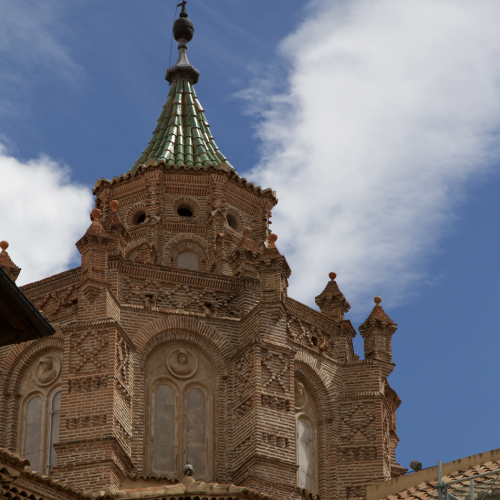
  • 14th century. In 1342, Santa María became a collegiate church, prompting yet another remodeling. The original chancel, outgrown with the addition of the new bays, was expanded with the construction of a crossing, and the apses were replaced with new ones. In addition, the central nave was equipped with a new covering consisting in a magnificent painted ceiling that was lighter weight and more appropriate. The crossing and new Mudejar apses, designed by master builder Yuçaf de Huzmel, were also coated in plaster and decorated. Expansion, 16th to 17th century. In 1537 Juan Lucas, also known as Botero, whose designs included the lantern towers of the cathedral of San Salvador in Zaragoza and of the cathedral of Tarazona, laid out the designs for the new Mudejar lantern tower. It was completed in 1538 under the supervision of Martín de Montalbán, replacing the medieval tower and providing more light for the recently installed main altarpiece by Gabriel Joly. In the late 17th century, a rectangular ambulatory was built around the east end, the side apses were removed and the ceiling structure of the central nave was covered over with vaults.

  • Expansion, 18th century. In the early 18th century, construction of the ambulatory began, building chapels and adjacent rooms such as the chapterhouse, the vestry and the main sacristy. Most of the side chapels also date from that century, and a new ceiling was constructed, covering the central nave of the cathedral with quadripartite rib vaults and stellar vaults over the side aisles, thus concealing the Mudejar ceiling structure until well into the 20th century.
The cathedral has a rectangular floor plan with three naves, an ambulatory and side chapels. The central nave is taller and wider than the aisles and all three are divided into four bays by means of pointed supporting arches covered by an interesting Mudejar collar beam ceiling over the central nave and a flat double- joist ceiling over the aisles.

The ambulatory features chapels and altars along the north-south axis, such as the main sacristy attached to the north side and the chapterhouse attached to the south, covered by a groin vault. There are side chapels arranged on either side of the aisles, three on the Gospel side – the chapels of Nuestra Señora de los Desamparados, of the Pérez Aranal family, and of La Coronación (formerly, the chapel of the eleven thousand virgins) – and four on the Epistle side – the baptistery and the chapels of the Holy Kings (formerly of St. Thomas of Canterbury), of Venerable Aranda and of Santa Emerenciana.

Other elements of the cathedral include its rectangular east end with a heptagonal presbytery (originally the central apse of the church, built in the 14th century) oriented for the liturgy and covered by a ribbed vault, the crossing with the octagonal lantern tower rising above its central space, a plaster balcony space near the ceiling with a parapet decorated in knotwork, and the bell tower/gate tower attached to the west end of the central nave.

Natural light floods the interior of the cathedral through a row of openings arranged around the entire temple. Thus, the central nave is pierced with round- arched windows, the sides of the transept feature oculi, the lantern tower has two sets of double round-arched windows with colonettes in the first set, the ambulatory has rectangular apertures and the chapels have a variety of openings.

The free-standing nature of the building is striking from the exterior, in which the materials used in its construction over the years can be discerned: ashlar stones only for the corners, perimeter walls built with colossal masonry then covered in plaster, the east end and lantern tower are made with brick and the tower boasts a combination of stone, brick and ceramic.

CEILING STRUCTURE: The collar beam roof structure is decorated with beautiful paintings depicting medieval society in Teruel in the 13th century.

A fusion is observed here between Muslim ornamental motifs and structure and Christian decorative themes, thus creating one of the greatest examples of Mudejar art.

It dates from 1270 and 1300, coinciding with the expansion of the original Romanesque structure of Santa María de Mediavilla to transform it into a Gothic church of larger dimensions. A lighter structure, appropriate for covering the central nave, was needed after raising the height of the walls. The ceiling measures 32 m in length and 7.76 wide and it divided into nine sections by means of ten tie beams. The decoration consists of both sculpted and tempera- painted motifs in the Gothic linear style, with a wide range of designs: plants, geometric shapes, inscriptions, figurative images, etc. The iconography shown in the ceiling design has been interpreted in a number of ways.

Interventions

20th century The cathedral sustained serious damage during the Spanish Civil War in areas such as the vaults concealing the Mudejar ceilings over the side aisles, and was even damaged by gunfire.

Restoration, 20th to 21st century Restoration work was carried out to repair the damage after the Spanish Civil War, thus revealing the Mudejar ceiling that had been covered over by the corbel vault constructed during the remodeling around 1700. The actual heights of the original Romanesque apertures and walls were also discovered. The Mudejar ceiling was restored between 1938 and 1945 after the Civil War. It was brought back to its true splendor with the latest restoration in 1999, funded by Caja de Ahorros de la Inmaculada savings bank, the Government of Aragon, the Ministry of Culture and the Cathedral Canonry, for a total investment of 721,214.53 euros, of which 279,842.85 were provided by the Government of Aragon.

The most recent full restoration was completed in 2005. In 2001, the Government of Aragon and Caja Inmaculada savings bank sponsored the restoration of the Crowning of the Virgin altarpiece with a budget passed under the Order dated April 2, 2004 for the Cultural Interest of the Santa María de Mediavilla Cathedral.

In November 2010, the Ministry of Public Works reasserted its participation in the funding for the recovery of Teruel’s historical heritage, allocated to the budget item reserving 1% of the budget for cultural purposes. The Ministry of Public Works will earmark 818,141.30 euros for the full restoration of the Mudejar tower of the cathedral of Teruel. The Government of Aragon also helps fund this project. The restoration project calls for repairing cracks in the walls to prevent moisture infiltration, the restoration of stone and ceramic materials, treatment of wood structural elements affected by wood-eating insects and fungus and roof waterproofing work.

Declarations

On November 28, 1986 UNESCO added the Mudejar architecture of Teruel to its World Heritage list, in which four of its most important monuments are included: the tower, ceiling and lantern tower of the Santa María de Mediavilla Cathedral, the tower and church of San Pedro, the El Salvador church tower and the tower of the church of San Martin.

Bibliography

  • ALCALÁ PRATS, ICÍAR, PÉREZ SÁNCHEZ, ANTONIO Y SANZ ZARAGOZA, JOSÉ MARÍA. La arquitectura mudéjar de Teruel: balance de veinte años como Patrimonio Mundial (1986-2006), en Turia (revista cultural) nº80 (nov. 2006 – feb. 2007), Instituto de Estudios Turolenses, Teruel, 2007, p. 361-377.
  • ALCALÁ PRATS, ICÍAR, REVILLA HERNANDO, ANA MARÍA Y RODRIGO GARZA, BEATRIZ. Guía del arte mudéjar en Aragón, Centro de Estudios Mudéjares, Prames, 2005. BORRÁS GUALIS, GONZALO M. El arte mudéjar, Instituto de Estudios Turolenses, Teruel, 1990. BORRÁS GUALIS, GONZALO M. La techumbre mudéjar de la Catedral de Teruel, Caja de Ahorros de la Inmaculada, Zaragoza, 2000. CORRAL, J. LUIS Y PEÑA, F. JAVIER (EDS.). La cultura islámica en Aragón, Diputación Provincial de Zaragoza, Zaragoza, 1986.
  • RABANAQUE, E.; NOVELLA, Á; SEBASTIÁN, S. Y YARZA, J. El artesonado de la Catedral de Teruel, IberCaja, Zaragoza, 1981.
  • GALINDO PÉREZ, SILVIA (COORD.). Aragón Patrimonio Cultural Restaurado. 1984/2009. Bienes muebles, Gobierno de Aragón, Zaragoza, 2010.
  • VV.AA. La techumbre de la Catedral de Teruel. Restauración 1999, Gobierno de Aragón-Ministerio de Cultura, Caja de Ahorros de la Inmaculada-Cabildo de la Catedral.
  • VV.AA. El mudéjar de Teruel, Patrimonio de la Humanidad, Instituto de Estudios Turolenses-Ayuntamiento de Teruel, Teruel, 1989.

Santa María de Mediavilla Cathedral

Pl. de la Catedral, 3, 44001 Teruel

Visit Teruel

City Hall: 978 61 99 00 wwww.teruel.es WOULD YOU LIKE TO KNOW MORE? www.turismo.teruel.es