Palace of the Luna family, Daroca

Palace of the Luna family, Daroca

Calle Mayor, 44. 50360 Daroca (Zaragoza)

CURRENT PROTECTION STATUS: Asset of Cultural Interest (ACI)

TYPE OF ASSET: Property

CATEGORY: Residential OWNER:
  • From: Contemporary era- 21st century
  • To: Contemporary era- 21st century. Two thirds of the palace were purchased by Fundación Campo de Daroca with the aim of restoring it and using it for cultural purposes. The remaining third is still owned by a private owner and used as a residence.
ARCHITECTURAL STYLE: Mudejar

CONSTRUCTION DATE: 14th to 15th century
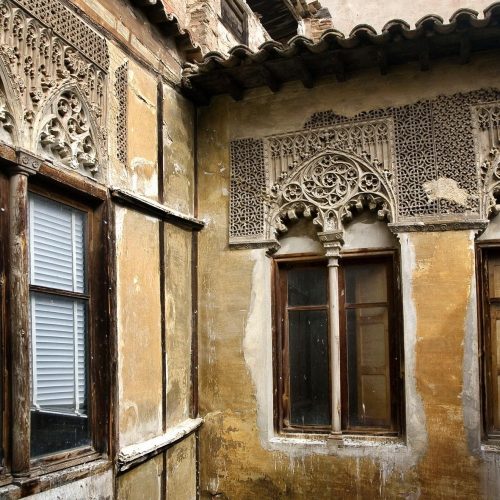
The palace of the Luna family in Daroca is an excellent example of Mudejar civil architecture in Aragon. Its construction dates back to the late 14th and early 15th century. It was commissioned by the Luna family, whose heraldic symbols can be seen throughout the building.

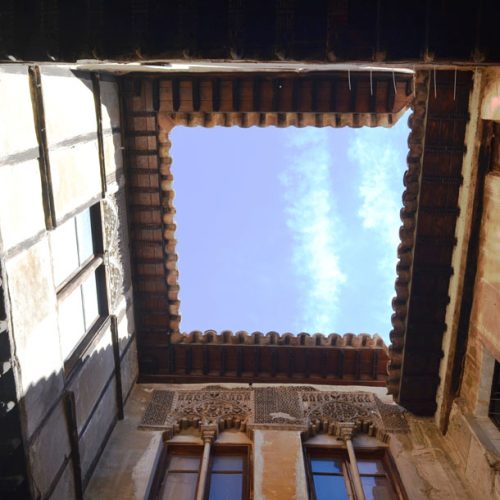
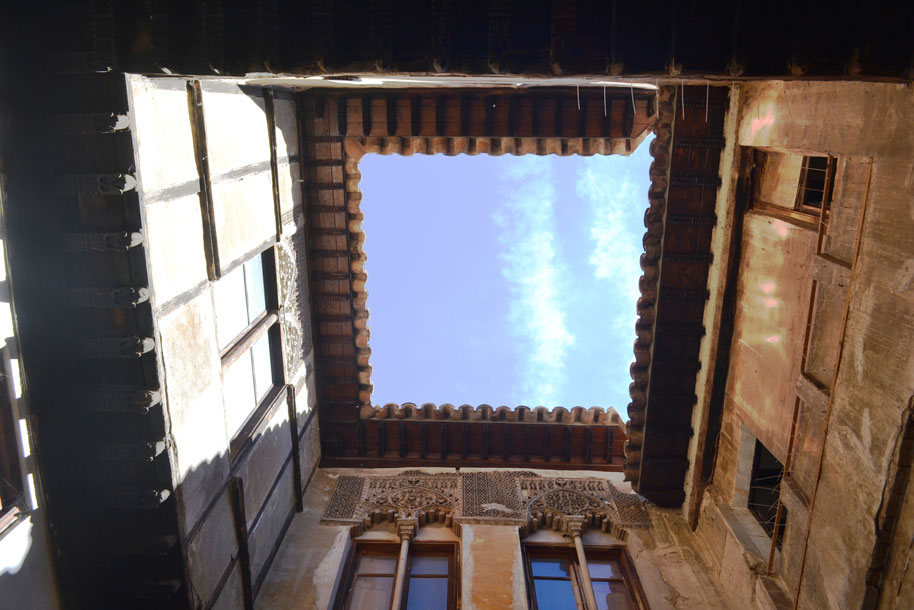
The original building had a U-shaped floor plan distributed on the ground floor, main floor and granaries, all arranged around a central interior courtyard.

On the ground floor, the original entrance to the palace was through a round arch in the façade facing Calle Mayor. Given the considerable height of the ground floor level, it was divided into two parts, thus creating a mezzanine level.

The ground floor is divided into three parts perpendicular to the façade to create a U-shaped floor plan wrapped around an inner courtyard.

This division is created by means of arcades resting on columns. Although their spans have been covered over, those on the left-hand side still exist and could be fully recovered, while the arcades to the right were replaced with Tuscan columns and wood lintels resting on bolsters when remodeling work was done in the late 16th century.
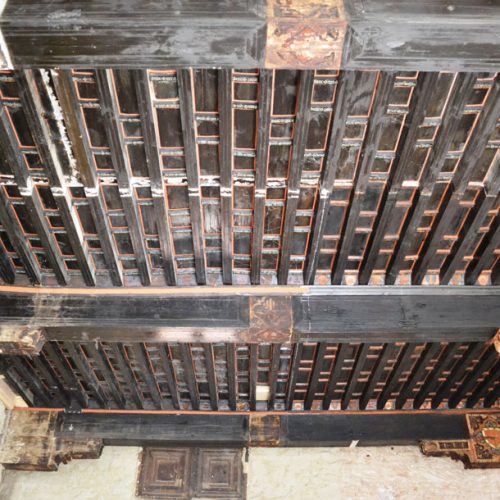
The main floor is the focus of great interest, covered almost entirely by a wood ceiling in which the alfarje structure displays painted decorative motifs of heraldic symbols. The ceiling can be dated between the 14th and 15th centuries thanks to an inscription of the word “BENEDICTUS”, directly referring to the papacy of Benedict XII (1397-1416).

The eaves found on both the exterior and interior of this level are striking, particularly those facing the exterior, which, like the ceiling inside, are decorated with highly deteriorated tempera paintings depicting heraldic symbols, coats of arms and references to the owners of those crests.

The upper level must have been used as a granary and features the thick frames holding up the roof.

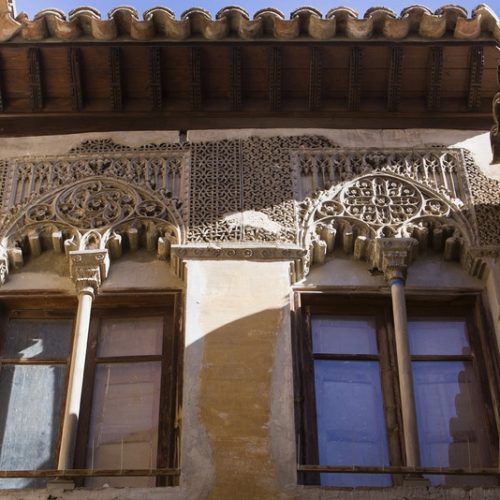
The main floor looks out onto the inner courtyard through three windows, one in the center and two on the left side, boasting colonettes and a surround featuring interlacing decorative motifs and Mudejar plasterwork.
Interventions

The property is currently divided into two residences, with commercial establishments on the ground floor.

The building has undergone several interventions in the 21st century. In the first phase, the Government of Aragon invested 300,000 euros in stabilizing the building. In June 2011, the second phase began, sponsored by Obra Social de Ibercaja with 150,000 euros. That work focused on restoring the coffered wood ceilings on the main floor.

After the purchase of two thirds of the original palace by Fundación Campo de Daroca, the architect Javier Ibargüen was entrusted with the restoration project. The work was broken down into two phases: in 2010, the focus was on cleaning and tearing down added elements, in addition to testing walls, architectural and pictorial features with a view to gathering information so as to plan other activities. One year later, in 2011, cleaning and debris removal tasks were carried out in two storerooms, besides restoring the coffered wood ceiling on the main floor.

Projects and interventions

Projects and interventions, and the driving forces behind them, define the history of monumental buildings and how they are perceived.

Declarations

DECLARATION (1931-2002)

The Palace of the Luna family was declared a National Monument on June 3, 1931 (published in the Gazette of June 4, 1931).
The Official Gazette of Aragon (BOA) dated March 22, 2002 published Decree 94/2002, March 6, by the Government of Aragon, declaring the Palace of the Luna Family in Daroca (Zaragoza) an Asset of Cultural Interest, Monument category.

Current condition

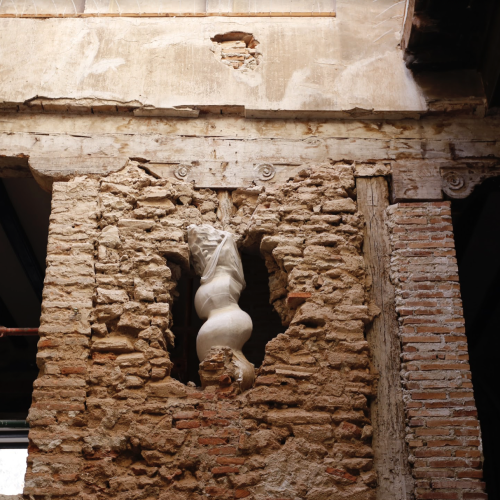
Currently, part of the palace constructed by the Martínez de Luna family in the late 14th century remains standing, including the load-bearing walls, several wood ceilings and certain decorative elements, mainly plasterwork.

It is divided into two private residences facing an inner courtyard dating from the 16th century, in addition to businesses on the ground floor.

Bibliography

MAÑAS BALLESTÍN, FABIÁN (COORD.). Comarca del Campo de Daroca, Colección Territorio 8, Diputación General de Aragón, 2003.

VV.AA. Campo de Daroca, Colección RUTASCAI por Aragón nº 27, Zaragoza, 2005.

VV.AA. Guía de Daroca, Centro de Estudios Darocenses, 1994.

VV.AA. Tierra Mudéjar. El mudéjar aragonés, Patrimonio Mundial., Heraldo de Aragón. D.L., 2002.

VV.AA. El Arte Mudéjar. La estética islámica en el arte cristiano, Madrid, 2000.

ADÁN, Cristina. El palacio de los Luna de Daroca recibe otra ayuda, pero aún queda medio millón de euros por invertir . Heraldo de Aragón. 01/11/2013 p. 14.

ADÁN, Cristina. El reto: devolver el esplendor a la casa de los Luna. Heraldo de Aragón. 28/02/2010 p. 20.

ADÁN, Cristina. La Fundación Campo de Daroca compra el palacio de los Luna para Heraldo de Aragón. 23/12/2009 p. 14.

ADÁN, Cristina. Nueva inyección económica para el palacio de los Luna. Heraldo de Aragón. 12/12/2010 p. 20.

Ibercaja colabora en la restauración del palacio de los Luna. Heraldo de Aragón. 25/03/2011 p.13.

Appendixes

Palace of the Luna family

Calle Mayor, 44
50360 Daroca (Zaragoza)

Visit Daroca

City Hall: 976 800 312
www.daroca.es
WOULD YOU LIKE TO KNOW MORE?
www.turismodezaragoza.es

Church of Santo Domingo de Silos, Daroca

Church of Santo Domingo de Silos, Daroca

Plaza de Santo Domingo 50360

CURRENT PROTECTION STATUS: Asset of Cultural Interest (ACI)

TYPE OF ASSET: Property

CATEGORY: Religious

ARCHITECTURAL STYLE: Transition from Romanesque to Mudejar

CONSTRUCTION DATE:

The original building dates from the 12th century, and it was rebuilt in the 18th century. A fire prompted the reconstruction of the church between 1700 and 1741. Its orientation was shifted and a building with three naves and rib vaulting was constructed. The church was decorated in the Baroque style. The presbytery was covered by a dome resting on pendentives and decorated with Baroque mural paintings, and other new elements such as the choir and organ were added.
The construction of the church of Santo Domingo de Silos in Daroca dates back to the mid-12th century. Work initially began in the Romanesque era but was suspended for some time. The church faced east and the apse originally had a semicircular floorplan.

When construction resumed in the 13th century, the structure of the apse was modified to give it a polygonal shape. In the mid-13th century, coinciding with the construction of the apse of San Juan de la Cuesta, it was decided to continue building the tower in the Mudejar style, substituting stone for brick. This structure is considered the oldest remaining construction of its kind in Aragon.

Throughout the 14th century, the original Romanesque church was modified and transformed into a hall church layout attached to the apse and tower. It has a rectangular footprint with three naves and three bays covered by rib vaults resting on octagonal columns. There is a polygonal apse at the east end and the sides have straight ends.
In the 18th century a fire destroyed virtually the entire nave volume, with only the apse, tower, wood choir and the altarpiece dedicated to the church’s patron saint, done by Bartolomé de Bermejo, left standing. At that time, the decision was made to create a new nave volume in the Baroque style. The orientation was shifted so that the church would face west-east, leaving the former polygonal apse and Mudejar tower at the west end of the new building.

The exterior is divided into two parts as a result of the change in building materials, with the bottom part constructed of ashlars and the upper section made of brick. The upper section features openings separated in the middle by a cylindrical column that acts as the springing line for mixtilinear arches. These arches are framed and finished by two trilobed arches, with a secondary frame consisting of a lintel with bricks arranged vertically. Finally, there is a second level of openings featuring round arches on which another double arch rests.

The tower dates from the mid-13th century. It is a square-plan structure initially constructed using ashlars, and the interior houses a spiral staircase. The second phase of the tower was built of brick, leaving the interior hollow. The interior is divided into two rooms covered by rib vaults with round diagonal arches. These two rooms are connected by a spiral staircase located in a corner of the tower.

Interventions

Restoration, 20th to 21st century

In the restoration from 1960, the ancient south portal, an essential part of the original church, was eliminated. A new space was also created on the Gospel side to render the layout more symmetrical, thus completely changing the outer appearance of the temple, especially the portal.

Projects and interventions

Projects and interventions, and the driving forces behind them, define the history of monumental buildings and how they are perceived.

Declarations

Declaration, 21st century

The church of Santo Domingo de Silos in Daroca was declared an Asset of Cultural Interest under the Ministry of Public Instruction and Fine Arts Decree of June 3, 1931 published in the Gazette on June 4, 1931. The Official Gazette of Aragon (BOA) dated March 11, 2002 published the Department of Culture and Tourism Order of February 22, 2002, whereby the original declaration of the church as an Asset of Cultural Interest is supplemented pursuant to Transitional Provision One of Aragonese Cultural Heritage Act 3/1999, of March 10, defining the movable assets and the environment affected by the declaration.

Bibliography

CORRAL LAFUENTE, José Luis. Historia de Daroca. Daroca: Centro de Estudios Darocenses, 1983. GARCÍA GUINEA, Miguel Ángel; Pérez González, José María. (dir.). Enciclopedia del Románico en Aragón: Zaragoza. Aguilar de Campoo: Fundación Santa María la Real, 2010. 

HERMOSO CUESTA, Miguel. El arte aragonés fuera de Aragón. Un patrimonio disperso. Zaragoza: Gobierno de Aragón, 2009. 

IBÁÑEZ FERNÁNDEZ, Javier; Martín Marco, Jorge. Del “salón” al “falso salón”: Las reformas de la iglesia de Santo Domingo de Silos de Daroca (Zaragoza) durante la Edad Moderna. Artigrama. 2017 , nº 32, p. 287-317. 

MAÑAS BALLESTÍN, Fabián. Bartolomé Bermejo en la Daroca del siglo XV. Xiloca. 2019 , nº 47, p. 221-244.

ORTIZ VALERO, Nuria. Martín Bernat, pintor de retablos, documentado en Zaragoza entre 1450 y 1505. Zaragoza: Institución Fernando el Católico, 2013.

SANMIGUEL MATEO, Agustín. Torres de ascendencia islámica en las comarcas de Calatayud y Daroca. Aragón (España). Calatayud: Centro de Estudios Bilbilitanos, 1998.

TORRES BALBÁS, Leopoldo. La arquitectura mudéjar en Aragón: Las iglesias de Daroca. Archivo Español de Arte. 1952 , nº XXV, p. 209-221.

OLIVAN BAYLE, F. Daroca. Ciudad del Santo Misterio, CAZAR, Zaragoza, 1973.

VV.AA. Campo de Daroca, Colección RUTAS-CAI por Aragón nº 27, Zaragoza, 2005.

VV.AA. Comarca del Campo de Daroca, Colección Territorio 8, Diputación General de Aragón, 2003.

VV.AA. Tierra Mudéjar. El mudéjar aragonés, Patrimonio Mundial, Heraldo de Aragón. D.L., 2002.

VV.AA. El Arte Mudéjar. La estética islámica en el arte cristiano, Madrid, 2000.

Appendixes

Church of Santo Domingo de Silos

Plaza de Santo Domingo
50360 Daroza (Zaragoza)

Visit Daroca

City Hall: 976 800 312
www.daroca.es
WOULD YOU LIKE TO KNOW MORE?
www.turismodezaragoza.es

Apse of the Church of San Juan de la Cuesta, Daroca

Apse of the Church of San Juan de la Cuesta

Calle Mayor 44, 50360

CURRENT CATEGORY OF PROTECTION:
Bien de Interés Cultural (BIC)

TYPE OF PROPERTY: Real estate

CATEGORY: Religious

ARCHITECTURAL STYLE: Mudejar

DATE OF CONSTRUCTION: 13thCentury

The period of genesis and formation of Aragonese Mudejar art took place during the 13th century, in a process that began with the Christian conquest and which affected the different centres of Mudejar art in the Iberian Peninsula in different ways.

Daroca is an important place, as few of the testimonies of the process of replacing the churches built after the Christian conquest with others in the Mudejar tradition have survived. In the church of San Juan de la Cuesta, there was not a simple substitution of construction material in the Romanesque building, but rather the adaptation of the new construction system with elements from the Islamic tradition.

Thus, the Romanesque church dates from the mid-13th century, and its construction began in the apse, using ashlar stone, interrupted at mid-height to continue the brickwork.

It is a semicircular apse with six semi-columns, replaced at the top by brick, with a frieze of blind arches, except for a few small openings that alternate with the arches. The most significant feature is the use of a type of opening that uses the lobed arch, constituting the oldest example in Mudéjar art, and which will not be continued in Aragonese Mudéjar: there are two openings, one in the central section of the apse and another in the straight section of the presbytery in the wall of the epistle, semicircular lobed arches with little light, which are doubled by a seven-lobed arch, with a clear reference in the Aljafería in Saragossa.

Interventions

Restoration, 20th Century to 21st Century

It was restored in 1960 in which the original south doorway, an essential element of the original church, was removed. A new space was also opened up on the Gospel side to obtain greater symmetry of the whole, completely altering the external appearance of the church and especially the doorway.

Projects and interventions

Projects and interventions and their promoters define the history of monumental buildings as well as the perception of them.

The downloadable document presents the current status of the files under review, which will allow us to update our knowledge of each of the monumental buildings.

Declarations

Declaration, 21st Century

The Official Gazette of Aragon of 8 October 2001 published Decree 221/2001 of 18 September 2001, of the Government of Aragon, declaring the Abside of the Church of San Juan de la Cuesta in Daroca to be an Asset of Cultural Interest, in the category of Monument.

Bibliography

BORRÁS GUALÍS, G. M. Arte Mudéjar Aragonés, CAMPZAR and Colegio Oficial de Arquitectos Técnicos y Aparejadores de Zaragoza, Zaragoza, 1985, T. II, pp. 156

MAÑAS BALLESTÍN, FABIÁN (COORD.). Comarca del Campo de Daroca, Colección Territorio 8, Diputación General de Aragón, 2003.

VV.AA. El Arte Mudéjar. Islamic aesthetics in Christian art, Madrid, 2000.

VV.AA. Mudéjar Land. El mudéjar aragonés, Patrimonio Mundial, Heraldo de Aragón. D.L., 2002.

VV.AA. Campo de Daroca, Colección RUTASCAI por Aragón nº 27, Zaragoza, 2005.

Appendixes

Apse of the Church of San Juan de la Cuesta

Calle Mayor 44,
50360 Daroza (Zaragoza)

Visit Daroca

Town Hall: 976 800 312
www.daroca.es
WANT TO KNOW MORE?
www.turismodezaragoza.es