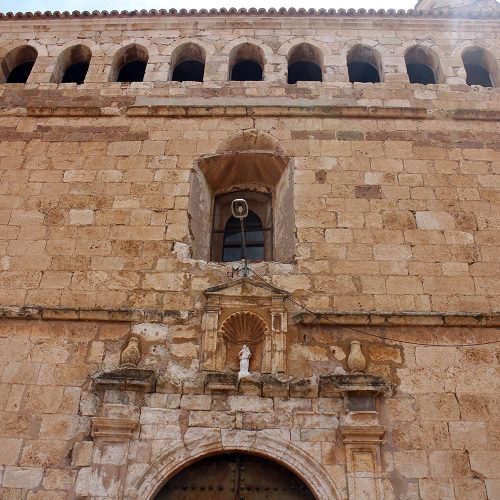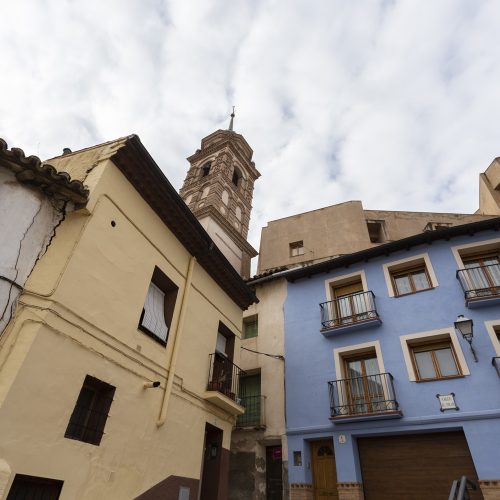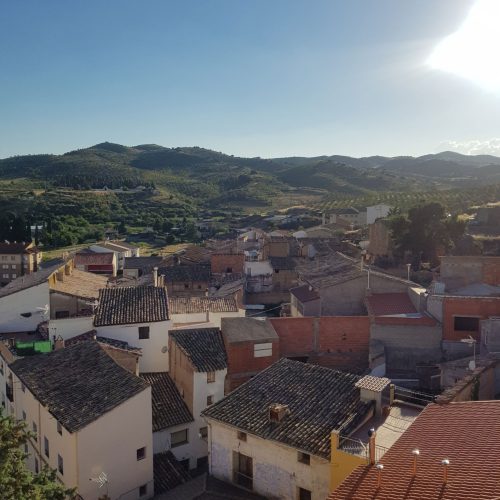
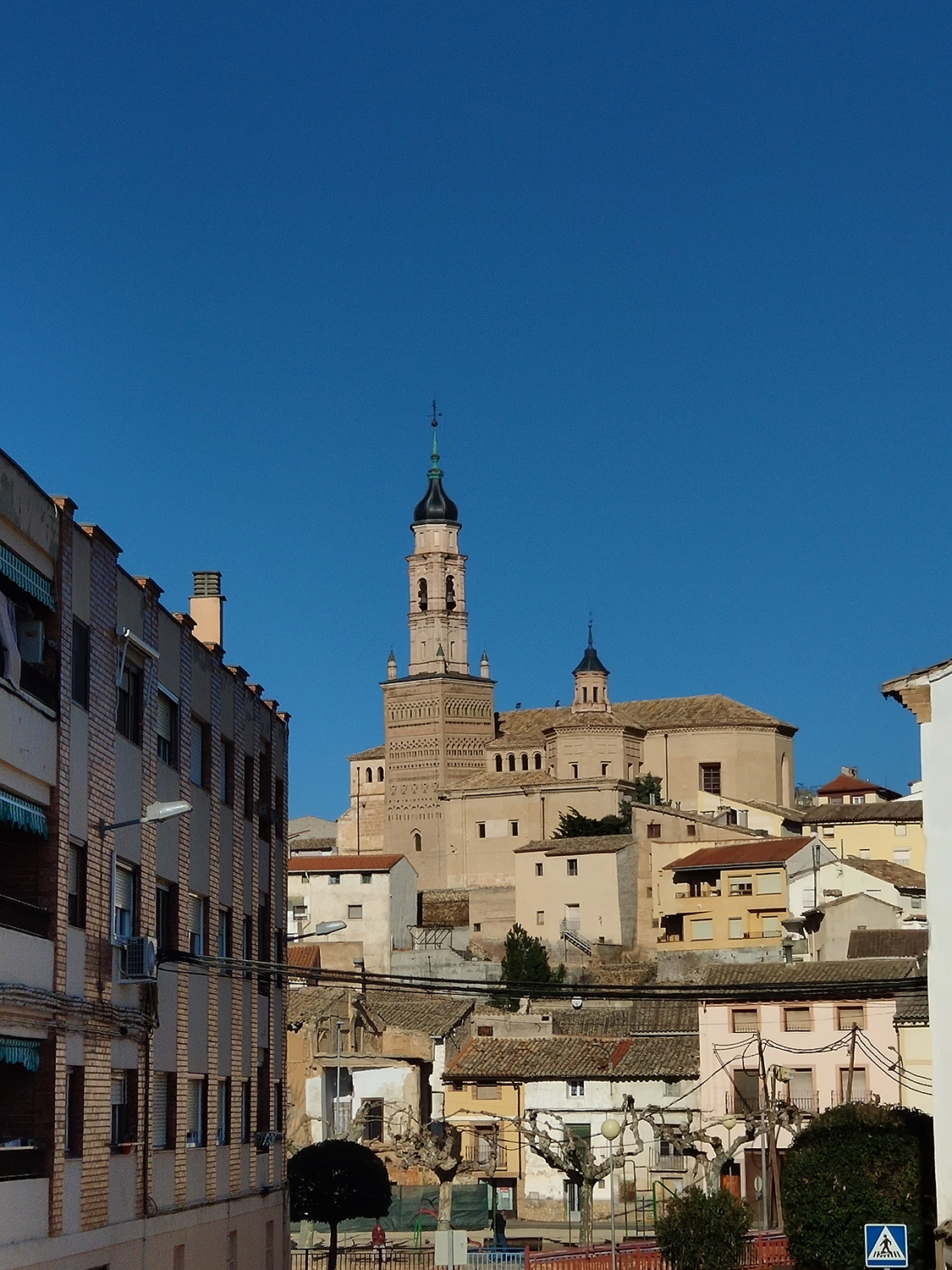
Tower of the church of Santa María, Ateca

Tower of the church of Santa María, Ateca

Plaza de Jesús, 10. Ateca (Zaragoza)

TYPE OF ASSET: Property

CATEGORY: Religious

ARCHITECTURAL STYLE: Mudejar

CONSTRUCTION DATE:

Middle Ages: Second half of the 13th century

Modern Era, 17th century: The second section of the Baroque tower replaced the original Mudejar tower.
This is a square-plan tower with two distinct sections, based on typology. It is attached to the last bay at the west end of the church of Santa María in Ateca, on the Epistle side of the temple. The tower was originally free-standing and traces of an ancient minaret can be seen in the lowest section. It was attached in an irregular manner in the 16th century to this final bay of the church.

The first section of the tower has a square floor plan and was built in the style of the Mudejar towers featuring an inner tower structure, around which another tower is wrapped, with a stairway between the two. The tower is divided rooms on four levels, one above the other, covered by barrel vaults. The stairway provides access to these rooms.

It is worth noting that, as one ascends the tower, the lower part of the stairway is covered by eight small barrel vaults made of brick laid in a sardinel bond arrangement. There follow six small quadripartite rib vaults and, finally, this roofing system, which is rather “experimental” in nature, is completed with a system of narrowing courses of brick like that seen in other towers such as the one in the church of Santa María in Tobed, which is the most widespread system in the second half of the 14th century and the 15th century.
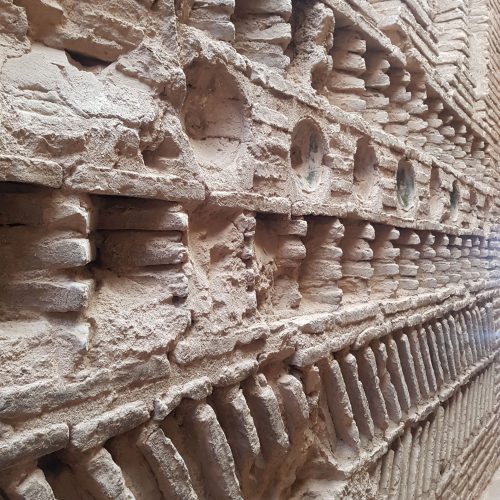
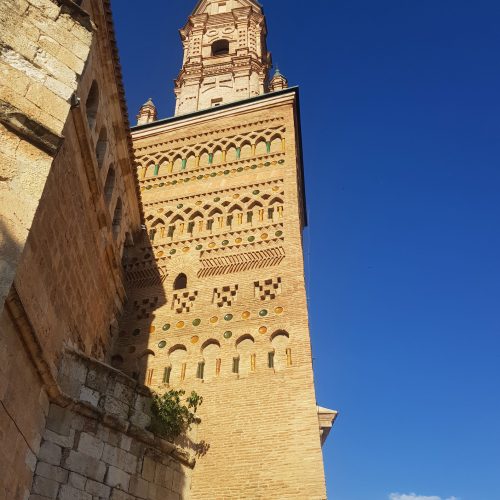
The strong Muslim influence is noticeable on the tower exterior, which boasts protruding brick and ceramic decorative motifs. Pointed horseshoe arches, cross shapes and ceramic discs are some of the ornamental features that were widely used in Aragonese Mudejar art.

The lower part of the first section has apertures to allow light into the stairway. This light was subsequently blocked when the tower was attached to the church at a later date. The openings were built at the level where the stairs provide access to the rooms in the inner tower, with an ogee arch of oriental influence in the south wall while the west wall features a surbased arch with voussoirs that are split at the center and thick perpends between those near the impost molding.

At the top of this first section of the tower, there is a series of decorative horizontal friezes forming large panels filled with seven blind pointed horseshoe arches resting on cylindrical honey-colored and green shafts with ceramic discs of the same colors and stamped fleurs-de-lis within the spandrels of the arches; a frieze of five cross shapes inscribed within a square to form a fishbone pattern; and a frieze of angled bricks adorning discs, as well as friezes of intertwined pointed arches resting on brick pilasters, flanked by ceramic shafts.
Interventions

RESTORATION, 20th CENTURY
The ceramic decorative work on the exterior was restored in 1970. The belfry, spire, façades and interior of the different sections have undergone diverse types of restoration work in recent years.

RESTORATION PROJECT, 20th CENTURY The restoration project was carried out in two phases, spanning from 1985 to 1994. A second restoration project was completed in 2001.

Projects and interventions

Projects and interventions, and the driving forces behind them, define the history of monumental buildings and how they are perceived.

Declarations

DECLARATION, 20th TO 21st CENTURY (1983-2001)
The church and tower of Santa María in Ateca were declared an Asset of Cultural Interest under the Ministry of Culture Decree dated January 12, 1983, which was published the Official State Gazette of March 5, 1983.
The Official Gazette of Aragon (BOA) dated October 22, 2001 published the Department of Culture and Tourism Order of September 25, 2001, whereby the original declaration of the church and tower of Santa María in Ateca (Zaragoza) is supplemented pursuant to Transitional Provision One of Aragonese Cultural Heritage Act 3/1999, of March 10.

Current condition

The tower of Santa María in Ateca is currently in ideal conditions of restoration and cleanliness after the successive phases of restoration work indicated above. One wise decision in this restoration work was to leave the interior wall of the tower leading to the arcade inside the church bare, without replacing the ceramic pieces, thus affording a view of the tower in its original condition prior to the restoration.

Bibliography

BORRÁS GUALIS, GONZALO M., Arte Mudéjar Aragonés, Caja de Ahorros y Monte de Piedad de Zaragoza Aragón y Rioja y el Colegio Oficial de Aparejadores y Arquitectos técnicos de Zaragoza, Zaragoza, 1985. 

GALIAY, JOSÉ. Arte mudéjar aragonés, Institución Fernando el Católico, Zaragoza, 2002.

MARTÍNEZ GARCÍA, FRANCISCO J. Ateca, desde sus orígenes hasta el año 1500, Institución Fernando el Católico, Zaragoza, 2015.

MILLÁN GIL, JULIÁN Y SANMIGUEL MATEO, AGUSTÍN (COORD.). Comarca de la Comunidad de Calatayud, Colección Territorio nº 20, Departamento dePresidencia y Relaciones Institucionales del Gobierno de Aragón, Zaragoza, 2005.

SANMIGUEL MATEO, AGUSTÍN. Torres de ascendencia islámica en las comarcas de Calatayud y Daroca, Centro de estudios bilbilitanos, Institución“Fernando el Católico”, Calatayud, 1998.

  • VV. AA. Tierra Mudéjar. El Mudéjar Aragonés, Patrimonio Mundial, Heraldo de Aragón, D.L. 2002.
  • VV. AA. Comunidad de Calatayud y El Monasterio de Piedra, Colección RutasCai por Aragón nº 12, Zaragoza, 2004.
  • VV. AA. Las supuestas características almohades de la torre de Ateca, IV Encuentro de Estudios Bilbilitanos, I, Calatayud: Centro de Estudios Bilbilitanos, 1997.
  • MARTÍNEZ GARCÍA, Francisco José. Ateca, desde sus orígenes hasta el año 1500. Zaragoza: Institución Fernando el Católico, 2015.
  • SANMIGUEL MATEO, Agustín. Torres de ascendencia islámica en las comarcas de Calatayud y Daroca. Aragón (España). Calatayud: Centro de Estudios Bilbilitanos, 1998.

Appendixes

Tower of the church of Santa María

Plaza de Jesús, 10.
Ateca (Zaragoza)

Visit Ateca

City Hall: 976 842 005 www.aytoateca.es WOULD YOU LIKE TO KNOW MORE? www.turismodezaragoza.es

Clock tower, Ateca

Clock tower, Ateca

C. Cambra, 13, 50200 Ateca

CURRENT PROTECTION STATUS: Listed

TYPE OF ASSET: Property

CATEGORY: Religious

ARCHITECTURAL STYLE: Mudejar

CONSTRUCTION DATE: 1560
The tower was built in 1560 by the master builder Domingo and the Morisco Meçot to house the clock, probably influenced by the Torre Nueva clock tower in Zaragoza. The clock was designed by Johan Escalante in Zaragoza and installed in 1561. Following the Mudejar tradition, the tower consists of two sections plus an octagonal volume at the top.

The lower section was built of plaster-based mortar and its smooth façades are punctuated by a projecting brick cornice. The upper section also has a square plan, though smaller in size, and is made of brick, arranged on two levels, the lower one featuring the clock on one side, while the others have double blind round arches.

Finally, the drum and spire were erected, designed and built by the aforementioned masters, in addition to Meçot’s son, who was hired as an apprentice. In early 1561, the tile detail work was done, consisting of some 3400 tiles covering the spire, plus eight medallions and a stained glass window.

When the work was nearly finished, it was decided to replace the old clock, commissioning master clockmaker Johan Escalante, of Zaragoza, to design the new one. The bells were also designed and installed during this phase. In 1723, the masonry in the lower section had to be reinforced after one of the corners became detached, seriously endangering the integrity of the entire tower.

The tower has a square plan, and the rich ornamentation on the second section is quite striking. The transition from the masonry section to the brick section is achieved by means of a cornice of molded brick pieces.

In turn, the second section is divided into two levels. On one side of the lower level is a large modern clock with a white face installed in 2005 after the previous clock had been out of order for several years. The old clock machinery, along with its counterweights, has been preserved as a museum artifact, dating from 1854. When the 16th century clock ceased to operate and could not be repaired, the city council was forced to replace it, as the only public clock in the town.
It was agreed that the new clock should have features similar to the old one, with bells ringing every quarter hour and on the hour; the larger bell was reused, but the smaller one, which had been changed in 1801, was replaced. Francisco Echecoín was commissioned to build it and the contract contained a warranty period and a person tasked with maintenance during this period. In 1855, the job was given to Pedro Ibarreta, primary school teacher, who was also in charge of the upkeep of another clock that had been installed in the Capuchin convent. In exchange, he received a sum of 200 reals per year, and he and his son Vicente were exempt from military enlistment obligations.

On all the other sides of this level there are double round-arched openings with a blind oculus in the parapet. The protruding brick decorative work includes strips of angled brick in which a sawtooth pattern alternates with a staggered pattern. A strip of this latter type, in addition to a dentil molding, mark the transition to the upper level.

The upper level of this second section is divided vertically into three parts by means of impost moldings that reach halfway up the side of the openings and the springing line of the arches. The decorative work on this section is also made of protruding brick featuring recessed crisscrossing patterns at the bottom, which are combined with narrow strips of staggered angled bricks in the center and two strips of staggered angled bricks in the upper part; the first of these strips combines two rows of double sawtooth patterns with three rows of staggered patterns in the center, while the upper strip has a staggered pattern. The cornice at the top of this section is decorated with a strip of staggered angled brick work and a line of inverted pyramid-shaped corbels.

In addition, there are turrets with a square base and circular top on all four corners of the tower. In the center of each side of the drum there is a small oculus.

The spire is an 18th century addition that replaced the original spire covered in green tiles with the slate shingles seen today.
Interior de iglesia en Longares con bóvedas de crucería estrellada y retablo mayor dorado al fondo.

Projects and interventions

Projects and interventions, and the driving forces behind them, define the history of monumental buildings and how they are perceived.

Declarations

Declaration, 21st century Under the Department of Culture and Tourism Order dated September 6, 2002, which was published in the Official Gazette of Aragon on September 30, 2002, the tower was declared a Listed Asset of Aragonese Cultural Heritage.

Bibliography

BLASCO SÁNCHEZ, JESÚS. Pasado y presente de la Muy Ilustre Villa de Ateca: historia, geografía, arqueología, Asociación para la Defensa del Patrimonio de Carenas ASPACAR, 2010. MILLÁN GIL, JULIÁN Y SANMIGUEL MATEO, AGUSTÍN (COORD.). Comarca de la Comunidad de Calatayud, Colección Territorio nº 20, Departamento de Presidencia y Relaciones Institucionales del Gobierno de Aragón, Zaragoza, 2005. 

VV.AA. Comunidad de Calatayud y El Monasterio de Piedra, Colección RutasCai por Aragón nº 12, Zaragoza, 2004.

Appendixes

Clock tower

C. Cambra, 13.
50200 Ateca (Zaragoza)

Visit Ateca

City Hall: 976 842 005
www.aytoateca.es
WOULD YOU LIKE TO KNOW MORE?
www.turismodezaragoza.es